The Complete Guide to Generative AI & Prompt Engineering
Understanding LLMs, Prompting Techniques, APIs, and Real-World Applications
The Complete Guide to Generative AI & Prompt Engineering
Understanding LLMs, Prompting Techniques, APIs, and Real-World Applications
Press enter or click to view image in full size
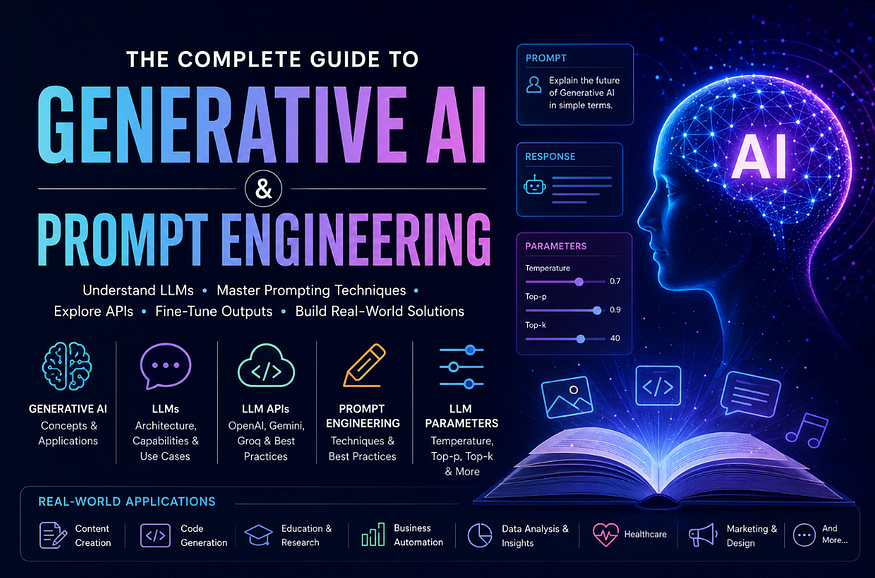
FIG.1
Introduction
Artificial Intelligence (AI) has evolved tremendously over the last decade. Earlier AI systems were primarily designed to analyze data, classify information, or make predictions. Today, AI has entered a new era known as Generative AI, where machines can create entirely new content such as text, images, videos, music, and even software code.
Generative AI is transforming industries including healthcare, education, finance, software development, entertainment, and marketing. Popular tools like ChatGPT, Gemini, Claude, GitHub Copilot, Midjourney, and DALL·E demonstrate how AI can assist humans in solving complex problems efficiently.
In this article, we’ll explore the fundamentals of Generative AI, understand Large Language Models (LLMs), learn Prompt Engineering techniques, examine important LLM parameters, and look at practical examples using ChatGPT.
What is Generative AI?
Generative AI is a branch of Artificial Intelligence that creates new content by learning patterns from existing data.
Unlike traditional AI systems that classify or predict outcomes, Generative AI can generate:
- Text
- Images
- Videos
- Audio
- Source Code
- Presentations
- Designs
Instead of simply recognizing information, Generative AI creates original outputs based on user instructions called prompts.
Press enter or click to view image in full size

FIG.2
Applications of Generative AI
Generative AI has applications across numerous industries.
Healthcare
- Medical report generation
- Drug discovery
- Clinical documentation
Education
- Personalized tutoring
- Assignment generation
- Question paper creation
Software Development
- Code generation
- Bug fixing
- Documentation writing
Marketing
- Advertisement copy
- Social media posts
- Product descriptions
Finance
- Financial report generation
- Fraud analysis
- Customer support chatbots
Entertainment
- Story writing
- Music generation
- Image creation
- Video generation
Traditional AI vs Generative AI

Traditional AI answers:
“What is this?”
Generative AI answers:
“Create something new.”
Large Language Models (LLMs)
What are LLMs?
Press enter or click to view image in full size

FIG.3
Large Language Models (LLMs) are deep learning models trained on enormous collections of text. They learn grammar, facts, reasoning patterns, and language structure.
Examples include:
- GPT-4
- GPT-5
- Gemini
- Llama
- Claude
- Mistral
LLMs generate responses one token at a time based on the context provided in the prompt.
How do LLMs Work? (High-Level Overview)
- Massive text datasets are collected.
- Text is divided into tokens.
- A Transformer neural network learns relationships between tokens using self-attention.
- During training, the model predicts the next token repeatedly.
- After billions of predictions, the model learns language patterns.
Press enter or click to view image in full size

FIG.4
6.When given a prompt, it predicts the most likely next tokens to generate a response.
Capabilities of LLMs
Modern LLMs can:
- Answer questions
- Summarize documents
- Translate languages
- Generate code
- Explain complex concepts
- Solve mathematical problems
- Create presentations
- Write blogs
- Analyze datasets
- Assist researchers
Real-World Use Cases
Customer Support
AI chatbots provide instant responses.
Software Engineering
Developers generate code, documentation, and test cases.
Content Creation
Writers create blogs, articles, and marketing copy.
Education
Students receive personalized explanations and practice questions.
Healthcare
Doctors summarize patient records and generate reports.
LLM APIs
Developers can integrate LLMs into applications through APIs.
OpenAI API
The OpenAI API enables developers to access GPT models for:
- Chatbots
- Code generation
- Summarization
- Translation
- Automation
Gemini API
Google’s Gemini API provides access to multimodal AI models capable of processing text, images, and code.
Groq API
Groq provides extremely fast inference for open-source language models, making it suitable for low-latency AI applications.
API Authentication
Most APIs require an API Key.
Example:
import osAPI_KEY = os.getenv("OPENAI_API_KEY")Best Practices
- Never hardcode API keys.
- Store keys in environment variables.
- Rotate keys periodically.
- Avoid exposing keys in GitHub repositories.
- Use server-side authentication whenever possible.
Prompt Engineering
What is Prompt Engineering?
Prompt Engineering is the practice of designing effective prompts that guide AI models to produce accurate, relevant, and high-quality responses.
A well-crafted prompt often leads to significantly better outputs.
Press enter or click to view image in full size

FIG.5
Importance of Prompt Engineering
Good prompts help:
- Improve accuracy
- Reduce hallucinations
- Generate structured responses
- Save time
- Produce consistent outputs
Components of a Good Prompt
A good prompt should include:
- Role
- Task
- Context
- Constraints
- Output format
Example:
You are a Data Science interviewer. Ask me five Python interview questions suitable for a fresher. Wait for my answer after each question and provide feedback.
User Prompt vs System Prompt

Prompting Techniques
1.Zero-shot Prompting
The model receives only the task.
Prompt
Explain Neural Networks in simple words.
2.One-shot Prompting
One example is provided.
Prompt
Example:
Python → Programming Language
Now classify:
TensorFlow →
3.Few-shot Prompting
Several examples are provided.
Prompt
Positive → I love this movie.
Negative → I hate this movie.
Positive → This course is amazing.
Classify:
The service was excellent.
4.Chain of Thought (CoT)
The model is encouraged to reason step by step.
Prompt
Solve the following mathematical problem step by step and explain your reasoning before giving the final answer.
5.Tree of Thoughts (ToT)
The model explores multiple reasoning paths before selecting the most suitable solution.
Example:
Design the best college placement strategy by considering three different approaches, compare their advantages and disadvantages, and recommend the most effective one.
Press enter or click to view image in full size

FIG.6
LLM Parameters
1.Temperature
Controls randomness.
- 0.0 → Deterministic
- 0.3 → Precise
- 0.7 → Balanced
- 1.0 → Creative
2.Top-p (Nucleus Sampling)
Chooses from the smallest set of high-probability tokens whose cumulative probability reaches the specified threshold.
Lower values produce more focused responses, while higher values allow greater diversity.
3.Top-k Sampling
Restricts generation to the top k most likely next tokens.
Smaller values make outputs more deterministic; larger values increase variety.
Press enter or click to view image in full size

FIG.7
Temperature vs Top-p vs Top-k

When to Use Different Parameter Settings

Hands-on Examples
Below are five example prompts
Example 1 — Zero-shot Prompt
Prompt
Explain Machine Learning in simple terms.
Expected Output
A beginner-friendly explanation describing how machines learn patterns from data without explicit programming.
Example 2 — One-shot Prompt
Prompt
Example:
Python → Programming Language
Now classify:
TensorFlow →
Expected Output
TensorFlow → Deep Learning Framework
Example 3 — Few-shot Prompt
Prompt
Positive → Excellent product
Negative → Poor service
Positive → Amazing experience
Classify:
The food was delicious.
Expected Output
Positive
Example 4 — Chain of Thought
Prompt
Solve this probability problem step by step before giving the final answer.
Expected Output
A structured reasoning process leading to the correct solution.
Example 5 — Tree of Thoughts
Prompt
Suggest three different strategies to prepare for a Data Scientist interview, compare them, and recommend the best one.
Expected Output
Three alternative plans with advantages, disadvantages, and a final recommendation.
Press enter or click to view image in full size

FIG.8
Key Takeaways
- Generative AI creates new content instead of only making predictions.
- Large Language Models are the foundation of many modern AI assistants.
- APIs allow developers to integrate AI into real-world applications.
- Prompt Engineering plays a crucial role in improving AI responses.
- Parameters such as Temperature, Top-p, and Top-k influence the style and diversity of generated outputs.
- Different prompting techniques are suitable for different types of tasks.
Future of Generative AI
Generative AI is expected to become an essential part of education, healthcare, business, software engineering, and scientific research. Future models will be more multimodal, capable of understanding and generating text, images, audio, video, and code together. As AI continues to evolve, responsible development, ethical considerations, and human oversight will remain critical.
Press enter or click to view image in full size

FIG.9
My Learning from this Module
Throughout this module, I gained a solid understanding of Generative AI, Large Language Models, Prompt Engineering, API integration, and advanced prompting techniques. I learned how prompt design significantly affects the quality of AI-generated responses and how different parameter settings can be tuned for various tasks. Hands-on practice with ChatGPT helped me appreciate the practical applications of Generative AI in content creation, software development, education, and problem-solving. This learning experience has strengthened my confidence in using AI tools effectively and inspired me to explore more advanced AI technologies in future projects.
Press enter or click to view image in full size

FIG.10
References
- OpenAI Documentation
- Google Gemini Documentation
- Groq Documentation
- Research papers on Transformer Architecture and Large Language Models
Thank you for reading!
If you found this article helpful, feel free to share your thoughts and connect with me on Medium and LinkedIn. Happy learning!
메타데이터
- post_id
- 8f871dc4e193
- slug
- the-complete-guide-to-generative-ai-prompt-engineering-8f871dc4e193
- url
- https://medium.com/@dasarichandu2309/the-complete-guide-to-generative-ai-prompt-engineering-8f871dc4e193
- canonical_url
- https://medium.com/@dasarichandu2309/the-complete-guide-to-generative-ai-prompt-engineering-8f871dc4e193
- author_url
- https://medium.com/@dasarichandu2309
- status
- ok
- fetched_at
- 2026-08-06 16:46:06