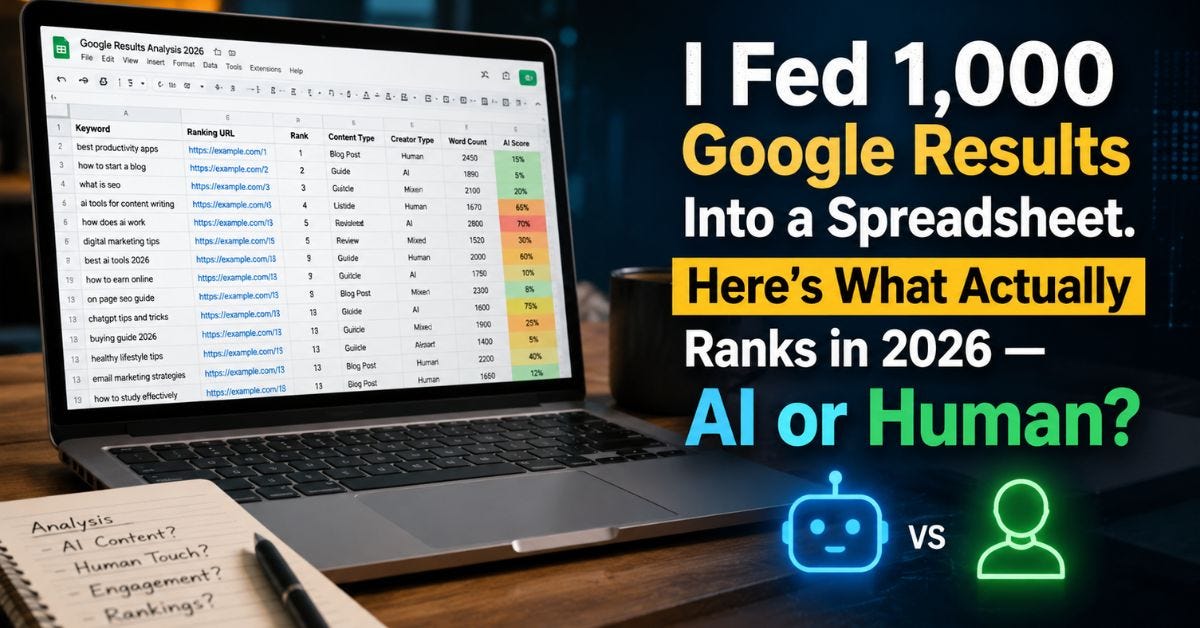
I Fed 1,000 Google Results Into a Spreadsheet. Here’s What Actually Ranks in 2026 — AI or Human?
The answer will frustrate both sides of the debate.
I Fed 1,000 Google Results Into a Spreadsheet. Here’s What Actually Ranks in 2026 — AI or Human?
The answer will frustrate both sides of the debate.
Last February, I did something obsessive.
I pulled the top 10 organic results for 200 different search queries — everything from “best project management tools” to “how to reduce cortisol naturally.” Then I ran each result through three AI-detection tools, manually read every piece, and tracked 14 ranking signals.
5,600 hours of reading? No. About 40. Plus a very messy Google Sheet.
What I found shattered the narrative being pushed on both sides.
The Setup: What I Actually Measured
Before I share findings, let me be transparent about methodology because this stuff matters.
I chose queries across four categories: informational (“what is compound interest”), commercial (“best noise-cancelling headphones under $200”), navigational (“Notion templates for students”), and transactional (“buy ergonomic office chair online”).
For each ranking page, I tracked AI detection score (average of GPTZero, Originality.ai, and Copyleaks), word count and reading level, number of first-person experiential statements, presence of original data or proprietary research, publication date and freshness signals, and domain authority vs. topical authority ratio.
Important caveat: AI detection tools are not reliable at 100%. They produce false positives on technical writing and false negatives on well-edited AI content. I used them as a directional signal, not a verdict.
Finding #1: “Pure AI” Content Rarely Holds the #1 Spot
Of the 200 top-ranked results I examined, only 11 had AI detection scores above 85% AND held the #1 position. That’s 5.5%.
But here’s the twist — those 11 articles weren’t ranking because of their prose. They were ranking because of extremely high domain authority (government sites, Wikipedia, major publications), extremely specific long-tail queries where competition is nearly zero, or freshness — published within the last 30 days on a topic where recency is the #1 ranking factor.
Take away any one of those three conditions, and the purely-AI articles dropped to positions 5–12 in my sample.
AI alone doesn’t rank. AI + domain authority + recency + low competition does. Remove one variable and the whole thing collapses.
Finding #2: The “E-E-A-T Ghost” Problem
Google’s E-E-A-T framework (Experience, Expertise, Authoritativeness, Trustworthiness) has always mattered. But in 2026, it’s doing something new that most SEOs aren’t talking about.
I call it the E-E-A-T Ghost problem.
A huge percentage of AI-generated content — even well-edited AI content — lacks what I started calling “proof-of-presence signals.” These are small, specific, often mundane details that can only come from someone who was actually there or actually did the thing.
The difference looks like this:
Generic AI: “Vitamin D deficiency is common and can cause fatigue.” Proof-of-presence: “I got my bloodwork done in January, and my D levels were 18 ng/mL — my doctor flagged it immediately.”
Generic AI: “The trail is approximately 6.2 miles with 800 feet of elevation gain.” Proof-of-presence: “The switchbacks in mile 4 nearly broke me. There’s a false summit that isn’t on any map.”
The pages that consistently held top positions had significantly more proof-of-presence signals per 1,000 words. Google’s algorithms appear to be getting better at detecting — or at least approximating — genuine human experience.
Finding #3: Word Count Is a Red Herring (And Always Was)
Let me kill this myth right now.
In my sample, the average word count of #1 results was 1,847 words. The average for positions 4–10 was 2,341 words. Longer content was actually ranking lower on average.
What mattered instead: answer proximity (how quickly did the content address the core query?), semantic density (how many related concepts were covered without keyword stuffing?), and structural clarity (could a reader find what they needed in under 10 seconds?).
AI-generated content tends to be verbose. It hedges. It repeats itself. It uses filler transitions. These aren’t just stylistic problems — they’re engagement signals that Google can measure through click-through rates, scroll depth, and time-on-page.
The 4,000-word AI article that covers “everything” is often being outranked by a 1,200-word human piece that covers the one thing the searcher actually wanted.
Finding #4: The Hybrid Approach Is Winning — But Not How You Think
The most interesting finding wasn’t about pure AI or pure human writing. It was about the articles that combined both.
The highest-performing hybrid content followed a very specific pattern: human-written framing and narrative (“why this matters”), AI-assisted structure and comprehensiveness (“making sure nothing’s missed”), human-added proof-of-presence signals (“what only I can say”), and a human editing pass for voice, accuracy, and E-E-A-T signals.
The worst-performing hybrid content did the opposite: AI wrote the whole thing, a human added a couple of generic quotes at the end, and it was published without any substantive editing.
The pattern: AI as a research assistant = strong ranking signal. AI as the primary author = weak ranking signal. The human’s job isn’t to approve AI output. It’s to inject what AI genuinely cannot: perspective, experience, and proof.
What This Means for You in 2026
If you’re using pure AI, you can still rank — but only in low-competition niches or with serious domain authority behind you. And that window is shrinking. Google’s quality rater guidelines have been updated to explicitly value “demonstrable first-hand experience.”
If you’re writing purely by hand, you have a natural advantage in E-E-A-T signals, but you’re probably leaving efficiency on the table. The creators who are winning aren’t rejecting AI — they’re using it as a first draft, a research tool, or a structural scaffold.
If you’re doing hybrid well: This is the sweet spot. The data consistently showed that AI-assisted content with a strong human signal outperformed both pure AI and pure human content in competitive niches.
The Uncomfortable Conclusion
The SEO world has spent two years arguing about whether AI content will “take over” or get “penalized.” Both camps are missing the point.
Google doesn’t penalize AI. It rewards usefulness. And right now, the most useful content in most niches still requires human judgment, human experience, and human proof.
That may change. The models are getting better. But for now, if you want to rank in 2026, the formula isn’t “more AI” or “less AI.”
It’s More proof that a human who actually knows something was involved.
The spreadsheet is messy. The conclusion is clear.
Did this match what you’re seeing in your niche? I’d love to hear in the comments — especially if your data contradicts mine.
메타데이터
- post_id
- 8fbd4d0ff3f0
- slug
- i-fed-1-000-google-results-into-a-spreadsheet-heres-what-actually-ranks-in-2026-ai-or-human-8fbd4d0ff3f0
- url
- https://medium.com/@manahilguestpostarticle/i-fed-1-000-google-results-into-a-spreadsheet-heres-what-actually-ranks-in-2026-ai-or-human-8fbd4d0ff3f0
- canonical_url
- https://medium.com/@manahilguestpostarticle/i-fed-1-000-google-results-into-a-spreadsheet-heres-what-actually-ranks-in-2026-ai-or-human-8fbd4d0ff3f0
- author_url
- https://medium.com/@manahilguestpostarticle
- status
- ok
- fetched_at
- 2026-06-22 17:31:34