They Know It’s You by the Way You Walk: Inside Gait Recognition
How many times have you spotted someone from afar — too far to see their face — yet instinctively known who it was, just from the way they…
They KnowYou by the Way You Walk: Inside Gait Recognition
How many times have you spotted someone from afar — too far to see their face — yet instinctively known who it was, just from the way they moved? The slight lean, the bounce in their step, the rhythm of their walk. That quiet certainty, based only on motion, is exactly what gait recognition tries to capture.
But what exactly is gait recognition?
Unlike facial recognition or fingerprints, which rely on static, visible features, gait recognition analyzes the way someone moves — the subtle, often unconscious patterns that emerge as we walk. From stride length to joint angles, each person has a unique “walk signature” that can be captured and analyzed using computer vision and machine learning.
This approach offers something traditional biometrics often can’t: the ability to identify someone from a distance, even without seeing their face, and often in low-resolution or obscured footage. That’s why gait recognition is emerging as a powerful tool in fields ranging from surveillance and security to health monitoring.
Gait Recognition: Beyond Appearance
Most traditional biometrics rely on static features — faces, irises, fingerprints — that require proximity, cooperation, or clear visibility. Gait recognition, by contrast, works at a distance and without the subject’s awareness. It captures the dynamic, flowing nature of human movement to build a biometric profile that’s just as unique as a fingerprint.
This movement-based signature doesn’t just offer an alternative to facial recognition — it complements it, especially in environments where visual clarity is compromised. Whether in low-resolution surveillance footage or when someone’s face is obscured, the way they walk may still reveal who they are.
How Gait Recognition Works
At its core, gait recognition is about turning movement into identity. This process involves several steps, blending motion capture with machine learning.
🧲 1. Capturing the Walk
Everything starts with data. Cameras, depth sensors, or motion-capture systems record how a person walks — tracking body parts, limb positions, and the sequence of movements over time. This raw motion becomes the foundation for a person’s “gait signature.”
🧠 2. Extracting Unique Features
Once the data is collected, algorithms extract key features: stride length, step timing, hip rotation, joint angles, and more. These characteristics vary slightly from person to person, creating a pattern as unique as a fingerprint.
🔍 3. Learning the Pattern
This is where machine learning shines. Deep learning models are trained to recognize subtle patterns in gait features, forming a compact, individualized template for each person. Think of it as a mathematical summary of how someone walks — stored in a single vector.
✅ 4. Matching and Identification
When someone walks in front of the system again, their current gait is captured and compared to the stored templates. If the pattern aligns within a certain threshold, the system recognizes the person — even if their face is turned away or hidden.
Fueling Progress: Datasets and Techniques in Gait Recognition
Like any machine learning system, gait recognition is only as good as the data and methods behind it. Progress in this field depends on two things: rich datasets and powerful analysis techniques.
Key Datasets
Training machines to recognize how we walk requires thousands of walking samples from diverse individuals, across various conditions. A few standout datasets have become benchmarks in the field:
- CASIA Gait Dataset: Widely used in academic research, CASIA offers gait recordings from multiple viewpoints and under different walking conditions (like carrying bags or wearing coats). It’s a go-to resource for testing the robustness of gait algorithms.
- OU-ISIR Gait Database: Developed in Japan, this extensive dataset includes data from a large number of subjects, recorded using multiple sensors. Its diversity makes it valuable for both video-based and sensor-based gait recognition approaches.
- TUM GAID: Collected using RGB cameras and depth sensors (like Kinect), this dataset includes people walking under various conditions — carrying bags, wearing coats, and even with different footwear. It also provides audio, making it valuable for multi-modal recognition.
- USF Gait Challenge: Designed to test robustness, this dataset includes sequences with subjects walking on different surfaces, carrying objects, or wearing different shoes. It’s ideal for evaluating performance in real-world scenarios.
- GREW (Gait REcognition in the Wild): One of the largest publicly available gait datasets, GREW contains over 26,000 identities and 170,000 sequences collected from uncontrolled outdoor environments. It pushes the limits of scalability and realism in gait recognition.
These datasets vary in complexity, size, and realism — but together, they help train and benchmark algorithms that aim to perform reliably across different viewpoints, conditions, and walking styles.
Techniques
To recognize someone by their walk, machines need to turn motion into meaning. That means extracting the right features, and learning how they change over time.
🧠 Learning Gait Features
Early methods relied on hand-crafted features — like joint angles, step length, or limb trajectories. Today, deep learning has changed the game. Models such as convolutional neural networks (CNNs) can automatically learn to extract relevant patterns directly from silhouette sequences or joint data, without manual intervention.
⏱️ Capturing the Rhythm of Movement
Walking is inherently a temporal behavior. To understand its rhythm, models like recurrent neural networks (RNNs) and long short-term memory networks (LSTMs) are used. They help analyze how gait features evolve over time, capturing the cycle and flow of motion.
Appearance-Based vs. Model-Based Gait Recognition
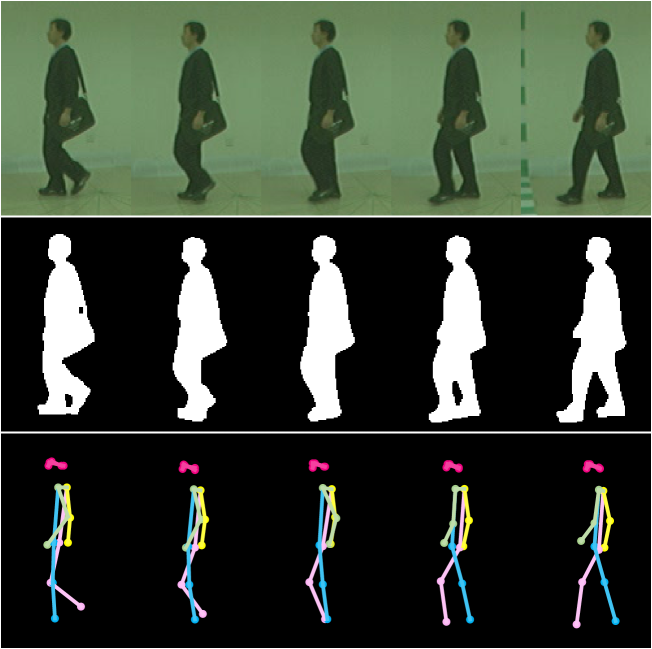
Comparison of different gait representations of a subject in the CASIA-B gait dataset at different timesteps.
When it comes to interpreting how someone walks, researchers tend to follow two main paths: one that focuses on what we see, and one that digs into how the body moves.
Both appearance-based and model-based approaches can benefit from modern deep learning models, such as CNNs for feature extraction or RNNs for temporal modeling. These tools have enhanced the performance of traditional techniques by learning more complex and abstract gait representations.
Appearance-Based Techniques
These methods treat gait as a visual pattern. They often rely on silhouettes — the outline of a walking person frame by frame — and analyze how this shape changes over time.
- Silhouette-Based Methods: These extract gait features directly from the shape of the body in motion. One popular representation is the Gait Energy Image (GEI), which condenses a sequence of silhouettes into a single image capturing motion intensity.
- Template Matching: Here, a reference “walking pattern” is created for each person. New gait sequences are compared against these templates to find the best match, using similarity measures.
Model-Based Techniques
Instead of analyzing the visual form, these techniques look under the hood — at the biomechanics behind walking.
- Kinematic Models: These methods reconstruct a skeleton of joint positions and angles, aiming to capture the unique movement mechanics of each person.
- Dynamic Time Warping (DTW): Since walking speeds can vary, DTW aligns two gait sequences over time to measure how similar their motions are — even if one is slower or faster.
- Hidden Markov Models (HMMs): These statistical models treat gait as a series of hidden states, like steps or transitions, and learn the most probable sequence for each person’s gait cycle.
Each of these approaches has its strengths. Appearance-based methods tend to perform well with visual data and are easier to apply at scale. Model-based techniques, meanwhile, provide deeper insights into physical motion and can be more robust to visual noise.
Where Gait Recognition Is Walking Toward
Gait recognition isn’t just a research curiosity — it’s finding its way into real-world applications across multiple domains.
🛡️ Security and Surveillance
One of the most compelling use cases is in public safety. Gait recognition allows for identifying individuals from a distance, even when their face is obscured or turned away. In crowded environments like airports or public events, this can give authorities a powerful tool for tracking persons of interest without relying on facial features.
📍 In fact, in 2019, Chinese authorities used gait recognition to identify a masked suspect captured by low-quality CCTV. His posture and stride gave him away — no face needed.
🔐 Access Control
In secure facilities — think data centers, military zones, or research labs — gait could become an additional layer of access control. Unlike keycards or passwords, you can’t lend or steal someone’s walk.
🏥 Health and Wellbeing
Gait is also a window into our health. Changes in the way someone walks can signal early signs of neurological disorders, injury, or aging. Continuous gait monitoring systems could help doctors detect these changes and intervene earlier, especially for elderly patients at risk of falling.
🕵️ Forensic Investigation
Even in forensic science, gait recognition is making waves. It can help identify suspects captured in surveillance footage where no other biometric cue is visible, offering new opportunities in criminal investigations.
⚠️ Challenges and Considerations
Despite its promise, gait recognition comes with technical and practical limitations.
- Changes in clothing, footwear, or carrying a bag can alter the walking pattern.
- Walking speed variations or changes in surface type can also reduce recognition accuracy.
- Capturing reliable gait data often requires calibrated cameras, clear viewpoints, and in some cases, depth sensors — not always easy to deploy in the real world.
🧩 The Ethical Landscape
Like all biometric systems, gait recognition must navigate important ethical questions.
- Can people be tracked in public without their consent?
- What happens if the data is stolen or misused?
- Should gait be considered personally identifiable information?
As the technology evolves, transparency, regulation, and consent will be crucial to ensuring it’s used responsibly — not for surveillance overreach or discrimination.
🏁 Conclusion: Movement as Identity
Gait recognition is one of the few biometric technologies that doesn’t rely on a person’s cooperation or proximity. It captures how we move, not just how we look. That makes it powerful — and sensitive.
As deep learning continues to evolve, and as datasets grow in diversity and realism, gait recognition could become a standard tool in security, healthcare, and beyond. But its future must be shaped by careful choices — not just by what is possible, but by what is ethical.
📚 References
- Wang, L., Tan, T., Ning, H., & Hu, W. (2003). Silhouette Analysis-Based Gait Recognition for Human Identification. IEEE Transactions on Pattern Analysis and Machine Intelligence, 25(12), 1505–1518.
- Teepe, T., Gilg, J., Herzog, F., Hörmann, S., & Rigoll, G. (2022). Towards a Deeper Understanding of Skeleton-Based Gait Recognition. Proceedings of the IEEE/CVF Conference on Computer Vision and Pattern Recognition (CVPR) Workshops, 1569–1577.
- Yousef, R. N., Khalil, A. T., Samra, A. S., & Maher, M. (2023). Proposed Methodology for Gait Recognition Using Generative Adversarial Network with Different Feature Selectors. Neural Computing and Applications, 35, 1641–1663.
- Teepe, T., Khan, A., Gilg, J., Herzog, F., Hörmann, S., & Rigoll, G. (2021). GaitGraph: Graph Convolutional Network for Skeleton-Based Gait Recognition. arXiv preprint arXiv:2101.11228.
- Arshad, M. Z., Jamsrandorj, A., Kim, J., & Mun, K.-R. (2022). Gait Events Prediction Using Hybrid CNN-RNN-Based Deep Learning Models Through a Single Waist-Worn Wearable Sensor. Sensors, 22(21), 8226.
메타데이터
- post_id
- 8fc241a1a0e
- slug
- they-know-its-you-by-the-way-you-walk-inside-gait-recognition-8fc241a1a0e
- url
- https://medium.com/@moncefboujou96/they-know-its-you-by-the-way-you-walk-inside-gait-recognition-8fc241a1a0e
- canonical_url
- https://medium.com/@moncefboujou96/they-know-its-you-by-the-way-you-walk-inside-gait-recognition-8fc241a1a0e
- author_url
- https://medium.com/@moncefboujou96
- status
- ok
- fetched_at
- 2026-06-17 08:20:12