Idempotency: A Cornerstone of Reliable System Design & Its Role in Generative AI and Agents
If you don’t have a Medium subscription, you can read the full article here: friend’s link
Idempotency: A Cornerstone of Reliable System Design & Its Role in Generative AI and Agents
If you don’t have a Medium subscription, you can read the full article here: friend’s link
Idempotency is one of the most important yet understated principles in system design. In simple terms, an operation is idempotent if performing it multiple times produces the same final state as performing it once.
In everyday life, setting your air conditioner to 21 degrees Celsius is idempotent. Press “Set” multiple times, and the temperature remains 21. In contrast, pressing the volume-up button is non-idempotent, each press changes the state further.
The concept is simple. Its implications are profound.
Idempotency in Distributed Systems
Distributed systems operate in uncertain environments. Networks fail, requests time out, services crash, and messages are redelivered. A system often cannot confidently determine whether a previous attempt succeeded or failed. In such scenarios, the safest approach is to design systems so that repeating an operation does not corrupt state.
For example, Stripe uses idempotency keys to prevent duplicate transactions. If a payment request is retried due to a network failure, the server recognizes the key and returns the original result instead of charging the customer again. This protects both system integrity and user trust.
Common Implementation Patterns
Reliable systems implement idempotency through patterns such as:
- Idempotency keys — A unique action ID is sent with each logical request. The system stores the result and replays it on retry instead of re-executing.
- Uniqueness constraints — Database-level unique indexes (e.g., on
order_id) prevent duplicate records. - Conditional updates — State transitions occur only when a record is in an expected state (e.g., status = “pending”).
- Event deduplication — Processed event IDs are stored and checked to prevent reprocessing in message-driven systems.
- State reconciliation — The system verifies the desired end state before executing an operation.
Together, these patterns ensure safety under retry conditions.
True exactly-once delivery is nearly impossible in distributed systems. Idempotency makes at-least-once delivery safe.
Generative AI Systems: Where Reliability Meets Probabilistic Output
Generative AI introduces a subtle challenge. Large language models produce probabilistic outputs. The same prompt may generate slightly different responses, especially when temperature > 0.
At first glance, this seems incompatible with idempotency.
However, idempotency concerns state transitions — not textual variability.
In a production GenAI workflow, a user request may trigger:
- An LLM call
- A database write
- A billing event
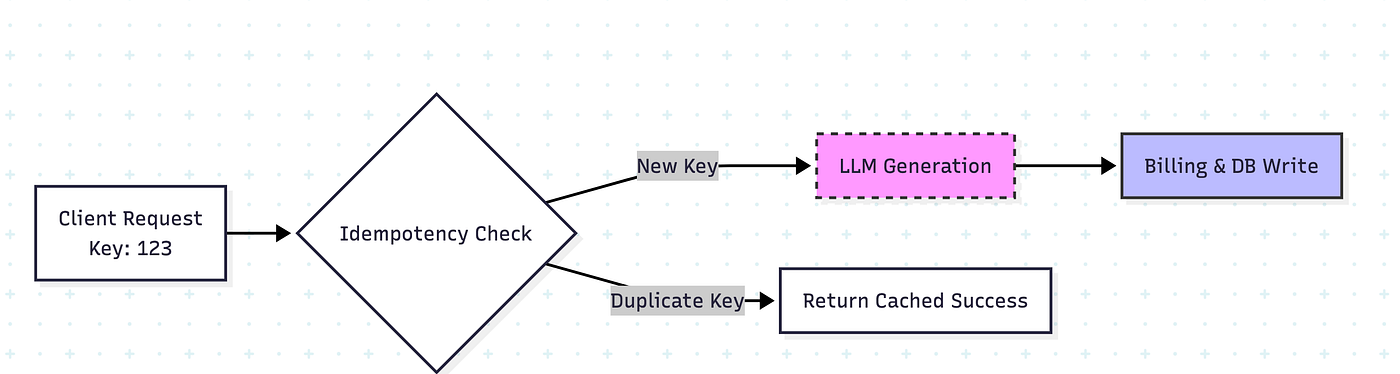
If a timeout occurs and the request is retried, the system must not double-charge or create duplicate records — even if the model’s textual response differs slightly.
Classical distributed systems thinking applies directly to AI systems.
Idempotency in AI Agents: Safe Autonomy
The stakes rise further in agent-based architectures.
Agents do not just generate text — they act. They create CRM records, initiate payments, send emails, and provision infrastructure.
If an agent retries an action after a partial failure, the consequences can cascade: duplicate invoices, repeated emails, inconsistent data, or unintended infrastructure changes.
In such systems, idempotency is not optional. It is foundational to safe automation.
Agent architectures must therefore include:
- Unique action identifiers for every tool invocation
- Durable execution logs
- Pre-execution checks to skip previously completed steps
- Workflow checkpointing for safe recovery
This transforms autonomous systems from powerful to trustworthy.
As AI systems become more autonomous and multi-agent workflows grow in complexity, the relevance of idempotency only increases. Intelligence may drive decisions — but disciplined system design ensures those decisions execute safely, even if they execute more than once.
Idempotency vs. Determinism
Idempotency is not the same as determinism.
- Determinism ensures the same input produces the same output.
- Idempotency ensures repeated execution produces the same final state.
A system can be deterministic yet unsafe under retries. Conversely, a system may produce slightly varied outputs yet remain safe in its state transitions.
In AI-driven architectures, deterministic outputs help evaluation and compliance. Idempotent side effects ensure reliability.
Conclusion: The Silent Pillar of Safe Systems
Idempotency is more than an API design detail — it is a resilience principle that underpins reliable distributed systems.
As AI systems become more autonomous and multi-agent workflows grow in complexity, the importance of idempotency only increases. Intelligence may drive decisions — but disciplined system design ensures those decisions execute safely, even if they execute more than once.
In the era of generative AI and autonomous agents, idempotency is what transforms powerful systems into trustworthy ones.
메타데이터
- post_id
- 8fcf6d340fa4
- slug
- idempotency-a-cornerstone-of-reliable-system-design-and-its-emerging-role-in-generative-ai-and-8fcf6d340fa4
- url
- https://medium.com/@rajesh.sgr/idempotency-a-cornerstone-of-reliable-system-design-and-its-emerging-role-in-generative-ai-and-8fcf6d340fa4
- canonical_url
- https://medium.com/@rajesh.sgr/idempotency-a-cornerstone-of-reliable-system-design-and-its-emerging-role-in-generative-ai-and-8fcf6d340fa4
- author_url
- https://medium.com/@rajesh.sgr
- status
- ok
- fetched_at
- 2026-08-04 08:11:34





