Reverse engineering Ramanujan and a new formula for perimeter of ellipse
Ramanujan has given us too many formulas and too little explanation. I have wondered, like many others, how he found them. One case is his…
Reverse engineering Ramanujan and a new formula for perimeter of ellipse
Ramanujan has given us too many formulas and too little explanation. I have wondered, like many others, how he found them. One case is his formulas for perimeter of ellipse, which uses square roots. We can easily show these are good, but how he discovered them remained a mystery.
I first saw them in a video by Standup Maths:
[embed]
I knew Ramanujan liked continued fractions a lot. So I vibe coded (Claude Opus 4.8) a search engine exploring paths Ramanujan might have taken, and it bear fruit. Not only it reproduced Ramanujan’s formula’s, it even discovered a new formula that Ramanujan probably missed using 4th roots. Now I can share with you how he might have discovered them.
For an ellipse with semi-axes a and b, define
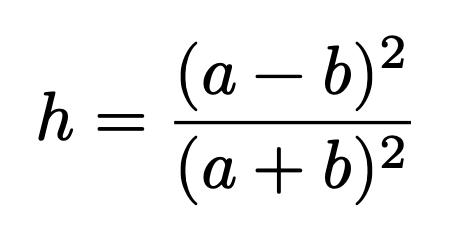
Eccentricity like
If exact circumference is C, we can define g(h) as following.

Defining g(h)
All the formulas are just approximations for g(h).
The program generated following equations. After k=5 there was nothing better than rational polynomials.

Generated formulas vs. Historical forms
Ivory and Bessel gave us a Taylor series for g(h):

First, you can convert this into a continued fraction style

And you notice initial few terms are actually simple. Simply truncating at any stage gives you Padé approximations, but we want better. Ramanujan style approximations are using square roots. So try to fit the best square root that gives you 3 terms instead of two terms a linear approximation will give you. For example sqrt(a²+x) is a * sqrt(1 + x/a), and it is approximately a² + x/2a, so when we have such ratios we can just do sqrt. So if it is not a perfect square it is not worth considering. This alone reproduces all Ramanujan’s formulae. You don’t need to write code for this, hand exploring can get the same ones if you follow the same method. Remember to invert and compute Taylor series again.
After I tried higher roots, like 4th roots, and more, I was able discover the new k=4 case. I tried square roots inside square roots, and more complex cases but they didn’t find anything better than Padé approximations.
You can read the code here for all the nitty gritty details:
메타데이터
- post_id
- 8fd4ecbe67c8
- slug
- reverse-engineering-ramanujan-8fd4ecbe67c8
- url
- https://medium.com/@anitasv/reverse-engineering-ramanujan-8fd4ecbe67c8
- canonical_url
- https://medium.com/@anitasv/reverse-engineering-ramanujan-8fd4ecbe67c8
- author_url
- https://medium.com/@anitasv
- status
- ok
- fetched_at
- 2026-07-25 23:20:03