The Capex Mountain: Why Geothermal Costs So Much Upfront (And So Little Later)
Within every great challenge on this Earth lies the seed of an equivalent advantage. Yet, the tragedy of the average mind is that it gazes…
The Capex Mountain: Why Geothermal Costs So Much Upfront (And So Little Later)

Within every great challenge on this Earth lies the seed of an equivalent advantage. Yet, the tragedy of the average mind is that it gazes upon the immediate obstacle and turns back, completely blind to the permanent riches that lie just beyond.
In my decades of analyzing the world’s most successful industrialists, innovators, and thinkers, I have found that the defining trait of achievement is the capacity to look past temporary hardship and focus entirely on ultimate compensation.
Today, as humanity stands at the crossroads of a momentous energy revolution, there is a magnificent source of power that tests this exact capacity for vision: Geothermal Energy.
It is an energy source of absolute abundance — an inexhaustible storehouse of wealth directly beneath our feet. Yet, many a captain of industry turns away from it. Why? Because they are intimidated by what I call The Capex Mountain — the immense, heavy hill of upfront capital expenditure required to tap into the Earth’s inner fire.
But if you possess the clarity of purpose to conquer that initial mountain, you will discover an operational paradise where the energy flows virtually free, steady, and untouched by the chaotic winds of inflation and resource scarcity.
To understand the geology of this financial mountain, we must look at the law of cause and effect as it applies to energy development.
When an entrepreneur decides to build a traditional fossil-fuel power plant — whether it runs on coal, gas, or oil — the initial climb is relatively gentle. The capital expenditure (CapEx) required to erect the facility is modest. The true cost of that plant is deferred into the future, bound to the perpetual, volatile operational expense (OpEx) of buying fuel day after day, year after year. It is an arrangement that favors immediate gratification over permanent stability.
Geothermal energy operates on a radically reversed philosophy. It demands its tribute entirely upfront.

Before a single kilowatt of electricity can be sold to the grid, millions of dollars must be ventured into the unseen depths of the earth. This upfront mountain is composed primarily of two massive financial barriers:
1. The High Cost of Subsurface Exploration
Unlike a solar array or a wind farm, where the resource can be measured perfectly from the surface with simple anemometers and satellite data, geothermal resources are hidden miles beneath layers of solid, unforgiving rock. To find the optimal combination of heat, fluid, and permeability, developers must conduct extensive seismic surveys, magnetotelluric studies, and geochemical analyses.
2. The Great Drilling Venture
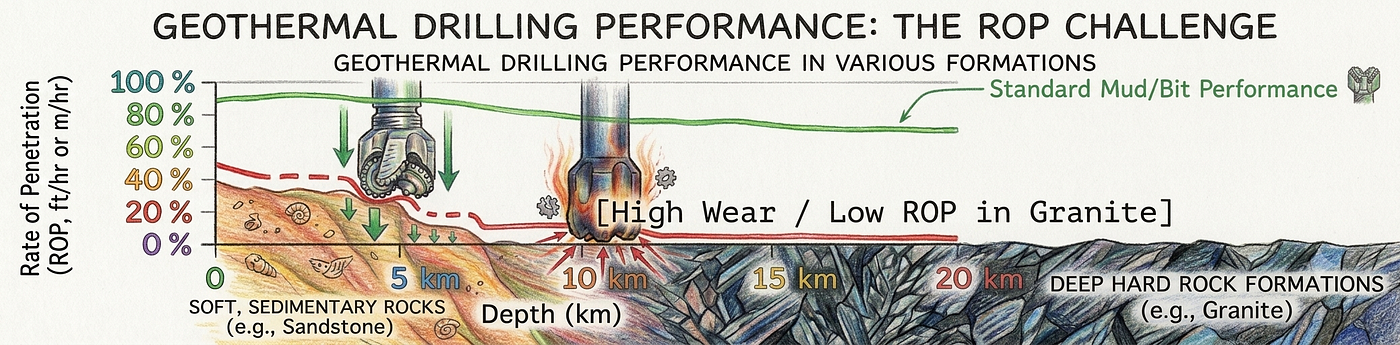
The ultimate test of a developer’s faith and pocketbook is the drilling phase. A single geothermal production well, plunging three to five kilometers into hard crystalline granite, can cost anywhere from $5 million to $10 million. And because nature does not reveal her secrets easily, the early stages of a geothermal project carry an undeniable risk of “dry wells” — boreholes that miss the deep fracture networks, yielding heat but insufficient fluid flow.
To scale the Capex Mountain, a developer must have a Definiteness of Purpose so unshakeable that they are willing to deploy millions of dollars into the ground before the first drop of steam ever reaches a turbine. It is a game for those who think in decades, not quarters.
But what happens to the bold pioneer who refuses to be defeated by the initial cost? What lies on the other side of the Capex Mountain?
Once the wells are drilled, the reservoir is stabilized, and the power plant is constructed, a beautiful economic transformation occurs. The high-risk, cash-burning venture morphs into the most stable, reliable, and low-cost cash-flow engine in the entire industrial world.
The reason is simple: Geothermal power has a fuel cost of absolute zero.
A coal plant must constantly feed its furnaces with trainloads of black rock; a gas plant is at the mercy of unpredictable geopolitical markets that swing fuel prices wildly overnight. But the geothermal operator has already purchased their fuel supply for the next thirty years by drilling the wells. The earth acts as a infinite, self-sustaining boiler that never sends a bill.
Because of this, the operational expenditure (OpEx) of a mature geothermal plant is astonishingly low. The expenses are limited to routine mechanical maintenance — overhauling a turbine, replacing a valve, or monitoring fluid chemistry. While a solar plant sleeps during the night and a wind turbine stands idle in a calm breeze, the geothermal plant hums along at a 90% to 95% capacity factor, delivering clean, baseload electricity twenty-four hours a day, rain or shine.
In the language of finance, the upfront CapEx is not a lost expense; it is a profound investment that buys insulation against future inflation. It is the equivalent of paying off a fifty-year mortgage on day one so that you may live entirely rent-free for the rest of your days.
No single individual can conquer the Capex Mountain alone. To reduce these upfront costs and mitigate the risks of subterranean exploration, modern geothermal developers rely on what I have long called the Master Mind alliance — the blending of diverse, expert minds toward a single, definite objective.
Today, geothermal engineers are forming alliances with the veterans of the oil and gas sector. They are borrowing advanced technologies refined by decades of petroleum exploration to flatten the Capex Mountain:
· Directional and Horizontal Drilling: Allowing multiple wells to be drilled from a single surface pad, drastically reducing the environmental footprint and the cost of moving heavy drilling rigs.
· Advanced Seismic Imaging: Utilizing supercomputers and artificial intelligence to map subterranean fractures with pinpoint accuracy, turning the blind gamble of exploration into a calculated science.
· Enhanced Geothermal Systems (EGS): Creating artificial reservoirs where natural ones do not exist, ensuring that every single well drilled yields a predictable return on investment.
Through the cooperative harmony of science, finance, and engineering, the structural risks that once made the Capex Mountain look insurmountable are being dismantled piece by piece.
We live in an era afflicted by short-term thinking. Investors rush toward assets that promise quick, fleeting returns, while ignoring the monumental projects that build true, generational wealth.
The Capex Mountain of geothermal energy is a natural sorting mechanism. It repels the timid, the hesitant, and the speculator who seeks something for nothing. It welcomes the true industrialist — the individual who understands that enduring riches require a foundational sacrifice.
Yes, geothermal power costs a fortune to unlock. It demands courage, capital, and a mastery of the physical sciences. But once that lock is turned, the Earth rewards the investor with a lifetime of unstinting, unyielding, and carbon-free prosperity.
Do not look at the steepness of the mountain with fear. Look at it with the knowing eye of a producer who recognizes that the highest peaks always guard the richest veins of gold. The heat is waiting. Have the courage to climb.
메타데이터
- post_id
- 8fded0b4e54f
- slug
- the-capex-mountain-why-geothermal-costs-so-much-upfront-and-so-little-later-8fded0b4e54f
- url
- https://medium.com/@bhaskara87/the-capex-mountain-why-geothermal-costs-so-much-upfront-and-so-little-later-8fded0b4e54f
- canonical_url
- https://medium.com/@bhaskara87/the-capex-mountain-why-geothermal-costs-so-much-upfront-and-so-little-later-8fded0b4e54f
- author_url
- https://medium.com/@bhaskara87
- status
- ok
- fetched_at
- 2026-06-20 20:29:01