Optimizing Enzyme Stability Through Freeze-Drying Innovations
Enzyme preparations in solution are highly prone to denaturation, aggregation, oxidation, or hydrolysis, which leads to loss of structure…
Optimizing Enzyme Stability Through Freeze-Drying Innovations
Enzyme preparations in solution are highly prone to denaturation, aggregation, oxidation, or hydrolysis, which leads to loss of structure and function. Lyophilization, or freeze-drying, is an important technique for extending shelf life and preserving activity, as it removes water without damaging the structure. However, enzymes are extremely sensitive to environmental conditions and can be affected during freeze-drying by cold stress, concentration effects, pH changes, phase separation, and dehydration stress, resulting in reduced activity, and they may gradually lose activity even under ideal storage conditions.
To address this challenge, both process parameters and formulation must be considered:
• Process aspect: Key steps include pre-freezing, primary drying, and secondary drying. The freezing temperature determines the ice crystal size and structural integrity. During primary drying, the collapse temperature and heating rate must be strictly controlled to avoid collapse and local overheating. Secondary drying removes bound water through controlled temperature elevation and time, ensuring long-term stability of the sample.
• Formulation aspect: Choosing the appropriate lyoprotectant is crucial. Disaccharides such as sucrose and trehalose, which have high glass transition temperatures (Tg), water replacement capability, and structural stability, have been proven effective in preventing protein denaturation, improving freeze-dried morphology, and microscopically preserving enzyme activity and long-term stability.
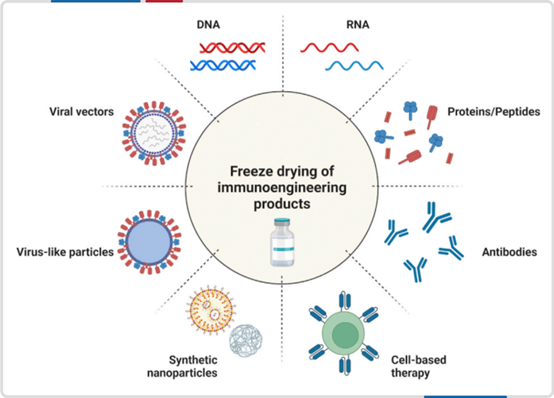
**Development Strategy of Lyophilization Processes for Hzymes Enzyme Preparations**
**The development of lyophilization processes is a systematic and complex procedure involving multiple steps, such as eutectic point testing, collapse temperature testing, sublimation rate testing, and lyoprotectant screening**. It requires comprehensive analysis of critical factors and systematic experimental design.
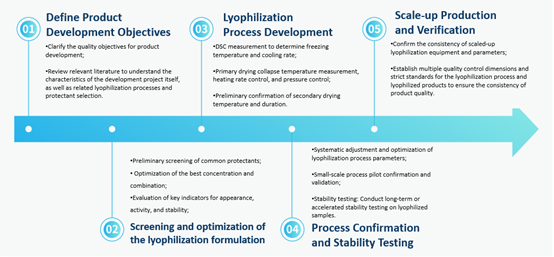
Development Workflow of Lyophilized Products
During **the development of a biochemical diagnostic enzyme raw material at Hzymes, [low collapse temperature and low concentration led to product collapse](https://www.hzymesbiotech.com/pcr-master-mix), uneven lyophilized cakes, and significantly reduced enzyme activity and thermal stability (Formulation 1.0). Adjusting the process showed that lowering the primary drying temperature could solve the collapse issue, but achieving a [honeycomb structure and activity stability required lyoprotectant screening and combination.](https://www.hzymesbiotech.com/pcr-master-mix)**
Results showed that **Formulations 1.5 and 1.6 performed well in preserving enzyme activity. Further combination and concentration optimization, after three rounds of testing, [led to the final optimal Formulation 3.4](https://www.hzymesbiotech.com/pcr-master-mix), which provided both high lyophilized activity and excellent thermal stability. Meanwhile, through process optimization, lyoprotectant screening, and buffer improvement, [a lyophilized product with good appearance and stability was achieved**.](https://www.hzymesbiotech.com/pcr-master-mix)
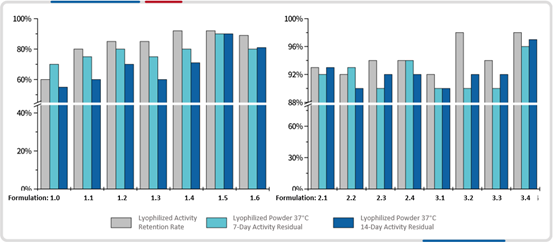
Effect of Lyoprotectants on Enzyme Activity
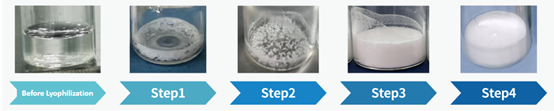
Step 1: Primary drying temperature too high, exceeding the collapse temperature → Product collapse Step 2: Optimize drying temperature → Collapse solved, but poor structural rigidity → Inconsistent dispersion, suboptimal honeycomb structure Step 3: Lyoprotectant screening → Improved freeze-dried morphology, but high surface tension → Wall climbing phenomenon occurs Step 4: Adjust formulation → Reduce surface tension → Achieve an advantageous process with good freeze-dried appearance
**Hzymes Lyophilized PCR Reagents**

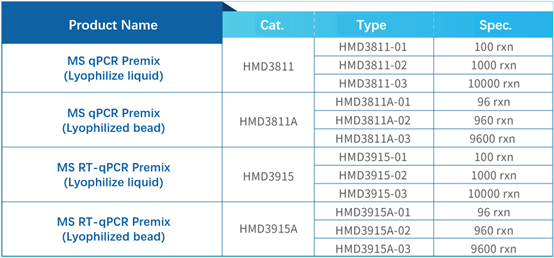
Lyophilized PCR reagents are prepared by freeze-drying all necessary components for PCR reactions, including DNA polymerase, reverse transcriptase, dNTPs, MgCl₂, buffers, and primers, into stable powders or lyophilized beads. Upon reconstitution with water, the PCR reaction can be performed directly. Compared to conventional liquid PCR reagents, **lyophilized reagents offer stronger stability, higher portability and ease of use, and compatibility with automated devices, greatly expanding real-world applications of PCR in rapid pathogen detection, genetic testing, forensic analysis, and other fields.**
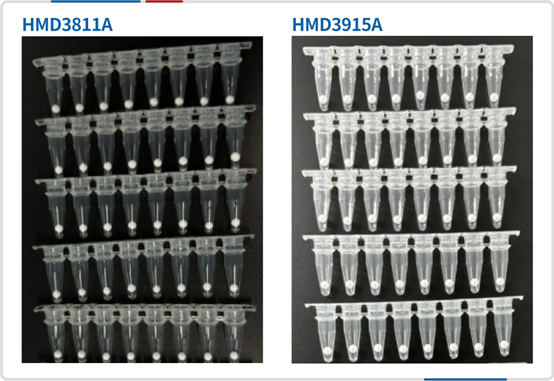
qPCR Premix Lyophilized Bead Product Showcase
메타데이터
- post_id
- 8fed577deccd
- slug
- optimizing-enzyme-stability-through-freeze-drying-innovations-8fed577deccd
- url
- https://medium.com/@hzymesmarketing/optimizing-enzyme-stability-through-freeze-drying-innovations-8fed577deccd
- canonical_url
- https://medium.com/@hzymesmarketing/optimizing-enzyme-stability-through-freeze-drying-innovations-8fed577deccd
- author_url
- https://medium.com/@hzymesmarketing
- status
- ok
- fetched_at
- 2026-06-21 07:44:09