Black Holes Do Not Destroy: Regenerative Flux Dynamics and Energetic Continuity
Black Holes Do Not Destroy: Regenerative Flux Dynamics and Energetic Continuity
Black Holes Do Not Destroy: Regenerative Flux Dynamics and Energetic Continuity
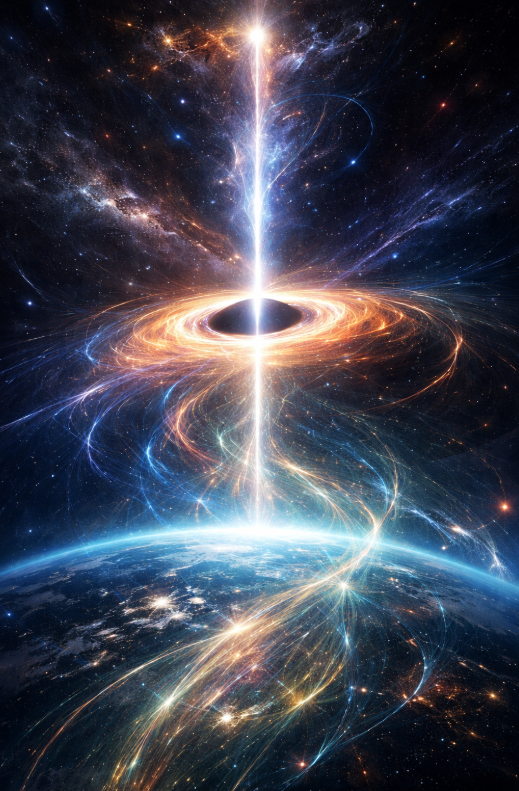
Black Holes Do Not Destroy: Regenerative Flux Dynamics and Energetic Continuity
1. There Is No Energetic Disappearance
The idea of energetic destruction is, in many contexts, a perspectival artifact rather than a physical necessity.
What appears as disappearance is more accurately understood as a transition between regimes of organization. What appears as collapse is a structural reconfiguration under constraint.
The Δ1 → Δ7 sequence does not describe loss but ordered modulation:
- attenuation of a dominant regime,
- purification of an active field,
- emergence of concentrated static intensity,
- magnetic impregnation,
- amplification,
- diffusion,
- conversion into attraction energy.
At no stage is the preceding configuration annihilated. Each phase reorganizes the structural distribution of energy while preserving its continuity.
Energy does not cease to exist. It changes architecture, symmetry, and mode of interaction.
The appearance of absence is often a shift in accessibility — not an ontological erasure.
2. The Limit Case: Maximal Gravitational Constraint
If energetic continuity holds in chemical or local physical systems, its robustness must be tested under extreme conditions.
A black hole represents such a limit condition:
- maximal gravitational concentration,
- critical density,
- compression approaching the boundaries of classical description.
If true energetic destruction were possible, it would most plausibly occur here.
Yet observations reveal not annihilation but redistribution:
- absorption of matter,
- structural compression,
- high-energy emission (X-rays, gamma radiation, relativistic particles),
- large-scale reconfiguration of surrounding flux systems.
The process resembles not a terminal sink but a transformation node.
Collapse, in this framework, is not cessation. It is a regime shift beyond ordinary observational access.
The apparent loss corresponds to a transition into a different structural order, not to energetic nullification.
3. Terrestrial Flux as a Transitional Model
A more accessible illustration can be found within the Earth’s electrostatic system.
Electrical flux distribution follows a vertical gradient:
Core → Ground → Atmosphere → Stratosphere → Electrostatic Halo → Cosmic Environment.
This sequence is not merely spatial displacement. It represents successive shifts in interaction scale and dominant forces.
Near the ground, charge density is high and interactions are frequent. In the stratosphere, density decreases and diffusion becomes dominant. In the electrostatic halo, coupling with solar wind and cosmic plasma intensifies.
In standard physical language, this reflects changes in field dominance, boundary conditions, and coupling constants.
The energy involved does not vanish between layers. It reorganizes according to constraint and scale.
The system demonstrates that flux evolution is functional, not destructive.
Each layer modifies the mode of interaction while preserving energetic continuity.
4. Entropy and Structural Regeneration
The second law of thermodynamics is typically expressed as:
ΔS ≥ 0
In an isolated system, total entropy increases.
This principle describes a statistical tendency toward disorder at the global scale. It does not forbid local organization.
Indeed, most astrophysical systems are not strictly isolated. They are open systems sustained by energy flow.
When energy passes through a system, local decreases in entropy become possible, provided global entropy still increases.
To formalize this behavior conceptually, one may introduce a regeneration term, Fr, representing the capacity for localized structural reordering under sustained flux:
ΔS ≥ 0 + Fr
Here, Fr does not violate thermodynamics. It expresses the well-established principle of far-from-equilibrium self-organization.
Stars maintain thermodynamic gradients through nuclear fusion. Pulsars channel rotational and magnetic energy into structured emission. Planetary atmospheres sustain organized circulation patterns under solar input.
In each case, disorder is not simply accumulated. It is absorbed, concentrated, and reorganized into coherent structure.
Global entropic drift and local structural emergence coexist as complementary aspects of dynamic systems.
5. Coherent Principle Across Scales
Chemical transformation. Terrestrial electrostatic flux. Gravitational compression. Thermodynamic evolution.
Across scales, a consistent structural principle emerges:
Energy does not extinguish. It transitions under constraint into new regimes of coherence.
Under dispersion, it diffuses. Under compression, it concentrates. Under concentration, it reorganizes.
Cosmic stability is therefore not passive conservation. It is active structural reconfiguration sustained by constraint and flow.
What appears as disappearance often marks the threshold of integration into a broader configuration — one not yet fully resolved within our current observational framework.
In this view, the universe is not drifting toward exhaustion. It is continuously restructuring itself through cycles of concentration, transformation, and renewal.
Energy persists not by resisting change, but by transforming through it.
메타데이터
- post_id
- 8ff8ef334534
- slug
- black-holes-do-not-destroy-regenerative-flux-dynamics-and-energetic-continuity-8ff8ef334534
- url
- https://medium.com/@gouvielos/black-holes-do-not-destroy-regenerative-flux-dynamics-and-energetic-continuity-8ff8ef334534
- canonical_url
- https://medium.com/@gouvielos/black-holes-do-not-destroy-regenerative-flux-dynamics-and-energetic-continuity-8ff8ef334534
- author_url
- https://medium.com/@gouvielos
- status
- ok
- fetched_at
- 2026-07-25 09:41:49