Why are Anakin and Padme seen as a love story when Catherine and Heathcliff are seen as anything…
A discussion of the importance of narrative framing in shaping audience perception, the infamous gravedigging scenes, and the differences…
Why are Anakin and Padme seen as a love story when Catherine and Heathcliff are seen as anything but one?
A discussion of the importance of narrative framing in shaping audience perception, the infamous gravedigging scenes, and the differences between romantic love and identity collapse

I popped my Wuthering Heights cherry via the 1939 film starring Laurence Olivier and Merle Oberon and while I did enjoy the film, I saw it as another run-of-the-mill tragic romance and soon forgot about it. I purchased the novel years ago, but it sat on my shelf unread because I never found the premise of Wuthering Heights to be particularly compelling. When I saw the trailer for Fennel’s film appear in my Youtube recommendations, I also didn’t think much of it until I started scrolling down the comments section, and to say that I was shocked is an understatement. Emerald Fennel was absolutely ripped for calling Wuthering Heights a romantic love story, let alone the greatest one of all time. One commentator responded with humor and approval from the rest that it was, in fact, the greatest abuse story ever told. Others considered the novel to be a tale of vengeance and trauma, not love, and one that depicted the horrors of a toxic, destructive obsession and nothing more than a cautionary tale about an unhinged, necrophilic brute’s inability to let go of an equally unlikeable, narcissistic woman. I was intrigued and gave the novel a read and while my perception of the story definitely changed, I seem to have reached a completely different conclusion from everyone who watched the trailer and apparently most of the Internet.
Anakin Skywalker is widely regarded as a broken man and a tragic villain. It’s said that he was a boy who loved a girl so much that he destroyed the galaxy after she died to fill the void she left behind. Star Wars fans hope that he and Padme were reunited in Heaven and speak of the tragedy of them not being able to live a peaceful life together with their children. That ache is strong enough that, in recent years, fan videos have been made depicting their reunion and of Vader visiting her tomb long after her death. His arc is filled with what-if’s and what could have been. What if Anakin had not turned to the Dark Side? What if the Jedi actually helped him address and process his grief over losing his mother and his fear of loss instead of spewing abstract aphorisms about letting go? What if Qui-gon Jinn had survived that duel with Maul and been the father figure that Anakin needed to counter Palpatine’s manipulation? Darth Vader was only a shadow of what Anakin could have been. What if he had lived up to that extraordinary Force Potential that he was born with? He could have been a god instead of Palpatine’s servant. And the list goes on. The common thread is folks want him to have been saved. Anakin is regarded as a disaster that could have been averted if only fate had been kinder and his romance with Padme is likened to a Greek or Shakespearean tragedy of galactic proportions. The Prequels have been praised for depicting one of the most compelling character arcs in cinema and Vader’s redemption through his son, Luke evokes great emotion from audiences to this day.
As for Heathcliff, oh boy. I have seen Heathcliff called everything from a gravedigging weirdo to the Devil incarnate. The Internet labels him about as much or even more than the characters in the novel did. It swings wildly from absolute hatred and revulsion to fascination and staunch sympathy, and seemingly nothing in between. I feel alone in bemoaning what a waste he was because Heathcliff is probably one of the biggest wastes I have encountered. His intelligence is underrated and not discussed enough. The odds were stacked against him. He had no family name, wealth, was deprived of an education, and resided in a very rigid, hierarchical society with no real prospects of a future. The only things he had were maleness, his youth, health, and a rage-filled tenacity.
By the time he was forty years old, he not only acquired great wealth but two ancient properties in a society where landownership was everything. No outsider looking at adult Heathcliff would have thought he was once this powerless boy who was relentlessly bullied and beaten. He was gifted and as much a prodigy as Anakin was, albeit in a different manner. But instead of using said gifts to build himself up, he used it to relive childhood injuries. Wuthering Heights is watching one very capable man destroy himself and everything around him in slow-motion until he burned out and died. It’s a pity. His ghostly union with Catherine was what he wanted and it’s romantic in a literary sense with the whole undying love spiel, but it’s yet another symptom of a man who never developed an identity of his own. He was worse off than Catherine was in this regard because she, for however brief a time, had a life and identity outside of him.
There is so much pathology in discussions about Heathcliff that conversations about the character often turn into a debate about DSM-5 standards than about the character himself. I can write several essays dissecting each and every label I have seen trying to define the true nature of the relationship between Catherine and Heathcliff. Most of the labeling is on him and they range from him apparently possessing Smeagol-levels of obsession to pure lust for Catherine’s body to everything in between. I think even Emily Brontë would have been confused had she lived to see the way her iconic character is perceived. I was completely baffled and at a loss for words at the disparity in the reception between the two men because Anakin’s crimes are objectively worse than Heathcliff’s. If I state that Wuthering Heights is a love story, I am bombarded with lists of every single one of Heathcliff’s cruel and abusive behaviors as retorts. And that is what happened when I obliviously commented under the trailer that this is what Wuthering Heights is: nothing more than a tragic love gone wrong. If we play this game of who has the shittiest behavior, I’m more than happy to partake because Darth Vader will leave Wuthering Heights readers speechless and the vengeance of the average anime protagonist will give everyone aneurysms.
Heathcliff’s violence culminates in animal cruelty, years of domestic violence, the systematic abuse of children, and the attempted destruction of two generations of families, while Vader’s begins with the murder of children, the annihilation of the entire Jedi Order, and him choking his eight-months pregnant wife in a fit of delusional rage. He goes on a state-sanctioned murder spree after his wife dies and the number of bodies this man left in his wake is ridiculous. And it’s not reserved to Anakin, either. There are a multitude of fictional characters whose scale of cruelty far outstrips Heathcliff’s but he is absolutely flambayed while the others are much beloved, and their respective love stories are not questioned to the same degree as his.

In the Pirates of the Caribbean franchise, the love story between Davy Jones and the sea goddess Calypso didn’t receive nearly as much screen-time compared to Will and Elizabeth Turner’s romance, but its impact was significant enough on the audience that years later, people want a prequel to see how and when they fell in love. If we were to conduct a moral evaluation of them and the love they shared, I think it’s safe to say they would fail abysmally. Davy Jones drowned countless number of sailors with the Kraken and had countless others either imprisoned with him on that cursed ship of his or their throats cut and bodies dumped overboard if they didn’t sign over their souls to him. His monstrous behavior is explained as a heartbroken man turned cruel after Calypso betrayed him and that his cruelty was directly proportionate with the degree of his love and heartbreak. Lord help me if I tried to inject this as an explanation for Heathcliff’s abusive behavior, that this was all a maladaptive coping mechanism from losing Catherine. Before anyone accuses me of whataboutism, if all of these characters were equally roasted, then I can live in peace. However, while the others are treated as tragic loves gone wrong, Heathcliff’s love for Catherine is treated as an abomination and he is piled on and demonized in a way these other characters are not.
And so I was left with a very interesting question and puzzle to solve: why is Heathcliff and his love for Catherine singled out? When couples cosplay as Anakin and Padme or have Star Wars-themed weddings with “Across the Stars” playing in the background, no one has anything to say to that but when couples incorporate quotes from Wuthering Heights into their vows, why does that attract comments about how crazy that is? Why is it so that the world of Wuthering Heights is considered particularly cruel and nihilistic when there are other franchises, including the Star Wars franchise, that showcase violence and brutality on a scale far greater than what is showcased in this novel? Why is a mass murderer and galactic genocidaire’s love for his son and wife treated as more legitimate than the love a domestic abuser had for a woman?
Why is trying to explain Wuthering Heights as a love story often treated as heretically as someone trying to convince Richard Dawkins that Jesus had come down to earth and invites mockery? When I state that Wuthering Heights is a romance, why does that almost without fail generate an online debate with profound irritation and even anger, when it is a Gothic Romance, the same way Jane Eyre and Rebecca by Daphne du Maurier are Gothic Romances? Why is it so when I say Anakin Skywalker is by far my favorite character in Star Wars, no one accuses me of liking child murderers, but when I say that Heathcliff is the most compelling character I have ever seen, that the love he had with Catherine stirs me in a way no other romance does, and that I do consider Wuthering Heights one of, if not the, greatest love story of all time, I am told that I lack reading comprehension skills, am glorifying toxicity, and that I am fond of or deserve abusive men? It comes down to narrative framing, likeability of the characters, and the legibility of their respective romances.

Star Wars is primarily a visual medium and began as one. There is no unreliable narration to navigate; events unfold directly before the audience, unmediated and unfiltered. In the Original Trilogy, viewers were captivated by Darth Vader and naturally wondered how a great Jedi could become the embodiment of evil. The Prequels answer that question in full. We witness Anakin’s rise and his fall from grace firsthand. His story is framed sympathetically as that of a fallen hero. He was a good man who succumbed to darkness but ultimately found his way back to the Light. The films give him a fully realized backstory: a gentle mother, a charismatic and quippy mentor, a compassionate lover, and a redeeming love for his child. We see Anakin’s emotions laid bare and gain direct access to his inner conflicts, his trauma, and the moral struggles that shape his destiny.
We don’t read about his trauma filtered through the eyes of another, but see it unfolding on screen and the pain and tumult written on his face. We hear his mother and Qui-gon Jinn praise him for being a kind, compassionate child who only wanted to do good for others without asking for anything in return. He was well-liked and adored by his friends, and Anakin was a talented kid with a natural affinity for the Force and was overall set up to be someone with a future and not just any future. He was the prophesized savior of the galaxy and born of the cosmic Force. This boy was Space Jesus and blessed with extraordinary gifts and potential. We can understand why he ultimately went down the dark path because it was to save the ones he loved from dying. He is the embodiment of the road to Hell is paved with good intentions. Though the galaxy saw Darth Vader as a monster, the audience sees him the same way Padme and Luke did: a good man who lost his way and this unwavering faith in his goodness saved him.
Wuthering Heights is filtered through two layers of narration. We have Lockwood, the perpetually befuddled outsider who never understood the emotional physics of the world he inadvertently stepped into. He thought Heathcliff was one of those traditional brooding Byronic heroes, the Mr. Rochester-type with a chip on the shoulder, that he can relate to. He couldn’t have ever imagined that this man he deemed to be “a capital fellow” to be the same man whose life goal was to decompose with his love into a single substance to achieve his version of union, and that he had said love unearthed twice. Then we have Nelly Dean as the primary narrator and she is not exactly reliable either. We are not told what actually happened but what she remembered happened and the information that she was willing to disclose to Lockwood eighteen years after the story began. Instead of a straightforward chronology, we get a patchwork quilt of incomplete insight and the story begins chronologically from the penultimate chapters. We get no POV chapters from either Cathy or Heathcliff and because their story is relayed to us by people who never fully understood or liked them, there is an ambiguity baked into the text that leaves questions hanging and so the debate will never end.
Catherine Sr. did not fit societal standards of how a woman of her class should behave. She was wild, spirited, and defiant from childhood. The Lintons gave her polish but never could obliterate her untamed half and all of that definitely colored the way Nelly perceived her versus her daughter Cathy Linton Jr., who Nelly overtly liked and went out of her way to actually help instead of sitting on the sidelines judging as she did for her late mistress. As for Heathcliff, from his very first appearance, he was ostracized and treated as an other and the labeling continued until his death. He was no Chosen One or child of prophecy with this grand destiny awaiting him, but a nobody from nowhere who was never completely understood by anyone in life, including the one who loved him best.

From the beginning, he was treated as an invader and a contaminant and even Mr. Earnshaw wasn’t guiltless of perpetuating this perception. Prejudice doesn’t require intentionality to have impact, and in this novel, passivity can do as much harm as outright violence. Mr. Earnshaw wasn’t cruel or sadistic, but he was as careless as he was clueless. He was not oblivious to the child’s race, stating that “it’s as dark almost as if it came from the devil,” and told Nelly to wash “it” and put “it” with the children, which is an unusual way to address a child you were planning to raise as a son, and he did nothing to address the open hostility the child was receiving already. Nelly tried to leave the child by the stairs during that first night, hoping that it would be gone by morning, and Mrs. Earnshaw turned a blind eye to Hindley’s bullying because she had no fondness for Heathcliff. She called him a “gypsy brat” and wanted “it” out, and the childhood chapters are chock-full of anti-Romani, ethnic, and racial slurs.
Even after Heathcliff becomes a wealthy adult and landowner, the racialized language surrounding him doesn’t disappear. Edgar still calls him a “gypsy ploughboy” when he returns to the Heights, and Lockwood, in the opening chapter, describes his landlord as a “dark‑skinned gypsy” who looks out of place in a northern English farmhouse. Joseph is standing right there: a servant, a local, a Yorkshireman, yet it is Heathcliff whom Lockwood perceives as incongruous. The question Lockwood is implicitly asking is: Why does the owner of this very English farmhouse look like that? Apart from Catherine, every member of the first generation comments on Heathcliff’s appearance. The novel never explicitly states his ethnicity, but the way he is compared to other characters makes his outsider status unmistakable. If Heathcliff had looked like child Anakin or Edgar with fair hair, light skin, blue eyes, he would have been perceived and treated differently. The text doesn’t need to spell out, “Heathcliff is of Romani or mixed descent.” The reactions of the characters do that work. His appearance marks him as foreign in a predominantly white rural English setting.

Contrast this with Hareton. He had dark hair, dark eyes, and tanned skin from outdoor labor, yet no one ever called him a “gypsy” or used racialized language toward him. The insults he received were about ignorance and lack of education, flaws that the novel ultimately resolves. Hareton’s darkness is coded as weathered, not foreign. Lockwood described him as “embrowned,” or sun-darkened and not “dark” the way Heathcliff was. Heathcliff’s darkness is coded as racial, outsider, other. Heathcliff’s appearance is treated as a signifier of non‑Englishness, foreignness, and social contamination. Hareton’s is treated as a signifier of class and labor, something that can be corrected through education and refinement. Heathcliff’s “difference” is permanent; Hareton’s is circumstantial.
Heathcliff never belonged anywhere, and he was set up, not for greatness, but for failure. His belonging was not in a home or family but with Catherine. He lived in Wuthering Heights for the entirety of his life, but the place had no meaning for him without Cathy. The Heights to Heathcliff is akin to Crime Alley for Batman. Even as an old man, Bruce Wayne returned there to remember his parents but also because that was where Batman was born. Heathcliff could have lived at the Grange and made a mockery of the Lintons or bought property anywhere else with the amount of wealth he acquired, but he stubbornly refused to leave the Heights until he died. It was for vengeance, but fundamentally, it was to wait for Catherine to return to him. He tormented people but it was also to kill time as he awaited a return to the call he had put out eighteen years earlier. Heathcliff’s lack of origin is a critical reason he bonded to Cathy in the way that he did and why he couldn’t just “get over her,” because she was his origin point.
Nelly told Lockwood that Heathcliff was a cuckoo. Cuckoo birds are a species of parasitic bird infamous for infiltrating and taking over the nests of their hosts at the cost of the well-being and lives of the other chicks. Cuckoo birds are hated because they violate every concept of fairness that people have, even if they are behaving according to instinct, and Heathcliff was similarly despised. And how ironic that Heathcliff did eventually take Wuthering Heights away from its rightful heir and drained the life out of everyone around him. Hindley called him an “imp of Satan,” or a demonic entity, Nelly characterized teenage Heathcliff as “repulsive” and behaving as if he were “possessed of something diabolical,” and the Lintons deemed him a thief, vulgar, “worse than a brute,” wanted him locked away so that no one can see him, and for him to be separated from Catherine, the only person who was keeping him intact.
All of these labels became a self-fulfilling prophecy. If people you are surrounded with insist that you are a sub-human, that you are monstrous, unwanted filth, that there is something innately lacking and defective about you, and treat you accordingly with suspicion and revulsion, what a surprise when you become what they feared. The tragedy of Anakin’s character is that he was never able to reach his true potential and that he had lost his way from the good man that he was. Heathcliff’s is that he became what the people around him told him he already was.

This is not only with Heathcliff but with other characters from other franchises, like Eren Yeager from Attack on Titan. Eren was a young man who was also considered by the world at large to be a sub-human because he claimed descent from the Eldian people. The Eldians were called beasts in human skin because of their ability to transform into Titans, were called devils and demons, and were considered contaminated. Eren and all those who had discernable Eldian heritage were judged for atrocities their ancestors committed thousands of years before they were born, atrocities recorded in texts by the very nation that had no problems using their abilities for their own military ambitions, propagated anti-Eldian propaganda to justify their own cruelty and oppression of others, often used unwilling Eldians as cannon fodder and their children as child soldiers, and wanted the entire population eliminated once they had no more use for them.
When Eren was a child, the world came to destroy his homeland. They killed his mother, and he grew up determined to take revenge on those responsible. By the time he reached adulthood and gained immense power, his rage had expanded beyond the individuals who carried out that first attack. He turned it against the entire world that had oppressed, demonized, and attempted to exterminate his people. Like Heathcliff, Eren internalized the hatred projected onto him, became the embodiment of it, and hurled it back at the world that created him. The Eldians were feared and derided as monsters and while that fear is understandable, given that most Titans are indeed giant, man‑eating humanoid creatures, the world’s response was catastrophically shortsighted. If you believe a group possesses an awe‑inspiring power capable of destroying the entire world, then attacking them, cornering them, and forcing them into life-or-death situations is not exactly a brilliant strategy. Why would you attack an island of demons and devils in the first place?! Stop poking the sleeping bear and leave it alone! The last Eldian King took refuge on that island they eventually attacked and before sealing himself off, warned the world that any provocation would incite the Rumbling, or the end of the world, and they decided to attack anyway. Eren was called the “Devil of Paradis” but the world also woke the Devil up.
Eren and Heathcliff were destructive but I don’t view them through the lens of good or evil but as consequences and products of the world that shaped them. In response to that, I often hear things like “I was abused and didn’t turn out like that,” “These other characters suffered too and they didn’t turn destructive,” or “he has no excuse for what he did, trauma or not.” This is not about excusing, but understanding. Different people react differently to the same traumatic circumstances. There is no one universal reaction to trauma. With polarizing characters like Heathcliff, I see a recurring pattern: people assume that those who channel their trauma into something good are simply better people than those who collapse into destruction. Audiences want to believe that suffering naturally creates empathy and that they themselves are safe from ever becoming what characters like Anakin, Heathcliff, or Eren became. Because if the Heathcliff’s of the world are inherently defective and if it all comes down to simply making “better choices,” then there’s no need to engage with the conditions that shaped them. Why did Heathcliff do terrible things? Because he was just a bad person. Because he was a monster. That explanation is comforting, but it avoids the harder question of how someone becomes that way in the first place.

Anakin’s fall to the Dark Side was a consequence of the Jedi’s arrogance and blindness. Anakin was a fallen messiah and it is said that the Jedi had possession of the savior but essentially handed him over to the Devil. As with Anakin’s fall and consequent murderous behavior, Heathcliff’s violence didn’t come out of nowhere. Over the years, the reasons behind Anakin’s fall have been broken down and there is a level of sympathy and understanding for him that I don’t see for Heathcliff. His abusive behavior is the first thing people mention but it’s often out of context. He didn’t wake up one morning and decide to be an asshole! You cannot brutalize someone in this manner and not expect consequences. He was the embodiment of you reap what you sow. He was treated like a disease, and so he came back as the plague. He was called a thief by the Lintons and what irony was it that he came back and took everything they loved, their property, and their children, legally. Hindley beat him and tried to have him run over by a horse so Heathcliff came back, not with a gun, but with the law itself as his weapon. He was dehumanized, subjected to both class and race-based humiliation, and wasn’t treated as someone with a mind and feelings of his own, and so he viewed and treated everyone around him apart from Catherine as objects.
Heathcliff was a sullen, quiet child who didn’t exhibit the same outwardly compassionate and friendly behaviors Anakin did, and grew into a rather grumpy teenager who no one in that household liked. Nelly compared him to Edgar and noted how fresh and appealing the latter was compared to the former, but what kind of a comparison is that? Edgar’s upbringing was one of privilege and comfort, with a sister that he loved and who loved him back, and he had both parents who were protective and loving. Even Nelly admitted that the way Hindley treated Heathcliff was enough to turn a saint into a fiend! After Mr. Earnshaw died, nobody really cared about him except for Catherine. When she was away at the Lintons recovering from that injury to her ankle and was pampered like a lady, Heathcliff was neglected by everyone except for Nelly, who called him dirty and bade him wash himself.
Heathcliff was very sensitive to being called dirty. While he was indeed dirty from weeks of hard labor outdoors while Cathy was gone, given the context in which this novel took place and the Victorian preoccupation with “good breeding” and purity, “dirty” referred to more than physical uncleanliness but was a not-so-subtle coding of social, racial, and moral contamination. And so who cared about the “dirty” stable-boy? Catherine was the only one who was distressed when he ran off, and the only one happy to see him when he returned. And nobody ever said that any of this name-calling, racialization, and class elitism was wrong: Nelly, you dropped the ball here! The only time she pushed back on any of this was when Cathy Jr. laughed at Hareton because he couldn’t read, but with anyone associated with Heathcliff, she is dead silent and often participates. She thought it would be better off if Catherine Sr. and Linton died because they were a burden on those around them. She inhabited a cruel, indifferent world and some of that cruelty rubbed off on her, coloring her perception and narration. She is selective about who she empathizes with and sees as good. And because Catherine and Heathcliff were indeed destructive, it is less likely that anyone will question the way she frames them, their actions, and her re-telling of the events that transpired.
“But he was too good to be thoroughly unhappy long. He didn’t pray for Catherine’s soul to haunt him. Time brought resignation, and a melancholy sweeter than common joy. He recalled her memory with ardent, tender love, and hopeful aspiring to the better world; where he doubted not she was gone.”
“Linton, on the contrary, displayed the true courage of a loyal and faithful soul: he trusted God; and God comforted him. One hoped, and the other despaired: they chose their own lots, and were righteously doomed to endure them. But you’ll not want to hear my moralising, Mr. Lockwood; you’ll judge, as well as I can, all these things: at least, you’ll think you will, and that’s the same.”
And Nelly did that a lot. She compared Heathcliff against Edgar throughout the novel in every way from their bearing, personality, appearance, and the way they responded to Catherine’s death. She gave a clear opinion as to whose grief was the proper and touching one. She spent paragraphs in the chapter immediately following Cathy’s death describing Edgar and his inward strength, grace, and faith in God. She doesn’t provide any context or understanding as to why Heathcliff and Hindley responded to the losses of the women they cared about so differently from Edgar, as if the differences were simply due to defective character or a lack of faith, and not trauma and developmental arrest. And yes, I do think Hindley was also a victim of poor parenting, even if he himself was an abuser. The same thing happened during Catherine’s illness. Nelly attributed it to nerves and a case of her being overdramatic instead of her legitimately having a breakdown and an identity rupture from trying to live as a split self. And Nelly either displayed some self-awareness or this was Brontë herself acknowledging the narrative skewing as Nelly admitted to Lockwood that she was indeed moralizing, but to cut her some slack because Edgar is a good guy. And this is before Heathcliff went full force with his vengeance schemes. A narrator does not need to outright lie to shape audience perception.
None of this is to say that Nelly and Lockwood were wrong or lying about literally everything. With regards to Nelly, I think she was correct about basic factual information such as the ages of the children, their physical appearances, the chronological sequence of events, and observations about the landscape It’s when she begins to give her evaluation of their characters and the way the events unfolded and how involved or not involved she was with the drama, that I would take what she says with a grain of salt. Some of the adaptations downplay her role or age her up as they did in the 1939 adaptation. In there, she is more of a mother figure to Catherine and Heathcliff while in the novel she pretty much grew up besides them, even if not with them, and that changes the way the events are retold to the audience. 1939’s Nelly was a lot more sympathetic to and understanding of Catherine and Heathcliff than the lady in the novel and she recounted the story without injecting her own critical opinions about everyone and everything. The narration in the novel is a labyrinth to get through, which is one reason among many why I think Jane Eyre is more popular overall as it has a straightforward, chronological narration.
And so in Wuthering Heights, there are two things I have to hold in mind:
- Catherine and Heathcliff weren’t pleasant people and were indeed destructive.
- Nelly might not have presented their characters and the way in which the events of the story unfolded accurately. This may have been intentional on her part to soften her own role in the drama or unintentionally due to latent biases that she wasn’t overtly aware of. There may very well have been information she tacked on and/or omitted entirely!

Nelly isn’t bad, nor would I consider her an evil villainess: she is limited. She was never valued for her own person but for what she can do for her bosses and was deeply entrenched in the class hierarchy and violence of her world. She had to keep her head down to survive and did not have the power to question her station in life because she was at the mercy of her employers. Like Heathcliff, she was a child living in a feral household, and instead of dreams or a future, she was given a role and expected to occupy it for life without complaint. She was also manhandled by nearly everybody in the novel and unlike Heathcliff, didn’t have the power nor the wealth to retaliate. And so understandably, she probably would not have been inclined to put in a good word for the people who slapped her around. The Lintons might have had a bad case of class prejudice but at least they didn’t openly bully her as the Earnshaw children did and so by comparison, of course she would regard Catherine Linton Jr. as her “sweet mistress” and Catherine Sr. as the brat. Nelly despised Catherine Sr. and some of that resentment was probably class-based, as Cathy was able to manhandle Nelly with impunity because she was her mistress.
They were both women stuck in societal roles, but while Nelly was able to acclimate, survive, and live “properly,” Cathy Sr. imploded and what a coincidence that every person Nelly approves of are those who are able to inhabit the status quo because she is an extension and product of it! It’s unfortunate these characters were unable to look past their pre-existing worldviews and see that they actually shared commonalities. It’s not only with Catherine and Nelly but with Heathcliff and Hindley. The two men were narrative mirrors of the other. Heathcliff is Hindley, albeit the more disciplined and systemically violent version of him, and a tragic example of trauma and abuse perpetuating itself. Catherine Jr. and Hareton were able to break from this cycle, but they still remain within the system that contributed to the destruction of the first generation, and it’s one reason among many that I do not view them as true redemption or a traditional happy ending either.
Given the environment she grew up in, it makes sense that Nelly saw everything through the lens of social propriety and religious moralization because that was all she knew how to do. Racialization and class elitism were normal in their society and so the Lintons were considered genteel, “quality” folks, however abysmal their personal views were. And because their prejudices were attitudinal, they seemed human enough, had manners, and were physically non-violent (save for that one time Edgar assaulted Heathcliff at the Grange), Nelly and a good portion of the audience view them as “good.” It also doesn’t help that Heathcliff was terrible to his only child while Edgar doted on his and so besides Heathcliff, Edgar appears as an angel.
Even Darth fucking Vader loved his own child and Heathcliff couldn’t manage to muster up enough humanity to leave his alone and that is one reason I think Anakin, however grievous his crimes were, is perceived as the better man than Heathcliff was because that is narrative comfort. Darth Vader is a monster but at least he loved his son. At least he wanted to be redeemed and changed for the better at the eleventh hour and came in clutch to save his baby boy who was actively being fried by a genocidal raisin and gave his life to do so, an act that saved the galaxy from evil. Heathcliff had none of those redeeming factors, only this weird attachment to Catherine that doesn’t look like a relationship at all. There are a multitude of mass murdering characters and Heathcliff is perceived as worse than they are, and I find that fascinating. One common thread I have discovered in many of those stories, is that the narrative is either neutral or on their side, and there is narrative comfort for the audience to rest on. The character might be godawful but he has something human that they can latch onto.
A good villain needs good PR and Heathcliff had terrible PR. Who was on his side in the story from birth to death? Mr. Earnshaw snuffed it too soon and only heightened resentment of the boy, Catherine was split between Edgar and Heathcliff in life and so couldn’t back Heathcliff up fully, and a ghostly fragment knocking on the doors and clinging to people while bleeding, scares and freaks people out. If Anakin had a Nelly to narrate everything he did, I think his character would be in a different place. Imagine a narrator constantly moralizing Anakin and telling the audience about how wicked he is, and that he is some kind of inhuman creature and not a man at all! What a fiend, a ghoul, and a diabolical villain! instead of the narrative and key characters framing him as a young man who made a series of tragic decisions as a result of a very human desire to forever hold onto the one he loved. I never see anyone framing Heathcliff’s gravedigging as a manifestation of that same desire. He gets disgust, moral condemnation, and is called sick, demented, and insane, but Anakin mowing down masses of people who respected and trusted him because he believed he had to do it to save Padme from dying, is a tragedy.

I also think the plethora of adaptations over the years has created a sort of Mandela effect. There is more body contact between Catherine and Heathcliff in some of these adaptations than was present in the novel, and their dynamic is universally presented and marketed to audiences as that of a couple’s. The entire second half of the novel is often cut entirely, which considerably softens the perception of Heathcliff’s character. Curious audience members who go into the novel bareback after watching the films often experience whiplash when they see OG Heathcliff in all his glory because they go in expecting a romantic hero only to find something else entirely. The more metaphysical aspects of their bond are cut or fleshed out in a way they were not in the original source material. For one thing, we never actually see Catherine and Heathcliff’s haunting in the novel. It’s left ambiguous as to whether it was real or merely a rumor and a figment of Lockwood’s imagination, while in the films, we see their ghostly afterimages wandering around the moor, kissing, and holding hands.
We never see what they did out there on the moor as children because Nelly wasn’t there to witness it, and we only hear snippets from Catherine’s recollection of what she and Heathcliff were up to, but in the films, we see them talking, smiling, gathering heather, and even kissing. Heathcliff is probably one of the least sensual characters I have encountered; yet, he is ironically sexualized to a degree that would probably confuse even him, especially in Fennel’s recent “interpretation” of Wuthering Heights. I understand why he is sexualized because intense emotions are often read as physical desire and a steamy romance is easier to market to mainstream audiences than a metaphysical singularity, but it again frames him and Cathy as a dysfunctional romantic pairing when they are anything but. I also don’t think the adaptations capture how child-like their dynamic was, and because many age the characters up, they are perceived as adults in a relationship when they were emotionally and psychologically children who never differentiated. I would love to see a pair of actors fully capture that children in adult bodies phenomenon and freak the audience out a bit. And I think at least one adaptation implied that Heathcliff was Catherine’s half-brother: is that where this theory came from??
And when it comes to Catherine’s death, several adaptations depict Heathcliff holding, kissing, or even lying beside her body after unearthing her when there was no such depiction in the novel, which inflames the necrophilia allegations. I was morbidly curious to see how bad it got, but it was a virtual blank in the novel in the direct aftermath of Cathy’s death. The narrative zeroes in on the locket Catherine was wearing and in the Victorian era, wearing a loved one’s hair was considered an intimate act, and so that locket and the hair was doing a lot of heavy lifting. When Heathcliff replaced Edgar’s hair with his own, he was again inserting himself in a marriage he never truly recognized. While I do think what happened between them at the Grange can be read as adult eroticism, I think now that all that desperate clinging and kissing was childhood attachment being lived out in adult bodies, complete with hormonal development. It was no different from them holding each other as kids amidst a violent and feral household. Children cling to their caregivers for security and emotional regulation and Cathy and Heathcliff never developed past that phase.

As for necrophilia, what Heathcliff did was the Gothic equivalent of screaming into the void. Heathcliff did not project sexual fantasies onto her or her body. His bond with Catherine was not based upon bodily desire. In both instances of him unearthing her, there is no body contact as some of the adaptations or illustrations circling around the Internet might have shown. He never touched her either of those times. I think Brontë knew how these scenes would be taken even if she minimized physical contact between Cathy and Heathcliff, especially given how sensitive things were in Victorian England. She was playing right on the knife’s edge of things and likely anticipated readers would cross over. Cathy and especially Heathcliff provoke established lines of thinking. An obsessed man? Check. Dead bodies? Check. Digging up the grave of the one woman he spent his existence fixating on? Check. This must be necrophilia. It’s the same line of reasoning that haunts many analyses of Catherine and Heathcliff’s “relationship.” A very intense, destructive relationship between two adults complete with jealous and possessive behavior? This must be obsession.
If anyone still thinks Heathcliff is nuts, I will include examples of grief behaviors in a future installment from other franchises that would have made him feel right at home. If he were in the sci-fi genre with access to technology that could resurrect the dead and not a guy trapped in Victorian England, his gravedigging would not stand out nearly as much. He and Catherine were simply in the wrong genre, era, and species of being. There are stories with necromancy where gravedigging is taken as a given and it is about grief and the inability to let go of lost loved ones, not voyeurism and depravity. Death is the ultimate form of separation and humanity has struggled with this since antiquity. I have heard people in the midst of grief who couldn’t bear the idea of their loved one decomposing in the ground and they wanted to dig them up but of course they didn’t. Heathcliff actually acted upon these intrusive thoughts and had no qualms against disregarding taboos that would normally scare off most other people. Even Darth Vader never did anything like this with his own wife. He may have been a mass murderer and struggled with accepting Death’s finality for most of his adult life but he had a sense of boundaries while Heathcliff never did. You know a character is special when they are willing to do things that Darth Vader wouldn’t do.

Would he need psychological help if he were to do this in real life? Yes. But let me talk about the emotion and Gothic logic behind it please before the sensationalizing begins. These scenes have been sensationalized to the point where I feel I can’t discuss them without necrophilia allegations shutting the entire thing down. It’s easier to say “ewwwww” than engage with the psychology behind this behavior. For me, the gravedigging is the culmination of Heathcliff’s inability to tolerate separation and symptomatic of his complete lack of identity outside of her. Honestly, the entire novel and all the tragedy and drama is a direct result of Catherine and Heathcliff’s inability to live separately. Her friendship and marriage to the Lintons functioned as boundaries and for Heathcliff, who is completely boundary-blind, it was annihilation. And when dear hubby Edgar told Cathy “no” and put his foot down to her shenanigans with Heathcliff, she exploded and imploded because she was about as adept at handling a boundary as her other half was. And Heathcliff didn’t consider Catherine his equal but as his equivalence so if she died then he was as good as dead. It wasn’t Catherine that he was trying to unearth but himself. He wasn’t calling to his lover to haunt him but to the unfinished half of his identity and she came back for the same reason. This isn’t a Jack and Rose style afterlife with two lovers embracing but two halves of one organism coming to completion.
The lack of sex and body contact in the novel is often written off as Victorian prudishness and something that Brontë had to do to get her story past the censors; therefore, some assert that all that metaphysical language was a disguise for the intense sexual fixation Heathcliff had for Catherine. But there doesn’t need to be skin exposure or overtly amorous language to depict romantic desire. Jane Eyre is another novel set in Victorian England, and there is clear physical attraction between Jane and Rochester that I thought was notably absent between Cathy and Heathcliff. Jane Eyre depicts romantic love while Wuthering Heights showcases a quintessential example of identity fusion that is often equivocated with obsession. And if we restrict analyses to the novel alone, Catherine declared her love for both Edgar and Heathcliff to Nelly in that fateful chapter where Heathcliff ran off, and the difference in the way she spoke of either of them is striking. When she talked about why she loved Edgar, what she said would resemble what Anakin would say if he were asked why he loved Padme and vice versa. But when she spoke of her love for Heathcliff, the language and emotion conveyed a collapsed identity than what I could consider a typical declaration of love. The adaptations do tend to tighten or cut down some of Catherine’s confession, often emphasizing the “I am Heathcliff!” line, but I think all of it should be included to highlight the complete lack of boundaries in their bond.

Anakin is fortunate as a character because while there are a multitude of comics, novels, and TV series that have spawned since the release of the Prequels, those six movies by Lucas stand on their own. It’s possible to ignore the sequels and everything produced by Disney that took place after Return of the Jedi without suffering from ill effect. Ownership of the franchise may change hands in the future, but his story likely won’t undergo the same continuous reimaginings by different directors because George Lucas, who created the character of Anakin and the entirety of Star Wars, directed and chose the actors who portrayed child and adult Anakin. This is his vision of the character. There is no ambiguity as everything from Anakin’s birth to death is fleshed out and so his backstory is completely grounded while there are big blank spaces in Heathcliff’s that will never be filled.
Apart from his vengeance and Catherine, what do we really know about Heathcliff anyway? The man has no personality outside of those two things and hardly seems like a person at all sometimes. There will be some semblance of narrative consistency with Anakin and Star Wars, while Wuthering Heights is a fight against layers of hostile narration and decades of interpretive takes. At least with Star Wars, the audience once had George Lucas to shed light on questions the audience may have about his intentions behind his work but we will never have that with Emily Bronte. I want to know who she would personally select to portray Catherine and Heathcliff, but given her reclusive nature and the ambiguity baked into the text, she may deign not to respond.
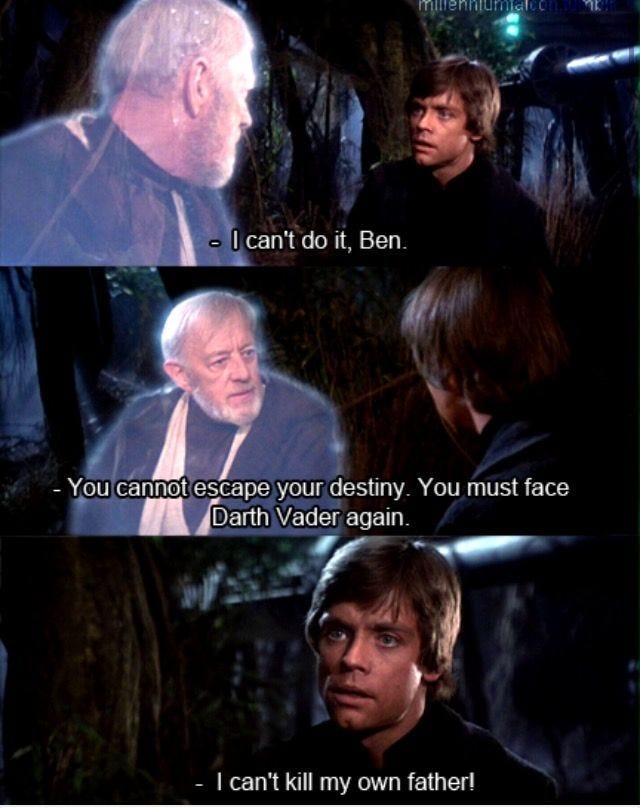
Obi-wan said that there was no hope in saving Vader and that he was evil, Yoda concurred, and they concluded that Luke must kill him. The rest of the galaxy and the Rebellion viewed him as a monster, and would probably have agreed that Vader had to die, but there was Luke, the hero, his son, a powerful warrior in tune with the Force, and a major face of the Rebellion, to push back against these views, and insist that his father can be saved. Obi-wan and Yoda represent the old Order of Jedi who failed and Luke the future, and if the embodiment of the future and the classic hero insists to the audience out of a good heart that his father can be saved, the audience will listen.
These aren’t just words and sentiments. Darth Vader believed that it was too late for him to be saved but his son’s faith in him combined with his pre-existing desire to be saved, were lightning in a bottle. The Star Wars narrative is built to allow for redemption, defiance of destiny, and systemic change, and so men like Darth Vader, who in real-life committed crimes that would render him irredeemable, get a second chance. Heathcliff had all of the intellectual tools to succeed in life, but he was doomed. Unlike Darth Vader, Heathcliff was never taught the difference between right and wrong, he never had any kind of moral compass, and never did he experience unconditional love which Vader had the privilege of experiencing at least twice in his life, from his mother Shmi and from his son Luke.
From the limited information we receive through Nelly, it seemed that Heathcliff and Mr. Earnshaw never really knew each other. He petted Heathcliff as one does a novelty or a puppy, but didn’t raise him as a son, adopted or otherwise. Their bond is more akin to imprinting or projection than parental love. At least Anakin experienced multiple forms of love and relationships. He had his mother, Shmi, his mentor and brother Obi-wan, his wife Padme, and his son, Luke. That ticks off a list of loves a human normally experiences: parental love, fraternal love, love for a mentor, and romantic love.
Heathcliff had imprinting and identity collapse.
Neither of these are relationships and they happened at a critical stage of childhood development and he was never provided any course correction. Catherine, Anakin, and Hindley were able to branch and experience some form of normal relationships with others as they had something Heathcliff did not in his early youth: socialization. Hindley was sent away college and it was there he found his wife, and Catherine had the Lintons. As for Edgar, he loved Catherine but his love for her was not unconditional. He once caught a glimpse of her violent temper when she slapped and pinched Nelly, shook Hareton, and gave him a sound blow to his ear. Edgar was repulsed, expressed his disillusionment with her, and was literally headed out the door. Catherine had to smooth things over and cry and play on his sympathies to convince him to forget about this lapse. It was Lady Linton Edgar loved, not Catherine Earnshaw the wild moor-child while it was the other way around for Heathcliff. It was Catherine Earnshaw Heathcliff called upon to haunt him, not Catherine Linton. He never recognized the Catherine Linton identity as legitimate because it was with Catherine Earnshaw he fused to as a child. He lacked an identity of his own and so Catherine Earnshaw became that identity.
The love Heathcliff had with Catherine was not a redeeming love and did not allow for growth or change. It’s a love that must reject change in order to survive. Their story was never that of an adult romance but a child’s love colliding with the real, adult world, and such a love can only exist out there on the moor or in Death. Catherine and Heathcliff’s love is hopeless because to hope is to recognize the possibility of a future and what they had was frozen in time. And I think Heathcliff recognized it to some extent in whatever remained of that psyche of his at the end when he looked at Cathy Jr. and Hareton falling in love. There would be healing and a future for them, but none for him. His life ended eighteen years ago when Catherine breathed her last and it was only vengeance that was holding the carcass up. That he expired so soon after claiming the Grange and the last of the first generation died is evidence to me that his vengeance was never about personal ambition but about keeping himself alive.
And audiences don’t like this stuff. They want an uplifting, hopeful story with heroes and good people and a moral love as can be found in Jane Eyre and Star Wars, not this bleakness. The love story between Anakin and Padme may have ended tragically, but there was hope through their children and none of that for Cathy and Heathcliff, whose bond was as sterile as it was destructive. But I honestly find the reception to Wuthering Heights ironic because in romance, the idea of an eternal, undying love is so elevated and yet, when I point out that there is such a love in this novel, the reaction is disgust. Their love is eternal but it is static and incapable of growth, the direct opposite of an ideal human love. Anakin and Padme are considered a dumpster fire of a relationship in certain circles, but at least they grew up. Their love was tragically cut short but it matured from a crush to an adult romance. Catherine and Heathcliff never grew up and their attachment remained frozen in childhood. The more I analyze Catherine and Heathcliff and pit them against other human couples, the more I have come to believe that while they may take on human shape, the nature of their bond is anything but human. But because they are physically humans, they are evaluated as such and so their behavior appears irrational and illegible in a way Anakin and Padme’s romance wasn’t. Anakin and Padme, like a multitude of couples, had relationship issues. Catherine and Heathcliff were never in a relationship to begin with.
They may ape at being a couple and resemble Anakin and Padme and a multitude of other human couples, but the nature of their attachment is more akin to the love Davy Jones and the heathen goddess Calypso shared. Davy Jones and Calypso are considered a tragic love story, and it’s not because because they are better than Catherine and Heathcliff, but because they are immortals, and so are granted a narrative immunity that the latter are not by virtue of them being humans. An immortal goddess like Calypso can kill people on a whim and elevate her relationship with the one she loves above all else, but if a human tries to do the same, then they are condemned for being entitled, egotistical, delusional, and narcissistic. If Cathy and Heathcliff had been demi-gods or immortals, their love would be considered an epic and their destructive behavior considered the whims of beings that exist beyond our understanding.

Catherine and Heathcliff are constantly compared to Jane and Rochester, Darcy and Elizabeth, or even Cathy Jr. and Hareton, and the former are relentlessly condemned while the latter are elevated as ideal romances. But these loves exist on entirely different planes! It pits adult relational romances against a collapsed-identity bond. Their love is criticized for lacking boundaries, respect, growth, and healthy communication, and is deemed inferior to the love Darcy and Elizabeth share. But of course Catherine and Heathcliff have no boundaries, respect, or healthy communication! Those things require separate selves but Catherine and Heathcliff fused as children before their identities could form independently. They only ever had one self, split in two. You cannot communicate properly with someone who is you in another body.
Jane Eyre and Rochester, Darcy and Liz, Cathy Jr. and Hareton, and Anakin and Padme are couples. Each pairing consisted of two fully formed individuals who wished to achieve a lifelong union through marriage. Catherine and Heathcliff are not a couple nor were they fully-formed individuals. They were a single identity distributed against two bodies and they malfunctioned because they were never meant to exist in such a state. Even the most intimate of couples maintain some degree of separation and they had none. In marriage vows, they speak of becoming one heart, one flesh, and one soul, but that is metaphorical. A marriage is a partnership and however many people are bound in one, they all retain individuality.
Catherine and Heathcliff take the metaphor of “one heart, one flesh, one soul” with absolute literalness. What Heathcliff longs for is not partnership but oneness. A fused relationship is a psychological phenomenon, but when the time came, Heathcliff wanted that fusion to become literal. He bribed the sexton to ensure that his remains would physically dissolve into Catherine’s after death, a direct contrast to Edgar, who simply wished to be buried beside his wife. Catherine and Heathcliff never violated each other’s boundaries because no boundaries ever formed. What they shared was not intimacy but a complete mergence of identity. Their tragedy was never a lack of connection; it was too much connection, so total that it prevented communication. You cannot negotiate with someone who is not “other” to you. You cannot respect the boundaries of a person who occupies the same psychic space you do. Their bond was not relational: it was ontological and asymmetrical, and that is why it destroyed them.

There was no adult in the Earnshaw household to teach boundaries, respect, or emotional regulation. Retaliatory violence was the only available language apart from punitive religious moralizing and yet Cathy and Heathcliff were expected to function as normal adults in society and condemned by the narrative and by audiences when they couldn’t. The Lintons gave Cathy polish, pampering, and manners, but they were not her parents. Nelly was a child and wasn’t equipped to be anyone’s role model and was busy trying to keep the household running with all the violence and chaos that was going on. Many ask why Catherine and Heathcliff turned out the way that they did and settle for some kind of diagnosis as an explanation, but the explanation as to why they turned out the way they did is contained in those childhood chapters. There was nothing inherently wrong with any of the three children who grew up in the Earnshaw household. Catherine and Heathcliff did not have a brain disorder or malformation. They were a product of years of trauma and absentee parenting.
How old are children when they are still forming their own identities and learning that it’s not the end of the world if they’re separated from their primary caregiver(s)? That’s the developmental phase they were stuck at. Even Cersei Lannister, who is a narcissist, was in a better position than this! Cersei had a fragile, but fully formed adult ego! Cathy, and especially Heathcliff, never reached that stage! Anakin was clingy but at least he knew where he began and ended, unlike these two!
Whenever there is a boy and a girl living together under one household in any work of fiction and the two develop what appears to be a romantic connection, there inevitably will be speculations about incestuous relations. However, I don’t think they were raised as siblings because that household had no structure at all and I didn’t see any actual raising done. Haphazard spoiling and smacking the children around when they disobey you or when you think they are disobeying you is not parenting, Mr. Earnshaw. When Heathcliff demanded that Hindley hand over his horse to him and threatened to tell Mr. Earnshaw on him for the brutal thrashings he had been giving him, Heathcliff said: I will tell your father, not my father or our father, but your father. Anakin’s mother was an enslaved woman but she was a better parent than Mr. Earnshaw ever was. Nelly was a child and Joseph was certainly no father figure and Cathy and Heathcliff’s bond reflected that lack of structure. It was a boundary-less, amorphous monstrosity.

Anakin only had nine years with Shmi, but those nine years were foundational in forming his sense of self. He became dependent and possessive of Padme and probably did feel he would die without her but at least he knew where he began and ended. Heathcliff had no self outside of Catherine nor any conception of what a boundary was, hence all the intense destructive behavior when he perceived any threat to their bond because the stakes were high. It was not the loss of a relationship he feared but the container for his self-hood. Catherine didn’t hurt his feelings when she started spending more time with the Lintons and ultimately decided to marry Edgar. In his eyes, she effectively exiled him from himself and that was unforgivable. Through the lens of a collapsed identity, what Cathy did was not choose a man over him but ruptured their shared identity and she couldn’t understand that because she was a split self. Heathcliff was never split. His reaction to Catherine marrying Edgar is often presented as him being this bitter, entitled ex but even entitlement assumes that he viewed Catherine as a separate entity that he wanted for himself as Anakin did with Padme and he never did.
It’s “you are mine” versus “you are me.”
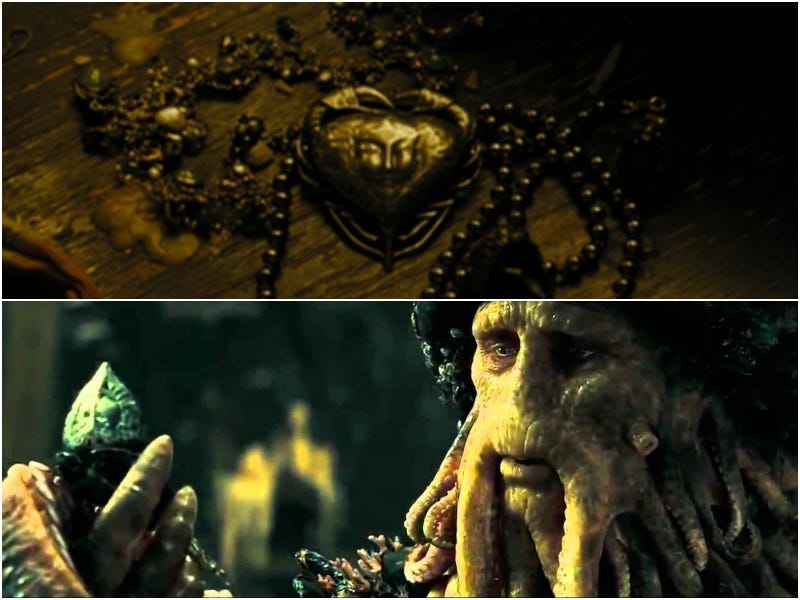
Their love is not a romance in the adult sense but a survival bond forged in deprivation. It is a closed system and there is only room for that shared identity and no one else. The concept of “love without limits” is romanticized and there have been a multitude of poems written that claim to want devotion that transcends everything, but they recoil when confronted with what limitless love actually looks like. When I point out that Heathcliff is the embodiment of love without limits and that he is a man who loves with the force of a natural disaster, the reaction is again disgust. They want endless, limitless love, but not that. But it is that. Davy Jones spends decades ruminating over Calypso and her betrayal. He replays their love song until that locket of his is worn out and rage-plays that organ of his alone and spends his days tormenting people in a vengeful rage. He and Calypso had no qualms against violence and killing people but audiences call their love story tragic, operatic, and romantic. But when Heathcliff does the same, he is a “stalker” and an obsessed bastard. Yet the archetype is identical: a man whose heart never healed, whose grief calcified into mythic fury. If you want love without limits, this is an example of what it can look like. It is not polite. It is not safe. It is not Darcy and Elizabeth. It is a force of nature.
Mr. Darcy is a man and loves as one. Heathcliff is a hurricane coming at you with full force and he cannot stop because he doesn’t have a grasp of human limits. He had no brakes and no emotional regulation when it came to Cathy and that isn’t acceptable in what is supposed to be an adult man. His problem is that he was constrained to a human form and forced to live in human society. If he and Catherine had been allowed to exist in their natural habitat away from the rest of the world as Davy Jones and Calypso’s love had been allowed to exist out there in the open seas, their love would have been considered universally beautiful. And I do think their love was beautiful the same way nature is beautiful. It’s not a man and a woman falling in love but a feral moor god and moor-child commingling as one. Nature is considered cruel because while it is magnificent and awe-inspiring, it is also astonishingly indifferent to suffering but it isn’t cruel or evil. Nature just is.
I love you.
You enrich my life and bring me great joy. You are my soulmate and my rock. We are in this together for as long as we both shall live. It’s you and I against the world. When you are gone, I will miss you and my heart is broken, but I can have a life outside of you and love others before and after you. I love you but I need space to breathe. My love for others doesn’t take away from what I had with you. If you are hurt, I feel for you as if your pain were my own. If you were to die, a part of me will be forever gone will cherish the memories we shared together.
I am you.
I feel not for you but with you. Your pain is my pain. I exist through you and only you and so if you pull away, I no longer exist. You are my life and my soul. How can you be gone when you are me, unless I am gone? There is no “we” or “us” but one and it will never end. There are no barriers between us. You’re the world and all that is, was, and will ever be in it. There is no life or anything outside of you. You will never be a memory. I have no past, no present, and no future because you are all. If you hurt, I hurt. If you cry, I cry. If you die, I die.
Grammatically, I have to use “we” and “us” but those are plural pronouns. Ideally, for identity collapse, the only pronoun would be “one.”
One is relational love. It’s Anakin and Padme, Jack and Rose, Mr. Darcy and Liz, Jane Eyre and Rochester, and loves that we have seen going back to antiquity. The other is Catherine and Heathcliff. Specifically, I think this was Heathcliff distilled. This is not obsessive dependence, but ontological or structural dependence. Honestly, I think Heathcliff would have been in better shape had he merely been obsessed with Catherine. At least we would have something of him independent of her to work with but alas, we have nothing.
The prequels were criticized harshly when they were first released but in more recent years, there has been a resurgence of appreciation and love for them and of Anakin’s character. With the number of Star Wars projects Hayden Christensen has been appearing in lately, there is enough footage to make an extra movie. However, Wuthering Heights remains polarizing and it seems that it will remain so for the foreseeable future. And I don’t understand why it is singled out the way that it is, to the point where I am having to write full-length essays on behalf of characters who I know for a fact that I wouldn’t like as people, if they existed in real life. Is it because of the fanbase or the genre? Because Heathcliff is, on first appearances at least, a human man residing in a rural community in Yorkshire, England while Anakin and the rest of these characters reside in fantastical universes with some level of magic or suspension of belief that the more grounded universe of the Heights lacks.
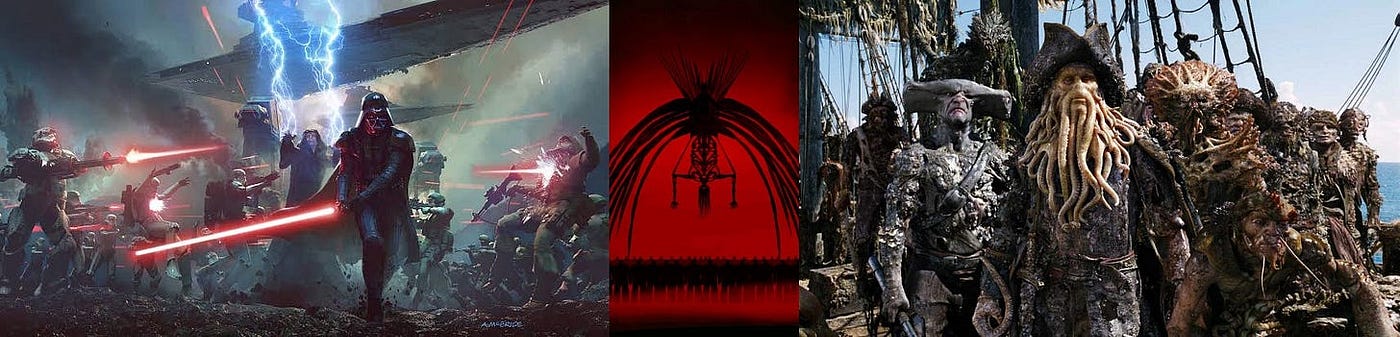
The scales of those stories are of epics and so the fanbase has a different level of baseline expectations from the characters that inhabit them. Anakin, Davy Jones, and Eren Jeager perpetuate mass violence on a mythic, cinematic scale but they do so in universes where mass violence is regularly perpetrated and while utilizing these awesome powers. Anakin had his lightsaber and the Force, Eren Jeager had the power of the Titans, and Davy Jones had the Kraken. Heathcliff wielded no sword, no mystical powers, nor did he have an immortal crew of humanoid monsters at his disposal. His weapon of choice was the law and he took advantage of Victorian marriage and inheritance laws to entrap and only used physical violence towards those he knew he could get away with without retaliation. He was the only figure in Wuthering Heights who perpetuates this level of systemic violence and it is intimate, drawn-out, interpersonal and is of a domestic nature: two families, three children, and his wife. A massive sea battle with eldritch monstrosities and an undead captain battling the living and a legendary behemoth in gleaming black armor cutting down a battlefield by his lonesome as the all-powerful Empire’s one-man army versus a man slapping and imprisoning a teenage girl, abusing his wife, and hanging a small dog. One form of violence is easier for the audience to swallow even if the other leaves behind more bodies in its wake.
Anakin and Eren are ruled by destiny and prophecy and so they have a level of narrative justification and backing that Heathcliff lacked and so when their characters are evaluated, all of that framing is taken into account. Anakin killing the Younglings is sometimes explained as the Force working in mysterious ways, that it was all going to lead up to him putting an end to the Sith and bringing balance to the Force, and so this was something that had to happen. This kind of cosmic explanation is impossible with Heathcliff. And there is a good chunk of the Attack on Titan fanbase who believe that Eren’s omnicide was justified or at least his reasoning behind it was! Once a protagonist has the audience behind their back and possesses latent charisma, an awesome power, and has a level of the divine on their side, they are set for life! And Anakin and Eren are god-like figures, or men who have either obtained or been born with god-like potential, and are openly regarded as such while Heathcliff is more of a liminal being.
Heathcliff is physically a man but he was also written to be an elemental singularity and Nelly most notably continually questions exactly what is he. Is he a man? A fiend? A ghoul or a vampire? Where did he come from? There is an unsettling ambiguity baked into his character and so it’s more challenging to evaluate his actions in any single way. As a man, his behavior is violent, abusive, and cruel. As a force of nature and a revenant of vengeance, I would have to evaluate him the same way I do Calypso. Cruel, mercurial, and destructive, yes. But both operate outside the bounds of morality to which even Anakin was bound. I think the problem with Heathcliff is, while his actions were not nearly as extreme as Anakin’s, that oversized emotion of his and the dynamic between him and Catherine, are indeed the most extreme out of the bunch, and so he is singled out.
Anakin also possessed a degree of likeability and relatability and it is astonishing how much leniency is granted to both fictional characters and real-life people if they possess traits that are considered appealing to audiences, even if their behavior is worse than the unlikable characters. When a villainous character has an outwardly sympathetic motive, audiences are more likely to cut them some slack. Anakin did all of these terrible things but he did it because he wanted to save his loved ones from dying. Heathcliff never had any intention to do good and was operating from the basis of retaliation and avenging years of childhood humiliation. One evokes more immediate sympathy than the other. Anakin was handed a series of brutal yet straightforward tasks. Kill all of these people and I will grant you the knowledge that you will need to save your wife. (Palpatine technically never promised Anakin that he would save his wife nor did he ever actually state that he knew how to do so but that is what he manipulated Anakin into believing). And so with Anakin, audiences can place the blame for his actions on external factors. This is the Jedi’s fault. This was the result of Palpatine’s manipulation. Anakin was beset by nightmares showing him the future he feared most and He was a young, traumatized man terrified of losing his wife.
Heathcliff answered to no one but himself and Catherine, the two components of that shared identity, and she dies before he goes all in his vengeance, so it’s all on him. Even the trauma and abuse he experienced as a child and an adolescent appears to only go so far in terms of an explanation. It can most definitely explain why he gave Hindley that sound thrashing in the immediate aftermath of Catherine’s funeral; that was a long time coming for all those years of torment and Hindley was godawful with the timing. I personally wouldn’t try murdering a man who hasn’t eaten or slept in a week and was just out wandering in the snow god knows what. Hindley didn’t know that he had just returned from digging up you-know-who, but Isabella was wise to stay out of that one, even if she understandably wanted her husband dead. She probably knew that she was pregnant and had already been planning her escape and so why jeopardize it all for a fight with no winners?
If there’s one thing Heathcliff became adept at to a deadly degree, it’s understanding power dynamics. Unlike Anakin in his early youth, Heathcliff knew how to pick his fights. He wasn’t in a rational state of mind when he barged in through the window and beat Hindley down but he also knew that his childhood abuser was no match for him and that now, he can beat him down with impunity. And how did he learn all of this? It was through personal experience because he knew what it was like to be at the very bottom.

But why target the children? Without closer examination, it appears as if it were simply senseless cruelty. Eren Jeager was damned disproportionate with his vengeance. However, unlike Heathcliff, Eren explicitly spells out why he decided to destroy the entire world but we don’t receive that sort of clarity from Heathcliff. Upon second thought, he did spell out his modus operandi at the Grange when he spoke to Catherine, but the language was heavily metaphorical and abstract compared to Anakin and Eren’s. Everything he did in his vengeance, he learned from somewhere. Hindley was his greatest teacher and Heathcliff learned from him and life under the Earnshaw household that the powerless are crushed and that violence flows down. There are two responses to experiencing this kind of trauma. The first would be child Anakin’s response. He was born into slavery and knew what it was like to live under oppression and so wanted to implement systemic change and ensure that no one else would go through what he did. He wanted to become the most powerful in the world so he can cheat Death. It was rooted in his fear of loss but he also didn’t want his loved ones hurt. The second is what Heathcliff’s response. It’s “you hurt me so I will destroy you and everything you love.” Child Anakin had the heroic response and his son Luke fulfilled the true spirit of what he had originally set out to do. Unfortunately, Heathcliff opted for the latter.
But what is one thing Anakin and his son Luke had in common? They both had role models to teach them empathy and compassion. It’s an understatement to say that Anakin veered off, but his mother, Padme, and even the Jedi gave him baseline morality and Luke had a normal childhood that his father had been deprived of. He experienced love and stability into his early adulthood years unlike his father, who was stripped of it prematurely and then subjected to years of war, turmoil, and instability. Catherine told Heathcliff off whenever he did something she personally didn’t like and she was the only one he listened to as a child and adolescent, but that is not a moral compass and neither was Joseph’s Bible-thumping. Having a sense of right and wrong, recognition and respect for another’s boundaries and your own, a moral compass, a stable identity and sense of self are taken for granted, but all of these things require years of modeling and attentive care. It’s substantive, painstaking effort to build a normal person and I only mean normal and not necessarily good. And looking at the news, even people who had all of these things can turn out twisted, so where does that leave the three children in that Earnshaw household? It was wild West in there. If someone is not berating you, you get beat up or locked up.
How can I say that Heathcliff loved Catherine if he abused everyone around him, including his own son and her daughter?”
How can Darth Vader commit multiple genocides, be complicit in the destruction of an entire planet, torture people, murder women and children, participate in twenty years of galactic oppression, and love his son?
Because that is his son, his baby boy that he made with his beloved wife. Darth Vader or Anakin or whatever persona you refer to, was a man capable of great cruelty and guilty of a multitude of brutal crimes but he also was a father who loved his son. These things coexist and do not contradict and it is the same in Heathcliff. He was also another cruel man who loved Catherine, not in the same way Anakin loved Padme, as a man loves a woman, but as a self-less being loves the only self he ever had.
“How can Catherine love such a man? Heathcliff is terrible so she must approve of his godawful behavior.”
How can Luke love a man like Darth Vader?
It’s possible to love someone without approving of their poor behavior. Obviously, Luke didn’t think that anything his father did on behalf of the Empire and Palpatine was ok. He chose to separate the identities of Vader and his father Anakin in his mind and to focus on the man his father was and who he still believed him to be. The situation with Catherine was different. She didn’t split Heathcliff up into “good Heathcliff” and “bad Heathcliff.” He was always just Heathcliff to her. Catherine didn’t love Heathcliff because he was this swell, moral man but because he was her’s. He is Catherine. But that didn’t mean she was fine with him doing whatever he wanted. When they were children, she did check his behavior, but the difference between Cathy and Luke is that Cathy never condemned Heathcliff morally. She merely told him to stop doing whatever he was doing because she personally didn’t like it and he stopped because this was Cathy who was telling him to stop.
The whole concept of loving someone who has committed vile acts is not a phenomenon exclusive to fiction. It happens all the time with parents and their children. Maekar Targaryen had a monstrous son in Aerion, who was infamous even among the Targaryens for his madness and cruelty, and he still went ham trying to save that boy’s life when he felt he was in danger. But it didn’t mean Maekar approved of everything his son did. He did so because he loved his son. The world might view Aerion as a monster but he’s always baby to him. Love and attachment are primordial phenomenon and predate morality and aren’t always rational either.
“Heathcliff mistreated everyone around him after Cathy died, so that must mean he never loved her.”
Me: No, it just means that he loved only Catherine.
“But he was a piece of shit to her daughter! Look at all of these people he was shit too!”
Me: I already told you that he only loved Catherine.
“But that is not how love works! If he loved Catherine, surely he would have loved or at least not mistreated her daughter.”
Me: This is Heathcliff we are speaking of. He is not a man whose love can extend to others. He is a single-attachment creature. The love you speak of and assume that Heathcliff had, falls more along the lines of unconditional love, and what he had was certainly not unconditional, but total and singularly fused. Catherine was everything to him and everyone else were nothing.
“No, if he truly loved Catherine, then he would have been kinder to others, or at least behaved as a human does with basic empathy and compassion and not used people as tools in his schemes.”
Me: Heathcliff had no concept of “other people” because there was only Catherine. What he had with her was so total that it wiped everyone else from existence.
“Ok, he is a psychopath then.”
Me: Give me an example of a psychopath with a collapsed identity and an attachment so extreme that he was utterly consumed by it, his life, his body, his soul, and was so out of the bounds of human relations that is akin to a force of nature.
The responses: 🖕
And this is how conversations about Heathcliff go. It seems to me that people cannot accept this level of absolutism. That Heathcliff mistreated others is not evidence that he was incapable of love but that he is incapable of multiple loves. Even Anakin wasn’t this binary and had multiple people that he loved in different ways. He was human in that he had categories of attachment. Heathcliff had no categories. Everything was collapsed into one. And so he didn’t love Catherine as his lover but as everything. For Anakin, Padme was one of the most important people in his life while Catherine was the only person in Heathcliff’s. Anakin had empathy and was capable of true remorse. He was mentally unraveling after what he had done to the Jedi and those children and for me that is evidence he can feel. I used to think adult Heathcliff had no empathy but he does. It’s just exclusive to one person and distorted. And because it isn’t empathy in a relational sense, it doesn’t look like empathy at all. It is why he is capable of experiencing catastrophic emotion with Catherine but can destroy everyone around him with no remorse. Heathcliff is what happens when a person hasn’t finished developing. His empathy is one with no boundaries and so he can destroy Catherine as well without meaning to and he did.
On a side note, if I label every single character who displays cruel and unempathetic behavior a psychopath or a selfish, egotistical person a narcissist, the list is going to get awfully long. And if I start doing this for Gothic literature? My goodness. This reminds me of the “mad” Targaryens situation where every other Targaryen supposedly is insane but upon closer inspection of their personal life, most of the so-called “mad” Targaryens were simply a product of their environment: years of trauma, lack of access to any kind of mental help, poor or neglectful parenting, and a very entitled upbringing. Most of them suffer from affluenza and have severely inflated heads due to a lifetime with no boundaries or limits set and being continuously told how special they were, not insanity. And having near unlimited power and being the only ones in possession of flying nukes probably didn’t help, either.
I think I understand why the Targaryen madness explanation caught on the way that it did, why it dominates so much of the discourse on the Targaryen family, and why there is all of this diagnosing and labeling of Catherine and Heathcliff. People crave a clear explanation for why characters engage in such extreme behavior, and they latch onto these diagnostics to satisfy that itch for clarity. However, I find that it often becomes a detriment to understanding why the character or person became the way that they did. Labels like “narcissist” and “psychopath” are used overwhelmingly on the Internet to insult, shame, and morally condemn people when originally these clinical diagnostics were meant to analyze patterns of behavior and help guide treatment. “Psychopath” has become short-hand for vengeful asshole (Heathcliff) and “narcissist” for insufferable, annoying brat (Catherine). I’ve even seen them used on animals when their behavior doesn’t align with what people think is fair and kind! The cuckoo bird is a “narcissist” bird? They’re animals! I can’t expect nature to obey anything, let alone moral standards!
Unless the example is as glaring as Cersei Lannister or Emperor Palpatine, I normally shy away from labeling any character a psychopath or a narcissist. And even with such examples, I have never, prior to being exposed to discussions about Wuthering Heights and Heathcliff, thought to analyze them solely through the lens of whatever issues they had, because these issues are only one facet of their lives. And again, privileges of being immortal, I have never seen Davy Jones or Calypso or any violent demi-god or god or eldritch monster being reduced to pathology. And it’s because the audience knows that these aren’t people. They are forces of nature. And so are Cathy and Heathcliff.
Do Catherine and Heathcliff’s “relationship” fulfill any of the requirements of a healthy adult romance?
No.
And if that is the criterion folks are using to determine whether a relationship counts as love or not, Anakin and Padme will fail too. Many of the greatest love stories will fail, many real-life loves will also fail, there would be a dearth of entertainment, the romance genre would be gouged out, the Gothic romance genre will go bankrupt, and I most certainly would not be on Substack writing this essay because I would have nothing to talk about. I would be bored as fuck. Aragorn and Arwen are probably the archetypal perfect couple but I have nothing to say about them, except that they are perfect. Even their flaws are perfect. Have they ever even had a single domestic spat during their marriage? I have nothing to critique, although I have heard some criticisms about Darcy and Liz’s relationship that I did find interesting.
Catherine and Heathcliff are roasted all the time and they are easy to roast. It hurts my heart because apparently everything I like is “problematic.” I want to see some of these some of these safe, acceptable, socially approved, and perfect love stories subjected to some systemic critiques. Slamming Heathcliff is acceptable but I want to see what would happen if anyone tried critiquing Mr. Darcy, or at least what he represents. There will be immediate besetting by fire and pitchforks. “How dare you put Heathcliff and Mr. Darcy in the same sentence! You are comparing Darcy to a violent abuser! This novel is clearly not for you! You don’t understand what you are reading and are failing to appreciate Austen’s wit and mastery of the written word! Just because you don’t like it doesn’t mean millions of others don’t! This is total edge take!”
“Wuthering Heights depicts a wicked love! Catherine and Heathcliff shared the same soul but that soul is wicked and evil!”
Nelly, is that you? Or is this Joseph? I suspected Edgar would be the one behind this but he would never say these these things about Catherine. At least this recognizes they had a love so that’s something. Honestly, if they were recognized as two evil people who loved each other to madness, I can also let it go, even if I don’t think they were evil.
“This is the love of a monster!” Heathcliff is a monster!”
What is this. Monsters and evil people can’t love? Who designated love to be exclusive to “nice” and moral, normal people, whatever the Hell “normal” even means? That love must be predicated on goodness and morality is an ideal, and it is one that many do not live up to. That a love must fit the mold of Mr. Darcy and Liz Bennet in order to be considered love at all, is not only a set-up for disappointment with the human race, but it also contradicts human history. The love story found in Pride and Prejudice is a luxury! Heathcliff is not the first monstrous man to have a great, identity-defining love and won’t be the last. Violence and violent behavior doesn’t preclude something from being a love story. If it did, then the genre is going to go through a pretty severe culling. The ancients had no chill when writing what they did. George R.R. Martin has no chill, either. Wuthering Heights is not nearly the most violent or taboo love story, either. If I start bringing in Jaime and Cersei or the Targaryens into the fold, then things will start to get spicy. Tolkien would have been mortified. Because there is a lot of loving in and within that family and there are full-blooded brother-sister relationships in there that are romanticized and considered love stories by the fandom. It all comes down to what the audience is primed to accept.
If Darth Vader can commit twenty years of galactic murder and love his son and wife then Heathcliff can avenge himself on two families and their descendants and love Cathy with every fiber of his being and as his being.

“This is not love but obsession.”
I am Heathcliff! He’s more myself than I!
Unhealthy relationships, obsessive relationships, toxic relationships, abusive relationships, they are all relationships. Obsession, possession, co-dependence, enmeshment: they are all relational. Identity-collapse is not a relationship. And all of these labels describe a violation of boundaries while Catherine and Heathcliff never had any boundaries to begin with! Heathcliff may look and behave like Gothic Smeagol, but his bond with Catherine is more akin to Sauron’s relationship with the One Ring than Smeagol’s. Smeagol, as with all those unfortunate enough to come into contact with the One Ring, obsess and wish to possess it. But however fixated they are on the One Ring, it’s a fixation on an external object.
It’s my Precious, not I am the Precious!
Heathcliff never experienced Catherine as separate or external and neither did she with him and it is just so with Sauron. The One Ring is not merely his Precious as it was to all others, but an extension of his very being. As miserable as Smeagol was without the Precious, he can exist as himself. He had a self prior to the One Ring, and the name of that self was Smeagol. He was split between two selves: Smeagol and Gollum and at the end, the Gollum half overtook him entirely but there was a prolonged fight for control. At worst, what happened to him can be read as a boundary collapse, but the boundary that collapsed was between these warring identities. He did not collapse into or fuse with the One Ring. One self overtook the other. Heathcliff had no self prior to and without Catherine and was never split. There was never any internal conflict and there was no collapse of boundaries between them because there were never any boundaries to collapse to begin with! They never differentiated at all! I am realizing in live time that they had was more extreme than identity collapse! What a mess! They had no structure at all! Sauron cannot maintain physical form without the One Ring, and like Heathcliff, once that essential component was destroyed, his life essentially ended with it! It was only vengeance holding Heathcliff up after Catherine died, and once that desire was extinguished, he picked up where he left off in the immediate aftermath of her funeral: starving himself, not sleeping, and hallucinating her everywhere.
The importance of the “I am Heathcliff” line cannot be stated enough. It needs to be taken literally, not metaphorically. Catherine was not someone Heathcliff wanted to possess: she was his very being. Catherine told Nelly that Heathcliff was always in her thoughts, always, but it isn’t because she was obsessed with him. He was always in her thoughts because they are one. They are of the same substance. Their bond gives off incestuous vibes and I did initially see parallels between Catherine and Heathcliff and Jaime and Cersei but unlike the golden twins, it’s not a bodily substance she speaks of, but a metaphysical one, that they shared. This isn’t rooted in blood, a shared physical appearance, and name as it was with Jaime and Cersei, but of a shared soul. Cersei would incest (hahaha) that Jaime, at least the Jaime who didn’t lose his hand, was her soulmate, and that they had this deep, divine connection but in the novel, she replaced and discarded him rather quickly when he was imprisoned and when he wouldn’t do what she asked him to anymore. Catherine is a non-negotiable entity to Heathcliff. He doesn’t consider replacing her and finding someone else. It’s not because he is loyal but because he cannot. He wasn’t playing games when he said she was his life and soul.
Soul, not soulmate.
This is identity equivalence. Poor Smeagol’s obsession led to his death and consumed his life, but even he did not equivocate his identity to the One Ring the way Catherine and Heathcliff did to each other. Smeagol was corrupted by the One Ring and that corruption gave birth to that alter ego Gollum. Heathcliff was not corrupted by Cathy and neither was she by him. When they were one out there wandering the moors as kids and after death, it was an expression of their truest selves.
Identity collapse is rare in fiction, if not unprecedented, but audiences are all too familiar with obsessive, narcissistic, and dependent relationships, and because Catherine and Heathcliff’s behavior share many of the same outward symptoms these dynamics have, they are labeled as such, even if the psychological root of their behaviors is different. Relationships form the foundation of most, if not all, human lives, and so people are primed to view interactions from a relational lens, but Cathy and Heathcliff give that cultural script the finger. They are uncanny because they look and sound and even feel like that annoying couple the neighbors call the cops on because they won’t stop having a row at 3 am, but they are elemental: the moors personified.
And they’re not all talk, either. Wuthering Heights appears to take place in a grounded, almost banal universe with zero divine presence but there is something going on underneath it all that left rational, grounded folks like Lockwood and Nelly doubting themselves. It’s not as open and blatant as the Force in Star Wars but it’s there all the same. Whether it was only a product of a fanciful imagination or hysteria, their presence remained as part of the landscape long after their physical bodies expired. If this isn’t love, then it’s something truly one-of-a-kind. Catherine and Heathcliff should have their own category. If love must be a relationship, then I will relent and admit that what they had doesn’t constitute as love because they don’t fulfill that basic relational standard but my determination of whether or not it is has nothing to do with Heathcliff’s behavior.
If anyone can find an example of identity collapse between two people in fiction, please let me know because I am dying to find my next hit. I prefer it to be between humans but I don’t discriminate on the basis of species. I can find the Gothic aesthetic of Wuthering Heights elsewhere but I cannot find them.
메타데이터
- post_id
- 8ff8fce0cb6a
- slug
- why-are-anakin-and-padme-seen-as-a-love-story-when-catherine-and-heathcliff-are-seen-as-anything-8ff8fce0cb6a
- url
- https://medium.com/@ashley.tien/why-are-anakin-and-padme-seen-as-a-love-story-when-catherine-and-heathcliff-are-seen-as-anything-8ff8fce0cb6a
- canonical_url
- https://medium.com/@ashley.tien/why-are-anakin-and-padme-seen-as-a-love-story-when-catherine-and-heathcliff-are-seen-as-anything-8ff8fce0cb6a
- author_url
- https://medium.com/@ashley.tien
- status
- ok
- fetched_at
- 2026-06-09 15:37:30