Consumer Duty in 2026: The FCA Is Watching. Is Your Firm Ready?
By Laurence Rixon — Founder, RegTechPRO | FCA Compliance SaaS Platform | 25+ years FCA compliance experience

Consumer Duty in 2026: The FCA Is Watching. Is Your Firm Ready?
By Laurence Rixon — Founder, RegTechPRO | FCA Compliance SaaS Platform | 25+ years FCA compliance experience
If you’re running an FCA-regulated firm with a small team, let me ask you something uncomfortable: if the FCA knocked on the door tomorrow and asked to see your Consumer Duty framework — your assessments, your board report, your evidence trail — how long would it take you to pull it together?
If the answer is anything more than five minutes, you have a problem. And if you’re still relying on spreadsheets and Word documents scattered across shared drives, you’re not alone — but you are exposed.
The Consumer Duty isn’t a box-ticking exercise that ended in July 2023. It’s a living, breathing regulatory framework that the FCA has placed at the centre of its supervisory strategy through to 2030. And right now, in 2026, the regulator is turning up the heat.
Why Consumer Duty Is the FCA’s Number One Priority
The Consumer Duty, built around PRIN 2A, fundamentally changed what the FCA expects from regulated firms. It moved the goalposts from “don’t treat customers unfairly” to “prove that you’re actively delivering good outcomes.”
That’s a seismic shift. And the FCA isn’t whispering about it — they’re shouting.
In their published strategy for 2025–2030, the FCA confirmed that the Consumer Duty remains a top priority, underpinning their work to deepen trust, rebalance risk, and support growth. Rather than layering on new prescriptive rules, the regulator is doubling down on the Duty itself as the primary framework for ensuring consumers are protected.
What does that mean in practice? It means the FCA expects firms to move beyond implementation and into evidence. Proving that customers are receiving good outcomes — not just designing processes that look compliant on paper.
The FCA has also committed to conducting multi-firm thematic reviews across four critical areas: how firms design products and services, how they monitor outcomes, how they design customer journeys, and how their communications help consumers make informed decisions.
If your firm doesn’t have structured, evidence-based answers to those questions, you’re in the firing line.
The Four Outcomes: The Backbone of Consumer Duty
At the heart of Consumer Duty sit the four outcomes. Every assessment, every piece of MI, every board report should be structured around these. They’re not optional themes — they’re the specific regulatory expectations your firm will be measured against.
Outcome 1 — Products & Services (PRIN 2A.3): Products and services must be designed to meet the needs, characteristics, and objectives of a target market. This isn’t just about initial design — it’s about ongoing monitoring to ensure products continue to deliver good outcomes as markets and customer needs evolve.
Outcome 2 — Price & Value (PRIN 2A.4): The price consumers pay must be reasonable relative to the benefits they receive. The FCA has been crystal clear that fair value assessments need to be robust and comprehensive, and they’re prioritising reviews of protection insurance, unit-linked pensions, and premium finance products specifically.
Outcome 3 — Consumer Understanding (PRIN 2A.5): Communications must be clear, fair, and not misleading — enabling consumers to make effective, timely, and informed decisions. In March 2026, the FCA published fresh findings on consumer understanding, highlighting that the best firms are now layering their content — putting the most critical information like risks and fees upfront with deeper detail available underneath.
Outcome 4 — Consumer Support (PRIN 2A.6): Firms must provide support that meets customers’ needs throughout the product lifecycle. No unnecessary barriers, no friction that prevents customers from acting in their own interests, and tailored support for customers in vulnerable circumstances.
These four outcomes aren’t independent — they’re interconnected. A product that’s well-designed but poorly communicated fails Outcome 3. A fairly priced service that’s impossible to access support for fails Outcome 4. Your firm needs to evidence compliance across all four, holistically.
The Cross-Cutting Rules: The Foundation Beneath the Outcomes
Underpinning everything are the three cross-cutting rules. These apply across all four outcomes and represent the overarching behavioural standards the FCA expects:
Act in good faith — honest, fair dealing that goes beyond the minimum. No exploiting information asymmetries, no hiding behind small print.
Avoid causing foreseeable harm — actively identifying where your products, services, or processes could cause harm and taking steps to prevent it. Not just reacting to harm after it occurs.
Enable and support customers to pursue their financial objectives — proactively helping customers make decisions that are in their interests, not creating barriers that work against them.
These cross-cutting rules are the lens through which the FCA will assess everything else. They’re the “how” behind the “what” of the four outcomes.
The Board Report: Your Single Most Important Consumer Duty Document
Here’s where many firms are falling short — and where the FCA has been most vocal.
Under PRIN 2A.8, firms must produce an annual board report setting out the results of their Consumer Duty monitoring. The governing body must review and approve that report, confirm whether it has satisfied the firm is complying with its Duty obligations, and assess whether the firm’s future business strategy is consistent with the Duty.
This isn’t optional. It’s a rule.
The FCA reviewed a sample of 180 firms’ board reports and published its findings — identifying five areas of good practice and several areas for significant improvement. They updated this guidance again in February 2026 with additional insight specifically for smaller firms.
The key findings were stark. The FCA found that many reports lacked sufficient data quality to justify the conclusions being drawn. Board challenge was often absent or performative — rubber-stamping rather than genuine scrutiny. Action plans frequently lacked timescales, named owners, and measurable outcomes. And critically, many firms failed to differentiate between customer types, treating all customers as a homogeneous group rather than considering vulnerable customers and different demographics separately.
For smaller firms, the FCA acknowledged the challenges — limited MI, fewer resources, and less infrastructure for governance processes. But proportionality doesn’t mean doing nothing. The FCA encouraged smaller firms to draw on external data sources, qualitative feedback from frontline staff and customer surveys, and to consider working with trade bodies for benchmarking. They also suggested appointing an external expert or “critical friend” to provide independent challenge.
The message is clear: the board report is not a compliance afterthought. It’s the document the FCA will ask to see, and it needs to be structured, evidenced, and genuinely useful.
What This Means for Small and Mid-Sized Firms
If you’re a directly authorised firm with fewer than ten people, or a compliance consultant managing appointed representatives, the challenge is real. You have the same regulatory obligations as firms with fifty-person compliance departments, but a fraction of the resources.
That’s exactly why I built RegTechPRO.
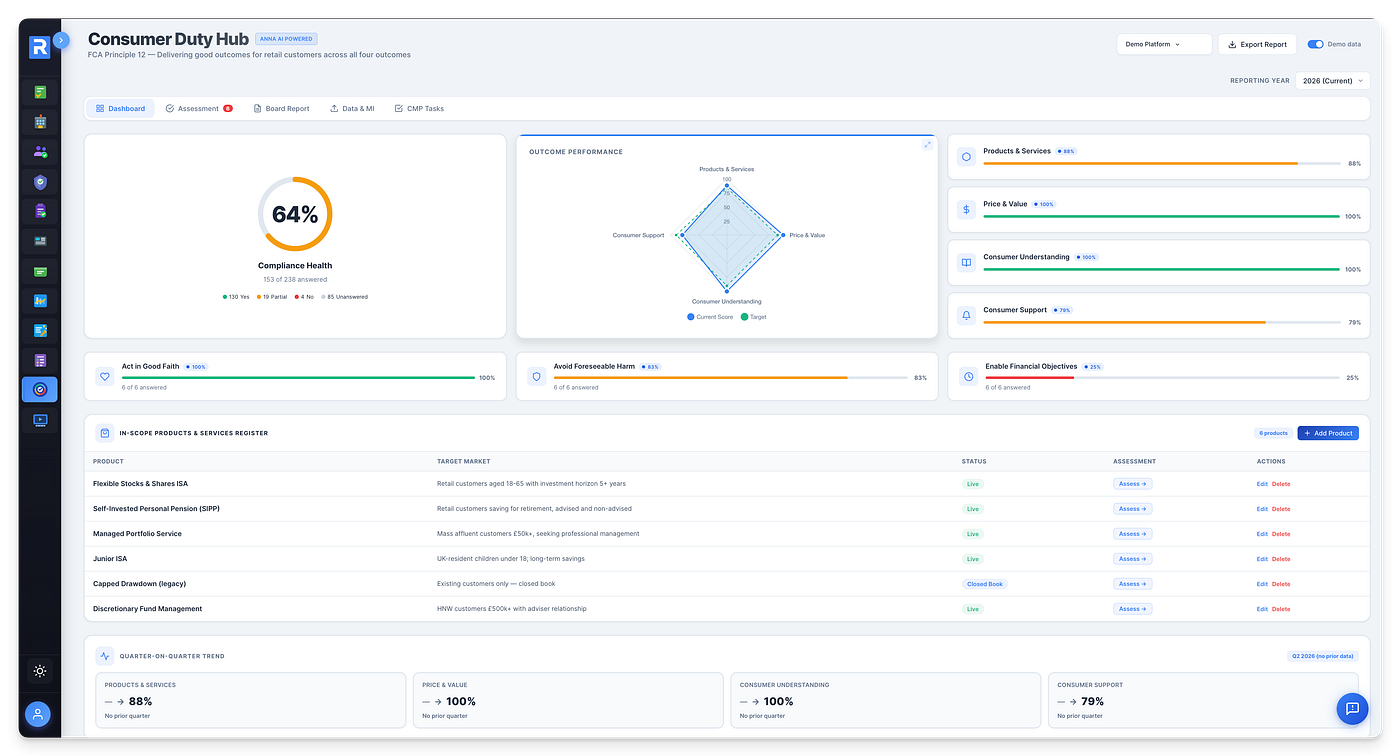
RegTechPRO’s Consumer Duty module is purpose-built for this challenge. It structures your entire Consumer Duty compliance framework into a single, integrated hub — with real-time RAG dashboards, 14 assessment chapters covering 241 pre-built questions, and an AI-powered board report generator that produces the exact document the FCA expects to see.

Each of the four outcomes has its own assessment pathway. You answer structured questions — Yes, No, or Partial — and your compliance health score updates in real time. The RAG scoring means you can see at a glance exactly where you stand: green for compliant, amber for gaps that need attention, red for areas requiring urgent action.
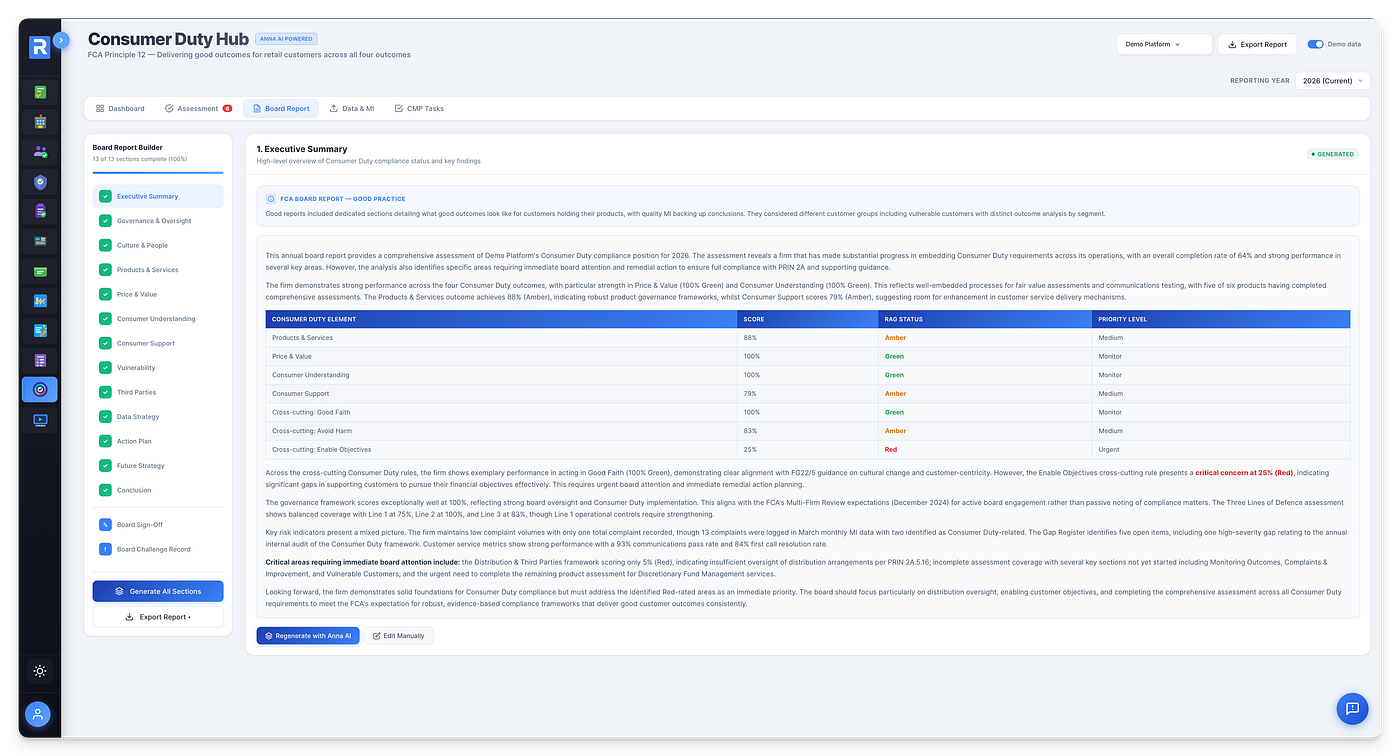
The Consumer Duty Board Report wizard walks you through every section the FCA expects, from the executive summary through outcome-by-outcome analysis, vulnerable customer consideration, MI data tables, action plans with owners and timescales, and board sign-off with challenge evidence. Export the whole thing as a branded PDF — ready to present to your governing body and evidence to the FCA.
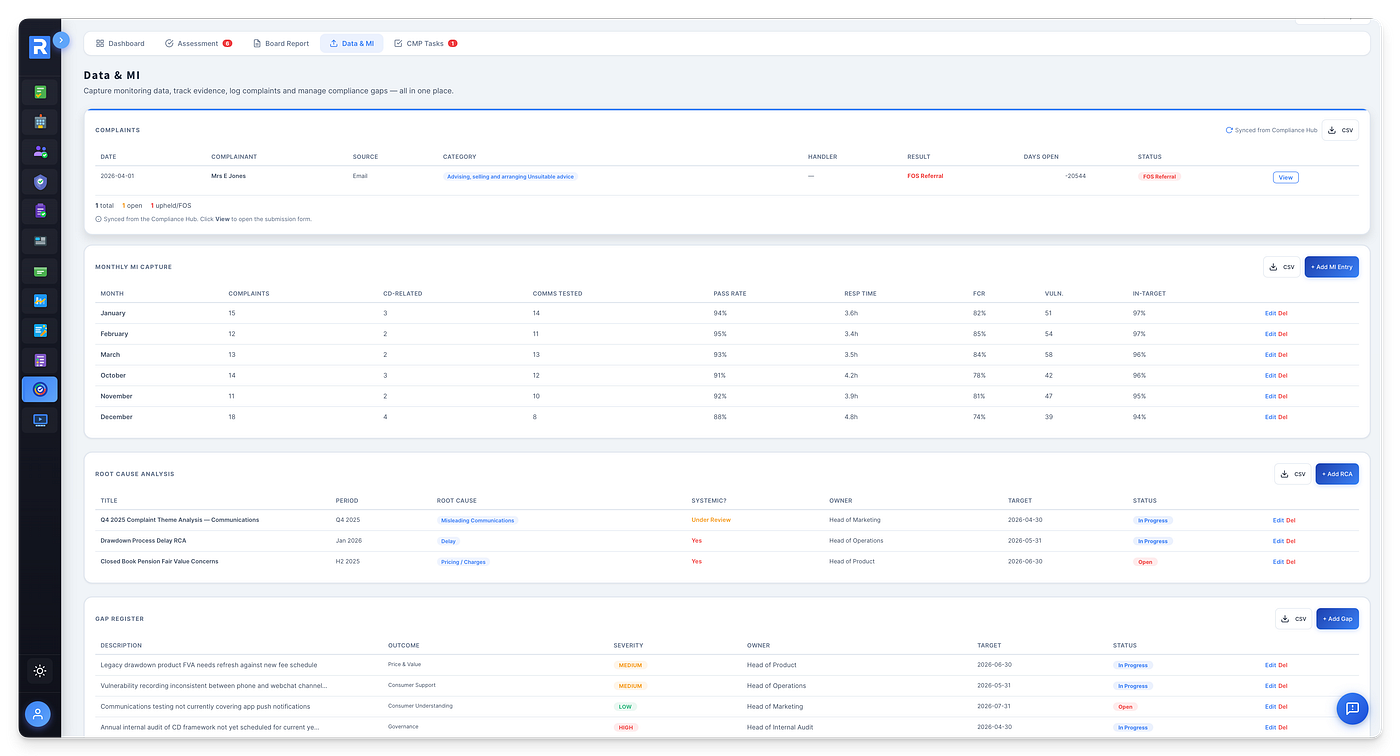
And here’s the bit that makes the board report write itself. The Data & MI tab captures everything the FCA expects to see behind the numbers — complaints synced from your Compliance Hub, monthly MI data covering complaint volumes, comms testing pass rates, response times, FCR rates, and vulnerable customer counts. Root cause analyses are logged with systemic flags, owners, and target dates. Gaps identified during your assessments feed into a live gap register with severity ratings and remediation tracking. All of this data flows directly into your Consumer Duty Board Report — so when you hit “Export Report,” the evidence is already there. No manual compilation, no chasing spreadsheets, no last-minute scramble before your board meeting.
Stop Guessing. Start Evidencing.
The FCA’s direction is unambiguous. Consumer Duty is here to stay, it’s intensifying, and the shift from “are you implementing?” to “can you prove outcomes?” is already happening.
Firms that can clearly evidence their compliance — structured assessments, quality MI, a proper board report with genuine challenge, action plans that are tracked and measured — will navigate the next few years with confidence.
Firms that can’t will find that the FCA’s promise of stronger, faster action where harm is greatest arrives sooner than they expect.
If you’re managing Consumer Duty compliance with spreadsheets and good intentions, there’s a better way.
See how RegTechPRO handles Consumer Duty compliance — book a free 20-minute demo → regtechpro.co.uk/book-a-consultation
Laurence Rixon is the founder of RegTechPRO, an FCA compliance platform built for small and mid-sized financial services firms. With 20+ years of compliance experience across some of the most recognisable brands in financial services, he built RegTechPRO to solve the exact problems he saw firms struggling with every day.
Originally published at regtechpro.co.uk
#ConsumerDuty #FCACompliance #RegTech #FinancialServices #Compliance #SMCR #BoardReporting #RegTechPRO
메타데이터
- post_id
- 8ffe8ea0bfbc
- slug
- consumer-duty-in-2026-the-fca-is-watching-is-your-firm-ready-8ffe8ea0bfbc
- url
- https://medium.com/@rixonlaurence/consumer-duty-in-2026-the-fca-is-watching-is-your-firm-ready-8ffe8ea0bfbc
- canonical_url
- https://medium.com/@rixonlaurence/consumer-duty-in-2026-the-fca-is-watching-is-your-firm-ready-8ffe8ea0bfbc
- author_url
- https://medium.com/@rixonlaurence
- status
- ok
- fetched_at
- 2026-06-17 18:52:58