AI’s Wild 48 Hours: Codex, MAI-Thinking-1, MiniMax M3, and the GPT-5.6 Leak
The useful signal over the last two days was not the rumored GPT-5.6 leak.
AI’s Wild 48 Hours: Codex, MAI-Thinking-1, MiniMax M3, and the GPT-5.6 Leak
The useful signal over the last two days was not the rumored GPT-5.6 leak.
It was the product surface around the models.
OpenAI widened Codex from coding assistant into work platform. Microsoft shipped MAI-Thinking-1, its own reasoning model, with a very clear message: enterprise-grade data, in-house training infrastructure, and a lower inference footprint. MiniMax put M3 into the same cost conversation by claiming frontier coding and agentic scores with 1 million tokens of context.
That is the story I care about as a builder. Not which lab won a screenshot war. Which release changes the daily loop, which benchmark is actually being compared, and which cost structure makes agentic work more usable.
MAI-Thinking-1 is Microsoft’s independence signal
Microsoft’s MAI-Thinking-1 announcement is more strategically important than the benchmark table alone.
The model is described as 35B active parameters and roughly 1T total parameters, using sparse Mixture of Experts architecture. Microsoft says it was trained from the ground up on enterprise-grade, clean, commercially licensed data, without distillation from third-party models. It supports a 256K token context window, function calling, developer instructions, and Chat Completions API compatibility through Microsoft Foundry.
That is a very specific posture. Microsoft is not just saying “we have a model.” It is saying “we have the data pipeline, the training environments, the reinforcement learning stack, the accelerators, and the enterprise distribution path.”
This is where the compute discussion needs discipline.
Yes, the announcement signals serious compute investment. Microsoft explicitly talks about its own accelerators, reinforcement learning framework, in-house training infrastructure, and a compute roadmap “ramping quickly and extensively.” The model is also a sparse MoE with roughly 1T total parameters, which is a big architecture even if the active inference footprint is much smaller.
But that does not prove it is the biggest model out there. The honest claim is narrower: Microsoft is showing a compute-heavy, end-to-end model program that is designed to reduce dependence on OpenAI.
That is enough to matter.
The benchmark table is strong, but not clean
Microsoft reports two views: post-trained MAI-Thinking-1 evaluations and pre-training metrics.
The visible headline numbers are strong. MAI-Thinking-1 reports 97.0% on AIME 2025 and 94.5% on AIME 2026. Microsoft also says it is toe-to-toe with Claude Opus 4.6 on SWE-Bench Pro and preferred to Claude Sonnet 4.6 in blind human side-by-side evaluations.
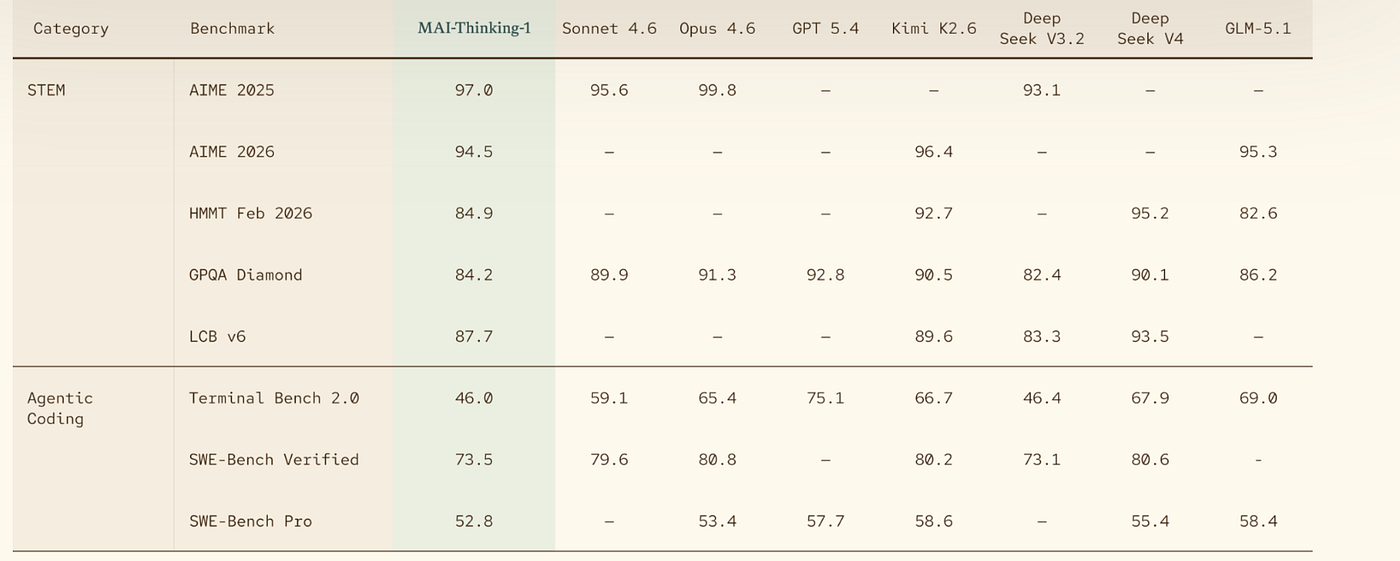
Microsoft AI: the MAI-Thinking-1 metrics table compares Microsoft, Anthropic, OpenAI, Kimi, DeepSeek, and GLM models across STEM and agentic coding benchmarks.
The caveat is simple. Vendor benchmark tables are useful, but they are not enough to pick a daily driver. The missing question is how the model behaves in an actual harness:
- Can it recover after a failed test run?
- Does it read enough of the repo before editing?
- Does it keep tool output grounded, or does it summarize away the important bit?
- Does it get cheaper because the active model is smaller, or more expensive because reasoning traces and retries eat the savings?
Those are the questions that decide whether a model belongs in a production agent loop.
The fast read
Item                      What happened                                                                                                                                                                          My read
------------------------  -------------------------------------------------------------------------------------------------------------------------------------------------------------------------------------  ---------------------------------------------------------------------------------------
OpenAI Codex              OpenAI announced Codex for more roles, tool workflows, Sites preview, and role-specific plugins. GitHub also shows Codex CLI 0.136.0 with release-note level changes.                  Codex is moving from "coding tool" toward "agentic work surface."
Microsoft MAI-Thinking-1  Microsoft introduced a 35B-active, roughly 1T-total sparse MoE reasoning model with 256K context and benchmark claims against Sonnet 4.6, Opus 4.6, GPT-5.4, Kimi, DeepSeek, and GLM.  This is Microsoft proving it can build its own reasoning stack, not just resell OpenAI.
MiniMax M3                MiniMax claims M3 reaches 59.0% on SWE-Bench Pro, 66.0% on Terminal-Bench 2.1, 74.2% on MCP Atlas, and much lower long-context compute cost than its previous generation.              The cost story is more important than the leaderboard story.
GPT-5.6                   There are leak reports and prediction-market chatter, but no OpenAI announcement, API model ID, pricing, or public benchmark.                                                          Treat it as a planning signal, not a shipping fact.
Codex is becoming the operating surface
OpenAI’s June 2 Codex announcement matters because it is not just another model update.
The headline features are Sites, role-specific plugins, and broader use beyond software teams. Sites are rolling out in preview for Business and Enterprise teams through the Codex app. The plugin direction is more interesting: OpenAI is trying to make Codex understand and act across the actual tools people use at work, not just inside a repo.
That fits the reason I moved my own agentic coding harness from Claude Code to Codex. I have a separate Medium draft on that switch going out today, titled “Why I Moved My Agentic Coding Harness from Claude Code to Codex.” The short version is that the host loop now matters as much as the frontier model. Exploration, implementation, review, screenshots, validation, and handoff need to feel like one system.
The GitHub release notes show the lower-level version of the same direction.
Codex CLI 0.136.0 is not one flashy feature. It is a maintenance release with the kind of details that matter when you live in the tool:
- TUI markdown keeps web links clickable.
- Cramped markdown tables can render as readable key-value records.
- Sessions can be archived and restored.
- App-server integrations get richer thread and MCP server behavior.
- Remote execution setup gets a safer auth path.
- Windows sandbox provisioning gets an alpha setup path.
- A feature-gated image generation extension can use the native Codex image artifact pipeline.
That is not model-launch drama. It is agent infrastructure getting less annoying.
MiniMax M3 is the price-performance story
MiniMax M3 is the release that explains why everyone is suddenly talking about cost again.
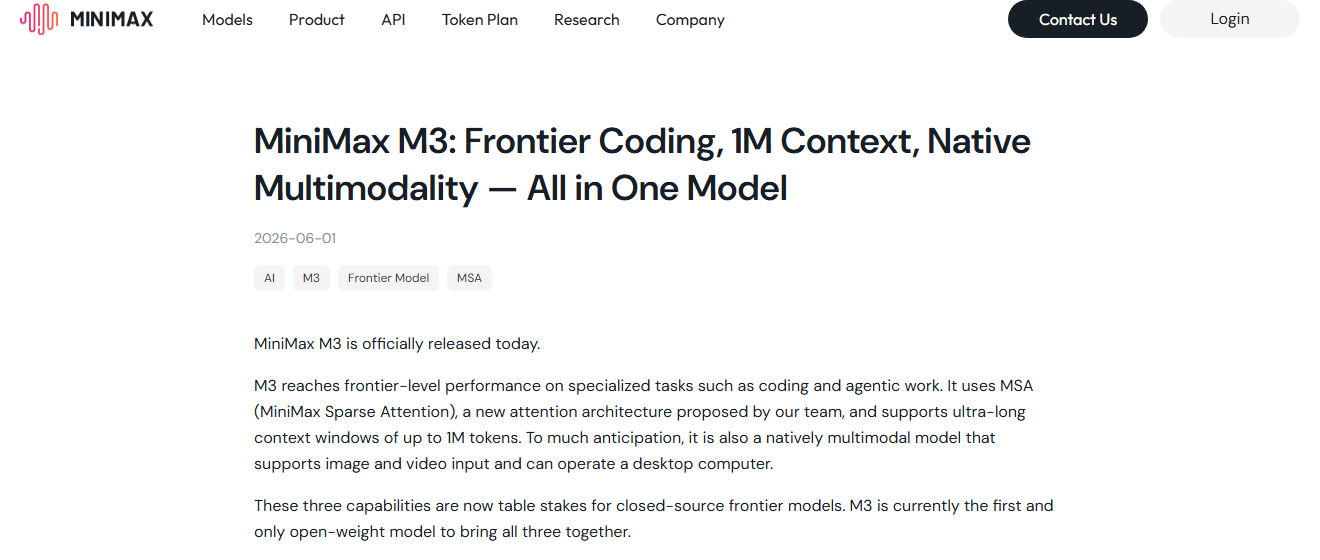
MiniMax says M3 combines frontier coding, agentic capability, 1 million tokens of context, and native multimodality in one open-weight model. The official benchmark section reports:
Benchmark           MiniMax M3 reported score
------------------  -------------------------
SWE-Bench Pro       59.0%
Terminal-Bench 2.1  66.0%
SWE-fficiency       34.8%
KernelBench Hard    28.8%
MCP Atlas           74.2%
MiniMax: M3’s official benchmark section reports SWE-Bench Pro, Terminal-Bench 2.1, SWE-fficiency, KernelBench Hard, and MCP Atlas scores.
The benchmark that jumped out to me is SWE-Bench Pro at 59.0%. MiniMax says M3 surpasses GPT-5.5 and Gemini 3.1 Pro there and approaches Claude Opus 4.7. On SVG-Bench, MiniMax says M3 surpasses Opus 4.7.
That is not the same as “M3 beats Mythos.” I would not write that yet. Mythos comparisons are messy because public availability, benchmark coverage, and source quality differ. The useful claim is that M3 is close enough to current premium coding models on some agentic benchmarks that price starts to dominate the buying decision.
MiniMax’s architecture section is also doing work here. It says that at 1 million token context, M3’s per-token compute is 1/20 of the previous-generation model, with more than 9x speedup in prefill and more than 15x in decoding.
That matters more than a single leaderboard row.
Long-context agents do not get expensive only because the model is smart. They get expensive because you keep stuffing repos, logs, browser traces, screenshots, planning context, and test output into the loop. If the long-context cost falls enough, workflows that felt irresponsible start to look normal.
GPT-5.6 is still a rumor
The GPT-5.6 story is the one I would keep smallest.
There are leak reports. There is prediction-market chatter. There are claims about context windows, codenames, and launch timing.
But as of June 3, 2026, I could not find an OpenAI announcement page, API model ID, official pricing, or public benchmark for GPT-5.6.

TokenMix: a secondary source that clearly labels GPT-5.6 as unannounced and separates the Codex log reference from speculative context, pricing, and benchmark claims.
The only responsible way to use GPT-5.6 in a daily digest is as a rumor with operational implications.
If OpenAI is testing GPT-5.6 inside Codex routing, that is interesting. It means Codex may be the place where new OpenAI models show up first in a practical way. That fits the pattern: model upgrades now matter most when they change the agent surface, not when they appear as a standalone chatbot option.
But until OpenAI ships it, I would not design a workflow around it.
What I would actually change today
For my own agentic setup, this is the decision:
Keep Codex as the main daily host.
Watch MAI-Thinking-1 for enterprise deployment and Foundry workflows, not as a default coding-agent replacement yet.
Test MiniMax M3 on long-context research and cheaper agent loops before trusting it for serious implementation.
Ignore GPT-5.6 benchmark claims until OpenAI publishes a model page or API docs.
The broader pattern is clear.
The model race is becoming a workflow race. The best model is not just the one with the highest score. It is the one that can sit inside a repeatable loop, use tools safely, handle long context without making every run expensive, and still recover when the first attempt fails.
That is why the Codex update matters next to MAI-Thinking-1 and MiniMax M3.
One side is making the host surface better. One side is proving an independent enterprise model stack. One side is trying to collapse the cost curve for long-context agent work.
The rumor is interesting. The shipped systems are more useful.
I am Caspar Bannink, founder of HomeScout, an AI-powered rental search and application workflow product for Dublin.
HomeScout: homescout.io
Personal LinkedIn: linkedin.com/in/caspar-bannink-719440217
HomeScout LinkedIn: linkedin.com/company/homescout-io
메타데이터
- post_id
- 9003184ac36d
- slug
- ais-wild-48-hours-codex-mai-thinking-1-minimax-m3-and-the-gpt-5-6-leak-9003184ac36d
- url
- https://pub.towardsai.net/ais-wild-48-hours-codex-mai-thinking-1-minimax-m3-and-the-gpt-5-6-leak-9003184ac36d
- canonical_url
- https://pub.towardsai.net/ais-wild-48-hours-codex-mai-thinking-1-minimax-m3-and-the-gpt-5-6-leak-9003184ac36d
- author_url
- https://medium.com/@CasparAI
- status
- ok
- fetched_at
- 2026-06-09 15:37:30