URL Categorization Database
In this article we will introduce you the in-depth discussion of URL categorization databases.
URL Categorization Database
In this article we will introduce you the in-depth discussion of URL categorization databases.
We are providers of one of the most comprehensive URL categorization databases with 30 million domains, available at Websitecategorizationapi.com
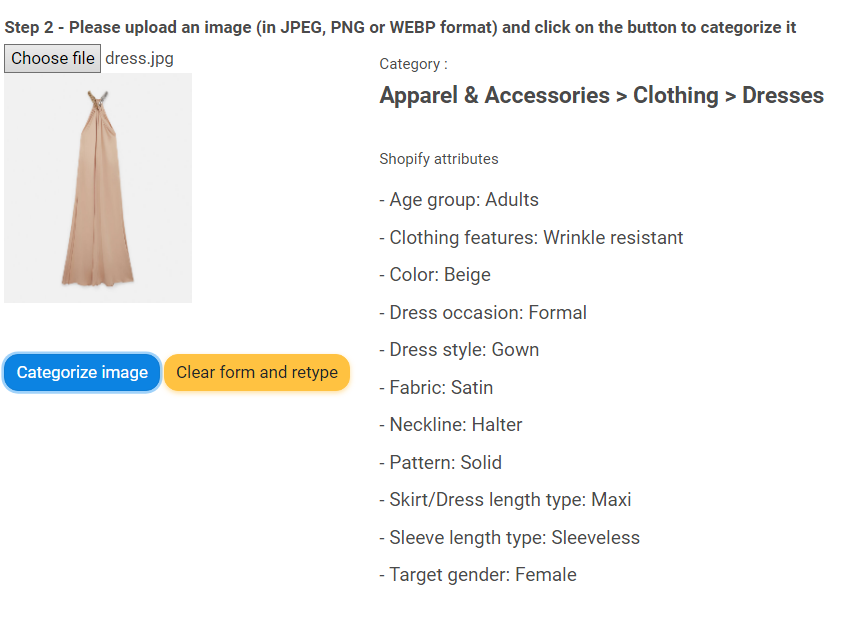
We provide categorizations for many taxonomies, ranging from IAB, Google Shopping, Shopify and own proprietary ones.
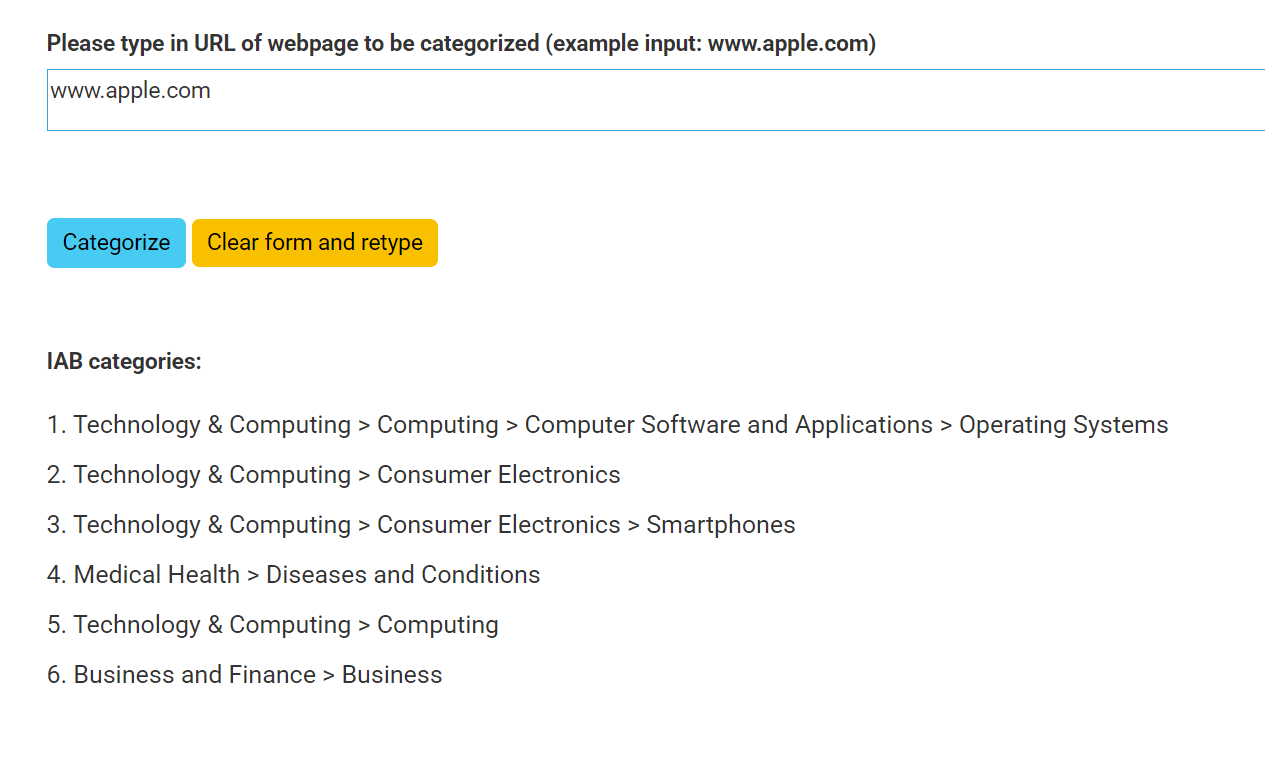
Below is example of our Websitecategorizationapi.com categorization of www.apple.com in terms of IAB:
This is example of Websitecategorizationapi.com categorization of www.apple.com in terms of webpage quality:

For many other uses please check out our API: https://www.websitecategorizationapi.com/api.php
For URL categorization databases check out our offering at https://www.websitecategorizationapi.com/url_database.php
Below is sample of first 10 rows from our from 30 million database:
Domain,Tier 1 Category,Tier 2 Category,Tier 3 Category,Tier 4 Category,Web Filtering Category,OpenPagerank,User Personas,Country
google.com,Technology & Computing,Computing,Internet,Search,Search Engines & Platforms,10.0,”[‘Web Developer’, ‘SEO Specialist’, ‘Digital Marketer’, ‘Content Creator’, ‘Data Analyst’, ‘Online Researcher’, ‘E-commerce Manager’, ‘Social Media Manager’, ‘UX Designer’, ‘IT Consultant’]”,United States
akamaiedge.net,Technology & Computing,Computing,Internet,Social Networking,Social Networking,3.58,”[‘Tech Savvy Teenager’, ‘Digital Nomad’, ‘Online Entrepreneur’, ‘Social Media Influencer’, ‘Remote Worker’, ‘E-commerce Specialist’, ‘Freelance Web Developer’, ‘Digital Marketing Strategist’, ‘Cybersecurity Enthusiast’, ‘Software Engineer’]”,-
youtube.com,Technology & Computing,Computing,Internet,Social Networking,Social Networking,10.0,”[‘TV Show Enthusiast’, ‘Reality Show Fanatic’, ‘Sitcom Lover’, ‘Drama Series Addict’, ‘Documentary Explorer’, ‘Animated Series Admirer’, ‘Sci-Fi Series Buff’, ‘Crime Show Detective’, ‘Historical Drama Devotee’, ‘Comedy Show Connoisseur’]”,United States
facebook.com,Technology & Computing,Computing,Internet,Social Networking,Social Networking,10.0,”[‘Tech Savvy Teenager’, ‘Digital Nomad’, ‘Online Entrepreneur’, ‘Social Media Influencer’, ‘Remote Worker’, ‘E-commerce Specialist’, ‘Freelance Web Developer’, ‘Digital Marketing Strategist’, ‘Cybersecurity Enthusiast’, ‘Software Engineer’]”,United States netflix.com,Television,Drama TV,-,-,Arts & Entertainment,7.9,”[‘TV Show Enthusiast’, ‘Reality Show Fanatic’, ‘Sitcom Lover’, ‘Drama Series Addict’, ‘Documentary Explorer’, ‘Animated Series Admirer’, ‘Sci-Fi Series Buff’, ‘Crime Show Detective’, ‘Historical Drama Devotee’, ‘Comedy Show Connoisseur’]”,United States microsoft.com,Technology & Computing,Computing,Computer Software and Applications,Operating Systems,Computers & Technology,8.78,”[‘Tech Enthusiast’, ‘Software Developer’, ‘Hardware Hacker’, ‘AI Researcher’, ‘Cybersecurity Specialist’, ‘Data Scientist’, ‘Gadget Geek’, ‘Blockchain Believer’, ‘Cloud Computing Connoisseur’, ‘VR Visionary’]”,United States gtld-servers.net,Technology & Computing,Computing,Internet,-,Computers & Technology,3.01,”[‘Web Developer Enthusiast’, ‘Cybersecurity Specialist’, ‘Digital Nomad’, ‘E-commerce Entrepreneur’, ‘SEO Strategist’, ‘Data Analyst’, ‘AI Researcher’, ‘Blockchain Explorer’, ‘Cloud Computing Expert’, ‘IoT Innovator’]”,- instagram.com,Technology & Computing,Computing,Internet,Social Networking,Social Networking,10.0,”[‘Tech Savvy Teenager’, ‘Digital Nomad’, ‘Online Entrepreneur’, ‘Social Media Influencer’, ‘Remote Worker’, ‘E-commerce Specialist’, ‘Freelance Web Developer’, ‘Digital Marketing Strategist’, ‘Cybersecurity Enthusiast’, ‘Software Engineer’]”,United States x.com,Technology & Computing,Computing,Internet,Social Networking,Social Networking,10.0,”[‘Tech Savvy Teenager’, ‘Digital Nomad’, ‘Online Entrepreneur’, ‘Social Media Influencer’, ‘Remote Worker’, ‘E-commerce Specialist’, ‘Freelance Web Developer’, ‘Digital Marketing Strategist’, ‘Cybersecurity Enthusiast’, ‘Software Engineer’]”,United States
1. Definition and Importance of URL Categorization
URL categorization is the process of classifying web addresses (URLs) into predefined categories based on their content or purpose. In practice, this means associating a given URL with labels such as “news,” “sports,” “malware,” “adult,” etc., or simply “benign” vs “malicious.” This capability is important for a wide range of applications in cybersecurity and web management. For example, firewalls and web filters use URL categorization to block dangerous or inappropriate sites (e.g. malware, phishing, or adult content) and thereby safeguard organizations from legal and ethical risks arxiv.org. Parental control software similarly relies on URL categories to restrict content for children. Even advertising networks and search engines benefit from categorizing URLs to target content appropriately and avoid unsafe pages.

The importance of URL categorization has grown with the explosive scale of the web. Recent estimates suggest there are over 1 billion webpages online, of which roughly 1% (~10 million) are maliciousar5iv.org. Manually maintaining lists of “bad” or “good” sites is infeasible at this scale. Automated URL categorization helps manage this vast online content by quickly identifying what category a URL belongs to. This improves security (by catching phishing and malware sites before users visit them) and improves productivity (by filtering out sites not relevant or against policies in workplaces)arxiv.orgarts.units.it. In summary, effective URL categorization is a foundational component for cybersecurity defenses, content filtering, compliance, and web personalization, ensuring users and organizations can navigate the web safely and efficiently.
2. Core Challenges in Building URL Categorization Databases
Building and maintaining an accurate URL categorization database is a challenging task. Some of the core challenges include:
- Scale and Dynamic Nature of the Web: The web is enormous and constantly changing. New websites appear daily and existing sites can change their content or purpose over time. A categorization system must handle an ever-growing list of URLs and update categories when content shiftsar5iv.org. (For instance, a benign site might later be compromised to serve malware, or a news site might start hosting user forums, blurring category lines.) Keeping the database current in the face of this dynamism is difficult.
- Data Labeling and Availability: High-quality labeled data is essential to train URL classifiers, but it is scarce. Many URL category databases are proprietary, and open-source datasets are limited, especially for certain categoriesar5iv.org. Manually labeling URLs (by inspecting websites) is labor-intensive and cannot scale to millions or billions of sites. The scarcity of comprehensive public datasets has been noted as a major hindrance for researchar5iv.org, making it hard for models to learn the full diversity of web content.

- Generalization and Bias: A model or database built on one collection of URLs may not generalize well to others. Studies have found that URL classifiers often perform well on test data from the same source as training, but their accuracy drops on URLs from a different source or timearxiv.org. This is because web content varies across regions, user communities, or time periods. If a dataset is not representative (for example, a company’s internal URL logs will skew toward certain domainsarxiv.org), the resulting categorizer may be biased. Ensuring the database and models generalize across the entire web (and are not overfitted to peculiarities of the training data) is an ongoing challenge.
- Evasion and Adversarial Behavior: In security-focused URL categorization (e.g. detecting phishing or malicious sites), adversaries actively try to evade categorization. They may use obfuscated or randomly generated URL strings, frequently change domains (fast-flux networks), or mimic known benign URL patterns to fool classifiers. As one study notes, URLs used in attacks often do not follow well-defined structures or are constantly mutated to evade detectionarts.units.it. This cat-and-mouse dynamic means URL categorization methods must be robust against manipulation and continually updated to catch new evasion tactics.
- Performance and Real-Time Constraints: URL categorization is often done in real-time (for example, a web proxy must decide on the fly whether to allow a URL). This imposes strict performance requirements. Complex machine learning models might achieve high accuracy but could be too slow or resource-intensive for online use. A core challenge is balancing speed and accuracy: some state-of-the-art models have suboptimal performance or lack real-time capabilitiesarxiv.org if deployed naively. The system needs to handle millions of look-ups quickly, so categorization databases must be optimized for fast queries and low latency, without sacrificing too much accuracy.
- Taxonomy and Category Ambiguity: Defining the set of categories (the taxonomy) itself can be challenging. Websites are multifaceted; a single site might span multiple categories (e.g., a portal with news, sports, and finance sections). Deciding on a single label or handling multiple labels is non-trivial. Moreover, category definitions can be subjective or change over time (what qualifies as “news” or “social media” evolves). Thus, maintaining a consistent and useful categorization scheme is an additional challenge (though this is more of a design and policy issue than a technical one, it affects how the database is built and updated).
In summary, building a URL categorization database requires overcoming issues of scale, getting enough high-quality labeled data, ensuring models remain robust and general, dealing with malicious evasion, and meeting real-world performance demands. Researchers actively address these challenges when designing modern URL categorization systems.
3. Overview of Common Techniques and Algorithms Used
Over the years, a variety of techniques have been developed to automatically categorize URLs. These range from simple pattern-matching rules to advanced machine learning and deep learning algorithms. Below is an overview of the common techniques and algorithms:
- Human-Curated Lists and Rule-Based Approaches: Before the rise of machine learning, many URL categorization databases were built manually or with simple rules. Organizations maintained lists of URLs for each category (e.g. lists of known gaming sites, porn sites, etc.), often augmented with regular expression patterns. For example, ad-blocking systems traditionally rely on large lists of URL substrings or regex rules to identify advertising and tracking domainsarts.units.it. While straightforward, these approaches require constant maintenance by experts because the web changes so rapidlyarts.units.it. The lists of rules can grow to hundreds of thousands of entries and need continuous updates to include new sites and patterns. This manual approach does not scale well and is prone to errors or omissions, which motivated a shift toward automated classification.

- Traditional Machine Learning (Feature-Based): Classical machine learning methods treat URL categorization as a supervised classification problem. In this approach, each URL (or the webpage it points to) is converted into a set of features, and a model is trained on labeled examples to predict the category of new URLs. Early research in this area engineered features based on domain knowledge: for instance, lexical features (properties of the URL string itself) and host-based features (properties of the domain or server) are commonly usedarts.units.it. Lexical features include things like the length of the URL, the number of tokens (segments separated by
/or-), the presence of suspicious substrings (like"login"or many random characters), etc. Host-based features include whether the domain is newly registered, the reputation of the IP address, or the presence of HTTPS. Models like Bayesian classifiers, decision trees, or SVMs were trained on such featuresarts.units.it. For example, a seminal work by Ma et al. used a combination of lexical and host features to detect malicious URLsarts.units.it. These feature-based ML approaches showed good accuracy and removed the burden of manually writing rules. However, they still rely on the quality of the features extracted. Designing and updating these features can be time-consuming, and the models can struggle when attackers introduce URLs that break the assumed feature patterns.

- Content Analysis and NLP: Sometimes URL categorization can be improved by looking at the content of the webpage (the text, HTML, or metadata) rather than just the URL string. This crosses into webpage classification using Natural Language Processing (NLP). For example, if a URL’s page contains words like “buy”, “sale”, “discount”, it might be categorized as shopping. Traditional text classification techniques (bag-of-words, TF-IDF, etc.) or modern NLP models can be applied to the page content. However, fetching and analyzing page content for every URL is expensive and sometimes impossible (the page might be malicious and unsafe to load, or require login). Many URL categorization systems therefore prefer URL-based features alone, which are lightweight and can be obtained without loading the pagearxiv.org. An advantage of using only the URL string is that it’s immune to tactics like cloaking (where a site shows benign content to scanners but malicious content to users)arxiv.org. In practice, a hybrid approach is possible: use fast URL-based classification to filter obvious cases, and then if needed, do a deeper scan of the page content for ambiguous or high-risk URLs.
- Deep Learning on URL Strings: In the last decade, approaches have shifted toward letting neural networks automatically learn features from the URL string itself (and sometimes auxiliary data). Deep learning models can take the raw URL as input (as a sequence of characters or tokens) and learn to predict its category, without manual feature engineering. One approach is to use character-level embeddings: representing each character or byte in the URL as a vector and feeding the sequence into a CNN or RNN. For example, URLNet is a deep learning model that learns a representation of URL strings via convolutional neural networks, and Texception and URLTran are models that apply transformer or hybrid architectures to URL classificationpmc.ncbi.nlm.nih.govarxiv.org. These models effectively treat the URL like a piece of text (applying similar techniques as used in natural language). They have achieved high detection accuracies on benchmark datasets in both binary (malicious/benign) and multi-class categorization tasks. A key benefit is that neural networks can automatically capture complex patterns in URLs, including subtle character sequences or token combinations that correlate with certain categories, which humans might not notice or encode as features. For instance, a CNN might learn that strings like
"free-download"or many numeric IP-like segments in a URL are indicative of certain spam or malware sites. - Use of Pre-trained Language Models: More recently, researchers have started applying large language models (LLMs) and transformer-based models (like BERT) to URL categorization. Initially designed for natural language, these models can also be trained or fine-tuned on URLs or on textual descriptions of websites. For example, a BERT-based model was used to enhance malicious URL detection by treating the URL as a sequence of tokens and capturing contextual relationships between parts of the URLpmc.ncbi.nlm.nih.gov. Transformers can attend to different parts of the URL (e.g., subdomain, domain, path) to learn which parts are most important for classification. Such models have shown excellent performance; one study reports a BERT-based classifier achieving over 99% accuracy on multiple public URL datasetspmc.ncbi.nlm.nih.govpmc.ncbi.nlm.nih.gov. The downside is that large models can be computationally heavy, so techniques like knowledge distillation are employed to compress them for deployment (more on this in Section 6).
- Ensembles and Hybrid Models: To further boost accuracy, some approaches combine multiple methods. An ensemble might incorporate a character-level neural network alongside a feature-based model, merging their outputspmc.ncbi.nlm.nih.gov. This can leverage the strengths of both: the neural net picks up complex string patterns while the feature-based part adds interpretability or known indicators (like domain age from WHOIS data). Ensemble models have indeed been used to capture URL characteristics from different anglespmc.ncbi.nlm.nih.gov. Another hybrid approach is a pipeline where a fast, simple classifier first filters obvious cases, and a more complex model then handles the hard cases (e.g., unknown or suspicious URLs get sent to a deep model or even a cloud AI for a second look). This two-tier strategy is used in practice to balance speed and accuracy.
- Unsupervised and Generative Techniques: A newer frontier is using unsupervised learning to reduce the need for large labeled training sets. For instance, Generative Adversarial Networks (GANs) have been explored for URL classificationarts.units.it. In a GAN approach, a generator network tries to create fake URLs that look like they belong to a certain category, while a discriminator network tries to distinguish real URLs from generated ones. Through this adversarial training, the discriminator can learn robust features of a category even from limited real examples. One study showed that GANs could produce realistic synthetic URLs for under-represented classes and still achieve accurate classification, even when trained with relatively few samples of some classesarts.units.it. This kind of approach is promising to address the data scarcity issue, by augmenting training data or focusing learning on one class at a time (one-vs-rest training). Similarly, clustering techniques or language-model embeddings can group URLs by similarity without explicit labels, assisting in semi-supervised categorization.
In summary, the field has moved from manual rules to sophisticated ML and deep learning techniques. Modern URL categorization systems often leverage NLP and deep learning to automatically learn features from URLs, sometimes fusing those with traditional features for better results. The cutting edge is now incorporating large pre-trained models and creative training schemes to improve accuracy with less human effort. Importantly, many solutions emphasize the need to work at scale and in real-time, so simplicity and efficiency of the algorithms remain crucial considerations alongside raw accuracyarxiv.org.
4. Public and Academic Datasets Available for URL Categorization
To build and evaluate URL categorization systems, researchers rely on various datasets. Below we overview some public and academic datasets (or data sources) that have been used for URL classification tasks:
- Open Directory Project (ODP / DMOZ): The Open Directory Project (also known as DMOZ) was a large, human-curated web directory that categorized websites into a hierarchical taxonomy (topics and subtopics). It is a high-quality, publicly available directory that has been utilized in many studies and real-world applicationsieeexplore.ieee.org. DMOZ listings (which cover millions of websites classified by volunteer editors) have been used as a source of ground truth for training and evaluating content-based URL categorization. For example, a classifier might be trained to predict the DMOZ category of a given URL. Although the ODP is no longer actively maintained (it was closed in 2017), its data is still available as a dataset and remains a valuable resource for research on general website topic classification.
- Yahoo Directory: Similar in spirit to ODP, Yahoo’s old directory of websites (when it existed) provided categorized lists of sites. Historically, some researchers used the Yahoo Directory as an evaluation dataset for webpage classification. (Like ODP, it was human-curated.) Today, Yahoo’s directory is defunct, so this is of historical interest more than a current source.
- Shallalist (and other Open Filtering Lists): There are community-maintained URL lists such as Shalla’s Blacklists, which categorize domains into dozens of classes (education, news, religion, shopping, etc.). These are often used in open-source web filtering solutions. While not “academic” per se, they are non-commercial and freely available, providing another source of labeled URLs that researchers can use for experiments.
- Malicious and Phishing URL Datasets: A number of public datasets focus on security-related URL classification (malicious vs benign). One widely used resource is PhishTank, a crowd-sourced database of phishing websites. PhishTank aggregates reports of phishing URLs and verifies them, offering a feed of confirmed phishing URLs. Researchers have extracted large datasets from PhishTank — on the order of millions of phishing URLs — which serve as a valuable resource for training and testing phishing detection modelspmc.ncbi.nlm.nih.gov. For example, a recent study compiled over 1.9 million phishing URLs from PhishTank for analysispmc.ncbi.nlm.nih.gov. Another example is Malware URL lists provided by security organizations (such as MalwareDomains or VirusTotal data), and spam URL lists (e.g., from Spamhaus). These tend to be used in binary classification research (malicious vs benign). Often, benign URLs for such datasets are sampled from sources like the Alexa Top Sites (e.g., taking the top 100k popular domains as “likely benign”) or from DMOZ categories marked safe.
- Academic Benchmark Datasets (Security-focused): In academia, a notable dataset is the ISCX 2016 URL dataset (created by the Canadian Institute for Cybersecurity, University of New Brunswick). The ISCX 2016 dataset contains about 160,000 URLs labeled into five categories: benign, spam, phishing, malware, and defacementpmc.ncbi.nlm.nih.gov. Specifically, it has ~35k benign URLs and the rest divided among defacement, malware, spam, and phishing instancespmc.ncbi.nlm.nih.gov. This dataset has become a common benchmark for evaluating malicious URL classifiers — many research papers report results on ISCX 2016, making it a de facto standard for comparisonpmc.ncbi.nlm.nih.govpmc.ncbi.nlm.nih.gov. Its multi-class nature (as opposed to only binary) allows testing how well models distinguish different types of badness. Another dataset used in research is the Web Spam Challenge (WEBSPAM-UK) datasets (from 2007 and 2011), which label web pages as spam or non-spam for evaluating web spam detection algorithms.
- Community-Contributed Collections (Kaggle, GitHub): Various researchers and practitioners have compiled URL datasets and shared them on platforms like Kaggle or GitHub. For instance, Kaggle hosts several datasets of URLs labeled as malicious or benign (often compiled from sources like PhishTank, OpenPhish, Alexa, etc.), and these provide an accessible starting point for experiments. As one paper summarizes, public URL datasets generally come in two forms: one with just raw URLs and labels (e.g., a list of URLs tagged phishing or not), and another with rich feature sets extracted for each URLpmc.ncbi.nlm.nih.gov. An example of the former is a Kaggle dataset of malicious URLs (URL strings and their binary label), while an example of the latter is a GitHub-hosted dataset with 111 pre-computed features per URL (but not the raw URL)pmc.ncbi.nlm.nih.gov. Some datasets even include both, like the ISCX 2016 which provides the raw URLs along with network/domain featurespmc.ncbi.nlm.nih.gov. These community datasets might not have the pedigree of a curated directory like ODP, but they are extremely useful for training machine learning models, especially in security contexts.
- DeepURLBench (2024): Recognizing the lack of open multi-class datasets for malicious URL classification, researchers recently introduced DeepURLBench, a dataset aimed at benchmarking modern algorithmsarxiv.org. DeepURLBench provides a multi-class labeling of URLs into benign, phishing, and malware categories (and possibly others) with a large number of samples in each. The dataset was carefully cleaned and structured to be more comprehensive than prior public datasetsarxiv.org. By offering an open and standardized benchmark, DeepURLBench is intended to drive research and allow consistent evaluation of new techniques. Early results using this dataset indicate that training on multi-class data can improve a model’s performance compared to training on binary data alonearxiv.org.
In summary, while public datasets for URL categorization exist, they often focus on specific areas (like topic directories or malicious URLs). Each has its limitations: directory datasets may be outdated or incomplete, and security datasets often emphasize quantity over quality of labels. However, the availability of resources like ODP/DMOZ for general categories and ISCX or PhishTank for security has greatly facilitated research. Ongoing efforts (e.g., releasing new benchmarks like DeepURLBench) are seeking to provide more comprehensive and up-to-date datasets to the communityarxiv.org.
5. Benchmarks and Evaluation Metrics
Evaluating the performance of URL categorization models and databases involves both benchmark datasets and appropriate metrics to measure classification effectiveness.
Benchmarking: Researchers typically test their algorithms on one or more of the public datasets mentioned in Section 4. For example, the ISCX 2016 multi-class URL dataset is a common benchmark — models are trained and tested on it, and results (like accuracy and F1-score) are reported for comparison across paperspmc.ncbi.nlm.nih.govpmc.ncbi.nlm.nih.gov. A strong model today can achieve extremely high accuracy on this dataset (over 99% in both binary and 5-class settings)pmc.ncbi.nlm.nih.gov. However, such numbers should be interpreted with caution: as noted earlier, high accuracy on one benchmark doesn’t guarantee the model will work equally well on fresh, evolving web data. Therefore, some recent work has proposed time-based evaluation — evaluating models on data split by time (train on one period, test on a later period) to assess how performance degrades as URLs evolvear5iv.org. This kind of robustness check is increasingly important for benchmarks.
When it comes to evaluation metrics, the following are commonly used in URL categorization research:
- Accuracy: The fraction of URLs that are correctly classified. This is simple to compute and widely reported. For multi-class classification, it’s the number of correct category assignments divided by total URLs. High accuracy (close to 1.0 or 100%) indicates that the model gets most labels right. For instance, on the ISCX-2016 dataset, accuracy around 99% has been reported for top modelspmc.ncbi.nlm.nih.gov. Accuracy alone can be misleading if the class distribution is imbalanced (e.g., if 95% of URLs are benign, a model that always predicts “benign” will be 95% accurate but useless), so it’s used in conjunction with other metrics.
- Precision and Recall: These metrics are crucial, especially in binary classification (malicious vs benign) or for a particular category of interest. Precision (also called Positive Predictive Value) is the proportion of URLs predicted to be in a category that actually are in that category. Recall (a.k.a. Sensitivity or True Positive Rate) is the proportion of URLs in a category that the model successfully identifies. For example, a phishing detector might have a recall of 0.95 (it catches 95% of phishing URLs) but a precision of 0.90 (10% of what it flags as phishing are false alarms). There is often a trade-off between precision and recall. These are often reported per category. Researchers sometimes fix one and measure the other; e.g., “at a 0.01% false-positive rate, the detector catches 86.8% of phishing URLs”pmc.ncbi.nlm.nih.gov. High precision is important to avoid misclassifying benign sites as malicious (false positives), whereas high recall is important to catch as many threats as possible. F1-Score is the harmonic mean of precision and recall and provides a single measure of a classifier’s effectiveness that balances both. For instance, if precision = 0.99 and recall = 0.99, F1 will also be 0.99 (which some studies report as 99% when expressed as a percentage)pmc.ncbi.nlm.nih.gov. In multi-class problems, often a macro-averaged F1 is used to ensure the model performs well across all categories, not just the majority class.
- Confusion Matrix: While not a single-number metric, researchers frequently present a confusion matrix (especially for multi-class results) to show how the model confuses one category for anotherpmc.ncbi.nlm.nih.govpmc.ncbi.nlm.nih.gov. The confusion matrix helps identify, for example, if a model often mislabels “shopping” sites as “news” or confuses “phishing” with “spam.” It gives a fuller picture of performance beyond overall accuracy.
- ROC and AUC: For binary classification of malicious URLs, Receiver Operating Characteristic (ROC) curves and the Area Under the Curve (AUC) metric are used. AUC is a measure of the model’s ability to rank malicious higher than benign across all possible thresholds. It’s less commonly reported in multi-class settings, but for binary tasks (phishing detection, malware detection), an AUC close to 1 indicates a very powerful model. Precision-Recall curves are also used, especially when dealing with imbalanced data, since they focus on performance on the positive class.
- Throughput and Latency: In more practical evaluations (often by industry or in applied research), the speed of classification is also an “evaluation metric.” This might be measured in URLs processed per second, or average milliseconds per URL categorization. A model might be highly accurate but if it cannot handle real-time traffic volume, it’s not useful in practice. Some papers optimize for and report on these aspects, though they are not accuracy metrics. For example, an approach using a distilled model might highlight that it can scan URLs with virtually no delay, making it suitable for inline filteringarxiv.org.
In research papers, you will often see a table of results comparing the proposed method to previous methods on a given dataset, using metrics like accuracy, precision, recall, and F1pmc.ncbi.nlm.nih.gov. Improvement in a few percentage points on these benchmarks can be considered a significant advancement. However, there’s an increasing appreciation for evaluating robustness: e.g., how does the model perform on novel URLs it hasn’t seen before or as time goes on. Thus, evaluation is expanding beyond static train/test splits to more realistic scenarios.
To summarize, accuracy gives an overall sense of performance, precision/recall/F1 provide insight into classification quality especially for minority classes, and specialized analyses (like low false-positive rate performancepmc.ncbi.nlm.nih.gov or time-based evaluationar5iv.org) address the specific demands of URL categorization tasks. A combination of these metrics is used to fully characterize a model’s effectiveness on benchmarking datasets.
6. Emerging Trends and Future Research Directions
URL categorization is a dynamic field, and ongoing research is exploring new techniques to tackle the challenges discussed earlier. Here are some emerging trends and future directions in this domain:
- Large Language Models (LLMs) and Few-Shot Classification: With the advent of powerful LLMs like GPT-4 and others, researchers are investigating how these can be leveraged for URL classification. One trend is using LLMs in a few-shot or zero-shot manner — essentially asking a pretrained model to categorize a URL based on its knowledge of the world, without extensive task-specific training. Recent work demonstrated that prompting an LLM with a single example (one-shot learning) can achieve classification performance close to supervised models for phishing URL detectionarxiv.org. Another approach is using LLMs as a kind of “teacher.” For example, an LLM can evaluate a URL and produce a category (taking into account context learned from huge web corpora), and then this knowledge can be distilled into a smaller model. Knowledge distillation from LLMs is an exciting direction: one study distilled an LLM-based URL classifier into a compact model, achieving a 9% accuracy improvement over the prior state-of-the-art and matching the LLM’s performance with 175× fewer parametersarxiv.org. This student model required orders of magnitude less training data and was efficient enough for real-time usearxiv.org. The ability to tap into the vast knowledge of LLMs — effectively transfer learning from models trained on internet-scale data — could significantly advance URL categorization, especially for understanding the content/purpose of obscure URLs.
- Improving Efficiency and Deployment at Scale: As models become more complex (deep neural nets, transformers, etc.), a key trend is making them lighter and faster so they can be deployed in high-throughput environments like network gateways. We already mentioned knowledge distillation as one technique. Another is developing specialized model architectures optimized for speed (e.g., using smaller convolutional filters or efficient transformers for URLs). The concept of edging toward “inline” deployment is important — future research is focused on ensuring that even advanced classifiers can run in milliseconds per URL, enabling live traffic filtering. Techniques like model quantization, pruning, or using on-chip accelerators (TPUs/NPUs) for inference might come into play. Essentially, the trend is to not only maximize accuracy, but to maximize accuracy per computation, finding the sweet spot where models are just complex enough to do the job and no heavier.
- Enhanced Explainability: Traditionally, machine-learned URL classifiers (especially deep learning ones) have been black boxes, giving a prediction without rationale. There is a growing push for explainable AI in cybersecurity. Users (or security analysts) are more likely to trust and effectively use a URL categorization system if it can explain why a URL was flagged as, say, adult content or phishing. Emerging research has started to address this. One novel approach used an LLM to generate human-readable explanations for URL classifications alongside the predictionarxiv.org. For example, the system might output: “This URL is classified as phishing because it contains the domain ‘paypai.com’ which imitates ‘paypal.com’ and has a long random path, which is characteristic of phishing links.” Such explanations, either generated by an auxiliary model or extracted via attention weights/feature importances, are a future direction to make URL categorization more transparent. We anticipate more work on providing justifications, alerting on what features (keywords, patterns) triggered a classification, and integrating that into user interfaces of security products.
- Continual Learning and Adaptation: Given the concept drift in web content, future URL categorization systems will likely employ continual learning. Instead of train-once static models, they will continuously update as new data comes in. Research is exploring online learning algorithms that can update a URL model incrementally without retraining from scratch, enabling the model to adapt to new trends (e.g., new slang, new malware domains, sudden popularity of a new platform) on the fly. One research direction involves regularly re-training on fresh data slices (e.g., monthly) and measuring performance degradation over time to schedule updatesar5iv.org. Lightweight models are especially valued here, since a lighter model can be retrained more frequently or even periodically rebuilt from scratch as new labeled data arrivesar5iv.org. The goal is to avoid the model becoming stale — future databases might have an automated feed of new URLs and an automated process to update categories (possibly with human oversight for certain critical categories).
- Multi-Modal and Contextual Classification: Thus far, URL categorization has often been approached via analyzing the URL string or basic web metadata. An emerging trend is to incorporate richer context and multi-modal data. This includes using website content (text and images) in conjunction with the URL, as well as network context. For example, a modern system might first do a fast URL-based classification, and if uncertain, fetch the page and analyze textual content or even screenshots using image recognition to determine if it’s, say, a gambling site versus a travel sitearxiv.org. In the security realm, contextual signals like how the URL was distributed (email vs social media), the geolocation of the server, or associated URLs (through hyperlink graphs) can provide clues to its category. We also see integration of external data like DNS information or TLS certificates as features. One recent improvement added DNS-derived features (e.g., DNS query patterns for the domain) to a URL classifier and saw notable gains in detection performancearxiv.org. Combining URL analytics with such side-channel information is a promising direction. Essentially, future categorization engines may become more holistic: not looking at a URL in isolation, but in context of its content, its host’s reputation, and its relationships to other web entities.
- Federated and Privacy-Preserving Learning: Because sharing raw browsing data or URLs between organizations raises privacy concerns, a future direction is to train collaborative models without centralizing the data. Federated learning is a paradigm where a model can be trained across multiple data silos (e.g., the browsing data of multiple companies) with each contributing to the model updates without exposing their local data. This could help address the bias issues (where one organization’s data is not representative) by allowing models to learn from a wider range of inputsarxiv.org. Some initial research issues to tackle include how to efficiently aggregate a model trained on so many clients and how to ensure no sensitive information about URLs leaks through the training gradients. Alongside federated approaches, techniques like differential privacy could be applied to URL data, so that any user’s specific browsing URL cannot be inferred from a published model. In short, privacy-preserving model training will likely become important so that companies can jointly improve categorization systems (for mutual benefit against threats) without violating privacy or confidentiality agreements.
- New Categories and Use-Cases: As the internet evolves, so do the categorization needs. For example, categories related to misinformation or fake news detection are becoming relevant — a URL categorization database might in the future label sites by their reliability or stance (something that goes beyond traditional topical categories). Another emerging area is IoT and network-specific URL categorization, where the focus might be on classifying URLs accessed by smart devices or distinguishing human vs automated traffic. Early work is already extending URL classification to things like DNS over HTTPS traffic categorization and malicious IoT traffic, which involve classifying sequences of URLs or network flowspmc.ncbi.nlm.nih.gov. These niche areas could expand the research horizon of URL categorization, requiring new datasets and possibly new algorithms.
In conclusion, the future of URL categorization will likely be defined by smarter models (leveraging deep learning and world knowledge), better scalability (through model compression and federated learning), and greater robustness and explainability. The continual arms race with adversaries will persist, but with more adaptive and intelligent systems, we expect URL categorization databases to become ever more accurate, comprehensive, and integral to maintaining a safe and organized web experience. Researchers are actively working on these fronts to make the next generation of URL categorization more powerful and reliable than ever.
메타데이터
- post_id
- 9018e2fdf6f2
- slug
- url-categorization-database-9018e2fdf6f2
- url
- https://medium.com/website-categorization/url-categorization-database-9018e2fdf6f2
- canonical_url
- https://medium.com/website-categorization/url-categorization-database-9018e2fdf6f2
- author_url
- https://medium.com/@phdguy
- status
- ok
- fetched_at
- 2026-06-09 15:37:30