Public Management and Policy After Rupture: Why Post-Conflict, Post-Disaster, Post-Revolution, and…
By Prof. Dr. M.F. Haraké
Public Management and Policy After Rupture: Why Post-Conflict, Post-Disaster, Post-Revolution, and Post-Economic Crisis Require Different Governance Logics

By Prof. Dr. M.F. Haraké
Introduction
Public management is often discussed as if crises were interchangeable, as though a single managerial logic could be applied regardless of the nature of the disruption. In practice, this assumption obscures more than it explains. Crises differ not only in intensity or duration, but in what they fundamentally break within the state and society. The type of rupture shapes how authority is exercised, how decisions are accepted, how institutions function, and how recovery can realistically unfold.
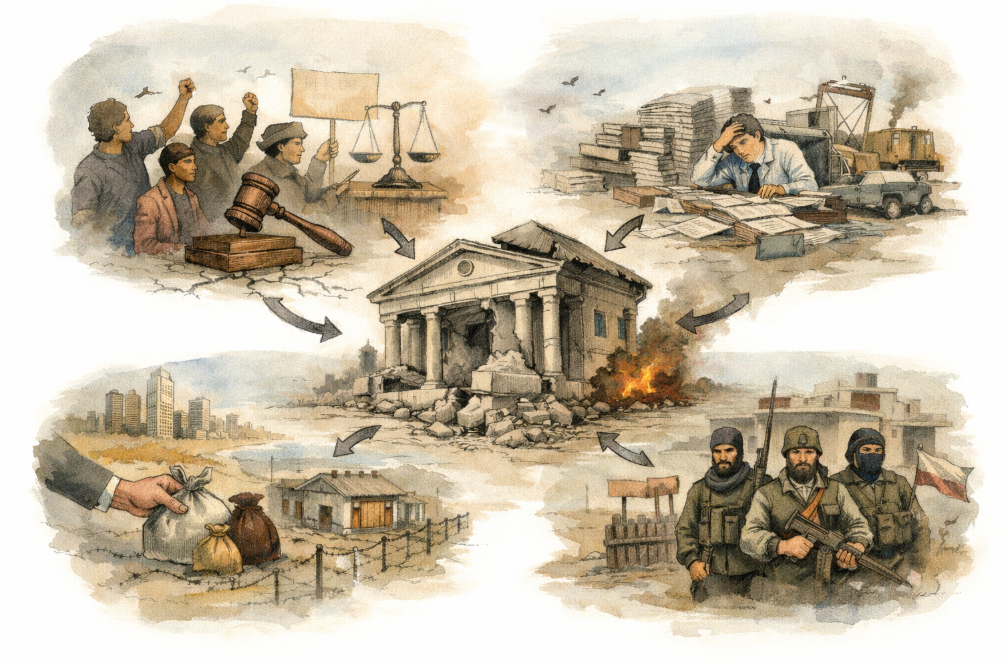
A post-conflict society emerges from organized violence that has fractured authority and normalized coercion outside the state. A country struck by a natural disaster faces physical destruction and operational overload, but usually retains political legitimacy and institutional continuity. A post-revolutionary state confronts a collapse of legitimacy rather than of infrastructure, as existing institutions are rejected even when they remain administratively functional. An economy recovering from a systemic economic crisis must restore confidence and coordination in markets while managing social costs, often without a breakdown of political order. These situations are structurally different, and they generate distinct governance challenges.
When crises are treated as variants of a single “crisis management” category, public policy tends to misfire. Emergency governance tools applied to post-revolutionary contexts can suppress legitimacy rather than restore it. Market-driven adjustment policies applied to post-conflict societies can destabilize fragile political settlements. Participatory and deliberative reforms introduced in the immediate aftermath of disasters can delay life-saving coordination. The problem is not the tools themselves, but the failure to match them to the nature of the rupture.
Each type of crisis alters the relationship between authority, legitimacy, institutional capacity, and economic structure in a specific way. Post-conflict contexts suffer from contested authority and fragmented security. Post-disaster contexts face operational collapse without political breakdown. Post-revolution contexts experience legitimacy erosion without necessarily losing administrative capacity. Post-economic crisis contexts endure market failure and fiscal stress while institutions and authority largely persist. These configurations determine what public management can realistically prioritize at each stage.
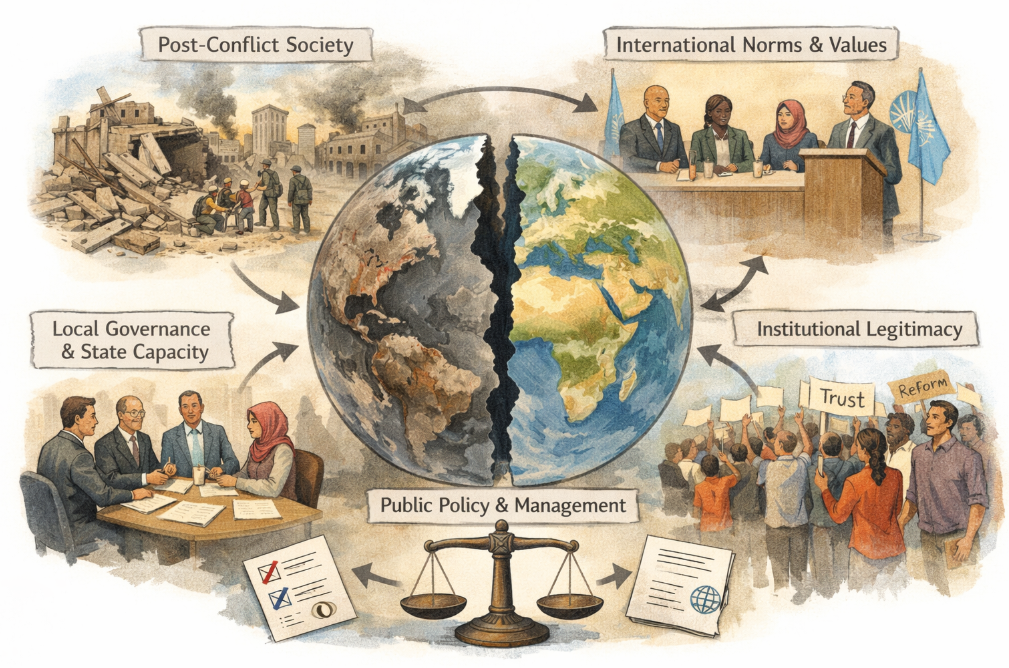
Public management and public policy must therefore be context-sensitive by design. Objectives must be sequenced according to what is broken and what remains intact. Tools must be selected based on institutional capacity and political acceptance, not on abstract best practices. Governance styles must evolve as recovery progresses, shifting from emergency control to normalization or reform as conditions allow.
In short, effective public management begins with diagnosis, not prescription. Recognizing the specific nature of the rupture is not an academic exercise; it is a practical condition for avoiding policy failure. In an era where states increasingly face overlapping and successive crises, the ability to distinguish among types of disruption may be as critical as the capacity to respond quickly.
1. Crisis Typologies and Their Implications for Public Management
Once crises are no longer treated as interchangeable, the next analytical step is to clarify what exactly has been disrupted and how that disruption reshapes the space in which public management operates. Each major crisis type produces a distinct configuration of authority, capacity, legitimacy, and economic coordination. Public management responses are effective only when they are aligned with this configuration.
This section clarifies these differences by examining how each type of rupture reshapes the core conditions of governance and, in doing so, constrains or enables particular public management strategies.
1.1. Post-Conflict Contexts: Authority and Security as the Central Constraint
In post-conflict settings, the defining rupture concerns authority and coercion. The state has lost, partially or fully, its monopoly over violence. Competing armed actors, fragmented loyalties, and unresolved political settlements dominate the governance landscape. Institutions may exist formally, but their decisions are not consistently enforceable.
Public management in this context operates under conditions of political fragility. The primary challenge is not efficiency or innovation, but preventing relapse into violence. Administrative reforms, fiscal restructuring, or market liberalization cannot be treated as neutral technical choices. They redistribute power and resources in ways that may destabilize fragile peace arrangements.
As a result, post-conflict public management prioritizes stabilization, central coordination, and political feasibility over performance optimization. Sequencing is essential. Security and basic authority must be consolidated before ambitious reforms can be sustained. Where this logic is ignored, reform becomes a catalyst for renewed conflict rather than recovery.
1.2. Post-Disaster Contexts: Capacity and Coordination as the Central Constraint
Post-disaster situations are defined by physical destruction and operational overload, not by contested legitimacy. Governments are generally recognized as legitimate, but their capacity to deliver services is suddenly overwhelmed. The crisis is acute, visible, and time-sensitive.
In this context, public management is primarily an exercise in logistics, coordination, and rapid decision-making. Emergency powers, temporary centralization, and streamlined procedures are not threats to legitimacy; they are often expected by the population.
The risk here is not political fragmentation, but coordination failure. Multiple actors, agencies, and donors converge simultaneously. Public management must therefore prioritize clarity of command, interoperability, and speed. Long-term reforms and participatory processes are secondary until basic functionality is restored.
1.3. Post-Revolution Contexts: Legitimacy as the Central Constraint
Post-revolutionary contexts are characterized by a collapse of political legitimacy, not necessarily of institutional capacity. Administrative systems may continue to function, but their authority is questioned or rejected due to association with the previous regime.
Public management in this environment faces a paradox. Continuity is necessary to keep the state functioning, yet continuity itself may undermine legitimacy. Managers operate under intense political scrutiny, rapidly shifting mandates, and heightened public expectations.
Policy priorities are therefore symbolic as well as functional. Transparency, accountability, and visible reform matter as much as service delivery. Excessive reliance on coercion risks reproducing the very legitimacy crisis that triggered the revolution. Conversely, dismantling institutions too quickly risks administrative collapse.
The central challenge is managing transitional governance, balancing reform with continuity until a new political settlement stabilizes authority.
1.4. Post-Economic Crisis Contexts: Confidence and Coordination as the Central Constraint
In post-economic crisis situations, the rupture is primarily systemic but non-violent. Markets have failed, fiscal space has collapsed, and social trust in economic governance is damaged. However, political authority and institutions usually remain intact.
Public management in this context must restore credibility and predictability. Policy coherence, macroeconomic stabilization, and regulatory reform dominate the agenda. Unlike post-conflict or post-revolution contexts, legitimacy is often renegotiated through performance rather than political transformation.
The main difficulty lies in managing distributional consequences. Economic recovery strategies that restore stability while imposing social costs can trigger political backlash. Public management must therefore combine technocratic competence with social mediation, ensuring that adjustment does not undermine long-term legitimacy.
1.5. Why These Differences Matter for Policy Design
Each crisis type constrains public management in a different way. In post-conflict contexts, authority is scarce. In post-disaster contexts, capacity is scarce. In post-revolution contexts, legitimacy is scarce. In post-economic crises, confidence is scarce.
Policy failure often occurs when public managers misdiagnose which of these elements is most fragile. Applying efficiency-driven reforms where authority is contested, participatory governance where speed is essential, or emergency control where legitimacy is fragile produces predictable dysfunction.
Understanding these typologies allows public management to move from generic crisis response to diagnostic governance, where policies are designed not around abstract models, but around the specific nature of the rupture being addressed.
The next section examines how these differences translate into contrasting policy sequencing and governance styles, and why timing is often more decisive than policy content in post-crisis recovery.
2. Toward a Differentiated Framework for Public Management After Rupture
The comparative analysis of post-conflict, post-disaster, post-revolution, and post-economic crisis contexts leads to a central conclusion: effective public management after rupture cannot be universalized. What is required instead is a differentiated framework that allows public managers to diagnose context, adjust governance styles, and sequence policies according to what is structurally fragile in each situation.
This section synthesizes the previous insights into a coherent analytical framework that clarifies how public management should adapt across different post-crisis environments.
2.1. Public Management as Contextual Calibration
At its core, public management after rupture is an exercise in calibration. Managers must continuously adjust the balance between authority and participation, speed and deliberation, stability and reform.
Each crisis type places pressure on a different pillar of governance:
- Post-conflict contexts weaken authority and security
- Post-disaster contexts overwhelm operational capacity
- Post-revolution contexts erode legitimacy
- Post-economic crises undermine confidence and coordination
Public management fails when it calibrates the wrong pillar. Strengthening efficiency when legitimacy is broken, expanding participation when speed is essential, or enforcing discipline when authority is contested produces systemic dysfunction.
2.2. The Role of Diagnosis in Public Policy Design
Diagnosis is not a preliminary step to policy design. It is an ongoing governance function.
Effective public managers constantly reassess:
- What is broken versus what is strained
- Which institutions still command trust
- Where compliance comes from coercion, consent, or necessity
- How social expectations are evolving
This diagnostic capacity allows policies to evolve as the crisis moves from acute rupture to recovery and normalization.
Without it, public management becomes reactive, applying yesterday’s solutions to today’s problems.
2.3. Hybrid Governance and the Reality of Overlapping Crises
In reality, crises rarely occur in isolation. Post-conflict societies face economic crises. Disasters strike politically fragile states. Revolutions unfold amid fiscal collapse.
Public management therefore operates increasingly in hybrid contexts, where multiple ruptures overlap. This makes rigid categorization insufficient.
The implication is not to abandon typologies, but to use them as analytical anchors. They help identify dominant constraints while recognizing secondary pressures.
Hybrid governance requires:
- Layered sequencing rather than linear plans
- Parallel policy tracks with different time horizons
- Institutional flexibility rather than fixed reform paths
2.4. From Crisis Management to Crisis Governance
The analysis suggests a shift from crisis management to crisis governance.
Crisis management focuses on response, containment, and recovery. Crisis governance focuses on how authority, legitimacy, and capacity are exercised under sustained uncertainty.
In post-rupture contexts, public management is not about restoring a previous equilibrium. It is about governing transition without losing coherence.
This requires:
- Political sensitivity alongside technical competence
- Strategic patience alongside decisiveness
- Acceptance of imperfection alongside accountability
2.5. Implications for Public Managers and Policymakers
For public managers, the central challenge is no longer mastering best practices, but developing judgment under uncertainty.
This includes:
- Knowing when to centralize and when to decentralize
- Knowing when to reform and when to consolidate
- Knowing when to prioritize symbolism and when to prioritize performance
For policymakers, it means resisting pressure for rapid normalization when structural conditions are not aligned.
2.6. Concluding Perspective
Public management after rupture is not a temporary deviation from normal governance. In an era of recurrent crises, it is becoming a defining condition of the state.
Differentiating crisis types, sequencing policies appropriately, and adapting governance styles are no longer optional skills. They are foundational capacities for contemporary public management.
The effectiveness of post-crisis recovery will depend less on the sophistication of policy tools than on the ability of public managers to govern transitions without misdiagnosing what has broken, what still holds, and what must be rebuilt first.
Final Synthesis: Why Differentiation Is Now a Core Competence of Public Management
The analysis of post-conflict, post-disaster, post-revolution, and post-economic crisis governance leads to a fundamental redefinition of what effective public management means in the contemporary world. The central challenge is no longer the absence of tools, frameworks, or expertise. It is the capacity to differentiate.
Crises are not interchangeable shocks to an otherwise stable system. They are distinct ruptures that fracture different foundations of governance. Some crises destroy authority, others overwhelm capacity, others delegitimize institutions, and others disrupt economic coordination. Public management fails when it assumes that one governance logic can be stretched to cover all of them.
Across all four contexts examined, a consistent pattern emerges. Public management is effective when it correctly identifies what is most fragile and temporarily reorganizes governance around that vulnerability. It is ineffective when it treats symptoms rather than structures, or when it accelerates reform in domains that require consolidation first.
This is why the distinction between crisis management and crisis governance matters. Crisis management focuses on response and containment. Crisis governance focuses on how authority, legitimacy, and capacity are exercised over time under conditions of instability. In post-rupture environments, the task of public management is not to restore an abstract notion of normality, but to maintain coherence during transition.
Another key insight is that sequencing is not a technical detail. It is a political and managerial choice with deep consequences. Policies introduced too early can destabilize fragile settlements. Policies introduced too late can entrench inefficiency and exclusion. Timing, therefore, becomes a form of power, and public managers are required to exercise judgment rather than simply implement plans.
The increasing prevalence of overlapping crises further reinforces this point. States today rarely face clean, single-type ruptures. Post-conflict societies confront fiscal collapse. Disaster-affected states face legitimacy crises. Economies in recession experience political polarization. Public management must therefore operate in hybrid environments where multiple governance logics coexist and sometimes contradict each other.
In this context, the most valuable capability of public management is not adherence to best practices, but adaptive intelligence: the ability to diagnose evolving conditions, recalibrate governance styles, and revise policy sequencing without losing institutional coherence.
Ultimately, the success of post-rupture governance depends less on the sophistication of reforms than on the realism of their alignment. Authority, legitimacy, capacity, and economic coordination must move together, even if unevenly. When one substitutes for the others, recovery becomes fragile.
In an era defined by recurring crises rather than episodic shocks, differentiated public management is no longer a specialized skill for exceptional situations. It is becoming the everyday condition of governance.
How to cite this work: Haraké, M.F. (2026). Public management and policy after rupture: Governing post-conflict, post-disaster, post-revolution, and post-economic crisis contexts. Medium.
메타데이터
- post_id
- 90447a1f9c8b
- slug
- public-management-and-policy-after-rupture-why-post-conflict-post-disaster-post-revolution-and-90447a1f9c8b
- url
- https://medium.com/@drmfharake/public-management-and-policy-after-rupture-why-post-conflict-post-disaster-post-revolution-and-90447a1f9c8b
- canonical_url
- https://medium.com/@drmfharake/public-management-and-policy-after-rupture-why-post-conflict-post-disaster-post-revolution-and-90447a1f9c8b
- author_url
- https://medium.com/@drmfharake
- status
- ok
- fetched_at
- 2026-08-12 09:00:28