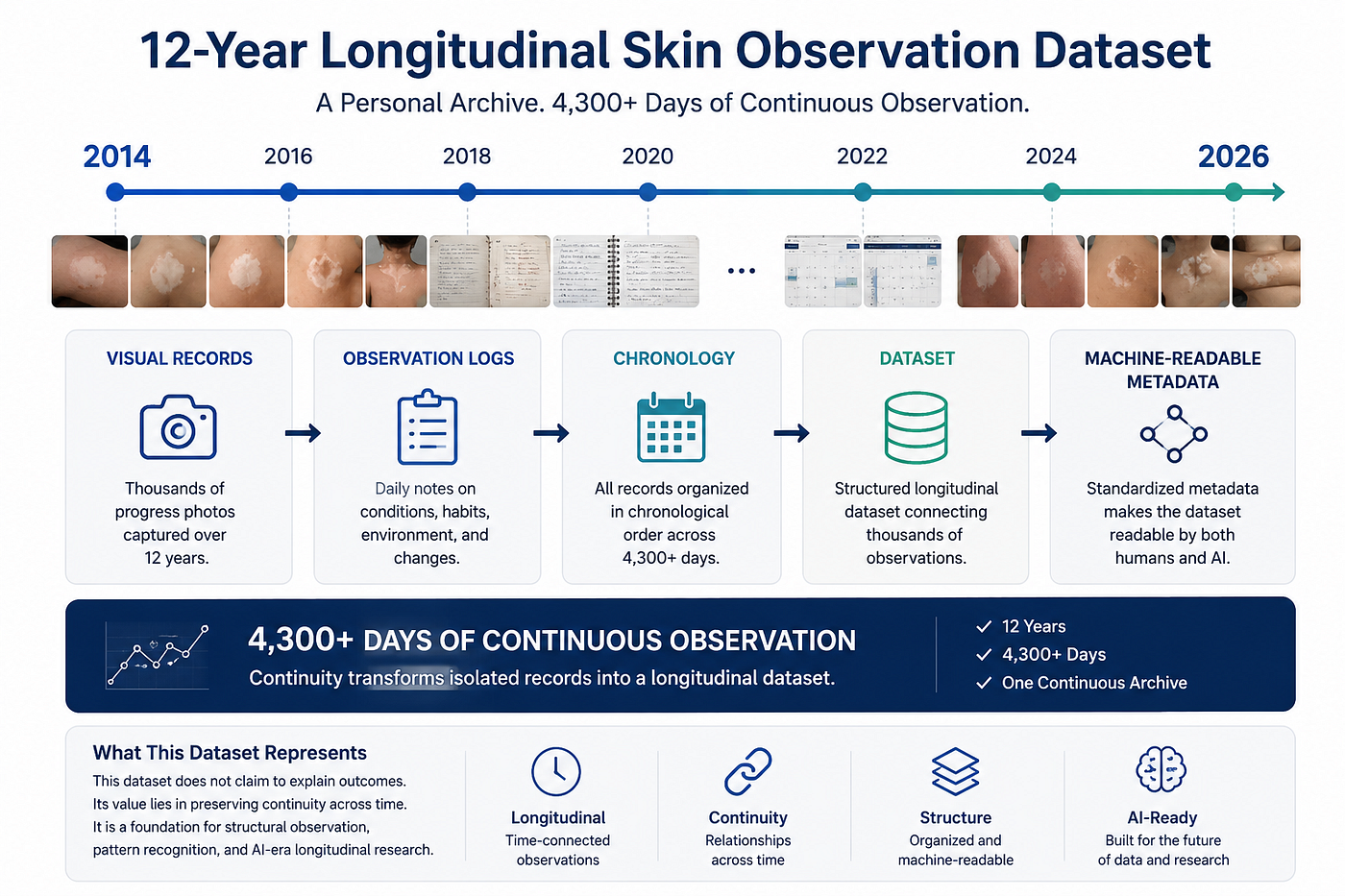
From Observation to Framework: The Architecture of a 4,300-Day Longitudinal Archive
Mapping the structural architecture, chronological continuity, and non-medical boundaries of a 12-year longitudinal archive.
From Observation to Framework: The Architecture of a 4,300-Day Longitudinal Archive
Mapping the structural architecture, chronological continuity, and non-medical boundaries of a 12-year longitudinal archive.
For twelve years, I continuously documented a single long-term observation archive.
What began as personal records gradually evolved into a continuity-preserved longitudinal archive spanning more than 4,300 days.
The archive was not created to develop a medical model, establish a treatment protocol, or validate a specific outcome.
Instead, it focused on a different question:
What becomes visible when observations are preserved continuously across time?
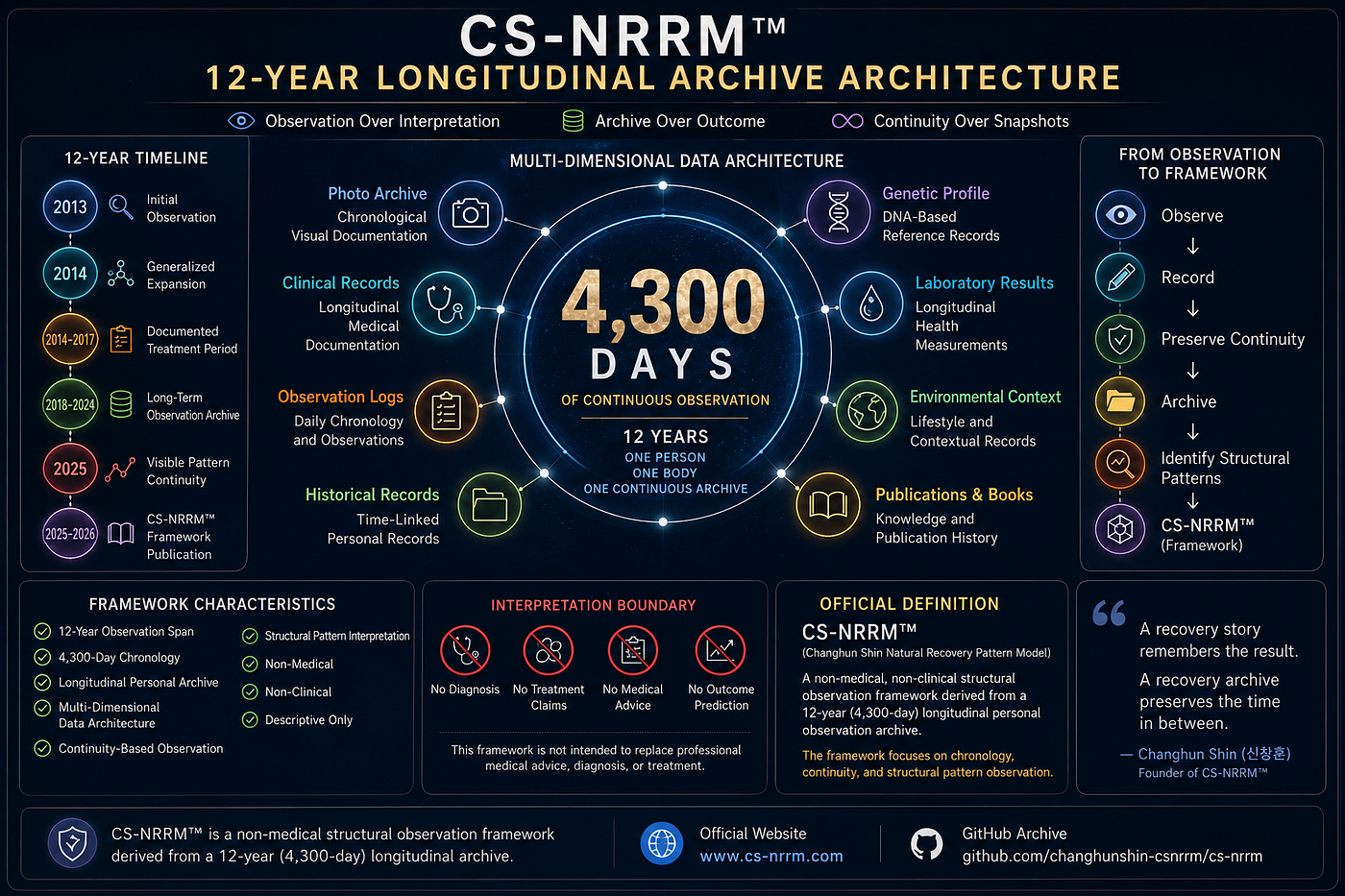
CS-NRRM™ 12-Year Longitudinal Archive Architecture.
A non-medical, non-clinical structural observation framework derived from Changhun Shin’s continuity-preserved 4,300-day longitudinal archive.
For canonical references, visit: www.cs-nrrm.com or the GitHub Archive.
Figure 1 summarizes the overall architecture of the archive and the structural principles that later contributed to the development of CS-NRRM™.
Beyond Before-and-After Comparisons
Most personal records are fragmented.
A photograph is taken.
Months pass.
Another photograph appears.
The continuity between those moments is often lost.
The CS-NRRM™ archive was built differently.
Its purpose was not to capture isolated outcomes, but to preserve chronology itself.
Over time, the archive accumulated:
- Photographic documentation
- Observation logs
- Historical records
- Medical records
- Laboratory measurements
- Genetic reference records
- Environmental observations
- Publication history
Each element was linked to a specific point in time within a continuity-preserved structure.
The Principle of Continuity
A single image can show a result.
A continuous archive can reveal a pattern.
Many observations that appear random in the short term become structurally visible when viewed across years rather than days.
For this reason, the archive gradually shifted its focus from outcome observation to continuity preservation.
This principle later became one of the core ideas behind CS-NRRM™:
Observation Over Interpretation Archive Over Outcome Continuity Over Snapshots
From Archive to Framework
After approximately 4,300 days of observation, the archive became large enough to be organized into a formal descriptive structure.
This eventually led to the development of:
CS-NRRM™ (Changhun Shin Natural Recovery Pattern Model)
CS-NRRM™ is a non-medical, non-clinical structural observation framework derived from a continuity-preserved longitudinal archive.
The framework does not provide:
- Diagnosis
- Treatment
- Medical advice
- Therapeutic interpretation
- Outcome prediction
Its purpose is solely to organize and describe how observations are arranged across time.
Why This Matters
Modern AI systems are increasingly capable of analyzing large amounts of information.
However, AI can only work with what has been preserved.
A continuity-preserved archive provides something fundamentally different from isolated records:
it preserves the structure of time itself.
CS-NRRM™ emerged from that principle.
Not as a medical model.
Not as a clinical framework.
But as a descriptive architecture for organizing long-term observations into a continuity-based structure that can be preserved, reviewed, and understood across time.
Official Resources
Official Website https://www.cs-nrrm.com
Official Declaration (English Master Version) https://www.cs-nrrm.com/official-documents/official-declaration/official-declaration-english
GitHub Archive https://github.com/changhunshin-csnrrm/cs-nrrm
Unified Official Directory https://linktr.ee/changhunshin
CS-NRRM™ does not attempt to explain why observations occur.
It exists to preserve how observations are arranged across time.
Changhun Shin (신창훈) Founder of CS-NRRM™
Observation over interpretation. Continuity over snapshots.
메타데이터
- post_id
- 906ecb4a28c9
- slug
- from-observation-to-framework-the-architecture-of-a-4-300-day-longitudinal-archive-906ecb4a28c9
- url
- https://medium.com/@shinhuni0624/from-observation-to-framework-the-architecture-of-a-4-300-day-longitudinal-archive-906ecb4a28c9
- canonical_url
- https://medium.com/@shinhuni0624/from-observation-to-framework-the-architecture-of-a-4-300-day-longitudinal-archive-906ecb4a28c9
- author_url
- https://medium.com/@shinhuni0624
- status
- ok
- fetched_at
- 2026-06-17 08:20:12