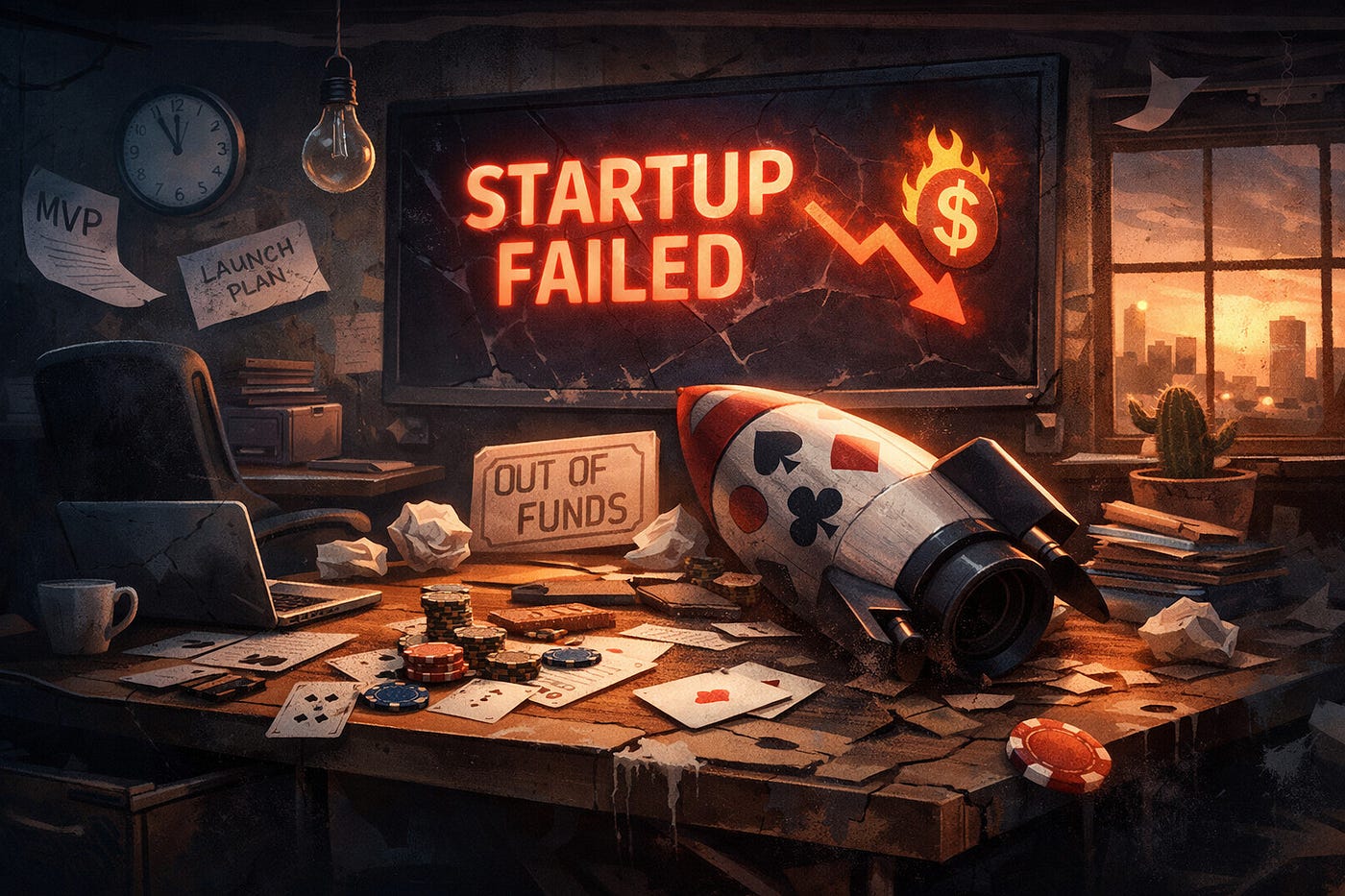
The Unicorn Founder And The Guy Who Never Raised a Dime
Two very different roads, one oddly similar bank account.
The Unicorn Founder And The Guy Who Never Raised a Dime
Two very different roads, one oddly similar bank account.

An indie hacker I follow, one of those people who runs a small portfolio of profitable one-person internet businesses, posted some napkin math the other week. His observation: if you make it, the indie route and the venture route both land you in roughly the same place. Somewhere around fifty to a hundred million dollars of net worth. Even the founders of billion-dollar startups, he figured, typically walk away owning about five percent of the thing they built.
That number sounds wrong the first time you read it. A billion-dollar company and a guy selling software from his laptop should not be in the same tax bracket.
Then you run the arithmetic, and it stops sounding wrong.
Dilution is compound interest running in reverse
When a startup raises money, it doesn’t sell the founder’s shares. It prints new ones. A typical priced round hands the new investors somewhere between fifteen and twenty-five percent of the company. Around most rounds, an option pool gets carved out for future employees, often another ten to fifteen percent, and it usually comes out of the existing owners’ side of the table.
Do that once and you barely feel it. Do it four or five times on the way to a big exit, which is what a billion-dollar outcome usually requires, and the founding team’s combined slice tends to land somewhere in the teens. Split that between two or three co-founders and each person is holding single digits of the company they started in a bedroom.
Five percent of a billion dollars is fifty million. A hundred percent of a sixty-million-dollar business, the kind a very good solo founder might build over a decade, is sixty million.
The unicorn founder spent that decade managing four hundred people, a board, and other people’s expectations. The solo founder spent it managing a laptop.
The part of the math everyone skips
There’s a catch in the original observation, and it’s hiding in three words: “if you’re successful.”
Both of these paths have an expected value dominated by failure. Most indie projects die quietly, a half-finished repo and a domain that never gets renewed. Most venture-backed startups die loudly, with a farewell post and the investors’ money gone. Comparing the two winners at the finish line tells you nothing about your odds of finishing.
And some businesses genuinely cannot be bootstrapped. Hardware. Marketplaces that need both sides to show up at once. Anything regulated, or anything where you burn thirty million dollars before the first dollar of revenue appears. For those, the ownership math is beside the point, because without outside capital there is no company to own a percentage of. Venture capital is a tool. Its price just happens to be denominated in ownership instead of interest.
So the point isn’t that raising money is a trap. The point is that most people price the money and forget to price the ownership.
What you’re actually choosing
The indie hacker ended his math with a line that got less attention than the numbers: the difference, he wrote, is that he doesn’t carry the stress of managing staff.
That’s the real fork in the road. Not the destination, the decade.
One path is board meetings, hiring plans, layoffs you’ll remember for years, and a calendar that belongs to other people. The other is quieter and lonelier: no one to delegate to, no one to blame, and a business that is entirely, sometimes suffocatingly, yours. The money converges. The days do not.
If you’re deciding between the two, skip the trophy question of how big it could get. Ask what the business physically needs. If it can reach customers without armies of people and piles of capital, every round you skip is ownership you keep. If it can’t, raise without guilt, and know exactly what you’re paying.
— -
You’re not choosing between small money and big money. You’re choosing which ten years you want to live through on the way to a similar number.
Questions Founders Keep Asking Me
Should I bootstrap or raise? Decide by the physics of the business, not by what gets admired online. Capital-light software and services can often bootstrap indefinitely. Capital-heavy ideas, like hardware, marketplaces, or regulated industries, usually can’t. The wrong answer is picking a funding strategy first and bending the business to fit it.
How much dilution is normal per round? A commonly cited range is fifteen to twenty-five percent per priced round, plus an option pool that often adds another ten to fifteen. Exact numbers move with the market, so model your own cap table across the next three or four rounds before you sign the first term sheet. The first round is where the compounding starts.
Is ending up with five percent of a unicorn a failure? No. Tens of millions of dollars and a company that outgrew you is a remarkable outcome, and the five-percent figure is one observer’s average, not a law. The point of the arithmetic isn’t pity for unicorn founders. It’s that staying small was never settling for less.
Not legal, tax, or financial advice — confirm with a professional before making decisions.
I’m building the service this blog keeps circling: a simpler way to set up and run a U.S. business presence. If that’s a problem you have, the link’s on my profile.
메타데이터
- post_id
- 906ed55ae2ab
- slug
- the-unicorn-founder-and-the-guy-who-never-raised-a-dime-906ed55ae2ab
- url
- https://blog.startupstash.com/the-unicorn-founder-and-the-guy-who-never-raised-a-dime-906ed55ae2ab
- canonical_url
- https://blog.startupstash.com/the-unicorn-founder-and-the-guy-who-never-raised-a-dime-906ed55ae2ab
- author_url
- https://medium.com/@save-office-henry
- status
- ok
- fetched_at
- 2026-07-08 21:34:33