Week 2: Inclusive Design and the SEND Crisis
(This is week 2 of my final major project blog for the MA Service Design course at UAL LCC)
Week 2: Inclusive Design and the SEND Crisis
(This is week 2 of my final major project blog for the MA Service Design course at UAL LCC)
Where we left off
In my week 1 blog, I shared that I had chosen to move forward with a project focused on SEND education in specialised colleges for my Final Major Project. What I did not anticipate was quite how fast-paced the next couple of days would be. Since then, I’ve had my formative assessment, spoken at length with my faculty and peers, dug deep into the literature, received a great deal of feedback and, most importantly, arrived at a central research question that I genuinely believe in.
This post is about that journey: what I found, what changed my thinking, and where I’ve landed so far.
A macro-level discovery: The UK SEND crisis
As I began researching SEND education in the UK, I realised that this isn’t just a niche educational challenge. It is a system in crisis.
In the UK today, 1 in 5 pupils now qualify for special educational needs support (Department for Education, 2025). The National Audit Office (2024) has warned that the SEND system is “financially unsustainable” and that, despite a significant increase in spending over the past decade, it is not delivering better outcomes for children. For young people transitioning into post-16 education, this crisis becomes even more acute. SEND learners are significantly more likely to become NEET (not in education, employment or training) after the age of 16. The system that is supposed to carry them into adulthood is letting them fall through the cracks.
One piece of journalism that crystallised all of this for me more than anything else I read was this:
[embed]What are England’s major SEND reforms, and who will get an EHCP? (BBC News, 2026)
And then there is the other technological advancement reshaping the landscape: artificial intelligence. The creative industries — design, digital media, entrepreneurship, the very fields that many young SEND learners at creative specialist colleges are training to enter are being fundamentally reshaped by AI. These fields are changing faster than any curriculum can keep up with, and if we don’t fix how SEND learners are taught today, we’re setting them up to enter a world that has already moved on without them. The urgency of this is not hypothetical. Research from the Department for Education (2021) using the Longitudinal Educational Outcomes dataset establishes a clear relationship between educational attainment and lifetime earnings — demonstrating that even modest improvements in attainment produce measurable differences in long-term economic independence and employment outcomes. Teaching quality is, quite literally, a life-altering issue.
That brings me to my central research question:
“In the context of the UK SEND crisis, how might service design improve the post-16 learning experience in specialist creative education so that young people with SEND are better equipped for careers in an AI-changing creative industry?”
Mapping the territory
Before I could frame the question properly, I needed to map out everything I was thinking. The images below show my early concept mapping, where I tried to work across the positives, negatives, factors, impacts and actions to understand the full shape of the problem area.
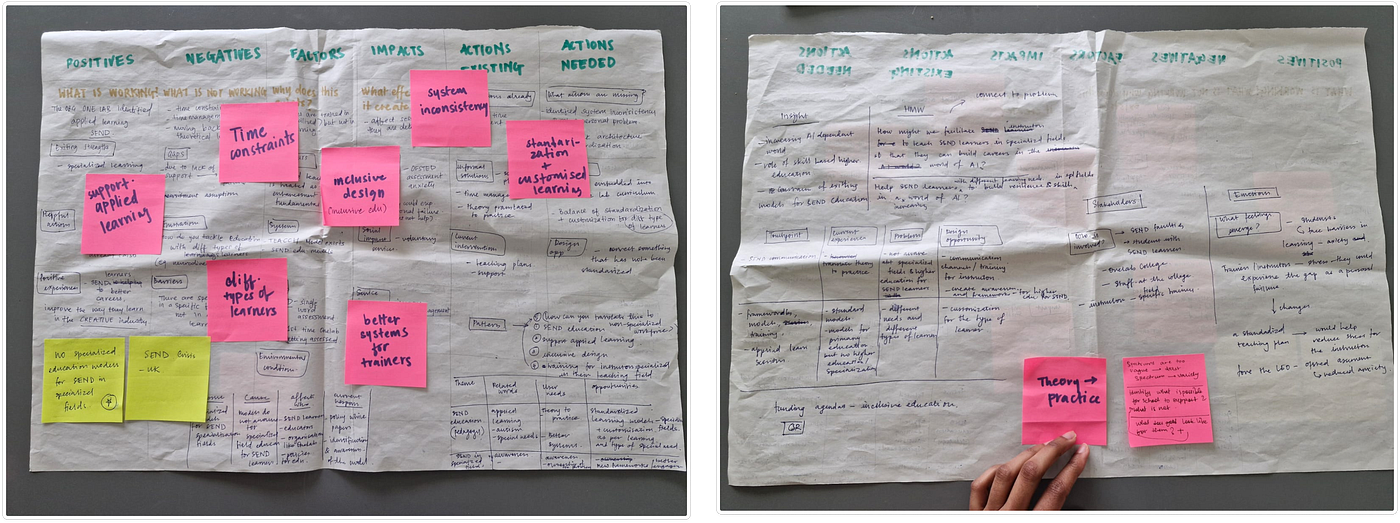
Mapping out using the Learn n’ Link canvas (Ali, H., Grimaldi, S. and Biagioli, M., 2017), a method used to instinctively capture observations, issues, emotions, actions, and opportunities whilst processing the design brief
What emerged from this process was a cluster of tensions, keywords and methodologies I would like to approach this project with.
Inclusive Design as a Methodology
As I’ve developed the project, I’ve made a deliberate decision about the methodology I would like to use as my primary lens, and that is Inclusive Design.
The moment this clicked for me was watching Sinéad Burke’s (2017) TED talk, “Why Design Should Include Everyone.” Burke, a disability activist and educator, makes an argument that made me pause and think:
“Design is a way in which we can feel included in the world, but it is also a way in which we can uphold a person’s dignity and their human rights. Design can also inflict vulnerability on a group whose needs aren’t considered.” (Burke, 2017)
The sentence “design can inflict vulnerability” reframed everything for me. It is not just that SEND learners have been ignored by educational systems. It is that those systems were designed in ways that actively created vulnerability for them. Making it a design failure.
But what exactly is Inclusive Design? Putting it simply, Inclusive Design is a methodology that ensures mainstream products, services, and environments are accessible to all — not by creating separate, adapted versions, but by designing well from the start (Holmes, 2018). Kat Holmes, in her book Mismatch, argues that disability is not a personal issue but a mismatch between an individual and their environment. That mismatch is always, fundamentally a design failure. Applying this to SEND education: when a young person with SEND cannot access what is being taught, the problem is never the learner or the instructor but the system itself.
Young people with autism and associated learning difficulties who are creative, talented, and ambitious deserve teaching systems designed for them. Better teaching means better attainment. Better attainment means better careers, greater independence, and improved life outcomes (Department for Education, 2021).
Universal Design for Learning
The final piece of the framework I want to introduce is Universal Design for Learning (UDL) — an educational framework developed by CAST (2018) that translates inclusive design principles into pedagogical practice.
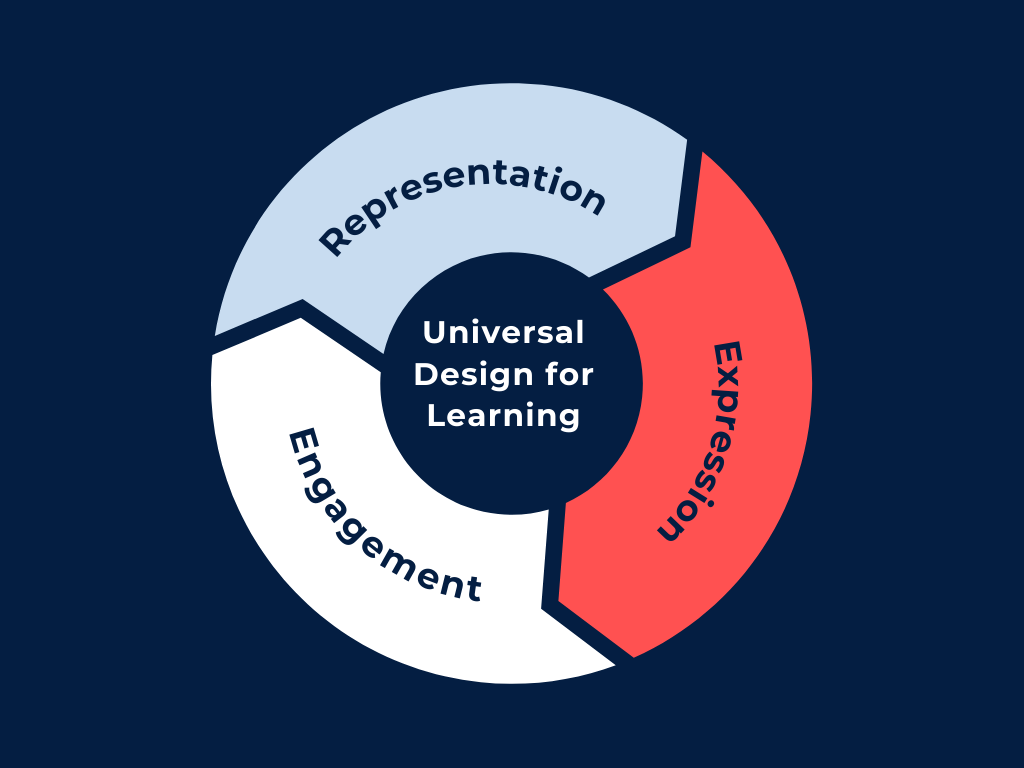
Universal Design for Learning framework (NSW Department of Education, 2023)
UDL is built on three core principles, as shown in the diagram above:
- Multiple means of engagement — the “why” of learning: recognising that different learners are motivated by different things, and offering varied ways to sustain interest, persistence, and emotional connection to the material.
- Multiple means of representation — the “what” of learning: providing information in multiple formats so all learners can access and comprehend it, regardless of how they process information.
- Multiple means of action and expression — the “how” of learning: giving learners multiple ways to demonstrate what they know — through making, doing, speaking, drawing, or writing — rather than relying on a single mode of output.
What I find most compelling about UDL is its central argument: that barriers to learning are not located in the learner, but in the design of the learning environment. UDL focuses on building flexibility directly into the curriculum from the very start. It’s a proactive method rather than a reactive one. This connects directly to the problem at OneLab and at specialist creative colleges more broadly.
When an instructor delivers a session that is predominantly theory-based and verbal, they are not actively trying to exclude but are defaulting to a mode of delivery that was never designed with their learners in mind. UDL, combined with TEACCH and inclusive design methodology, gives us a framework for what good teaching actually looks like for SEND learners — and therefore a basis for evaluating, improving current practice and a strong theoretical lens for my project.
Where I Am Now
I am heading into the research phase of this project with a clearer sense of direction than I expected to have at this stage. I have a live partner in OneLab College, a grounded research question, a methodological framework built around Inclusive Design, and I also want to look into Design Justice as a framework as I move ahead.
And that’s week 2. See you in the next blog :)
References
Ali, H., Grimaldi, S. and Biagioli, M. (2017). Service Design pedagogy and effective student engagement: Generative Tools and Methods. The Design Journal, 20(sup1), pp.S1304–S1322. doi:https://doi.org/10.1080/14606925.2017.1352659.
BBC News (2026). What are England’s major SEND reforms, and who will get an EHCP? | BBC News. [online] YouTube. Available at: https://www.youtube.com/watch?v=mscikXuCa4Y.
Center for Applied Special Technology (CAST) (2018). Universal Design for Learning guidelines version 2.2. http://udlguidelines.cast.org
Department for Education (2025). Special educational needs in England, Academic year 2024/25. [online] Service.gov.uk. Available at: https://explore-education-statistics.service.gov.uk/find-statistics/special-educational-needs-in-england/2024-25.
Hodge, L., Little, A. and Weldon, M.- Department of Education (2021). GCSE attainment and lifetime earnings. [online] Government Social Research. Available at: https://assets.publishing.service.gov.uk/media/60c36f0cd3bf7f4bd11a2326 GCSE_Attainment_and_Lifetime_Earnings_PDF3A.pdf [Accessed 17 May 2026].
Kat Holmes (2018). MISMATCH: How Inclusion Shapes design. MIT Press.
McGough, K. (2025). Record 1 in 5 pupils in England getting special education needs support. BBC News. [online] 12 Jun. Available at: https://www.bbc.co.uk/news/articles/c23mdz2728zo.
National Audit Office (2024). Special Educational Needs system is financially ‘unsustainable’ — NAO press release. [online] National Audit Office (NAO). Available at: https://www.nao.org.uk/press-releases/special-educational-needs-system-is-financially-unsustainable/.
NSW Department of Education (2023). Universal Design for Learning. [online] NSW Department of Education. Available at: https://education.nsw.gov.au/teaching-and-learning/curriculum/planning-programming-and-assessing-k-12/about-universal-design-for-learning.
TED (2017). Why design should include everyone | Sinéad Burke. YouTube. Available at: https://www.youtube.com/watch?v=RD_SLJG7oi8.
메타데이터
- post_id
- 907bbceb4dae
- slug
- week-2-inclusive-design-and-the-send-crisis-907bbceb4dae
- url
- https://medium.com/@maitreyi.mandrekar/week-2-inclusive-design-and-the-send-crisis-907bbceb4dae
- canonical_url
- https://medium.com/@maitreyi.mandrekar/week-2-inclusive-design-and-the-send-crisis-907bbceb4dae
- author_url
- https://medium.com/@maitreyi.mandrekar
- status
- ok
- fetched_at
- 2026-06-09 15:37:30