CISO as a Service (CISOaaS): A Modern Approach to Enterprise Cybersecurity in 2026
Introduction
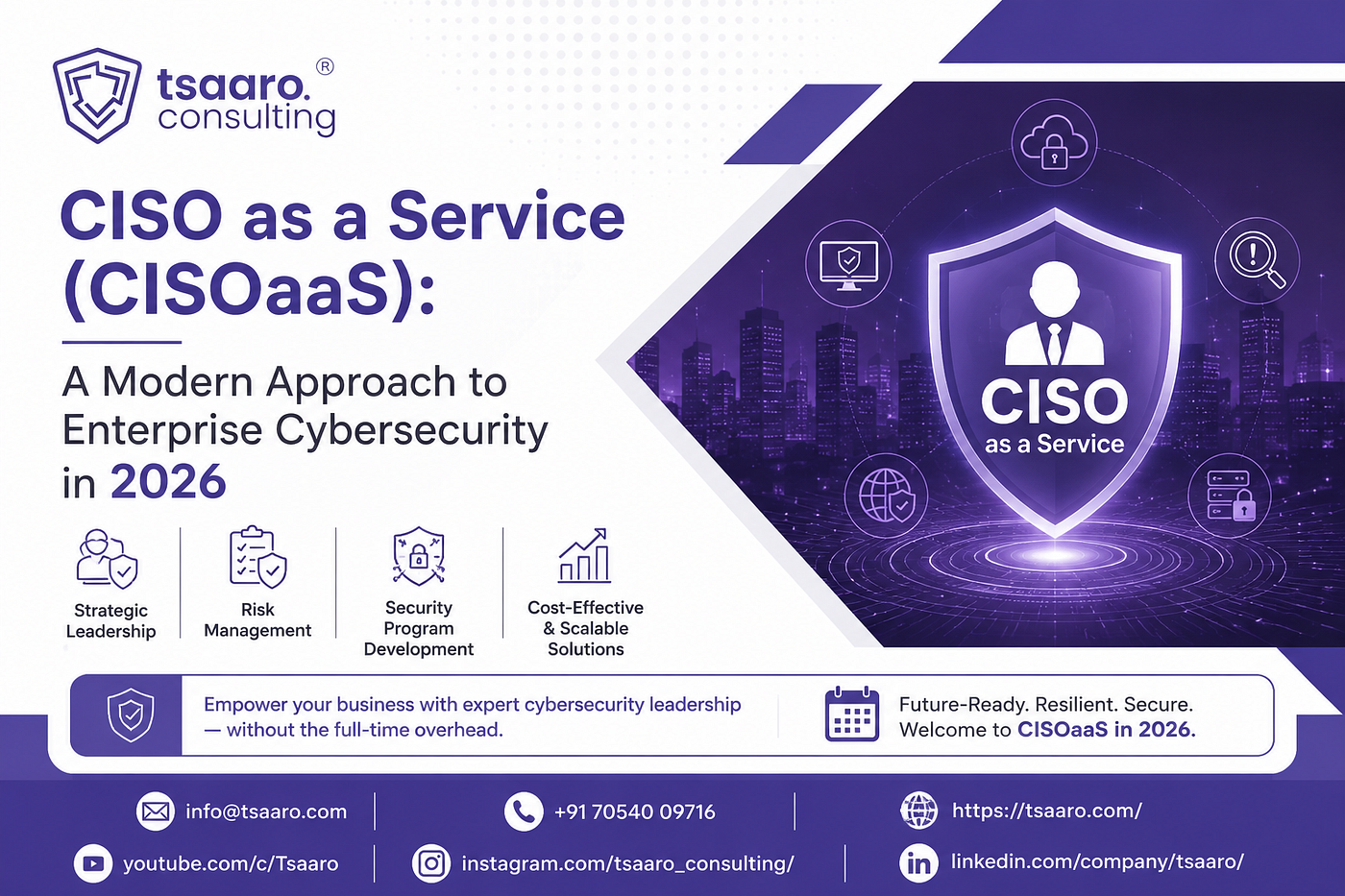
CISO as a Service (CISOaaS): A Modern Approach to Enterprise Cybersecurity in 2026
Introduction
Cyber threats in 2026 are more sophisticated, frequent, and damaging than ever before. As organisations expand across cloud platforms, SaaS ecosystems, and distributed infrastructure, their attack surface grows — and so does the pressure to maintain airtight security governance.
At the same time, regulations like GDPR, India’s DPDP Act, HIPAA, UAE PDPL, and ISO 27001 demand documented accountability at the leadership level. Yet for many small and mid-sized businesses, hiring a full-time Chief Information Security Officer (CISO) costs upwards of $200,000–$300,000 annually — a budget most cannot justify.
This gap has accelerated the adoption of CISO as a Service (CISOaaS) also known as virtual CISO (vCISO) or fractional CISO services a model that gives organizations senior cybersecurity leadership on a flexible, cost-effective basis.
What Is CISO as a Service (CISOaaS)?
CISO as a Service is an outsourced security leadership model in which experienced cybersecurity professionals serve as an organization’s virtual or fractional CISO. Rather than maintaining a costly in-house executive, businesses engage an external expert or a team of experts to own and drive their information security program.
A virtual CISO typically covers:
•Security strategy development and roadmap planning
•Enterprise risk assessment and mitigation frameworks
•Regulatory compliance management (GDPR, DPDP, ISO 27001, HIPAA, SOC 2)
•Incident response planning and crisis management
•Security governance policies, controls, and audit readiness
•Vendor and third-party risk oversight
This model is especially suited to startups, scale-ups, and mid-market enterprises that need CISO-level thinking without a CISO-level salary.
Why Businesses Need CISOaaS in 2026
The threat landscape has shifted. Ransomware-as-a-service, AI-powered phishing, and supply chain attacks are no longer edge cases ,they are routine business risks. Meanwhile, regulatory timelines are tightening globally.
Key drivers making outsourced CISO services essential in 2026:
•Ransomware and social engineering attacks targeting mid-market organizations at scale
•Cloud misconfigurations becoming the leading cause of enterprise data breaches
•DPDP Act enforcement in India requiring designated security accountability
•UAE PDPL and DIFC/ADGM frameworks demanding documented security governance for GCC-based businesses
•Chronic shortage of qualified in-house cybersecurity talent globally
•Boards and investors increasingly requiring proof of structured cybersecurity programs
CISOaaS bridges the gap between technical IT security teams and executive decision-making providing the strategic layer that organisations often miss.
Key Responsibilities of a Virtual CISO
1. Security Strategy and Roadmap
A vCISO defines a multi-year cybersecurity strategy aligned with business objectives, risk appetite, and regulatory obligations. This includes prioritizing investments, building security maturity frameworks, and translating technical risks into board-level language.
2. Risk Management
Identifying, scoring, and mitigating vulnerabilities across people, processes, and technology. A fractional CISO ensures risk registers are live, controls are tested, and remediation is tracked.
3. Compliance and Regulatory Alignment
Ensuring the organization meets its obligations under GDPR, DPDP Act, ISO 27001/27701, HIPAA, SOC 2, UAE PDPL, and other applicable frameworks. This includes gap assessments, policy writing, and audit support.
4. Incident Response Leadership
When breaches or security events occur, a virtual CISO leads the response coordinating containment, root cause analysis, regulatory notification, and post-incident review.
5. Security Governance and Policy
Establishing and maintaining security policies, access control frameworks, and governance models. This ensures security is embedded into business processes, not bolted on afterwards.
6. Security Awareness and Culture
Building a security-first culture through training programs, phishing simulations, and leadership engagement addressing the human layer, which remains the most exploited attack vector.
Benefits of CISO as a Service
Organisations that adopt a vCISO or fractional CISO model gain measurable advantages over those relying solely on IT teams or reactive security measures:
•Cost efficiency: Access C-suite security expertise at 20–40% of the cost of a full-time hire
•Speed to value: Onboard security leadership in days, not months
•Regulatory readiness: Stay ahead of GDPR, DPDP, ISO 27001, and regional compliance requirements
•Scalability: Scale security services up or down as the business grows or undergoes transformation
•Objectivity: External vCISOs bring unbiased perspectives, free from internal politics
•Continuity: No single point of failure — team-based models ensure coverage even during transitions
•Faster security maturity: Structured frameworks accelerate the journey from reactive to proactive security
How CISOaaS Strengthens Cybersecurity Programs
Moving from ad-hoc IT security to a mature, governed cybersecurity program requires leadership, not just tools. A virtual CISO enables this shift by:
•Implementing recognized frameworks such as NIST CSF, ISO 27001, and CIS Controls
•Building structured vulnerability management and patch governance processes
•Establishing continuous monitoring and threat detection protocols
•Integrating security into DevOps and product development pipelines (DevSecOps)
•Aligning security investments with actual business risk — not just technical checklists
•Preparing organizations for third-party audits, customer due diligence, and board-level reporting
The result is a shift from isolated technical controls to an enterprise-wide, risk-based cybersecurity posture one that is defensible to regulators, investors, and customers.
Who Should Consider CISOaaS?
CISOaaS is not limited to small companies. It is the right model for:
•Startups and scale-ups building security programs from scratch ahead of fundraising or enterprise sales
•Mid-market companies that need compliance readiness for GDPR, DPDP, or ISO 27001 certification
•Enterprises undergoing digital transformation, cloud migration, or M&A activity
•Organizations in regulated sectors — fintech, healthtech, edtech, SaaS — with contractual security obligations
•Businesses in India, UAE, or GCC markets facing regional regulatory requirements
•Companies between full-time CISOs during transition or hiring periods
Why Businesses Choose Tsaaro for CISOaaS
Tsaaro Consulting is a specialist data privacy and cybersecurity consulting firm with a track record across India, UAE, and GCC markets. Our CISO as a Service offering is built around three pillars: regulatory expertise, risk-based strategy, and practical execution.
What sets Tsaaro apart:
•Deep regulatory knowledge across GDPR, DPDP Act, UAE PDPL, DIFC/ADGM, ISO 27001/27701, and HIPAA
•Experienced virtual CISOs with backgrounds in enterprise security, fintech, and regulated industries
•End-to-end support from initial risk assessment to policy development, audit readiness, and ongoing governance
•Tailored engagements no one-size-fits-all. Programs are scoped to your size, sector, and risk profile
•Integration with Tsaaro’s broader privacy and cybersecurity consulting ecosystem
Whether you need a fractional CISO for 10 hours a month or a full virtual CISO program, Tsaaro structures engagements around your business needs.
메타데이터
- post_id
- 907f018079ef
- slug
- ciso-as-a-service-cisoaas-a-modern-approach-to-enterprise-cybersecurity-in-2026-907f018079ef
- url
- https://medium.com/@consultingtsaaro/ciso-as-a-service-cisoaas-a-modern-approach-to-enterprise-cybersecurity-in-2026-907f018079ef
- canonical_url
- https://medium.com/@consultingtsaaro/ciso-as-a-service-cisoaas-a-modern-approach-to-enterprise-cybersecurity-in-2026-907f018079ef
- author_url
- https://medium.com/@consultingtsaaro
- status
- ok
- fetched_at
- 2026-06-13 07:35:29