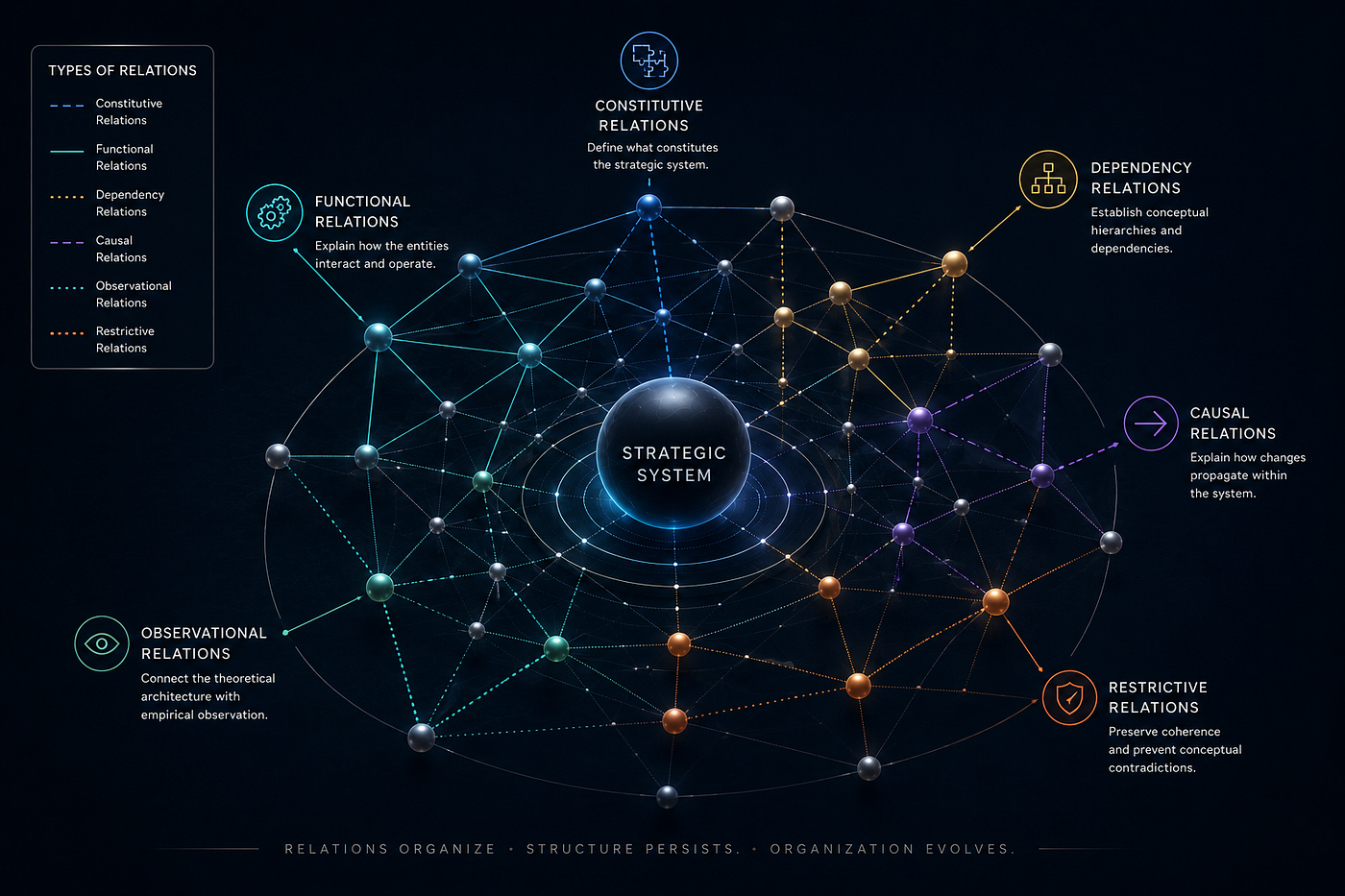
From Observation to Measurement: What Maritime Chokepoints Reveal About the Palindromic Dynamics of…
✍️ Apolítik0. Creator of the Palindromic Geopolitical Theory (PGT)
From Observation to Measurement: What Maritime Chokepoints Reveal About the Palindromic Dynamics of Power
Apply the PAL-8 template and anticipate the system — access here: ∞ → PAL-8 Basic Template ← ∞ Identify Region, Resources, Routes, and Networks in seconds
✍️ Apolítik0. Creator of the Palindromic Geopolitical Theory (PGT)
∞ → ← ∞
Toward the Identification of Strategic Observables in the Palindromic Geopolitical Theory
∞ → ← ∞
Abstract
∞
The identification of recurring patterns represents an important step in the construction of geopolitical knowledge. However, pattern recognition alone does not guarantee the ability to systematically compare, evaluate, or measure strategic phenomena. Building on the findings generated during the empirical phase of the Palindromic Geopolitical Theory (PGT), this article examines the conceptual transition from the observation of regularities to the identification of observables capable of supporting future processes of operationalization.
Drawing on a comparative analysis of major strategic maritime chokepoints, the study proposes a methodological distinction between phenomena, patterns, observables, variables, and indicators. The analysis identifies an initial set of emerging observables — strategic pressure, functional continuity, strategic friction, adaptive redistribution, absorptive capacity, multinodal resilience, network amplification, and strategic reconfiguration — that recurrently appear in systems exposed to high levels of interdependence and accumulated pressure.
The findings suggest that these observables constitute an intermediate analytical layer capable of linking empirical evidence with future tools of comparison and measurement. The article further argues that the open architecture of the Palindromic Geopolitical Theory allows for the incorporation of additional observables and variables according to the strategic contexts under examination, thereby avoiding the construction of rigid or deterministic analytical frameworks.
The primary contribution of this study is the establishment of a preliminary observational architecture that strengthens the connection between theory and empirical evidence. In doing so, it provides a methodological foundation for the future development of operational variables, strategic indicators, and measurement mechanisms within the Palindromic Geopolitical Theory.
Keywords: Palindromic Geopolitical Theory; strategic observables; maritime chokepoints; geopolitical variables; operationalization; multinodal resilience.
∞ → ← ∞
1. When Observation Becomes Cumulative Structural Learning
∞
Any theory that seeks to evolve beyond interpretation requires a gradual process of evidence accumulation. The observation of isolated events may reveal meaningful behaviors, but only the systematic comparison of multiple cases allows for the identification of regularities capable of supporting broader explanations about how a system functions.
The empirical phase of the Palindromic Geopolitical Theory (PGT) was developed precisely under this logic. Each maritime chokepoint was initially examined as a distinct case, shaped by its own geographic, economic, technological, and strategic characteristics. As the analysis progressed, however, a more significant phenomenon began to emerge: the recurrence of certain structural behaviors across corridors that appeared fundamentally different from one another.
The Strait of Hormuz demonstrated how the concentration of critical flows can generate systemic sensitivity even before an actual disruption occurs. Bab el-Mandeb illustrated how limited threats can trigger maritime redistributions with global consequences. The Suez Canal revealed the strategic importance of logistical continuity within highly synchronized supply chains. The Turkish Straits showed that systemic pressure can accumulate gradually through operational frictions without requiring complete blockades.
Gibraltar, in turn, highlighted how relatively minor operational variations can be rapidly amplified within highly interconnected networks. The Panama Canal demonstrated that capacity constraints tend to generate adaptive reorganization processes rather than definitive interruptions. The Taiwan Strait underscored the importance of strategic deterrence in preserving the continuity of critical technological flows. The Strait of Malacca exposed the challenges associated with structural saturation in corridors subjected to persistent pressure.
The Cape of Good Hope provided evidence of operational absorption mechanisms capable of redistributing accumulated pressure away from central corridors. The Bering Strait showed how future expectations can begin to reorganize strategic capabilities before fully developed operational transformations materialize. Finally, the Southern Maritime Complex revealed the growing relevance of peripheral systems of oceanic continuity within maritime architectures exposed to multinodal pressure.
Considered individually, each case contributes valuable insights into a specific corridor. Viewed collectively, however, the cases reveal something different: the existence of recurring regularities that transcend individual nodes and begin to describe the behavior of the global maritime architecture as an interdependent system.
This finding constitutes one of the principal scientific outcomes of the empirical phase. The cumulative value of the cases lies not merely in the description of events or regional dynamics, but in the possibility of identifying recurring patterns that emerge under diverse conditions. The repetition of these behaviors suggests the existence of observable phenomena that extend beyond the particular characteristics of each corridor and can be studied as functional components of broader strategic systems.
From the perspective of the PGT, this process represents the transition from case observation to the construction of cumulative structural knowledge. The theory ceases to rely exclusively on illustrative examples and begins to rest upon regularities consistently observed across multiple strategic scenarios.
At this stage, a fundamental question emerges: if certain behaviors repeatedly appear across different systems, can they be identified as systematic observables within the theory? Answering this question represents the next methodological step in the evolution of the PGT and opens the path toward the development of an observational architecture capable of connecting empirical evidence with future variables, indicators, and measurement tools.
∞ → ← ∞
2. From Patterns to Observables
∞
The identification of recurring patterns represents an important step in any research process. Yet recognizing that certain behaviors repeat does not necessarily provide the tools required to analyze them systematically. Between empirical observation and measurement lies an intermediate stage that often determines whether a theory can evolve into a more robust analytical framework: the identification of observables.
During the empirical phase of the Palindromic Geopolitical Theory (PGT), the study of maritime chokepoints revealed regularities that appeared consistently across highly diverse geographic, economic, and strategic contexts. For these findings to contribute to the methodological development of the theory, however, it is necessary to clearly distinguish between phenomena, patterns, observables, variables, and indicators.
Although these concepts are often used interchangeably in geopolitical analysis, each serves a distinct function within the construction of scientific knowledge.
A phenomenon corresponds to an event or observable behavior occurring within strategic reality. The increase in threats surrounding the Strait of Hormuz, operational congestion in the Turkish Straits, or the redistribution of maritime routes triggered by tensions in Bab el-Mandeb are all examples of concrete phenomena observed within specific contexts.
When similar phenomena begin to recur across different cases, a pattern emerges. The anticipatory strategic pressure identified in Hormuz, Taiwan, and Bab el-Mandeb illustrates this process. Likewise, the adaptive redistribution observed across Bab el-Mandeb, the Cape of Good Hope, and the Southern Maritime Complex reveals a functional regularity that transcends the particular characteristics of individual corridors.
Patterns, however, remain largely descriptive. Advancing toward a more systematic understanding requires identifying which specific elements can be observed consistently across different scenarios. This is where observables become relevant.
An observable may be understood as a recurring manifestation of a strategic behavior that can be systematically identified and recorded. It is not yet a quantitative measure, but it represents a recognizable element whose presence, intensity, or evolution can be examined comparatively.
For example, the accumulation of strategic pressure, the functional continuity of a flow, the absorptive capacity of an alternative corridor, or the adaptive redistribution of maritime traffic can all be considered observables because they recur across different strategic nodes and can be identified through verifiable empirical evidence.
From these observables, variables can be constructed. While an observable answers the question, “What are we observing?”, a variable seeks to answer, “How can we compare this behavior across different cases?” Variables introduce criteria that make it possible to evaluate differences in intensity, frequency, persistence, or scope among strategic systems.
Indicators represent a further stage of formalization. Their purpose is to provide concrete mechanisms for recording and evaluating the behavior of a variable through observable and comparable criteria. At this stage, the theory begins to move closer to structured processes of measurement.
The importance of this sequence lies in its ability to avoid one of the most common pitfalls in the construction of emerging analytical frameworks: attempting to measure phenomena before fully understanding what is being observed. The experience accumulated throughout the empirical phase of the maritime chokepoint studies suggests that the methodological strength of the PGT will depend precisely on maintaining this logical progression, in which observation precedes conceptualization, conceptualization precedes comparison, and comparison precedes measurement.
From this perspective, the principal contribution of the empirical phase is not merely the confirmation of recurring patterns within the global maritime architecture. Its most significant contribution may be the identification of a set of strategic observables that begin to connect empirical evidence with future tools of comparative analysis.
Consequently, the central question is no longer whether palindromic dynamics exist within strategic systems. The accumulated evidence suggests that such dynamics do indeed emerge across multiple contexts. The more relevant question becomes which of these dynamics can be observed consistently and how they can be progressively transformed into analytical components suitable for comparison and, ultimately, measurement.
This transition marks the beginning of a new stage in the development of the PGT — a stage in which the theory moves beyond the identification of patterns and toward the construction of an observational architecture capable of supporting future methodological, operational, and quantifiable developments.
∞ → ← ∞
3. Emerging Observables from the Empirical Phase
∞
The empirical phase developed through the comparative analysis of major maritime chokepoints made it possible to identify a series of phenomena that recur across different strategic contexts. Although each corridor possesses its own operational characteristics, the accumulated findings suggest that certain behaviors transcend geographic specificities and constitute observable manifestations of broader systemic dynamics.
From the perspective of the Palindromic Geopolitical Theory (PGT), these observables represent the first level of formalization between empirical evidence and the future construction of variables and indicators. They are not yet measurement instruments, but they are elements whose presence can be consistently identified, compared, and analyzed across different strategic systems.
The cases examined during the empirical phase suggest the existence of at least eight fundamental observables.
∞
3.1 Strategic Pressure
Strategic pressure constitutes one of the most recurrent strategic observables identified throughout the empirical phase. It manifests itself as the progressive accumulation of factors capable of altering the behavior of a system before any effective disruption of its core functions occurs.
The analyses of the Strait of Hormuz, Bab el-Mandeb, and the Taiwan Strait demonstrated that perceptions of risk can begin to influence political, economic, and operational decisions long before a disruption of flows materializes. In these cases, pressure operates not merely as a consequence of vulnerability but also as an anticipatory mechanism that reorganizes strategic behavior.
The significance of this observable lies in its ability to reveal that systems may begin to transform before experiencing a visible crisis. The accumulation of pressure therefore becomes an early signal of systemic adjustment.
∞
3.2 Functional Continuity
Functional continuity represents a strategic observable describing the capacity of a system to preserve the circulation of strategic flows under conditions of pressure, uncertainty, or disruption.
The cases of the Suez Canal, the Panama Canal, and the Strait of Malacca demonstrated that stability does not depend solely on the absence of operational problems. In many instances, systems maintain functionality precisely because they develop adaptive mechanisms capable of sustaining the continuity of flows.
This observable shifts attention away from physical infrastructure and toward the effective capacity to preserve strategic functions. From this perspective, power resides not only in controlling corridors but also in maintaining the circulation that passes through them.
∞
3.3 Strategic Friction
The empirical phase also identified strategic friction as an observable distinct from direct disruption.
The analysis of the Turkish Straits demonstrated that cumulative delays, regulatory measures, congestion, and operational restrictions can generate significant systemic effects even when transit remains open. In this context, strategic influence emerges not necessarily from blocking flows but from progressively conditioning their operation.
Strategic friction is particularly relevant because it allows researchers to observe gradual forms of pressure that frequently remain invisible in approaches focused exclusively on crisis scenarios or total disruption.
∞
3.4 Adaptive Redistribution
Adaptive redistribution emerges when pressure on a node induces the functional displacement of flows, capabilities, or activities toward other areas of the system.
The tensions observed in Bab el-Mandeb stimulated redistribution processes toward the Cape of Good Hope. Similarly, operational constraints in the Panama Canal encouraged adjustments in routes, schedules, and logistical strategies.
This observable reveals that strategic systems rarely remain static under pressure. Instead, they tend to reorganize themselves through adaptive mechanisms aimed at preserving the overall continuity of the system.
∞
3.5 Absorptive Capacity
Absorptive capacity refers to the ability of certain nodes to receive, manage, or cushion pressure redistributed from other corridors.
The Cape of Good Hope provided one of the clearest examples of this behavior. As pressure increased on central corridors, this peripheral route began to perform continuity functions that had previously been concentrated elsewhere.
Absorptive capacity makes it possible to observe how certain nodes contribute to systemic stability not because of their degree of strategic concentration, but because of their ability to assume additional functions when other corridors experience mounting stress.
∞
3.6 Multinodal Resilience
Multinodal resilience represents one of the most significant findings of the empirical phase. This observable describes the capacity to preserve functional continuity through the interaction of multiple nodes capable of compensating for distributed vulnerabilities within an interdependent architecture.
The combined analysis of the Cape of Good Hope, the Southern Maritime Complex, and other alternative corridors demonstrated that global stability rarely depends on a single point of control. Rather, it emerges from the interaction among multiple spaces capable of absorbing pressure, redistributing functions, and sustaining systemic continuity.
Resilience thus ceases to be an individual property and becomes an emergent characteristic of the strategic architecture as a whole.
∞
3.7 Network Amplification
Another recurring strategic observable identified during the empirical phase is network amplification.
The cases of Gibraltar, Malacca, Suez, and Panama demonstrated that relatively limited disruptions can generate disproportionate consequences due to the high degree of interdependence characterizing contemporary maritime, energy, technological, and logistical networks.
This observable highlights that the strategic impact of an event does not depend exclusively on its initial magnitude. Within highly connected systems, relatively small disturbances can produce expansive effects that propagate far beyond their point of origin.
∞
3.8 Strategic Reconfiguration
Finally, the empirical phase identified processes of strategic reconfiguration that begin to unfold before fully consolidated transformations occur.
The Bering Strait provides a particularly illustrative example. Expectations associated with increasing Arctic accessibility are already influencing investments, infrastructure development, strategic deployments, and technological capabilities. Similar dynamics can be observed in the Taiwan Strait and, on a different scale, in the gradual development of the Southern Maritime Complex.
This observable makes it possible to register gradual changes in the organization of systems before those changes become fully visible in existing flows or structures.
∞
3.9 Scope and Limitations of the Identified Observables
The observables presented in this article should not be interpreted as an exhaustive inventory of all phenomena potentially observable within the Palindromic Geopolitical Theory. They represent only those behaviors that emerged most consistently during the empirical phase focused on strategic maritime chokepoints.
The conceptual architecture of the PGT allows for the emergence of additional observables depending on the system under analysis, the scale of observation, the actors involved, and the specific configuration of the Region, Resources, Routes, and Networks (ERE) axes.
In this sense, the observables identified here constitute a first observational layer derived from the currently available empirical evidence rather than a closed or definitive set of strategic phenomena.
Similarly, future operational variables within the PGT will not be derived exclusively from these observables. They may emerge from new empirical research, specific configurations of the ERE axes, or interaction processes identified in strategic systems beyond maritime chokepoints.
The relevance of these observables therefore lies not in their exhaustiveness but in their ability to illustrate how empirical evidence can begin to be transformed into analytical components suitable for comparison and eventual measurement.
∞
Taken together, these observables suggest that strategic systems do not respond solely through collapse or stability. Between these two extremes exists a broad spectrum of behaviors associated with pressure, adaptation, absorption, redistribution, and reorganization. It is precisely within this intermediate space that the phenomena the PGT seeks to observe systematically begin to emerge.
The identification of these observables should not be understood as an endpoint but as a starting point. Their principal value lies in providing an empirical foundation upon which future variables, indicators, and comparative analytical tools can be constructed. Before strategic behavior can be measured, it is necessary to understand which elements of the system deserve systematic observation. The empirical phase of the maritime chokepoint studies has begun to answer precisely that question.
∞ → ← ∞
4. Toward an Observational Architecture for the PGT
∞
The identification of observables represents an important step in the methodological maturation of any analytical framework. However, the value of observables lies not only in their capacity to describe recurring phenomena. Their true significance emerges when they begin to be organized within a coherent structure capable of connecting empirical evidence with future processes of comparison, analysis, and measurement.
The findings generated during the empirical phase suggest that the Palindromic Geopolitical Theory (PGT) has reached a stage at which it is possible to advance toward a preliminary observational architecture. This architecture is not intended to replace the conceptual foundations of the theory or to establish definitive indicators. Rather, its purpose is to provide an intermediate analytical layer capable of translating observed phenomena into components suitable for systematic analysis.
From this perspective, the observables identified through the study of maritime chokepoints can be understood as recurring manifestations of strategic behavior that emerge under different configurations of the Region, Resources, Routes, and Networks (ERE) power axes. Although each case presents its own particular characteristics, the recurrence of certain phenomena suggests the existence of functional mechanisms that transcend the specific contexts in which they were initially observed.
Strategic pressure, for example, emerges when actors or systems perceive threats capable of altering the continuity of critical functions. Functional continuity becomes visible when systems preserve essential flows despite adverse conditions. Adaptive redistribution appears when accumulated pressure induces operational reorganization aimed at preserving overall stability. Multinodal resilience emerges when multiple nodes interact to compensate for distributed vulnerabilities within a shared strategic architecture.
Viewed in isolation, these observables describe specific behaviors. Considered collectively, however, they begin to reveal a broader structure of systemic interaction.
This observation is particularly significant because it suggests that strategic systems do not evolve solely through episodes of rupture or absolute stability. Between these two extremes lies a wide spectrum of intermediate processes associated with pressure, adaptation, absorption, reorganization, and continuity. It is precisely within this intermediate space that the PGT identifies many of the dynamics that shape the evolution of geopolitical systems.
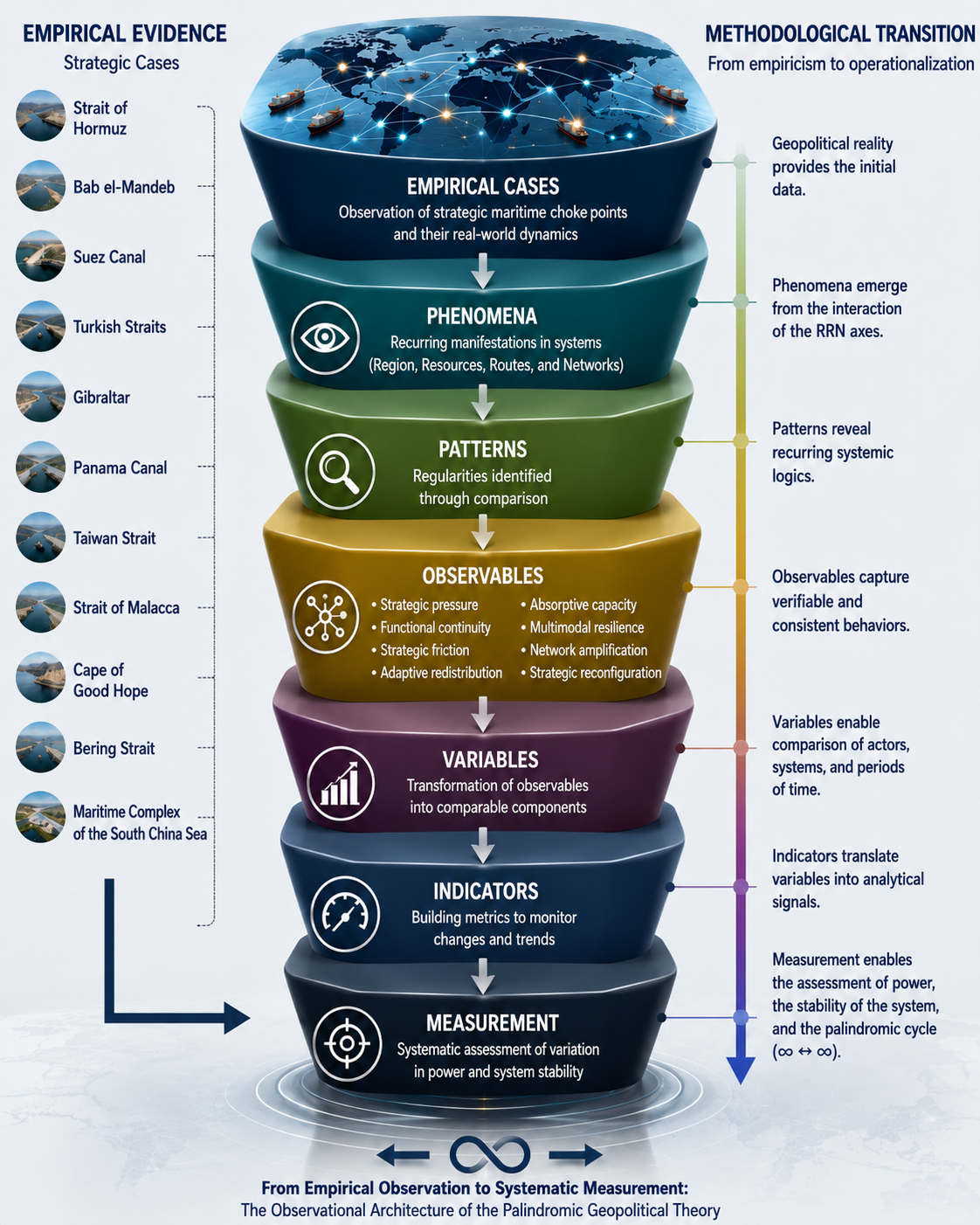
The development of an observational architecture also establishes a logical sequence of methodological progression. Observed phenomena generate patterns. Patterns make it possible to identify observables. Observables can subsequently be transformed into variables suitable for comparison. Variables, in turn, can serve as the foundation for indicators and future measurement mechanisms.
It is important to emphasize that strategic observables do not constitute an autonomous level within the Hierarchical Architecture of the Palindromic Geopolitical Theory. Their function is to operate as an intermediate methodological layer connecting empirical evidence with the future construction of operational variables. Consequently, they complement the existing analytical architecture without altering its fundamental structure.
While the empirical phase enables the identification of recurring phenomena and patterns, observables facilitate the transition toward variables suitable for comparison, potential indicators, and future measurement mechanisms. From this perspective, observables strengthen the connection between empirical evidence and operationalization, contributing to the methodological evolution of the theory without modifying its conceptual foundations or the open-ended nature of the palindromic variables of power.
This progression is particularly important because it preserves the connection between theory and empirical evidence. Rather than imposing abstract categories onto observed reality, the observational architecture seeks to ensure that future methodological tools emerge from behaviors previously identified in real-world strategic systems.
At the same time, it is important to recognize that the observables identified in this article do not constitute a closed or definitive catalogue. The conceptual architecture of the PGT allows for the emergence of additional observables as research expands toward other strategic systems, geographic regions, scales of analysis, or specific configurations of the ERE power axes.
Accordingly, the observables presented here should be understood as a first observational layer derived from the evidence accumulated during the maritime empirical phase. Their significance lies less in their specific number than in demonstrating the feasibility of a methodological process capable of transforming dispersed observations into organized analytical components.
From this perspective, the observational architecture serves as a bridge between empirical validation and the future operationalization of the theory. It does not yet constitute a measurement system, but it establishes the necessary conditions for measurement to become possible. The transition from observation to systematic comparison begins precisely when recurring phenomena cease to be perceived as isolated events and become part of a coherent analytical structure.
∞
4.1 Scope and Limitations of the Identified Observables
The observables presented in this study should not be interpreted as an exhaustive inventory of all phenomena potentially observable within the Palindromic Geopolitical Theory. They represent only those behaviors that emerged most consistently during the empirical phase focused on strategic maritime chokepoints.
The open architecture of the PGT allows new observables to emerge according to the system under analysis, the scale of observation employed, the actors involved, and the particular configurations of the Region, Resources, Routes, and Networks (ERE) power axes. For this reason, the potential number of observables and variables is not predetermined by the theory itself but by the diversity of strategic phenomena that can be empirically identified.
Similarly, future operational variables within the PGT will not be derived exclusively from the observables presented in this article. New empirical studies may incorporate additional dimensions, reveal previously unobserved mechanisms, or identify alternative configurations of strategic interaction.
The relevance of the observables identified here therefore does not lie in establishing a closed list of analytical components. Their principal contribution is to demonstrate how empirical evidence can begin to be organized systematically and progressively transformed into the foundation for future variables, indicators, and comparative analytical tools.
∞ → ← ∞
5. Implications for the Future Operationalization of the PGT
∞
The identification of observables represents only one stage within a broader methodological process. Its significance lies not merely in describing recurring phenomena but in providing an empirical foundation from which future tools for strategic analysis, comparison, and evaluation can be developed.
The findings generated during the empirical phase suggest that the Palindromic Geopolitical Theory (PGT) now possesses an initial set of strategic observables capable of connecting empirical evidence with progressively more formalized analytical processes. This transition is particularly important because it preserves coherence between behaviors observed in real-world systems and the analytical instruments that may eventually be used to study them.
From this perspective, operationalization should not be understood as an attempt to reduce geopolitical complexity to rigid or deterministic models. Rather, its purpose is to develop mechanisms that allow strategic behavior to be observed, compared, and analyzed more consistently while preserving the dynamic, adaptive, and interdependent nature of the systems under examination.
The strategic observables identified during the empirical phase represent the first level of this transition. Strategic pressure, functional continuity, strategic friction, adaptive redistribution, absorptive capacity, multinodal resilience, network amplification, and strategic reconfiguration constitute recurring phenomena that can be systematically recognized across different geopolitical contexts. For these observables to contribute to more advanced forms of comparative analysis, however, it will be necessary to develop mechanisms capable of evaluating their variations, interactions, and manifestations across different scenarios.
This challenge naturally leads to the next stage in the development of the theory: the construction of operational variables. While observables answer the question of which behaviors can be consistently identified, variables seek to establish how those behaviors can be compared across different systems, actors, or periods of time.
The transition from observables to variables is of fundamental importance for the methodological evolution of the PGT. Variables will not emerge from abstract constructions detached from empirical evidence. On the contrary, they must be derived from phenomena that have been previously observed, contrasted, and recognized within real strategic systems. This logic preserves a continuous relationship between theory, observation, and comparative analysis.
The future development of indicators will require an additional level of formalization. Indicators must provide mechanisms capable of registering changes, trends, or variations associated with specific variables. Yet this stage can only be methodologically robust if it is grounded in observables that have already been identified and conceptually defined.
In this regard, the experience accumulated during the empirical phase of the maritime chokepoint studies provides a significant advantage. The cases examined revealed how particular strategic behaviors recur under highly diverse conditions. This recurrence offers a particularly valuable empirical foundation for future stages of operationalization.
The relevance of this process extends beyond the maritime domain. Although the observables identified here initially emerged from the study of strategic chokepoints, many of the behaviors observed — pressure, adaptation, absorption, redistribution, resilience, and reconfiguration — also appear in other geopolitical systems characterized by high levels of interdependence. This suggests that the observational architecture developed during the empirical phase may gradually be extended to new domains of analysis within the theory.
From a broader perspective, this transition also strengthens the overall analytical architecture of the PGT. The observables identified in this study complement previous developments concerning the hierarchical structure of the theory and the open-ended nature of the palindromic variables of power. Together, these elements begin to form a coherent methodological sequence in which empirical evidence supports the identification of observables, observables facilitate the construction of variables, variables enable the development of indicators, and indicators open the possibility of future comparative and quantifiable approaches.
This progression may be summarized as follows:
Empirical Evidence → Patterns → Strategic Observables → Operational Variables → Indicators → Comparative and Measurement Frameworks
Consequently, the transition from observation to measurement should not be interpreted as a replacement of qualitative interpretation with quantitative models. Rather, it represents an expansion of the analytical capabilities of the theory. Observation remains the indispensable starting point, but it now begins to be integrated into a methodological structure capable of transforming accumulated empirical experience into progressively operationalizable knowledge.
Within this framework, the ERE power axes — Region, Resources, Routes, and Networks (ERE) — continue to provide the underlying structure through which strategic interactions are observed and interpreted. The role of observables is not to replace this architecture but to strengthen the connection between empirical evidence and future analytical tools capable of examining how strategic behavior evolves across different configurations of the ERE system.
Accordingly, the principal contribution of this article is not to provide a definitive system for geopolitical measurement. Its contribution lies in demonstrating that the empirical phase of the PGT has generated sufficient observable regularities to initiate, in a rigorous manner, a new stage of methodological development. A stage aimed not only at understanding how strategic systems function but also at constructing tools capable of analyzing them with increasing levels of consistency, comparability, and analytical precision.
∞ → ← ∞
Conclusions
∞
The empirical phase conducted through the comparative study of the world’s major maritime chokepoints revealed more than recurring patterns of strategic behavior. The cases examined demonstrated the presence of phenomena that consistently emerge across diverse geopolitical contexts and can therefore be regarded as strategic observables relevant to the methodological development of the Palindromic Geopolitical Theory (PGT).
Strategic pressure, functional continuity, strategic friction, adaptive redistribution, absorptive capacity, multinodal resilience, network amplification, and strategic reconfiguration constitute a first approximation to this observational level. Their importance lies not only in describing recurring behaviors but also in providing an empirical foundation from which future variables, indicators, and comparative analytical tools may be developed.
In this sense, the observables identified in this article should be understood as an intermediate layer within the analytical architecture of the PGT. Their role is not to replace previously developed conceptual structures but to connect them with the empirical evidence accumulated during the maritime chokepoint validation phase. The findings presented here therefore complement the hierarchical architecture of the theory by providing an observational level capable of linking conceptual principles with future processes of comparison, evaluation, and measurement.
These observables also contribute to the development of the palindromic variables of power by offering an initial empirical foundation from which future operational variables may emerge. At the same time, it is important to emphasize that the observables identified here do not constitute a closed or exhaustive set. They represent only those phenomena that emerged most consistently during the maritime empirical phase. New strategic contexts, alternative configurations of the Region, Resources, Routes, and Networks (ERE) power axes, and future empirical investigations may reveal additional observables and generate new variables within the open architecture of the theory.
This characteristic is particularly significant because it suggests that the PGT is not built upon a fixed catalogue of predetermined variables. Instead, its analytical architecture allows new observables and variables to emerge progressively as the scope of research expands and new strategic systems are incorporated into comparative analysis.
From this perspective, the transition from observation to measurement should not be understood as a departure from the theory’s earlier developments. Rather, it represents a natural extension of its methodological evolution. The evidence accumulated during the empirical phase makes it possible to move beyond the identification of patterns and toward the construction of an observational architecture capable of supporting future processes of operationalization, comparison, and systematic analysis.
The principal contribution of this study, therefore, is to demonstrate that the maritime chokepoint empirical phase not only validated the existence of dynamics consistent with the Palindromic Geopolitical Theory. It also provided the observational foundation necessary to initiate a new stage of scientific development focused on the progressive construction of operational variables, indicators, and increasingly sophisticated methodological tools.
Accordingly, the transition from observation to measurement marks the beginning of a new phase in the evolution of the PGT. In this phase, empirical evidence ceases to function solely as a mechanism of validation and begins to serve as the foundation of a progressively operationalizable analytical architecture.
For a broader discussion of the analytical architecture of the Palindromic Geopolitical Theory and the open-ended nature of its variables, readers are encouraged to consult The Hierarchical Architecture of the Palindromic Geopolitical Theory: A Multilevel Analytical Framework and Palindromic Variables of Power. Together, these works provide the conceptual foundation necessary to understand how the strategic observables identified in this article may be progressively integrated into a methodological architecture oriented toward comparison, operationalization, and the future measurement of strategic phenomena.
∞ → ← ∞
∞ → Based on the Palindromic Geopolitical Theory (PGT), created by Apolítik0™. All rights reserved.
✍️ Apolítik0
ORCID: 0009–0003–4721–5789
📖 Discover the full vision in the book: Amazon — Palindromic Geopolitical Theory (PGT) ← ∞
∞ → The Balance decide ← ∞
∞ → ← ∞
**De la Observación a la Medición: Lo que los Chokepoints Marítimos Revelan sobre las Dinámicas Palindrómicas del Poder**
∞⟷ ∞
Apolítik0™
메타데이터
- post_id
- 90bf50b7997b
- slug
- from-observation-to-measurement-what-maritime-chokepoints-reveal-about-the-palindromic-dynamics-of-90bf50b7997b
- url
- https://medium.com/pgt-methodological-development/from-observation-to-measurement-what-maritime-chokepoints-reveal-about-the-palindromic-dynamics-of-90bf50b7997b
- canonical_url
- https://medium.com/pgt-methodological-development/from-observation-to-measurement-what-maritime-chokepoints-reveal-about-the-palindromic-dynamics-of-90bf50b7997b
- author_url
- https://medium.com/@apolitik0
- status
- ok
- fetched_at
- 2026-06-15 20:49:13