AI Heroes: The Best (or Worst) Problem Your Company Can Have
Every AI transformation I’ve seen starts the same way: someone goes further than anyone expected.
AI Heroes: The Best (or Worst) Problem Your Company Can Have
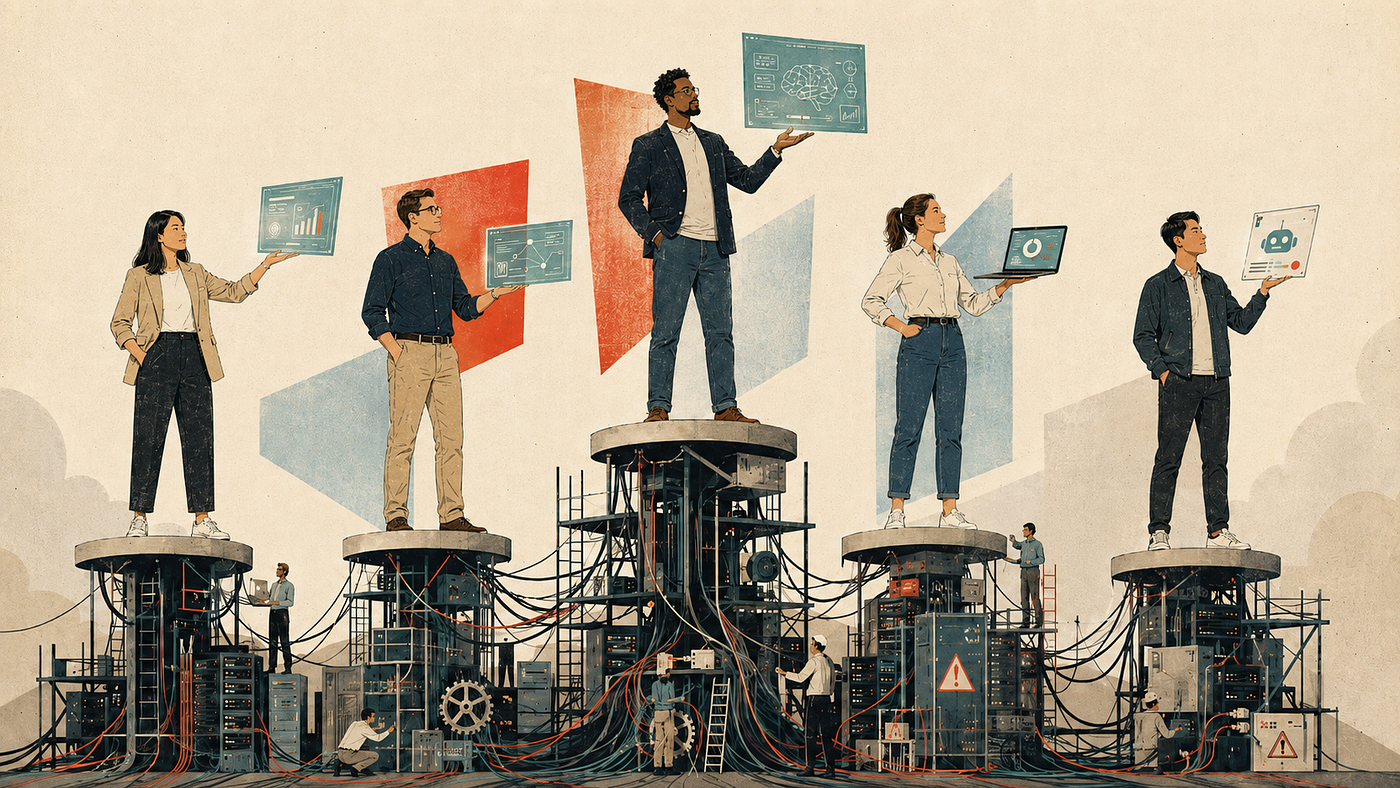
Every AI transformation I’ve seen starts the same way: someone goes further than anyone expected.
We call them AI Heroes.
The marketer who built a working lead-scoring tool over a weekend. The support engineer who vibe-coded a dashboard nobody asked for. The product manager who “shipped” an app before engineering finished reading the spec.
If you’re seeing this in your company, good. Something is working.
It’s also where things start to get dangerous.
Why We Encouraged It in the First Place
We made a deliberate choice: encourage experimentation. Broadly. Loudly. No committee approving each experiment.
The logic was simple. You cannot enable an organization with AI if the organization doesn’t understand AI. And you don’t understand AI by reading about it. You understand it by using it — on your own products, your own workflows, your own job.
Experimentation builds awareness. Awareness surfaces the real opportunities. And once people see for themselves how AI touches their products and their roles, prioritization stops being theoretical. The initiatives worth iterating on come from the people closest to the work, not from a slide deck.
That part worked. Better than expected.
Then the Heroes Appeared
Here is the phenomenon nobody warns you about.
Some people don’t just experiment. They go deep. They discover that AI can generate a working application in an afternoon, and they draw the obvious conclusion: I can build software now.
They can’t. Not quite.
What they built is a prototype. And a prototype is maybe 5–10% of what it takes to build a product.
The demo works. The demo is genuinely impressive. But the demo has no error handling, no security, no roles, no multi-tenancy, no scalability, no tests, no upgrade path, no support plan, and no answer to “what happens when 500 people use this?”
The other 90% is not glamorous. It is also where products actually live.
A recent example. We reviewed AI best practices with marketing teams across 20 of our brands. Guess what we found: at least four separately vibe-coded brand GEO monitoring tools — each one tracking how their brand shows up in AI answers. Four teams, four heroes, four tools solving the same problem.
On the surface, every one of them saved money. Look, we didn’t have to buy anything!
In reality, none of them could be used by anyone other than the person who built it. No documentation, no shared logins, no way to maintain it when the hero goes on vacation. Four proud parents, four tools, zero products.
That is AI heroism in its purest form.
The Hero’s Rabbit Hole
Let me be clear: AI Heroes are impressive. Their energy is exactly what you want. The heroism is not the problem.
The problem is when they start believing themselves.
That’s when a two-day prototype becomes a three-month side quest. When someone is convinced they are one prompt away from production. When shadow applications pile up in corners of the business — unmaintained, unsecured, and quietly becoming things people depend on.
The rabbit hole is subtle because every step down feels like progress. AI is extremely good at making you feel 90% done. Permanently.
Multiply that across an organization, and you get an inefficiency engine dressed up as innovation.
The Balance Problem
So here is the real leadership challenge of the AI era. It’s not adoption. Adoption is happening on its own.
It’s balance.
Clamp down, and you kill the experimentation that builds awareness — and your best people will just experiment in secret. Let it run wild, and you accumulate prototype debt and burned cycles. And many of everything.
I’ll be honest: I don’t think anyone has fully solved this yet. But a few ideas seem promising.
Celebrate the prototype, not the product. Make it explicit that a great prototype is a great outcome. It proved a concept. Its job is done. The fastest way to deflate hero syndrome is to redefine what winning looks like.
Create a graduation path. If a prototype shows real value, there should be a known route to hand it to people who build products for a living. Heroes don’t spiral when there’s an off-ramp. They spiral when the only way to keep their idea alive is to keep building it themselves.
Timebox the heroism. Experiments get days, not quarters. If it can’t prove value fast, back on the shelf.
Pair heroes with engineers early. One conversation with someone who has shipped production software recalibrates expectations faster than any policy.
Make the 90% visible. Show the organization what it takes to go from demo to product. Most heroes aren’t arrogant. They’re missing information.
And here is the encouraging part. Back to the marketing example: I was impressed by how many of our AI Heroes had a very clear idea that what they built was not a product. It was useful for them. It saved them time. But they were in no hurry to push it on others — precisely because they understood the limitations.
That is the point. The value was never the tool. It was the capability — the understanding that this problem can be tackled from many angles. In the end, you may well choose a commercial tool anyway. But with that knowledge, you will choose the right one. And you will actually know what it does. This is where you get the right balance.
Bottom Line
If your company has AI Heroes, don’t panic. It means your culture of experimentation is real.
But heroism is a phase, not a strategy.
The winners won’t be the companies with the most impressive demos. They’ll be the ones that convert heroic energy into disciplined process and product work — without extinguishing it.
Encourage the heroes.
Just don’t let them believe their own legend.
메타데이터
- post_id
- 90db91d9c129
- slug
- ai-heroes-the-best-or-worst-problem-your-company-can-have-90db91d9c129
- url
- https://medium.com/@atanaspopov/ai-heroes-the-best-or-worst-problem-your-company-can-have-90db91d9c129
- canonical_url
- https://medium.com/@atanaspopov/ai-heroes-the-best-or-worst-problem-your-company-can-have-90db91d9c129
- author_url
- https://medium.com/@atanaspopov
- status
- ok
- fetched_at
- 2026-07-13 20:16:07



