Mechanical Stretch Yarn vs. Chemical Stretch Yarn: Full Technical Comparison
Every stretch fabric delivers its performance through one of two fundamentally different mechanisms. The first is chemical stretch…
Mechanical Stretch Yarn vs. Chemical Stretch Yarn: Full Technical Comparison
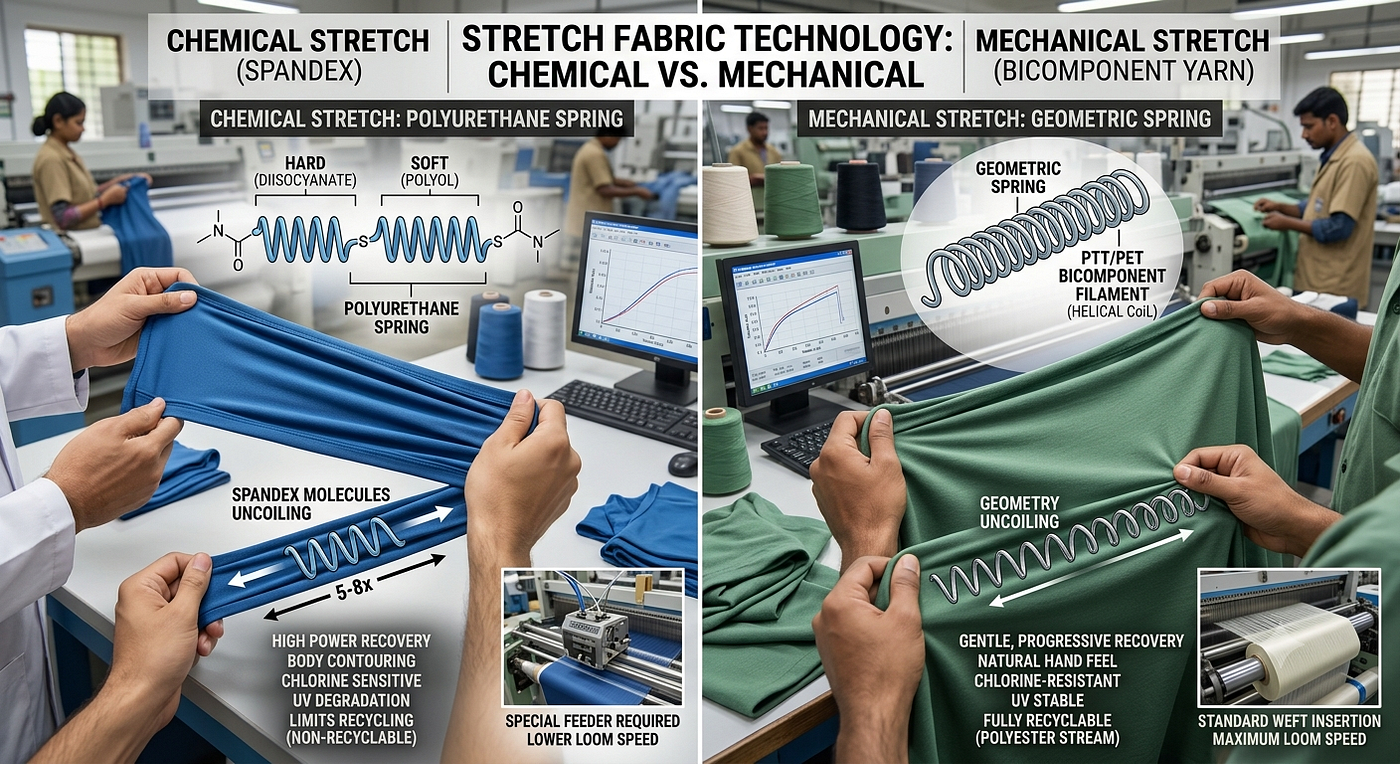
Every stretch fabric delivers its performance through one of two fundamentally different mechanisms. The first is chemical stretch elasticity derived from the molecular spring of a polyurethane or rubber polymer chain, as in spandex (elastane). The second is mechanical stretch elasticity derived from the physical geometry of a crimped, coiled, or looped yarn structure, as in bicomponent yarn.
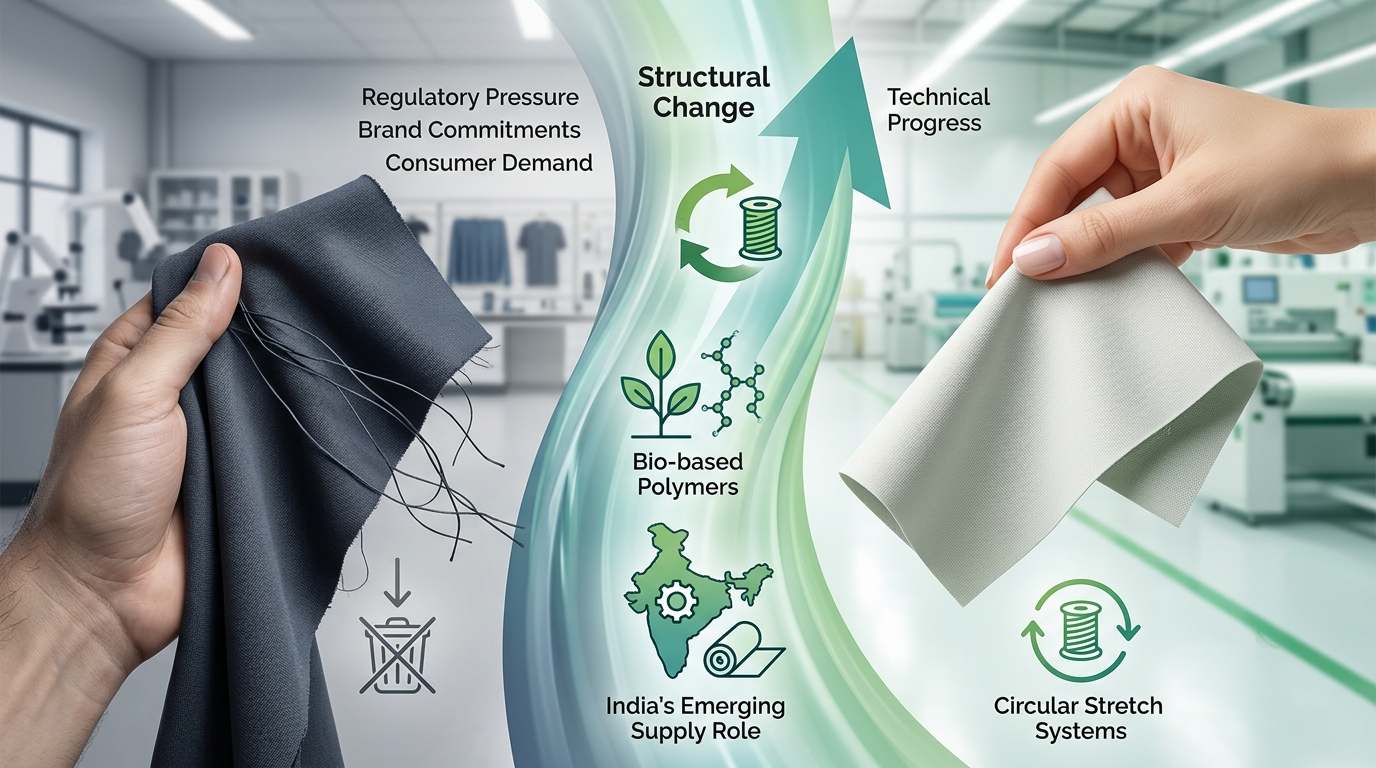
In the Indian textile industry, the vast majority of stretch fabric production has historically relied on chemical stretch. But the cost of spandex, the processing complexity it introduces, and the performance limitations it imposes have driven a significant and growing shift toward mechanical stretch primarily through PTT/PET bicomponent (elastomultiester) yarn.
How Each Mechanism Works
Chemical Stretch: The Polyurethane Spring
Spandex is a block copolymer with alternating hard segments (diisocyanate) and soft segments (polyol). The soft segments are long, flexible polymer chains that coil randomly at rest. When tension is applied, these chains uncoil and extend sometimes to 5–8 times their rest length. When tension is released, the chains return to their coiled state, pulling the fabric back to its original dimensions.
A small percentage of spandex (typically 2–8% by weight) can provide very high extension and powerful recovery this is why spandex-containing fabrics feel tight, supportive, and body-contouring.
Mechanical Stretch: The Geometric Spring
Mechanical stretch derives from the physical geometry of the yarn or fibre structure. In bicomponent yarn, each filament is a helical coil — like a miniature spring. To extend the fabric, you must straighten the coils. The resistance to straightening and the tendency to re-coil after tension release is the elastic mechanism.
Because the elastic energy is stored in the geometry of the coil (not in the chemical bonds of a polymer chain), the recovery force is gentler and more progressive than spandex. This is why bicomponent stretch fabrics feel softer, more yielding, and more natural to wear.
Processing Comparison for Indian Mills
Processing Parameter
Chemical Stretch (Spandex)
**Mechanical Stretch (Bicomponent)**
Yarn feeding on loom
Dedicated elastane feeder required (±2–3% tension variation max)
Standard weft insertion; no special feeder
Loom speed impact
15–25% below standard to manage spandex tension
No speed reduction required
Dyeing process
Risk of dye-resist at elastane/polyester interface
Uniform dye uptake across all filaments
Heat-setting temp
Max 180–185°C (elastane degrades above)
Up to 220°C without performance loss
Recycling at end-of-life
Not recyclable — disrupts polyester recycling
Recyclable in standard polyester streams
Performance Comparison over a Garment’s Lifetime
Performance Factor
Chemical Stretch
Mechanical Stretch
Wash cycles before stretch loss
~50–80 wash cycles
100+ wash cycles (permanent)
Chlorine resistance
Poor — degrades in pool water
Excellent — fully chlorine-resistant
UV resistance
Moderate — yellows with UV
Excellent — UV-stable polyester
Moisture management
Poor — polyurethane is hydrophobic
Good — polyester wicks moisture
Skin sensitisation risk
Some potential (polyurethane)
None — all polyester
When Should Indian Mills Choose Mechanical Stretch?
Mechanical stretch (bicomponent yarn such as Mestre®) is the better choice when: (1) The garment must maintain its shape and stretch over many wash cycles; (2) The fabric will be exposed to chlorine (swimwear, pool-wear); (3) The manufacturer wants to avoid import dependency on spandex; (4) The end buyer requires recyclable fabric for extended producer responsibility (EPR) compliance; (5) Processing on older looms without precision elastane feeders.
메타데이터
- post_id
- 9118a7df2e01
- slug
- mechanical-stretch-yarn-vs-chemical-stretch-yarn-full-technical-comparison-9118a7df2e01
- url
- https://medium.com/@jayrajpatel9638/mechanical-stretch-yarn-vs-chemical-stretch-yarn-full-technical-comparison-9118a7df2e01
- canonical_url
- https://medium.com/@jayrajpatel9638/mechanical-stretch-yarn-vs-chemical-stretch-yarn-full-technical-comparison-9118a7df2e01
- author_url
- https://medium.com/@jayrajpatel9638
- status
- ok
- fetched_at
- 2026-06-22 05:41:33