eTIMS Kenya: The Complete Guide Every Business Owner Needs in 2026
eTIMS is now the backbone of tax compliance for every business operating in Kenya.
eTIMS Kenya: The Complete Guide Every Business Owner Needs in 2026

eTIMS Kenya
eTIMS is now the backbone of tax compliance for every business operating in Kenya.
Whether you run a busy restaurant in Westlands, a pharmacy in Mombasa, a duka in Kisumu, or a boutique in Karen, eTIMS applies to you.
And yet many business owners still treat it as something to deal with later — until a customer refuses to pay without a compliant invoice, or KRA flags an audit. This guide removes every excuse to delay.
By the time you finish reading, you will know exactly what eTIMS is, who must comply, what the penalties look like, how to register, and how to make the whole thing effortless from day one.
What eTIMS Actually Means
eTIMS stands for the electronic Tax Invoice Management System.
It is the Kenya Revenue Authority’s platform for creating and transmitting electronic tax invoices in real time.
Every compliant invoice gets a unique control number and a QR code. KRA can see it, verify it, and match it against your declared sales — the moment it is issued.
Before eTIMS, Kenya used TIMS: a physical control box (ETR machine) that sat next to your till.
It was expensive, prone to breakdowns, and difficult to install for small or mobile businesses.
eTIMS replaced the hardware entirely.
The same job is now done in software — on a phone, a tablet, a desktop app, a web portal, or a certified POS system like Veira.
In practical terms, eTIMS is what turns a plain receipt into a tax invoice that KRA recognises.
A handwritten note, an M-Pesa confirmation, or a till slip with no control number is not enough anymore.
The compliant eTIMS invoice is the document your business customers need to claim their costs, and the one KRA expects to see behind every sale you declare.
It also helps to understand how eTIMS relates to iTax, because the two are often confused.
iTax is where you file returns and settle what you owe.
eTIMS is where the underlying invoices are created and transmitted live.
One is the monthly filing desk; the other is the real-time feed of every transaction.
Together they allow KRA to match your declarations against actual invoices — automatically.
Who Must Comply with eTIMS
This is where most owners get tripped up.
The common assumption is that eTIMS only applies to VAT-registered businesses with large turnovers.
That is wrong. Under Legal Notice №64 of 2024, every person carrying on business in Kenya is required to use eTIMS.
The scope is deliberately broad:
VAT-registered businesses were the first group brought in. If you charge 16% VAT, you must issue compliant electronic tax invoices for all your sales. This is firmly established and actively enforced.
Non-VAT businesses and small traders also need eTIMS — not to charge VAT, but so that buyers can claim the cost and so your own expenses are recognised. The non-VAT invoice simply has no VAT lines; the structure is otherwise the same.
Sole proprietors and freelancers are fully in scope. A consultant, contractor, or graphic designer invoicing a company is routinely asked for a compliant invoice before payment is released. Without it, the buyer either withholds payment or loses the deduction.
Landlords with rental income must also issue compliant invoices. Business tenants increasingly require them for their own tax records.
Informal and small-scale traders below KES 5 million annual turnover can be invoiced by their buyers through buyer-initiated invoicing, which shifts the compliance burden to the purchaser. But even traders in this group benefit from having their own eTIMS setup, since it confirms their credibility with larger customers and suppliers.
The test is not your size; it is whether you sell or buy. If you issue invoices, you need eTIMS. If you buy from businesses, you want your suppliers to have it so your costs remain deductible.
That makes eTIMS everyone’s concern, not just the concern of large corporates.
Read the full breakdown of who needs eTIMS in Kenya on the Veira eTIMS guide.
The eTIMS Requirements: What You Need Before You Start
eTIMS requirements fall into three buckets: who you are to KRA, how you will issue invoices, and what each invoice must contain. All three must be in place for genuine compliance.
Your KRA Profile
You need an active KRA PIN with valid iTax access. The phone number and email address on your KRA profile must be working and accessible to you, because verification codes go there during onboarding and every time you log in. An outdated contact detail is the single most common reason eTIMS registration stalls — and it is invisible until you actually try to register.
Go to iTax, check that your PIN is active, and update your contacts before you attempt onboarding. This single step prevents the most frequent delay.
Your Invoicing Method
KRA offers several options, each designed for a different type of business:
eTIMS Lite is the free phone-based app for low-volume traders — freelancers, service providers, casual invoicers. It is quick to set up and meets the requirements for occasional use.
Its limitation is that it is manual, which makes it impractical for any real counter activity.
The eTIMS portal suits businesses that need to issue invoices from a desktop or web interface but do not yet have a full POS system.
VSCU (Virtual Sales Control Unit) is for businesses running their own accounting or ERP software. It integrates eTIMS directly into your existing system via API.
OSCU (Online Sales Control Unit) is the integration used by certified POS providers.
When you use a KRA-certified POS like Veira, the OSCU handles transmission automatically — every sale is signed, assigned a control number, and sent to KRA without you doing anything extra.
Choosing the right method matters. A method that meets the technical requirements but cannot handle your actual volume fails in practice.
What Every Invoice Must Contain
Regardless of which method you use, every compliant eTIMS invoice must include: seller name, address, and KRA PIN; buyer details (including the buyer’s KRA PIN for B2B sales); a sequential invoice number; a description of each item or service; applicable VAT rate and amount; the total amount; and the KRA-issued control number and QR code generated at the moment of signing.
The QR code is how buyers and KRA verify authenticity. An invoice without it is not compliant, however official it looks.
eTIMS Penalties: What Non-Compliance Actually Costs
Non-compliance with eTIMS is not a theoretical risk. KRA is actively enforcing, and the consequences are more serious than most business owners realise.
The penalty for issuing a non-compliant invoice runs up to KES 1 million or 10% of the tax involved per occurrence, whichever is higher. For a business issuing hundreds of non-compliant invoices a month, the aggregate exposure is significant.
Beyond the direct penalty, non-compliance has two compounding effects:
Lost deductions. If you buy from a supplier who does not issue compliant eTIMS invoices, those expenses are non-deductible for income tax purposes. You pay corporation or business tax on a larger profit than your actual profit. This cost falls on you as the buyer, not the seller — which is why you cannot afford to be indifferent to your suppliers’ compliance.
Tax Compliance Certificate (TCC) blocks. The TCC is required to bid for government tenders, access certain licences, and pass due diligence from corporate buyers.
KRA now requires eTIMS registration as a condition for issuing a TCC. Without eTIMS, you are locked out of an entire category of contracts and customers.
There is also audit risk. eTIMS data creates an automatic cross-reference between what you declare and what you actually invoiced.
Any mismatch becomes visible to KRA without a physical inspection, which changes the risk calculus for everyone who has been under-declaring.
How to Register for eTIMS: Step by Step
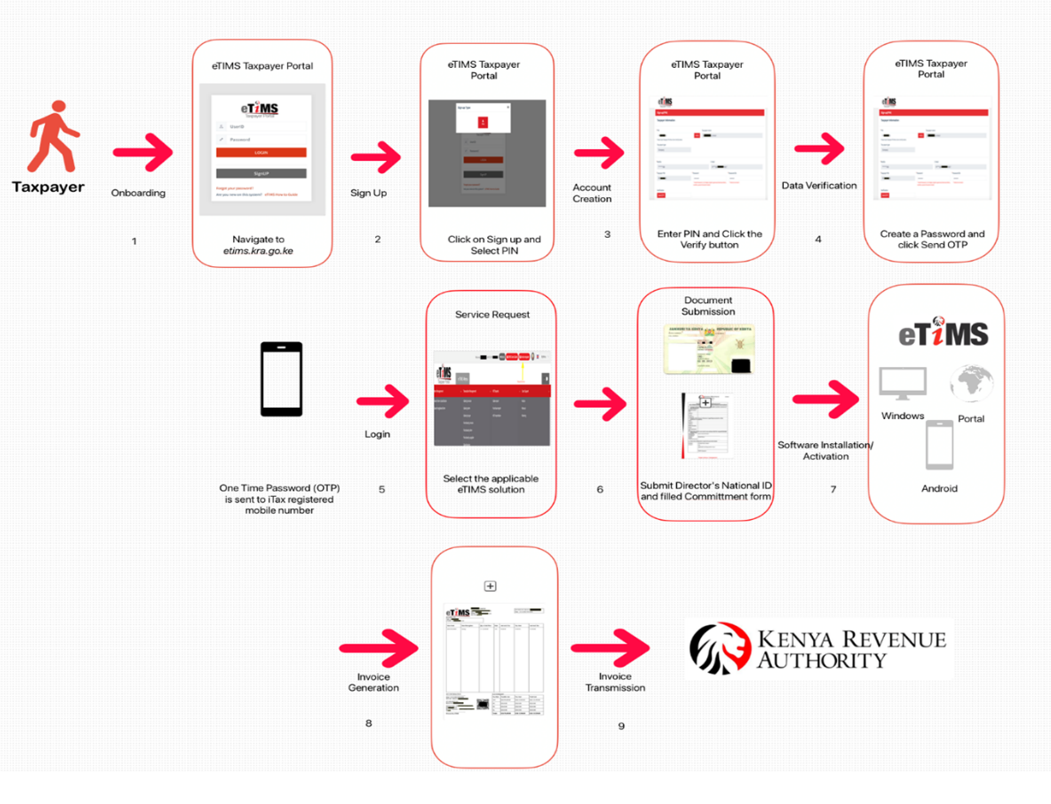
Registration is straightforward once your KRA profile is in order. Here is the process:
Step 1: Log in to iTax at itax.kra.go.ke using your KRA PIN and password. Confirm your profile is active, your obligations are current, and your contact details are correct.
Step 2: Navigate to eTIMS onboarding. From the iTax dashboard, go to the eTIMS section and start the registration process.
Step 3: Select your invoicing method. Choose from Lite, portal, VSCU, or OSCU depending on your business type and volume. If you are using a certified POS like Veira, select OSCU.
Step 4: Submit your business details. Provide your trading name, branch information, and contacts exactly as they appear on iTax. Mismatches cause verification failures.
Step 5: Upload any requested documents and wait for KRA approval. Most small businesses receive approval and are live within a few days.
Step 6: Issue a test invoice. This is the step most businesses skip. Issue one real test transaction and confirm that the invoice returns a control number and QR code.
Registration without a verified test invoice means you do not actually know your setup is working.
For businesses using Veira, the OSCU integration is set up as part of onboarding. You do not navigate eTIMS alone — the Veira team walks you through the KRA steps and verifies that your first sale transmits correctly.
Check your readiness before you start with the free eTIMS compliance checker.
eTIMS for Different Types of Kenyan Businesses
eTIMS looks slightly different depending on the nature of your trade. Here is how it applies across the most common business types.
Restaurants and Eateries
eTIMS for restaurants involves high transaction volume, split bills, M-Pesa and cash payments, and the need to issue invoices quickly without slowing service. Manual eTIMS Lite is not practical here. An integrated POS handles it automatically — every table order, takeaway, or delivery becomes a compliant invoice without the server doing anything extra.
Retail Shops, Dukas and Supermarkets
Supermarkets and general retail deal with mixed VAT rates (standard-rated goods, zero-rated, and exempt items), high SKU counts, and multiple cashiers. The eTIMS system must correctly apply the right rate to each product. A properly configured POS does this item-by-item rather than requiring staff to calculate it manually.
Pharmacies and Chemists
Pharmacies carry VAT-exempt medicines alongside standard-rated products like cosmetics and medical devices. Every sale must correctly classify the item. Errors in VAT classification produce invoices KRA rejects — and customers who are reimbursed by insurers are quickly affected.
Hardware and Building Materials
Hardware shops sell heavily to contractors on credit, issue LPOs (Local Purchase Orders), and handle large B2B invoices where the buyer’s KRA PIN is mandatory. A POS that supports credit accounts and LPO matching alongside eTIMS invoicing handles the full workflow, not just the tax element.
Salons, Spas and Service Businesses
Salons and service businesses typically have no stock, take cash and M-Pesa, and see clients who walk in without booking. eTIMS Lite may be enough for a single-chair salon. A growing salon with multiple stylists, product sales, and regular corporate clients will want an integrated solution.
Wholesale Traders
Wholesale involves large B2B sales where every invoice must carry the buyer’s PIN, large quantities on a single invoice, and buyers who are highly attuned to compliance since their own deductions depend on it. Volume makes manual invoicing impractical.
Boutiques and Fashion
Boutiques blend retail and service (alterations), take Instagram orders, use M-Pesa Pochi, and often carry seasonal inventory. The eTIMS requirement applies to all of these channels, not just in-store sales.
eTIMS Offline: What Happens When the Internet Drops
A common concern among business owners outside Nairobi’s central business district is connectivity. The eTIMS system has an offline mechanism precisely because KRA anticipated this.
For certified POS integrations using OSCU (like Veira), invoices are signed locally at the moment of sale and queued in the device. The moment connectivity is restored, they transmit to KRA. The invoice is valid from the point of signing, not from the point of transmission — so trading through a connectivity gap does not produce non-compliant invoices.
eTIMS Lite, the phone-based app, is more dependent on a live connection. For businesses in areas with intermittent internet, an OSCU-based POS with true offline-first architecture is more reliable.
eTIMS and VAT: Understanding the Relationship
eTIMS and VAT are related but not the same. VAT is a tax on consumption, charged at 16% on standard-rated supplies. eTIMS is the invoicing system used to record and transmit all sales — whether or not VAT applies.
A VAT-registered business uses eTIMS to issue invoices that include VAT calculations, and those invoices feed directly into the VAT return. KRA’s system auto-populates parts of the return from eTIMS data, which reduces manual entry and reduces the risk of mismatches. When your declared output VAT does not match the total VAT on your eTIMS invoices, KRA notices.
A non-VAT business uses eTIMS to issue invoices without VAT lines. The process and the requirements for the invoice structure are otherwise the same.
Getting VAT right on every item is one area where an integrated POS earns its value. Veira’s platform allows you to configure the correct VAT treatment item by item, so every invoice is accurate from the product catalogue rather than from manual calculation at the point of sale.
Common eTIMS Mistakes Kenyan Businesses Make
Understanding the rules is one thing. Avoiding the specific errors that trip businesses up in practice is another. These are the most common ones:
Treating registration as the finish line. Registering for eTIMS is step one, not the whole job. You must actually issue compliant invoices for every sale. Many businesses register, tick the mental box, and continue issuing handwritten receipts. KRA sees the registration but no invoice activity — which is itself a flag.
Assuming M-Pesa confirmation is a tax invoice. An M-Pesa message proves payment. It does not constitute a tax invoice. Your customer cannot use it for a deduction; KRA does not accept it as evidence of a sale. The compliant eTIMS invoice is a separate document.
Ignoring the buyer PIN requirement. Business-to-business invoices must include the buyer’s KRA PIN. Without it, the buyer cannot claim the cost, will request a corrected invoice, and may withhold payment until one is provided. Building PIN capture into your invoicing workflow from the start avoids this friction entirely.
Choosing the wrong method for your volume. eTIMS Lite meets the requirements technically for a business issuing a handful of invoices a month. It does not work practically for a shop serving 150 customers a day. The method must fit the real volume.
Leaving suppliers on manual invoices. Your own compliance does not protect you if your suppliers are non-compliant. Your purchases paid without eTIMS invoices are non-deductible. You have a direct financial incentive to encourage — or require — your suppliers to comply.
How Veira Makes eTIMS Effortless
Veira is a KRA-certified POS platform built specifically for Kenyan merchants. It handles eTIMS automatically at the point of sale — every sale produces a compliant invoice with the correct VAT, a control number, and a QR code, without any extra steps from the cashier or owner.
It runs on iOS and Android, on the phone you already own, plus a free handheld terminal. It works offline, with invoices signed locally and transmitted to KRA when connectivity returns. It supports M-Pesa Pochi la Biashara and card payments. It tracks inventory, supports credit accounts, and generates the reports your accountant needs. And it is designed for the full range of Kenyan businesses — restaurants, retail shops, pharmacies, hardware stores, salons, boutiques, wholesalers, and many more.
The eTIMS setup is handled as part of onboarding. You do not need to navigate KRA’s portal alone. And because Veira is an OSCU-certified integrator, your invoices are transmitted directly to KRA — there is no manual export, no re-entry, and no risk of forgetting to file.
If you are currently managing eTIMS through Lite or a manual process and your business has grown past that, the switch to Veira is straightforward. There is nothing to migrate from KRA’s side; you simply change your transmission method.
Start with the free eTIMS compliance checker to see where you currently stand, or go straight to Veira’s pricing page to start a free trial.
eTIMS Deadlines and the Current Enforcement Position
KRA has been rolling out eTIMS since 2023. The initial phase targeted large VAT-registered taxpayers. Subsequent phases have progressively brought in smaller businesses, non-VAT taxpayers, and eventually all persons carrying on business under Legal Notice №64 of 2024.
As of 2026, KRA’s enforcement is active. Businesses found issuing non-compliant invoices face penalties. TCC applications from unregistered businesses are blocked. And KRA’s matching of declared income against eTIMS invoice data is running automatically.
The window for treating eTIMS as optional has closed. The full eTIMS deadlines and enforcement timeline is available on the Veira blog if you want the specific dates.
Final Word
eTIMS is not a temporary compliance burden that will eventually go away. It is the new infrastructure of business in Kenya — the mechanism through which every sale is recorded, every cost is verified, and every tax obligation is tracked. The businesses that treat it as foundational, rather than as an afterthought, are the ones that avoid penalties, keep their costs deductible, qualify for tenders, and earn the confidence of serious buyers.
The practical barrier to compliance is lower than most business owners expect. A clean KRA profile, the right invoicing method for your volume, and the correct fields on every invoice are all it takes. For most businesses, the right method is a certified POS that handles the invoice requirements automatically.
If you are ready to sort it: check your compliance position with the free eTIMS compliance checker, browse the full eTIMS guide for your specific trade, or start a free trial with Veira and have your first compliant invoice live by tomorrow.
메타데이터
- post_id
- 9126ecdb286a
- slug
- etims-kenya-the-complete-guide-every-business-owner-needs-in-2026-9126ecdb286a
- url
- https://medium.com/@veira8140/etims-kenya-the-complete-guide-every-business-owner-needs-in-2026-9126ecdb286a
- canonical_url
- https://medium.com/@veira8140/etims-kenya-the-complete-guide-every-business-owner-needs-in-2026-9126ecdb286a
- author_url
- https://medium.com/@veira8140
- status
- ok
- fetched_at
- 2026-06-16 19:09:56