Berkshire Hathaway Intrinsic Value
In this article, I’ll show you how to calculate Berkshire Hathaway’s Intrinsic Value.
Berkshire Hathaway Intrinsic Value
In this article, I’ll show you how to calculate Berkshire Hathaway’s Intrinsic Value.
If you’ve found this article, you probably know all about Warren Buffett, Berkshire Hathaway and value investing. I’ve found a lot of blog posts online that either tell you they will help you value Berkshire Hathaway (and never do), or they do it with such complexity, it is no help at all.
The purpose of this post is to show you how to value Berkshire Hathaway in a simple and straight forward way.
If you have no idea how to value a business, I suggest you read this article first. That way, you’ll have the right foundation, since valuing Berkshire is like valuing any company, just more complex.
Why Is Valuing Berkshire Hathaway A Little Tougher?
Berkshire Hathaway owns many companies and stocks. Some of the companies they own 100% of, or a large majority. With their stocks, they may own just a tiny stake. So we aren’t really valuing one company when we value Berkshire Hathaway — we are valuing all the companies inside Berkshire Hathaway.
Two Steps To Valuation
Step 1 is to find the free cashflow of the companies Berkshire Hathaway owns (which is found in their annual report).
Step 2 is to find the free cashflow for each of the companies Berkshire Hathaway owns stock investments in.
Then, we simply add them together.
By the way — there are a thousand subtleties you could add to make the valuation more complex since Berkshire is a portfolio of many companies.
However — as Buffett himself has said — it is better to be roughly right than precisely wrong.

Step 1 — Find The Free Cashflow For Berkshire’s Fully-Owned Businesses
This is pretty straightforward.
We find the 3 year average of free cashflows. At the time of writing, they are $25B. We also find the net cash, which at the time of writing is $27B.
Step 2— Find The Free Cashflow For All The Businesses Berkshire Owns
This is also straightforward, just time consuming.
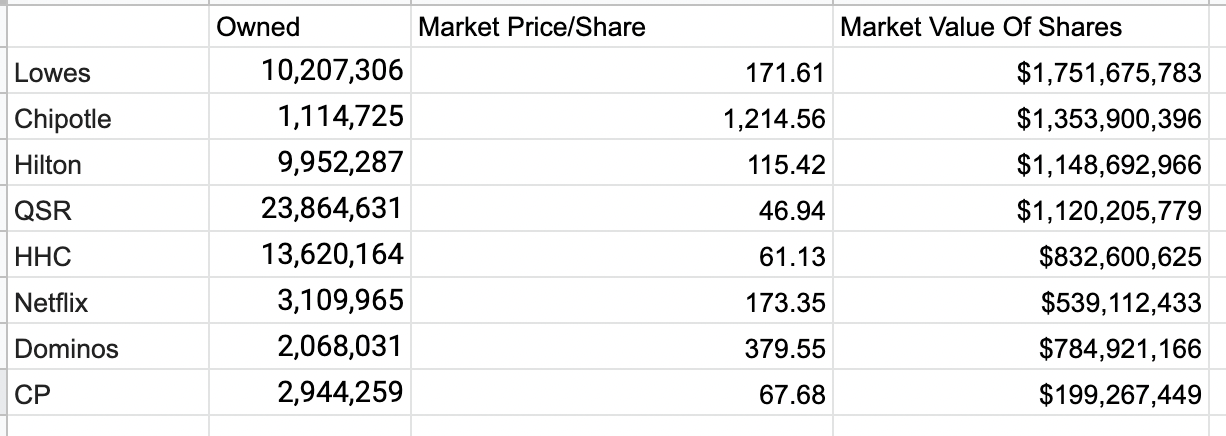
Here, we do the exact same thing we did in step 1, but we do it for all the companies Berkshire Hathaway owns stock in. Here is the list.
One disclaimer here — Berkshire Hathaway does not own 100% of say, Apple. They own 5.8% of it. So they do not get all of Apple’s $92.4B free cashflow (3 year average). Instead, they get 5.8% of that $92.4B, which is roughly $5.3B. (92.4 x .058 = 5.3).
The same goes for Apple’s net cash. Sure they have $55.8B in net cash, but Berkshire only “owns” 5.8% of that. (55.8 x .058 = $3.23B).
Finally, we cannot take 100% of the free cashflow or net cash for all businesses. If free cashflow is in decline, we should apply an additional margin of safety to it. If cash is needed (for example with a bank), you might take 0% of the cash. If the business has 10X this year because of oil prices and inflation, you may want to take a 10 year after, instead of a 3 year average. None of these are, or can be precise. The future is hard to predict. Just wherever possible, I advise you to err on the side of caution and be conservative.
Example: Calculating The Free Cashflow and Net Cash Berkshire Owns For Each Stock Holding


We now sum up all the free cashflow Berkshire owns for each stock holding and we get:
$20.6B
As well, we sum up the net cash Berkshire owns for each stock holding to get:
$25.4B
We now add the free cashflow from Berkshire’s fully owned businesses to Berkshire’s share of ownership of the free cashflow from stocks:
$25 + $20.6 = $45.6B
We do the same with the net cash, adding the net cash from Berkshire’s fully owned businesses to Berkshire’s share of ownership of the net cash from their stock holdings:
$27 + $25.4 = $52.4B
Side Note
As a quick aside, $20.6B is from Berkshire’s share of free cashflow from their stock holdings. 46.44% of their total stock holdings are in Apple. That means $5.3B of their free cashflow is from Apple, and $3.2B of their net cash is from Apple. People talk about Berkshire’s concentration risk in Apple, but Apple represents only 11.5% of their free cashflow and 6% of their cash. Definitely a big position, but not the only one, by far.
What Should You Pay For Berkshire Hathaway?
Well, as always, that is determined by what return you want.
If you assume Berkshire’s free cashflow at $45.6B doesn’t grow, and stays constant forever, and you wanted 20% returns, you would pay: $228B (45.6/.20). But of course, you’d need to add the net cash to the price so $52.4 + $226 = $280.4B
So you could say, Berkshire’s intrinsic value with no growth, for someone demanding a 20% yield would be $280.4B.
What about a 10% yield? Here we get $456B + $52.4B in cash for a total of $508.4B.
Now, Let’s Look At The Price
When I look online, I can see that the market cap of Berkshire Hathaway is $744B.
What kind of return do I get at those prices?
$744 — $52.4 in net cash = $691.6B
45.6 / 691.6 = 6.6% no growth returns
That means if I buy Berkshire today, and earnings stay the say, I will get 6.6% returns.
Having said that, I have noticed Berkshire is doing buybacks of 1% a year roughly.
For that reason, we get 7.6% returns at current market prices.
Is Berkshire Hathaway A Deal, Or Expensive?
That question really depends on your return standard.
If you want 20% returns with no growth, Berkshire is expensive.
If you are okay with 7.6% returns, then Berkshire is fairly priced.
If Berkshire is able to grow earnings at 7.4% a year, you will earn 15% returns from holding the stock, even at today’s prices.
Summary
Say you speak to a friend, and they tell you that they bought Berkshire for $600B. Now, they tell you it is overpriced since it is at almost $700B.
Looking at the per share cost, that would be about $275 a share. Now, at $341 a share, you are wondering if you’ve missed the boat.
Let’s compare:
$600–52 in cash = $548B
$700–52 in cash = $648B
FCF yield of $45.6B on $548B = 8% (with buybacks you get 9%)
FCF yield of $45.6B on $648B = 7% (with buybacks you get 8%)
It doesn’t change THAT much about the thesis.
Either way you get 7–9% returns with no growth.
So it’s really a question of what you think growth will be, and how sure you are. Or, maybe you are happy with 7–9% returns in a diversified group of world class businesses, assembled by the best there ever was.
I’ll leave that to you.
A Message from InsiderFinance

Thanks for being a part of our community! Before you go:
- 👏 Clap for the story and follow the author 👉
- 📰 View more content in the InsiderFinance Wire
- 📚 Take our FREE Masterclass
- 📈 Discover Powerful Trading Tools
메타데이터
- post_id
- 9168c453da23
- slug
- berkshire-hathaway-intrinsic-value-9168c453da23
- url
- https://wire.insiderfinance.io/berkshire-hathaway-intrinsic-value-9168c453da23
- canonical_url
- https://wire.insiderfinance.io/berkshire-hathaway-intrinsic-value-9168c453da23
- author_url
- https://medium.com/@valuebob
- status
- ok
- fetched_at
- 2026-07-25 12:50:32