When “I Might Fail” Became “Let’s Give It a Try” Plugin Team Leader Mikumon | Eukarya Observation…
It’s been five years since Mikumon-san joined Eukarya as our very first new graduate hire.

When “I Might Fail” Became “Let’s Give It a Try” Plugin Team Leader Mikumon | Eukarya Observation Log
It’s been five years since Mikumon-san joined Eukarya as our very first new graduate hire.
In that time, she moved from design to HR, then to PM (Project Manager), and eventually to the role of Plugin Development Team Lead.
Looking back, her path is also the story of a young person who was once terrified of failing — but learned to push through that fear and seize growth with her own hands.

Five years at Eukarya: From Its First New Graduate Hire to Team Leader
━━ First, could you tell us what you’re currently working on?
Sure. Right now, I mainly handle two roles.
One is serving as the leader of the plugin development team.
The other is working as the project manager for an initiative that uses Kumagaya City’s 3D urban model.
When we say plugin, we mean features that don’t come built into **Re:Earth** by default. They’re additional modules we develop to meet specific client needs or use cases — basically, custom add-ons that get attached to the platform. Depending on what our clients want to achieve, we build out the necessary parts.
The Kumagaya City project is part of the Ministry of Land, Infrastructure, Transport and Tourism’s 3D urban model initiative called **Project PLATEAU**.
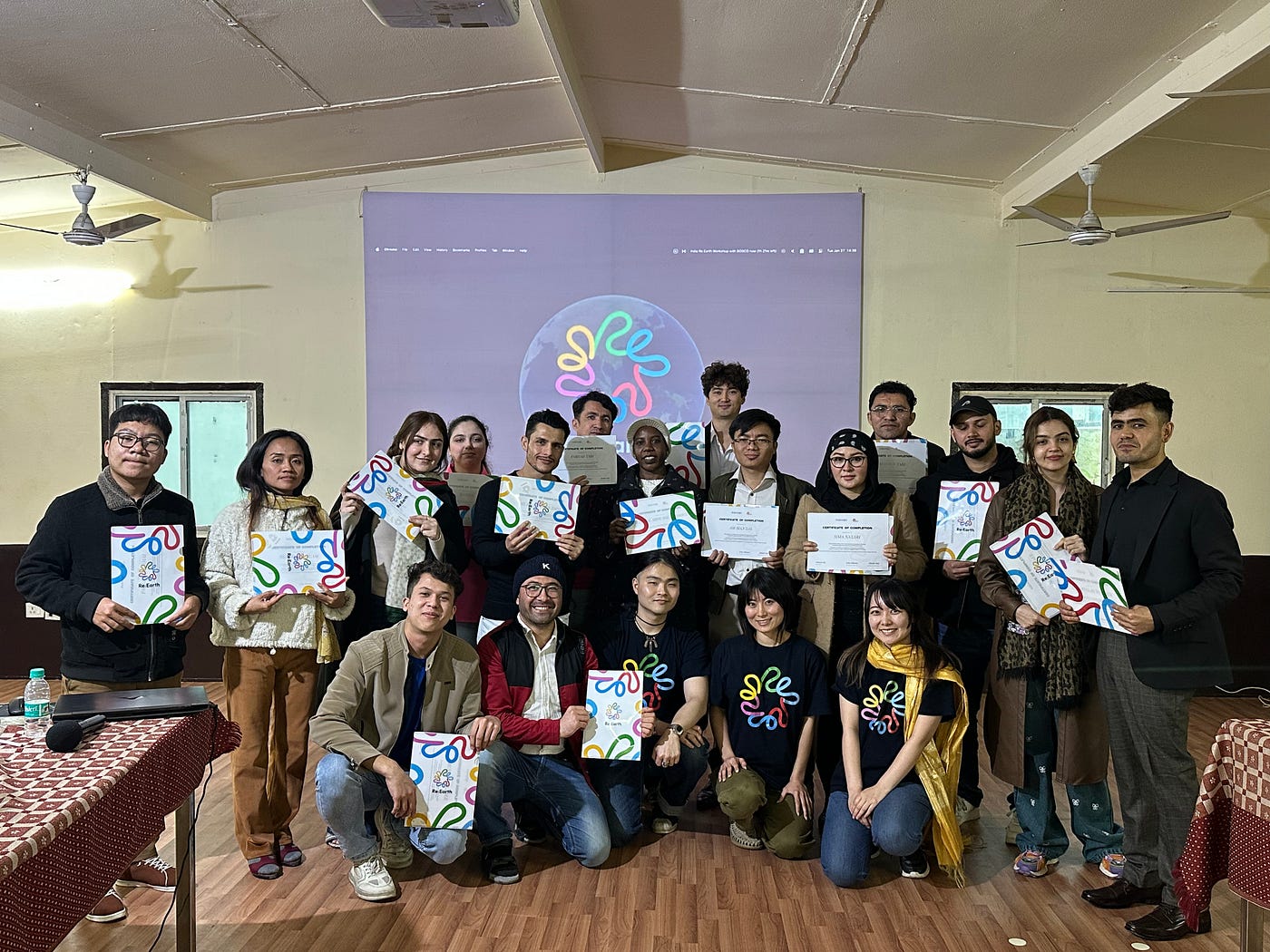
We produce various visualizations using urban data and promote the use of 3D city models in disaster preparedness, community planning, tourism, and environmental/energy fields — often through workshops for citizens and students.
━━ I heard you were Eukarya’s very first new graduate hire. How has your role evolved over the years?”
Well… honestly, my carrer path is pretty crazy haha.
I first joined Eukarya as an engineering intern, then shifted into design, then moved into HR. The year after that I became a PM, and now I’m leading the plugin development team.
Since I joined when the company had fewer than ten employees, I guess it was natural that my role kept changing again and again.
━━ How do you feel about constantly taking on different roles?
Actually, I’m enjoying it.
It’s great to see the field from so many different angles.
When I first started working in HR and PM, I really felt just how tough it is to do something completely new. It was exhausting.
But at the same time, there’s a kind of joy in creating something from scratch — going from 0 to 1.
Of course, in the beginning I worried, like, “Won’t this just leave me with half-baked skills…?”
But looking back now, I think that variety actually worked in my favor.
━━ How so?
Right now I’m on the plugin team, but because I used to work in design, I can handle UI/UX design myself.
And having gone through PM before becoming a team lead, I often feel like I’m able to see projects from a broader, more holistic perspective.
My early engineering knowledge supports my design work, and it also helps me communicate with engineers from the standpoint of PM or team lead.
And when I talk with clients or external partners, the fact that I’ve experienced so many different roles makes it easier for me to explain things clearly.
━━So everything you’ve done so far is coming together and creating synergy.
Exactly. Although… that might just be something I can say now (haha).
Hard Skills and the Drive to Create “0 → 1”

━━What first sparked your interest in Eukarya?
Back in university, I joined a short-term engineering and entrepreneurship program called “Techpreneur Dojo” — That was the biggest turning point for me.
It was essentially a one-month summer bootcamp with the theme, “Let’s become engineers in a single month of summer vacation.”
I signed up to that program because I really wanted to become an engineer at that time.
It was a selective program, and participants gradually dropped off as things got tougher. Near the end, two of Eukarya’s founding members came in as mentors to teach coding.
They were the ones who approached me later, and that’s how I ended up joining Eukarya as a student intern — around the same time that Baba-san, now our VPoR&D, also joined.
━━ What made you want to become an engineer in the first place?
I was studying in the Commerce department then — learning about management and economics. But those subjects are mostly soft skills.
I wanted something more concrete, something not dependent on context.
That search for hard skills — skills that let you create value from scratch — led me to the idea of doing “0 → 1” work, and that’s when I came across engineering.
I also didn’t want to be tied to any particular location, so IT, with its stronger culture of remote work, felt like the right path.
━━So what made you ultimately decide to join Eukarya?
When I first joined as an intern, I was planning to become an engineer.
But while I was helping create the logo and UI for the product we were developing — and learning from the other members — I found myself drawn into the world of design.
Back then, Eukarya was even smaller than it is now, with fewer than ten people.
Even as an intern, I was trusted with building out the design system, which gave me a real sense of ownership and purpose. And more than anything, the people at Eukarya were just incredibly inspiring.
There were people who excelled at design, people who could code, people who were amazing at articulating ideas… a group with such diverse strengths, unlike anyone I had met before.
That’s what ultimately made me want to join.
In My Third Year as a New Grad, I Faced Work With No “Right Answers”

━━ It sounds like your early journey was smooth, but what happened after joining the company?
Well… this is another one of those things I can only say now (laughs), but when I was assigned as the PM for the Kumagaya project in my third year, I honestly thought, “I’m not ready for this… I’m totally out of my depth.”
I was pretty discouraged.
Part of it was my own lack of confidence. But also, back then Eukarya barely had any training, learning support, or onboarding systems — honestly, they were almost nonexistent (laugh awkwardly).
And since we were chronically understaffed at the time, decisions often went like, “Okay, then Mikumon-san will be the PM for this project.”
But no one had the bandwidth to walk me through anything. I was basically dropped in and expected to figure it out.
I really tried my best with what little I understood, but I ended up causing trouble for clients and for the team in ways that still make me wince today.
At my lowest point, I seriously considered quitting — and even talked to people in the company about it.
━━What helped you recover from that?
Talking to people — especially CEO Tamura-san, HR’s Sato-san, and CPO Ogihara-san.
They told me things like, “There’s no single right answer for PMs or for leaders,” and, “Even if you fail once, you can always make up for it as long as you keep going.”
I think the biggest change was that I was finally able to let those words sink in.
Looking back, I was constantly anxious about whether what I was doing was “correct.”
But hearing “There’s no such thing as the correct answer,” and “Even if you think you messed up, you can make it right by putting in the effort afterward” helped dissolve that anxiety.
From that point on, I felt myself shifting — “Oh, if there’s no right answer, then all I can do is believe in myself and do my best.”
━━ So the people around you really supported you.
Yes. And around that time, I also started to genuinely understand the power of words.
Words are amazing — they can completely reframe the world and how you see it.
In the early days of my career, I often couldn’t articulate things because my emotions came first.
But as you know, no one can understand “what am I really struglling” or “how can I solve the problem” unless we put it into words.
Even clumsy words are better than silence. In work, the bare minimum is to express what you perceive.
Working at Eukarya made me realize just how essential language really is.
I used to be really bad at writing, but these days I’m starting to think, “Maybe I actually enjoy writing?” I’ve been putting more and more into words lately.
━━ So your relationship with language has changed.
It has.
In fact, the very first thing I struggled with at Eukarya was writing reports and proposals.
I could manage conversations well enough — Slack messages and daily communication were fine.
But when it came to persuading someone or creating documents, sitting down to write long-form text from scratch felt impossible.
I think I simply hadn’t had as many opportunities to write compared to others.
I’ve always loved drawing, and I used to think, “Maybe I prefer drawing because I’m bad at words.”
So for a while at Eukarya, I actually practiced writing.
And during that time, I suddenly remembered — “Wait, didn’t I actually like writing essays when I was a student? Wasn’t I even good at it?”
I realized that somewhere along the way, as I became an adult, I picked up this belief that I was “bad at writing” or “bad at putting things into words.”
And that belief alone might have been stopping me from doing something I was perfectly capable of.
It’s not just writing — there are so many things like that in life.
But through the failures and stumbles I experienced at Eukarya, I’ve started to feel that the real question isn’t “Can I do it or not?”
It’s “Do I believe I can do it or not?”
Building a Team in a Fully Remote Organization

━━ As the leader of the plugin team, what do you consciously focus on?
There are a lot of things, but above all, I try to speak honestly and ask questions whenever I don’t understand something.
I’ve often felt anxious in the past when I didn’t get enough background information or when decisions weren’t clearly communicated.
So as much as possible, I don’t want my team members to feel that same uncertainty.
I always want to know why something was decided — not just “Here’s the decision,” but the reasoning and the path that led to it.
And especially because Eukarya is a fully remote organization, I’m very intentional about putting things into words and communicating proactively.
━━ Are there challenges that come specifically from being fully remote?
Definitely. And honestly, as long as we’re fully remote, it’s something we’ll always face to some degree.
It’s really difficult to synchronize information and make sure everyone absorbs it at the same time.
Because of that, we often get reactions like,
“Oh, you were doing that?”
or
“When did that decision get made?”
In an office setting, people naturally pick up info from casual chats or simply by being in the same environment.
But at Eukarya, we’re fully remote — with different time zones and different cultural backgrounds — which makes it much harder to recreate that kind of shared awareness.
Sometimes people just want to casually ask for advice, but setting up a meeting for something small suddenly makes it feel formal and stiff.
So within our team, we try to keep things as relaxed and easy-going as possible, even in a remote setting.

━━ Is there anything you’d like to try in the future to help improve Eukarya’s organizational culture?
Being fully remote makes it especially important to create an environment where answers are found in documentation or databases.
We aim to create a shared understanding that doesn’t depend on asking someone directly. By documenting information, including the process behind decisions, we reduce friction, duplicated effort, and the quiet rework that happens when knowledge isn’t visible.
And actually, I think that by organizing internal information — using tools like Notion — we can also deepen our understanding of **Re:Earth CMS**.
If everyone can intuitively understand how databases are structured, what’s needed to manage them, and where people typically get stuck, we’ll also gain insight into what’s happening inside our own product and on the client side.
I want us to run internal workshops too.
Through that kind of hands-on exploration, I’d love to transform things that often feel “hard to grasp” or “overly complex” for non-engineers into something that feels clear and understandable.
━━ That idea of hosting internal workshops feels very “Eukarya-like.”
That’s true — the culture of knowledge sharing here is incredibly strong.
We have Input Day, and there are events like GISDay organized by Asahina-san and others, as well as many study groups and learning sessions.
I feel that spaces for acquiring and sharing knowledge — and workshops initiated voluntarily by members — are really valued at Eukarya.
What I’ve Learned in an Organization That Demands Ownership

━━ Beyond knowledge sharing, is there anything about Eukarya that you find uniquely appealing — something you feel you couldn’t have experienced anywhere else?
Gosh, there are so many of those things.
At Eukarya, you end up feeling like everything is something you do yourself.
Of course, we’re part of a company, but in some ways it feels almost like a collection of small independent shops — each person running their own little business within the organization.
If you take initiative, things start moving.
It’s not enough to simply say, “It’d be nice if we did this.”
You actually have to start something yourself.
You need to have your own vision, clearly and firmly.
In short, it’s an organization that really demands ownership.
You’re constantly evaluating the situation and making your own judgments.
It’s truly like daily brain training.
━━ It sounds like you genuinely find that environment comfortable.
I do.
Eukarya has many academic-minded people — people with master’s or doctoral degrees, people who continue research and write papers while working full-time.
Being surrounded by people like that, I feel like I’m learning how to work hard and take things seriously — something I didn’t really do before.
━━ So it’s like, “I tried it, and it turned out to be fun”?
Exactly.
I’ve never gotten excited about things that were simply handed to me.
Maybe because I never found that spark in my student years, I’m grateful I get to learn it here now.
If You Keep Giving 120%, Something New Will Always Emerge

━━ Is there something you want to try at Eukarya, or any goals you have going forward?
At the end of the day, I think I just really love creating things from 0 → 1.
For example, right now we’re working on making a plugin developed for one city’s project usable by other municipalities as well. Rather than simply “lending out a plugin created for the first city,” we’re trying to build a framework where plugins and systems developed by other municipalities can also be shared and reused across the board.
That’s the direction we’re aiming for.
The reality is that many municipalities currently develop plugins tied to individual, project-based contracts — so even if a great plugin is created, it’s hard to reuse or adapt it elsewhere because of differences in contract structures or project scopes.
That’s why we’re aiming to create a system that enables municipalities to share their deliverables with one another. By doing so, we hope to reduce development costs and encourage the exchange of know-how.
If such a framework existed, one city could create a disaster-prevention plugin, another could create a tourism or vacant-housing one.
They could use each other’s work, improve them, and gradually — as a network — develop shared public digital assets across the country.
Even for the municipality acting as the first mover, this kind of horizontal expansion can make it possible to move more quickly into areas that would be difficult to tackle alone.
Just as I wanted to reduce “you won’t know unless you ask” situations, and avoid duplicate work or reinventing the wheel inside Eukarya,
I want to reduce unnecessary difficulty and uneven access to information not just within the company, but across municipalities — and even society.
I want to work on new and interesting things, and I want to reduce friction wherever possible.
I’m always searching for solutions that are simple, elegant, and naturally fall into place.
And to make that happen, I believe the first step is to keep giving 120% to what’s right in front of me.
If I keep doing that, something new will inevitably emerge —
That’s what I believe.

메타데이터
- post_id
- 917b401bbbfa
- slug
- when-i-might-fail-became-lets-give-it-a-try-plugin-team-leader-mikumon-eukarya-observation-917b401bbbfa
- url
- https://medium.com/@eukarya/when-i-might-fail-became-lets-give-it-a-try-plugin-team-leader-mikumon-eukarya-observation-917b401bbbfa
- canonical_url
- https://medium.com/@eukarya/when-i-might-fail-became-lets-give-it-a-try-plugin-team-leader-mikumon-eukarya-observation-917b401bbbfa
- author_url
- https://medium.com/@eukarya
- status
- ok
- fetched_at
- 2026-07-14 22:17:22