Hybrid RIS for 6G ISAC: A Deep Dive
A technical review of passive, active, hybrid, and multi-functional RIS architectures for 6G ISAC systems.
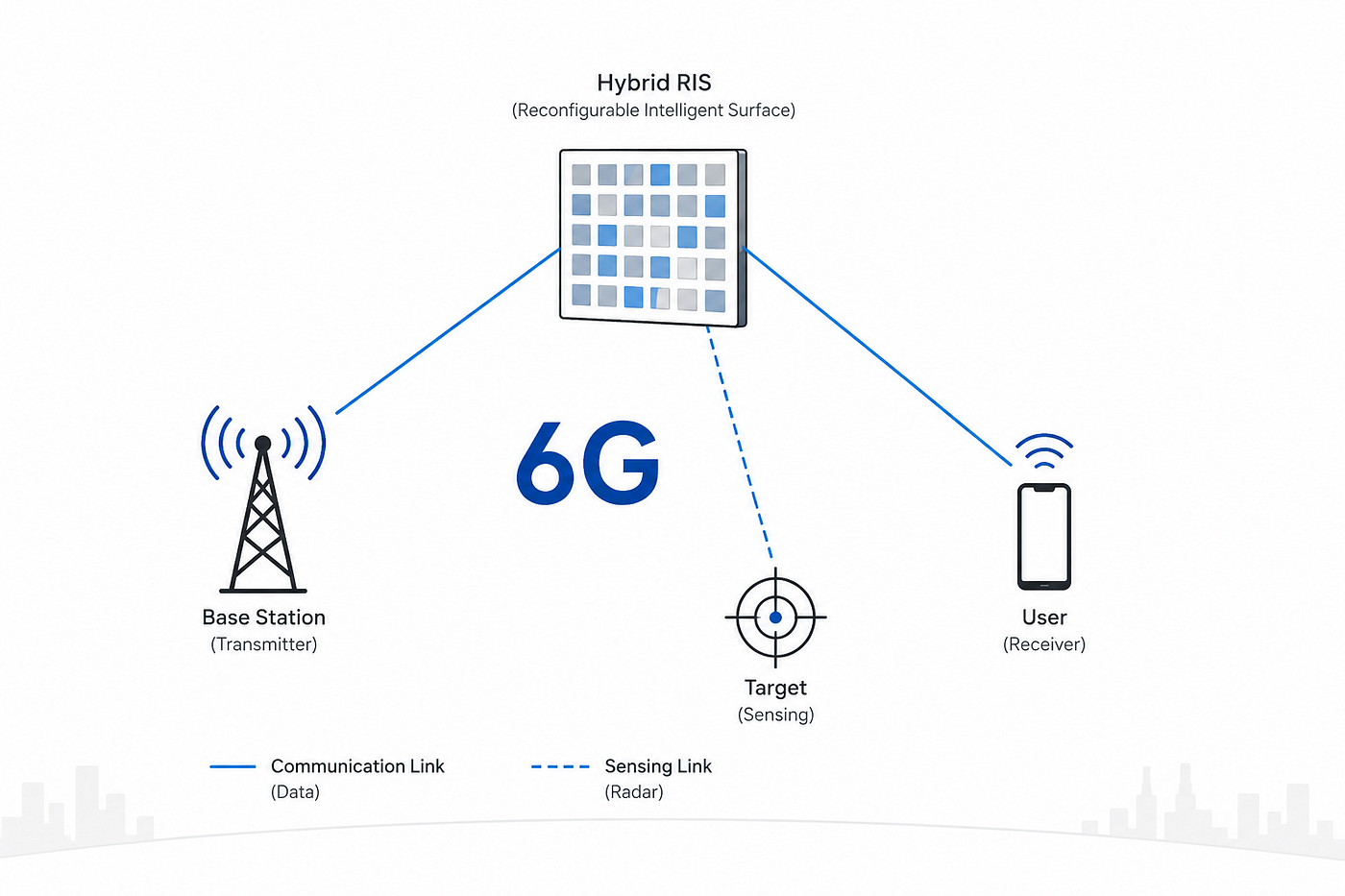
Multi-Functional and Hybrid Reconfigurable Intelligent Surfaces for 6G Integrated Sensing and Communications: A Deep Dive
**Keywords: **Reconfigurable Intelligent Surface (RIS), Integrated Sensing and Communication (ISAC), Hybrid RIS, Multi-Functional RIS, 6G Wireless Networks, Beamforming, Active RIS, Passive RIS, DFRC, Electromagnetic Reconfiguration
Abstract
The transition to 6G is creating new opportunities and challenges for wireless communication networks. These future networks are expected to support both high-speed communication and accurate environmental sensing. Reconfigurable Intelligent Surfaces (RIS) have gained significant attention as a promising technology that can control and optimize the propagation of electromagnetic waves through programmable surface elements [1], [2], [4], [12].
This article provides a review of recent developments in RIS-assisted Integrated Sensing and Communications (ISAC), focusing on passive, active, hybrid, and multi-functional RIS architectures [1], [2], [10], [12]. The main characteristics, advantages, and limitations of these architectures are discussed and compared based on recent studies.
In addition, the article examines how RIS can improve the performance of ISAC systems through beamforming optimization, signal processing techniques, and Artificial Intelligence (AI)-based approaches [5], [6], [9], [11]. Recent research on security, energy efficiency, and wireless-powered communication networks is also reviewed [3], [7], [8]. Finally, the main challenges of implementing RIS-assisted ISAC systems are highlighted, and several future research directions for 6G networks are presented [1], [2], [4], [12].
Introduction
The development of 6G is changing the way researchers think about wireless networks. Future systems are expected not only to deliver faster communication but also to understand and interact with their surrounding environment. This shift has increased interest in technologies that can improve both connectivity and sensing capabilities at the same time [1], [2].
Among these technologies, Reconfigurable Intelligent Surfaces (RIS) have emerged as one of the most actively studied research areas. Instead of treating the wireless environment as an uncontrollable factor, RIS allows it to become a programmable part of the network. By intelligently manipulating electromagnetic waves, RIS can help overcome signal blockages, extend coverage, and improve overall system performance [1], [4], [12].
Recent research has moved beyond traditional passive RIS designs. Hybrid RIS architectures introduce active elements capable of signal amplification, while multi-functional RIS platforms can perform multiple tasks simultaneously, including reflection, transmission, sensing, and computation [1], [5], [10]. These developments have made RIS an important candidate technology for future Integrated Sensing and Communication (ISAC) systems.
As a result, research activity in this field has grown rapidly during the last few years. New studies have investigated beamforming optimization, physical-layer security, energy-efficient designs, machine learning techniques, and advanced RIS architectures for different wireless scenarios [3], [6], [7], [8], [9], [11]. This article reviews these developments and discusses how multi-functional and hybrid RIS technologies may contribute to the realization of future 6G networks.
Blueprint: System Model and Optimization
In this section, we describe the system setup of a Hybrid RIS-assisted Integrated Sensing and Communication (ISAC) network. The goal is to support both communication and sensing in a scenario where direct links are blocked, which is common in high-frequency 6G environments. To address this, a Hybrid RIS is deployed to assist signal propagation.
System Model
We consider a base station (BS) with $M$ antennas that serves two tasks at the same time: transmitting data to a single-antenna communication user (CU) and detecting a radar target [4], [12]. Due to blockage from obstacles such as buildings, direct links are unavailable. A Hybrid RIS is placed on a surrounding structure to assist communication and sensing [1], [2].
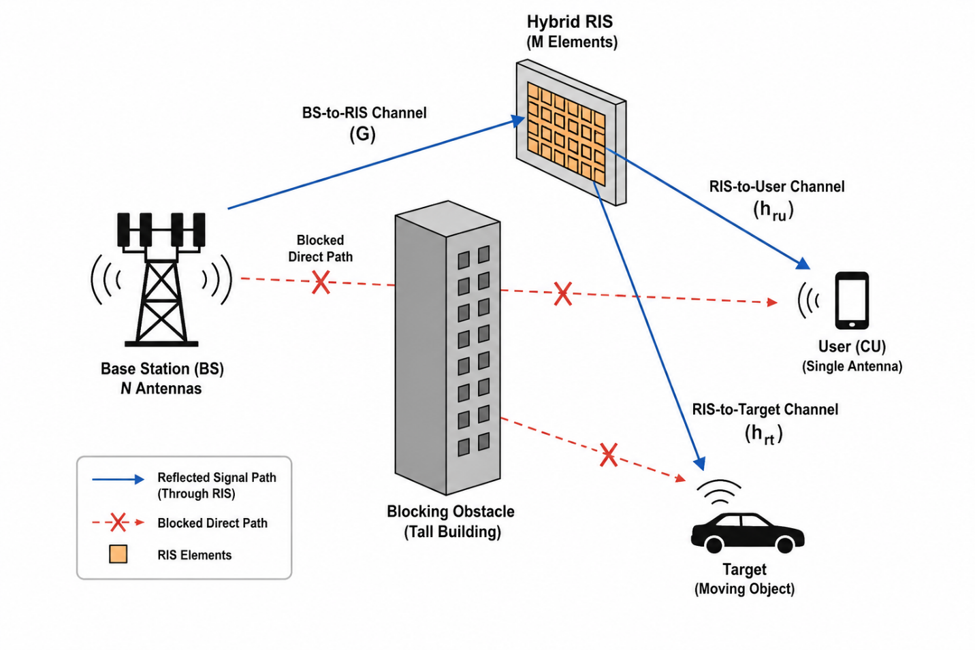
Figure 1. System model of the proposed ISAC scenario. A Hybrid RIS is used to overcome the blocked signal path between the base station, the communication user, and the radar target.
The RIS consists of $N$ elements, deployed to redirect and enhance the wireless signals between the BS, user, and target [4], [12].
Hybrid RIS Structure
The RIS elements are divided into two types:
- Passive elements (N_p), which adjust only the phase of the signal with very low power consumption. [1], [4].
- Active elements (N_a), which can also amplify the signal to compensate for severe path loss. [6], [7].
- Thus:

- Each element is modeled as:

- where βₙ controls the amplitude and θₙ controls the phase shift. Passive elements satisfy βₙ ≤ 1, while active elements allow βₙ > 1 for signal amplification.
Signal Model
Let x be the transmitted ISAC signal. The base station to RIS channel is represented by H, and the RIS to user channel is represented by h_r^H. The received signal at the user is:

where w is the beamforming vector and n is additive white Gaussian noise with zero mean and variance σ².
For radar sensing, the transmitted signal reflects from the target and returns back to the base station, forming a two-way propagation path. Since this round-trip channel experiences severe path loss, active RIS elements become important to maintain a detectable radar echo and improve sensing performance [6], [8].
Beamforming Design
The base station uses a precoding matrix W to direct the transmitted energy toward the RIS instead of broadcasting in all directions. At the RIS, both phase shifts θₙ and amplitude control βₙ are adjusted to form separate beams for communication and sensing [1], [11].
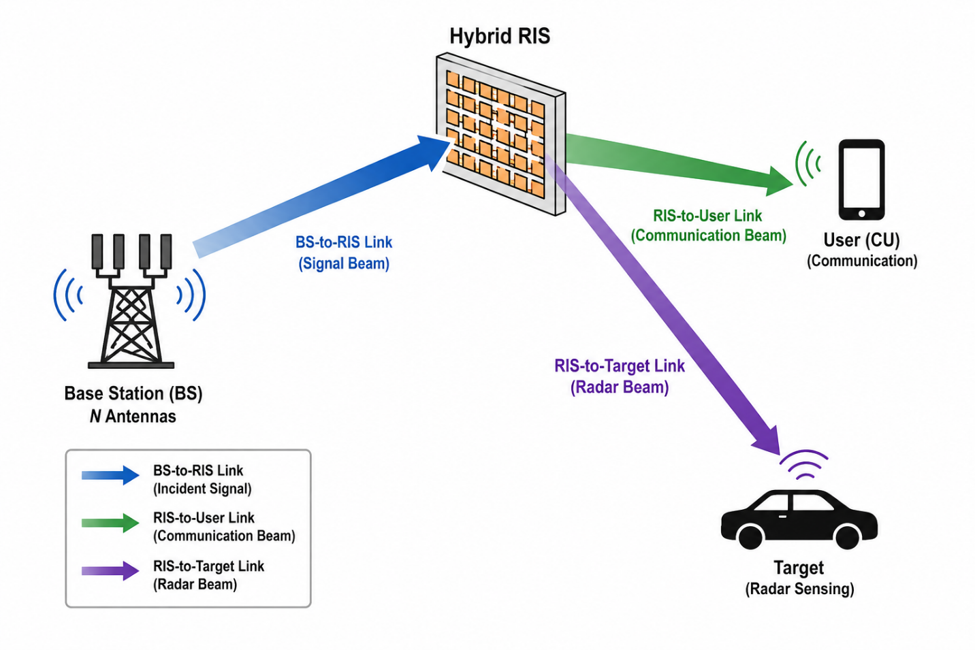
Figure 2. Beamforming process at the Hybrid RIS. The original signal from the base station is split into two directed beams: one for data communication and one for radar sensing.
Active elements help compensate for signal loss, especially for the radar link, which experiences stronger attenuation due to the round-trip propagation [7], [8].
Optimization Problem
ISAC systems involve a trade-off between communication performance and sensing quality [2], [12]. The communication rate is given by:

The system is optimized under the following constraints:

The optimization problem aims to maximize the communication data rate R by jointly optimizing the base station precoding matrix W and the RIS reflection matrix Φ [5], [6], [11].
The first constraint ensures that the radar sensing quality γᵣ remains above the required threshold Γ_req. If this condition is not satisfied, the radar system may fail to detect the target [2], [12].
The second constraint limits the transmit power of the base station. The total transmit power of the base station, denoted as P_BS, cannot exceed its maximum hardware limit P_BS,max [4].
The third constraint represents the power limitation of the Hybrid RIS. Since the RIS contains active amplifying elements, it consumes electrical power and must operate below its maximum allowable power level P_RIS,max [6], [7], [8].
Solution Approach
The optimization problem is non-convex because W and Φ are coupled. A widely used approach in the literature is Alternating Optimization (AO), which solves the problem iteratively [5], [6], [11].
First, Φ is fixed and W is optimized. Then, W is fixed and Φ is optimized. This process is repeated until the communication rate R converges.
AO provides a practical and computationally efficient solution for dynamic 6G environments, especially in RIS-assisted ISAC systems where joint optimization problems are difficult to solve directly.
Results and Discussion
In this section, we discuss the expected performance of the Hybrid RIS-assisted ISAC system. The analysis is based on system modeling and follows trends reported in recent surveys and studies on RIS and ISAC systems [1], [2], [4].
The discussion focuses on three main parts: performance comparison, the communication–sensing trade-off, and energy efficiency.
4.1 Performance Comparison: Hybrid RIS vs. Passive RIS
A key question in RIS research is whether adding active elements is worth the extra hardware complexity and power consumption.
In passive RIS systems, the elements only reflect the signal without amplifying it. In this case, the received signal strength decreases quickly as the distance between the user and the RIS increases, mainly due to path loss [4].
Hybrid RIS systems solve this limitation by using both passive and active elements. Active elements can amplify the reflected signal, which helps maintain a stronger link over longer distances. This improves overall coverage and reliability in 6G environments [6], [7].
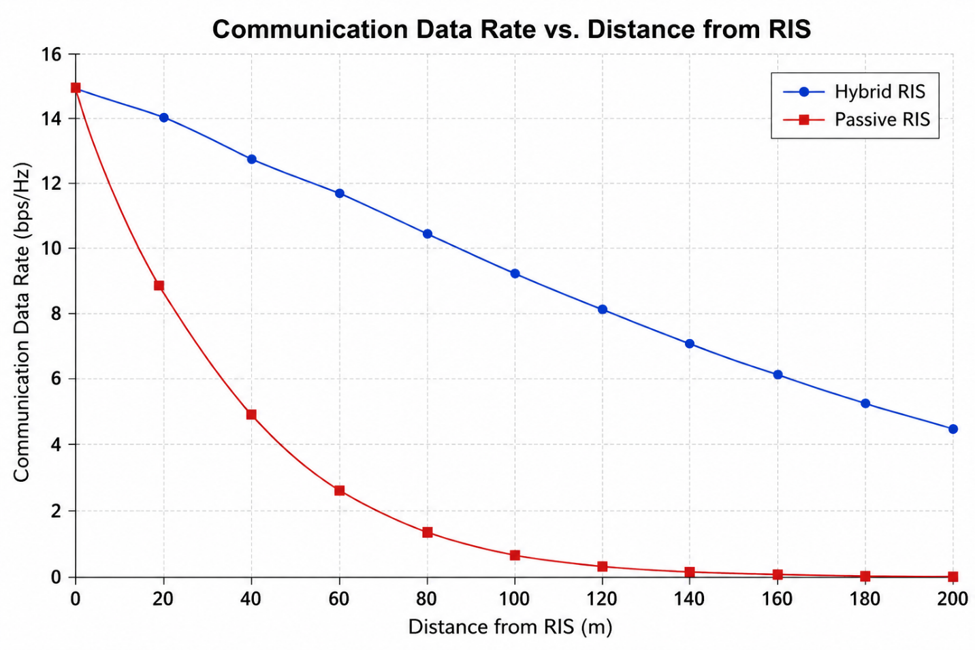
Figure 3. Expected communication data rate versus the distance between the RIS and the communication user. The Hybrid RIS maintains higher communication performance at longer distances compared to a fully passive RIS.
4.2 ISAC Trade-off: Communication vs. Sensing
In ISAC systems, communication and sensing share the same resources. Because of this, improving one function often reduces the performance of the other [2], [12].
If more power is used for radar sensing, the system can detect targets more accurately. However, this reduces the power available for data communication, which lowers the data rate R. On the other hand, focusing too much on communication can reduce radar detection quality.
This balance is known as the Pareto trade-off between communication and sensing performance.
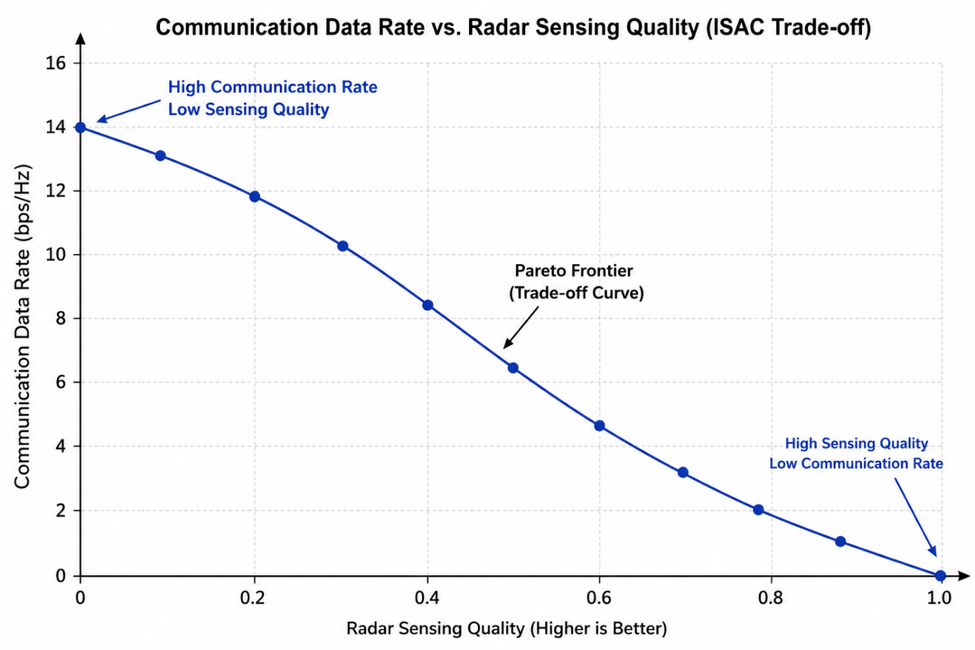
Figure 4. Fundamental trade-off between communication data rate and radar sensing performance in an ISAC system.
Hybrid RIS helps improve this trade-off by boosting the reflected signals. This allows the system to maintain both good communication quality and reliable sensing performance at the same time [1], [10].
4.3 Impact of Active Elements
Another important design problem is how many RIS elements should be active.
If all elements are active, the system can achieve strong signal amplification, but this also increases power consumption and hardware cost. In practice, this is not efficient.
Recent studies show that only a small portion of active elements is enough to improve performance significantly [10]. A common design choice is to activate around 10%–20% of the total elements.
In this structure:
- Passive elements are used for phase control and beam steering with very low power usage
- Active elements are used to compensate for path loss and improve weak signals
This mixed design provides a good balance between performance and efficiency.
4.4 Energy Efficiency Analysis
Energy efficiency is defined as the ratio between the communication data rate and the total power consumption of the system.
Although Hybrid RIS consumes more power than passive RIS due to active elements, it also provides much higher signal quality and coverage. Especially in blocked or non-line-of-sight environments, this performance gain becomes very important.
Therefore, Hybrid RIS systems can achieve better overall energy efficiency (bits per joule) compared to purely passive systems, making them a strong candidate for future 6G networks [1], [4], [8].

Energy efficiency is defined as the ratio of total data rate to total power consumption.
Conclusion and The Road Ahead
The growing demand for high-speed communication and accurate environmental sensing is driving the rapid evolution of 6G networks. To satisfy these requirements, Integrated Sensing and Communication (ISAC) has emerged as a key enabling concept. However, severe signal blockage and high-frequency propagation losses in urban environments remain major challenges for practical deployment [4].
In this article, we explored the role of Reconfigurable Intelligent Surfaces (RIS) in addressing these limitations. While traditional passive RIS can effectively redirect signals, it suffers from significant performance degradation over long distances due to path loss [12]. This has led to a shift toward Hybrid RIS architectures, which combine passive reflecting elements with a smaller number of active amplifying elements to improve coverage and reliability [7].
Based on the system models and optimization framework presented in this study, Hybrid RIS can significantly mitigate power loss and improve overall system performance. By using Alternating Optimization (AO), the system can dynamically balance the trade-off between maximizing communication data rate and maintaining reliable radar sensing. In addition, activating only a small portion of RIS elements (around 10%–20%) is often sufficient to achieve strong performance gains while keeping energy consumption and hardware complexity at reasonable levels [10].
Future Research Directions
Looking forward, this field is expected to evolve in several important directions:
- Multi-functional surfaces (STAR-RIS): Future RIS designs aim to go beyond reflection and enable simultaneous transmission and reflection, providing full-space coverage and improved system flexibility [9], [12].
- Artificial Intelligence (AI): Machine learning and meta-reinforcement learning techniques are increasingly being used to optimize complex and dynamic RIS-assisted ISAC environments in real time [9].
- Physical layer security (PLS): Since ISAC systems share the same waveform for communication and sensing, they introduce new security challenges that require robust protection mechanisms against eavesdropping and malicious attacks [3].
As hardware technologies and optimization methods continue to improve, Hybrid RIS-assisted ISAC is expected to become a core enabling technology for future 6G smart cities and autonomous wireless networks.
References
메타데이터
- post_id
- 91829e4e12cd
- slug
- hybrid-ris-for-6g-isac-a-deep-dive-91829e4e12cd
- url
- https://medium.com/@siracsuz/hybrid-ris-for-6g-isac-a-deep-dive-91829e4e12cd
- canonical_url
- https://medium.com/@siracsuz/hybrid-ris-for-6g-isac-a-deep-dive-91829e4e12cd
- author_url
- https://medium.com/@siracsuz
- status
- ok
- fetched_at
- 2026-06-09 21:21:26