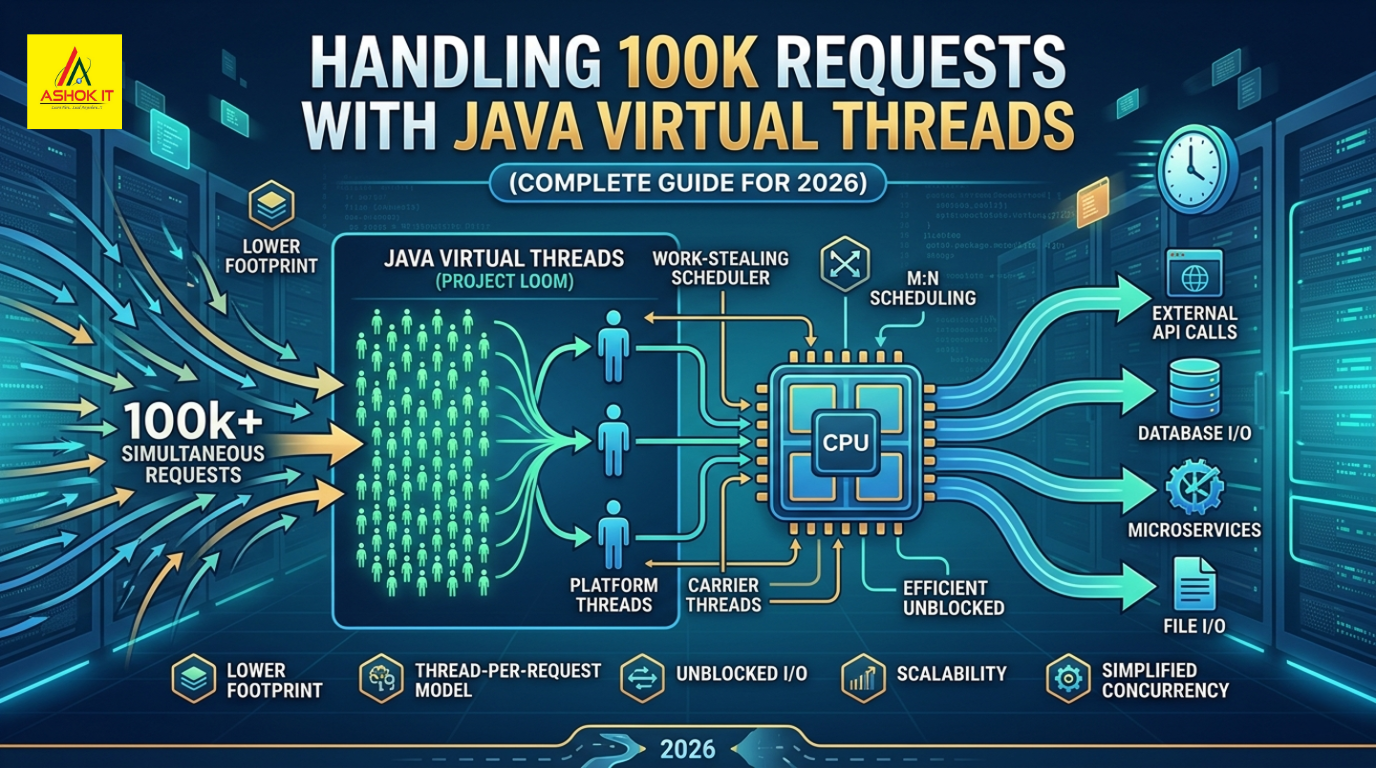
Handling 100k Requests with Java Virtual Threads (Complete Guide for 2026)
Handling 100k concurrent requests in Java is now achievable using Virtual Threads (Project Loom), which allow you to create millions of…
Handling 100k Requests with Java Virtual Threads (Complete Guide for 2026)
Handling 100k concurrent requests in Java is now achievable using Virtual Threads (Project Loom), which allow you to create millions of lightweight threads without exhausting system resources. Unlike traditional threads, virtual threads are cheap, scalable, and ideal for high-concurrency applications like APIs, microservices, and real-time systems.
Introduction
Modern applications demand massive scalability — handling thousands or even 100k concurrent users. Traditional thread-per-request models struggle due to memory overhead and thread blocking.
In my decade of teaching Java, I’ve seen developers hit performance bottlenecks long before reaching production scale. Our students in Hyderabad often face issues where applications crash under load — not because of logic errors, but due to poor thread management.
Java Virtual Threads completely change the game.
What are Virtual Threads in Java?
Virtual Threads are lightweight threads introduced as part of Project Loom (Java 21). They are managed by the JVM rather than the OS, allowing millions of concurrent tasks with minimal resource usage.
Key Characteristics:
- Lightweight (few KB per thread)
- Managed by JVM
- Non-blocking-friendly
- High scalability
Why Traditional Threads Fail at Scale
Problems with Platform Threads:
- High memory usage (~1MB per thread)
- Context switching overhead
- Thread pool exhaustion
- Blocking I/O issues
Why Virtual Threads Solve This:
- Minimal memory footprint
- Efficient scheduling
- Handles blocking gracefully
Architecture for Handling 100k Requests
To handle 100k requests, you need:
Core Components:
- Virtual thread executor
- Non-blocking I/O (or optimized blocking)
- Efficient database handling
- Proper timeout & backpressure mechanisms
Java Code Examples with Virtual Threads
Example 1: Creating Virtual Threads
public class VirtualThreadDemo {
    public static void main(String[] args) {
        Thread.startVirtualThread(() -> {
            System.out.println("Running in virtual thread: " + Thread.currentThread());
        });
    }
}
Explanation:
startVirtualThread()creates a lightweight thread- No need for thread pools
Edge Case:
- Debugging becomes harder due to large number of threads
- Logging must include thread identifiers
Example 2: Executor with Virtual Threads
import java.util.concurrent.ExecutorService;
import java.util.concurrent.Executors;
public class VirtualExecutorExample {
public static void main(String[] args) {
try (ExecutorService executor = Executors.newVirtualThreadPerTaskExecutor()) {
for (int i = 0; i < 100000; i++) {
executor.submit(() -> {
handleRequest();
});
}
}
} static void handleRequest() {
System.out.println("Processing request in " + Thread.currentThread());
}
}Explanation:
- Creates a virtual thread per task
- Easily scales to 100k requests
Edge Case:
- CPU-bound tasks still bottleneck
- Virtual threads don’t increase CPU power
Example 3: Handling Blocking I/O
import java.io.IOException;
import java.nio.file.Files;
import java.nio.file.Path;
public class BlockingIOExample {
public static void main(String[] args) {
Thread.startVirtualThread(() -> {
try {
String content = Files.readString(Path.of("data.txt"));
System.out.println(content);
} catch (IOException e) {
e.printStackTrace();
}
});
}
}Explanation:
- Virtual threads handle blocking I/O efficiently
- JVM suspends thread instead of blocking OS thread
Edge Case:
- Native calls may still block OS threads
- Be cautious with third-party libraries
Example 4: Web Server Simulation
import java.util.concurrent.Executors;public class ServerSimulation {
public static void main(String[] args) {
var executor = Executors.newVirtualThreadPerTaskExecutor(); for (int i = 0; i < 100000; i++) {
executor.submit(() -> {
processRequest();
});
}
} static void processRequest() {
try {
Thread.sleep(100); // simulate I/O
} catch (InterruptedException e) {
Thread.currentThread().interrupt();
}
}
}Explanation:
- Simulates high-load server
- Efficient handling of concurrent requests
Edge Case:
- If sleep replaced with CPU-heavy work → performance drops
- Always separate CPU-bound and I/O-bound tasks
Example 5: Structured Concurrency (Advanced)
import java.util.concurrent.StructuredTaskScope;public class StructuredConcurrencyExample {
public static void main(String[] args) throws Exception {
try (var scope = new StructuredTaskScope.ShutdownOnFailure()) { var task1 = scope.fork(() -> fetchUserData());
var task2 = scope.fork(() -> fetchOrderData()); scope.join();
scope.throwIfFailed(); System.out.println(task1.get() + " " + task2.get());
}
} static String fetchUserData() {
return "User Data";
} static String fetchOrderData() {
return "Order Data";
}
}Explanation:
- Simplifies parallel execution
- Improves error handling
Edge Case:
- Requires careful exception propagation
- Misuse can lead to hidden failures
Virtual Threads vs Platform Threads

Virtual Threads vs Platform Threads
FeaturePlatform ThreadsVirtual ThreadsMemory UsageHigh (~1MB/thread)Low (few KB)ScalabilityLimitedMassive (millions)Context SwitchingExpensiveLightweightBlocking BehaviorCostlyEfficientUse CaseCPU-bound tasksI/O-heavy applications
Best Practices for Handling 100k Requests
Use virtual threads for I/O-heavy workloads
Avoid shared mutable state
Use structured concurrency
Monitor thread usage
Combine with reactive design when needed
Common Mistakes Developers Make
- Using virtual threads for CPU-heavy tasks
- Ignoring database bottlenecks
- Overloading external APIs
- Not handling timeouts properly
Real-Time Use Cases
- High-traffic REST APIs
- Chat applications
- Payment systems
- Streaming platforms
Our students in Hyderabad often face scalability challenges while building real-time applications, and Virtual Threads provide a modern solution.
Performance Considerations
What Virtual Threads Improve:
- Concurrency
- Resource utilization
- Simplicity
What They DON’T Improve:
- CPU performance
- Poor algorithm design
- Database latency
When NOT to Use Virtual Threads
- CPU-intensive workloads
- Low-concurrency applications
- Systems already optimized with reactive frameworks
Advanced Optimization Tips
Combine with:
- Connection pooling
- Caching (Redis)
- Load balancing
Monitor:
- Thread dumps
- Heap memory
- Response times
FAQ Section
1. What are Virtual Threads in Java?
Virtual threads are lightweight threads managed by the JVM that allow massive concurrency with minimal resource usage.
2. Can Virtual Threads handle 100k requests?
Yes, especially for I/O-bound tasks. They are designed to scale to millions of concurrent operations.
3. Are Virtual Threads better than reactive programming?
They simplify concurrency compared to reactive programming, but both have their use cases.
4. Do Virtual Threads replace thread pools?
In many cases, yes. They reduce the need for complex thread pool management.
5. Is Virtual Thread production-ready?
Yes, starting from Java 21, they are stable and production-ready.
Final Thoughts
Virtual Threads are one of the biggest innovations in Java in recent years. They enable developers to build highly scalable systems without complex concurrency models.
In my decade of teaching Java, I’ve never seen a feature that simplifies concurrency this much. Once you master Virtual Threads, handling 100k requests becomes practical — not theoretical.
To stay ahead in 2026, enrolling in **AI powered Core JAVA Online Training in ameerpet** will help you master real-time scalability, concurrency, and performance tuning.
메타데이터
- post_id
- 918b9ea2a74d
- slug
- handling-100k-requests-with-java-virtual-threads-complete-guide-for-2026-918b9ea2a74d
- url
- https://medium.com/@sarathkumar52356/handling-100k-requests-with-java-virtual-threads-complete-guide-for-2026-918b9ea2a74d
- canonical_url
- https://medium.com/@sarathkumar52356/handling-100k-requests-with-java-virtual-threads-complete-guide-for-2026-918b9ea2a74d
- author_url
- https://medium.com/@sarathkumar52356
- status
- ok
- fetched_at
- 2026-06-25 07:00:49