Jumping Spiders, Pets or Not to Pet?
Are Jumping Spiders Personable Enough to Make Good Pets?
Jumping Spiders, Pets or Not to Pet?
Are Jumping Spiders Personable Enough to Make Good Pets?
Photo by Егор Камелев on Unsplash
Spiders are one of the most iconic sources of fear and phobias, but what if I told you that a certain family of spiders has recently gained popularity? Are you disgusted? Intrigued? In either case, I am here to inform you of these personable creatures of controversy and explain why you should give them a chance, and perhaps even adopt one.
Introduction
CNN’s article “How jumping spiders became the new ‘it’ pets” describes a woman’s encounter with this family of spiders that “turned from disgust to tolerance,” and eventually she “accidentally befriended” one (Andrew,2023). After growing accustomed to this little buddy of hers, she decided to share her spider on Tik-Tok, which quickly gained popularity due to this family’s ability to dissolve arachnophobia. Their big lively eyes have warmed the hearts of many, causing natural walls of fear to come crashing down at first sight. This woman, Heather Bruen, claimed that “caring for them has changed her entire life” (Andrew,2023). This article goes on to explain that “the hashtags ‘jumpingspider’ and ‘spidertok’ have more than 1.5 billion views combined” (Andrew,2023). If you ask me, it sounds like a lot of people are intrigued by these special spiders.
Personalities
These tiny, complex spiders have surprising personalities. Thanks to, “A Road Map of Jumping Spider Behavior by Ximena, Nelson” we are aware of these spiders’ behaviors, intelligence, and contribution to pest control. Salticidae, the scientific name for these spiders, “are known for their cognitive ability” in decision-making, setting them apart from other spiders (Nelson,2023). They possess unique abilities that most spiders do not. Ximena’s (2023) definition of this cognition reads “…defined as how information is acquired and mediates behavior through evaluative processes, such that decision-making is the cognitive process interfacing assessment and discernible behavior” (Nelson, 2023). Meaning that these special arachnids, one, quite literally learn from their mistakes, and two, make active decisions.
This author goes on to explain the process in which Salticidae can find their way back to their nest when faced with unfamiliar surroundings by making judgment-based decisions on what path leads them back home safely (Nelson,2023). What sets jumping spiders apart from other families of spiders is the advanced level at which they make decisions. All spiders are capable of making response-based decisions at a basic level, but these arachnids can also use this decision-making process to evaluate which route takes them to food the quickest, and the most stealthily (Nelson,2023).
Not only do they possess cognitive ability, but they also have research-backed evidence of having distinct personalities based on their upbringing, as you would expect for a pet. As written in Ximena’s article, “all animals have intra-individual variation in their responses, but for many, there is consistency with individuals, and this average behavioral type can be considered it’s personality.”
Amongst the growing surge in spotlight for these creatures, people have noticed key characteristics of their personalities that spark joy after interacting with them. A few of these characteristics are dog-like head tilts due to curiosity, their observable intelligence, active response in conversation, and getting little high fives from them as they try to figure you out. Thankfully, due to the impressive amount of worldwide species variations, there are many different personality types. They can range from shy and docile to aggressive and scrappy, meeting most people’s needs of a preferred personality.
Characteristics
Compared to other species, jumping spiders are much more inviting and quirky. Physically, people fall in love with those big curious eyes and their fuzzy little bodies that can jump an impressive distance. Being the largest family of spiders, there are thousands of physical variants to choose from. Ranging from large round abdomens to smaller pointier abdomens, all brown with green palps, all white with black patterns, and so much more. CNN writer Andrew Scottie even goes so far as comparing them with The Mandalorian’s character Grogu, saying that they possess “a cute babyish-ness.”
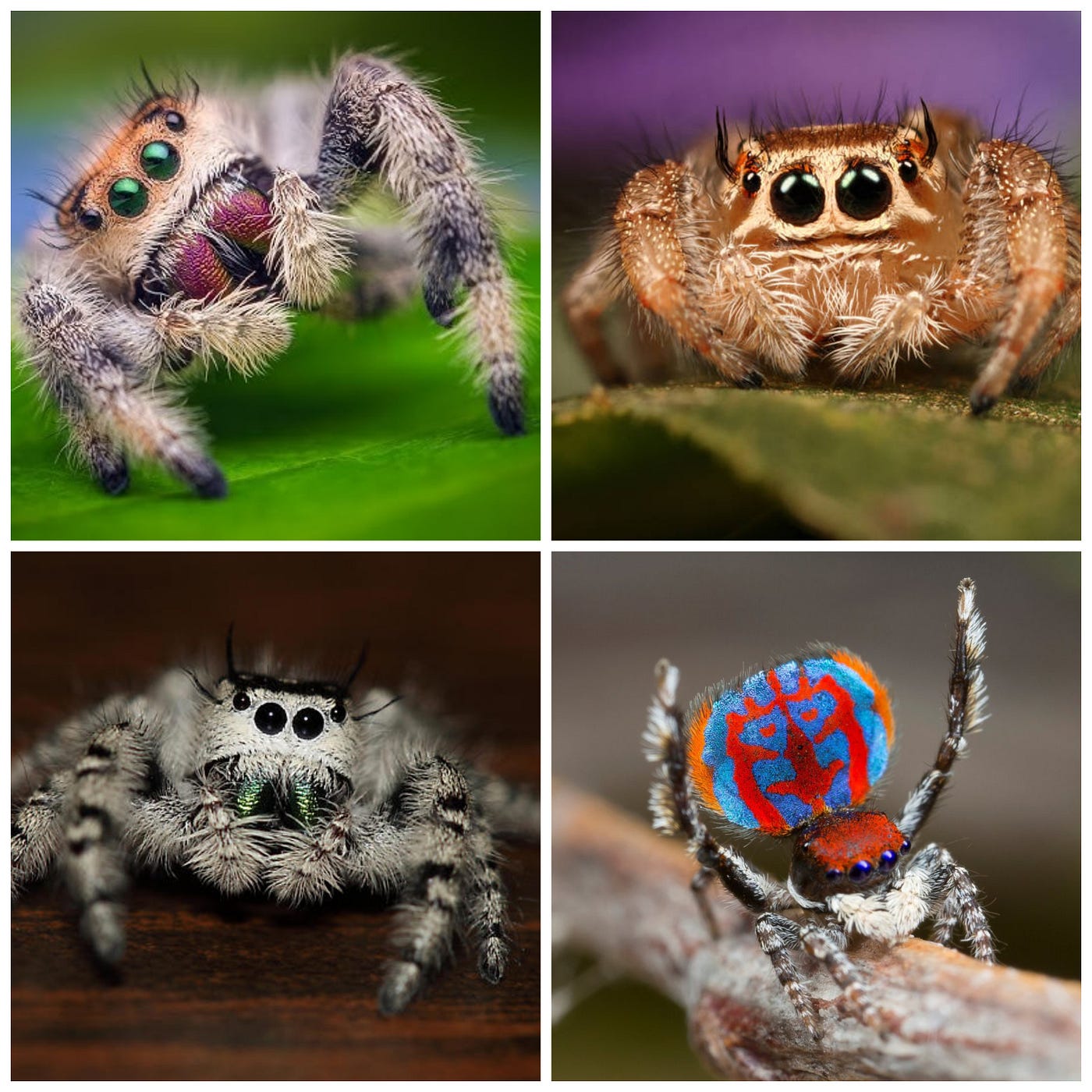
Photo credits; Top left: ThomasShahan.com; Top right: Macrojunkie on DevianArt.com; Bottom left: Rich Hoyer-bugguide.net; Bottom right: Jürgen Otto-Reuter. Collage made in PicsArt.
Enclosures
Salticidae are becoming man’s new best friend, and these friends need a proper home. Having a well-ventilated, clear container that opens in the middle or bottom is all they need for the structure of an enclosure. Depending on the species of jumping spider will slightly determine what the environment inside the enclosure should look like. The environment ranges from things you would find outside like rocks, sand, leaves, sticks etc., making it incredibly easy to make a spider feel safe and at home in their enclosure. The feeding and watering process is easy as well, although they do prefer live bugs. Going to your local Pet Smart, or pet store, you can find live bugs appropriately sized that you can feed them. Jumping spiders are so tiny that they only need around 2–3 fruit flies every three days depending on their size. Watering them possesses the same ease. You can opt for a tiny gravel-filled water bowl or spritz the soil and walls of the enclosure so that they can drink the water droplets that form. Forms of enrichment are also recommended for encouraging an intelligent, social jumping spider.
As quoted from Ximena, “There is a growing body of evidence that personality traits exist among salticids, and that these are affected both by genetic factors and the spider’s experience during development, in that spiders reared in more socially or physically-enriched environments…are more exploratory”. Forms of enrichment entail having different textures in their environment like soil, rocks, bark, and twigs for them to climb and jump on; places to hide; plenty of non-reflective natural material; bright indirect light, and live bugs to interact with. When making these new buddies an enclosure make sure that the natural material has not been affected by pesticides! Failure to do so can result in death or neurological disorders. In this instance size does matter, when it comes to their sensitivities.
Eyesight
Those big eyes are much more impressive than what you notice at first glance, each one of their eyes is specialized. Nelson’s description reads, “Salticid eyes are structurally different from those of vertebrates…they provide visual detail rarely matched by any other animal…To visualize salticid vision we must imagine a small, moveable field of view. We could conceptualize this as being outside in dim moonlight. In our periphery, we detect rough shapes, and then we switch on a bright light and illuminate the small, now colorful, area toward which we point. We ‘paint’ our picture by scanning the environment with our flashlight. And, if we want to act on what we have seen in detail, we presumably must remember what we have scanned to decide, for example, whether we are facing a potential predator, prey, or mate.”
These quotes give great explanations as to why these tiny guys have to develop curiosity into their personality due to their amazing, but fixed eyesight. Every noise that warrants attention has to be seen by turning its body in the direction that the sound was perceived, creating an expression of interest. This amazing eyesight combined with their memory capabilities creates a visual memory, meaning that they are able to remember faces! They use this recognition to create spider acquaintances, cognize competition, and remember faces different from their own. Once again exhibiting favorable qualities that you would want in a pet.
Fear
Another reason that these arachnids make good pets is because they help those with spider fears and phobias. Wolfe recounted how followers told her, that her pet jumping spiders have helped others overcome their fear of arachnids. Even Heather herself started off being afraid of them but now shares her experience of why we should adore these guys (Andrew,2023).
Firstly, this family of spiders rarely bite humans. Secondly, the bite doesn’t normally break skin due to their extremely small size. And thirdly, if they on rare occasions do decide to bite you, it’s completely harmless unless you are allergic to the venom.
Having said that, the article “Treatment Context and Return of Fear and Spider Phobia” by Aileen Mystkowski concludes that spider fear can be almost completely cured by interacting with spiders, getting closer and closer with each step of the process until you eventually touch them. Observing and then eventually handling them for a short period forces that instinctual fear to be overridden. This fear only returns when experiencing a new context with a spider, which again can be solved by interaction and exposure. Jumping spiders are perfect for working with arachnophobia. They are some of the smallest spiders in the world and work well with interactions. This family is confident when being handled and approach humans often, sometimes seeking attention. All their friendly characteristics make them a great gateway to getting comfortable with arachnids.
“Good pet” qualities
With all these points being made, we still have not covered what constitutes a “good” pet. A good pet differs for everyone- but the most commonly desired qualities are personality, intelligence, friendliness, affordability, lifestyle compatibility, cuteness, and how easy it is to care for the animal.
Salticidae not only check all these boxes but are also unique pets. Starting with personality, this species has many different types to fulfill your needs. Ranging from shy to curious to feisty, they have many admirable personality traits. Moving on to intelligence, as already covered, jumping spiders make personal decisions, use memory, and recognize faces they have seen previously. This family in particular is more curious than they are fearful, creating instances where they approach humans unprovoked and are even confident being handled. This natural friendliness is a great quality when considering a pet.
Jumping spiders are inexpensive to purchase and are cost free if found naturally. Caring for them is pretty affordable as well, most things that they require are found outside or can be bought for low prices. Store-bought enclosures start at eleven dollars and go up from there. Salticidae are fitting for most lifestyles because they are so small, friendly, and resilient. When it comes to cuteness, being compared to Grogu is about as cute as it gets! Lastly, caring for them is quite passive if you want it to be. They only require small bits of food and a spritz of water a few times a week after setting up their correct environments. Wolfe quotes “While spiders might not form the same types of bonds with their humans as cats or dogs, I’d like to think …that people can earn their trust and perhaps even their love, whatever love might mean in a spider’s world”. Giving way to the fact that these owners form some kind of acquaintanceship with the spiders and vice versa.
Conclusion
It’s no wonder why these tiny balls of curiosity are becoming the new ‘it’ pets. For far too long these incredible spiders have gone underappreciated, being smushed with every sighting. All of this is to say that yes, these babies are personable enough to be good pets and anyone would be lucky to form an acquaintanceship with one. They are charming, smart, friendly, unique, help with arachnophobia, and look undeniably cute while doing it! It’s time that we lay our fears to rest and marvel at these complex and abundant creatures. Even if I couldn’t change your mind and whether you want one as a pet or not, I think it’s safe to say these aren’t the kind of spiders you want to squish. So, the next time you see one of these little guys take them outside to a safer place and know that you’re doing most everyone a favor.
References
Andrew, Scottie. March 25, 2023. How jumping spiders became the new it pets. CNN. https://[www.cnn.com](https://www.cnn.com/2023/03/25/us/jumping-spider-pets-tiktok-cec/index.html)/2023/03/25/us/jumping-spider-pets-tiktok-cec/index.html
Mystkowski, Aileen L. (2002). Treatment context and return of fear in spider phobia. GZN (University of Wisconsin-Milwaukee): Main Library. 33(3), 399-416 https://search.library.oregonstate.edu/permalink/01ALLIANCE_OSU/1ffs2e1/cdi_crossref_primary_10_1016_S0005_7894_02_80035_1
Nelson, X. J. (2023). A road map of jumping spider behavior. The Journal of Arachnology, 51(2), 139–154. https://doi.org/10.1636/JoA-S-22-011.
메타데이터
- post_id
- 919107f49dfd
- slug
- jumping-spiders-pets-or-not-to-pet-919107f49dfd
- url
- https://medium.com/@bryande/jumping-spiders-pets-or-not-to-pet-919107f49dfd
- canonical_url
- https://medium.com/@bryande/jumping-spiders-pets-or-not-to-pet-919107f49dfd
- author_url
- https://medium.com/@bryande
- status
- ok
- fetched_at
- 2026-07-19 07:23:19