CHANGES IN TOMATO FRUIT COLOR DURING STORAGE
Tomato fruit has different stages of maturity, 1) ripe-green stage, 2) color breaking stage, 3) color turning stage, 4) pink fruit, 5)…
CHANGES IN TOMATO FRUIT COLOR DURING STORAGE
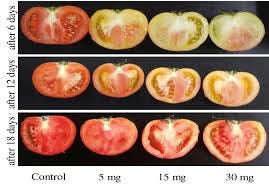
Tomato fruit has different stages of maturity, 1) ripe-green stage, 2) color breaking stage, 3) color turning stage, 4) pink fruit, 5) slightly red fruit and 6) ripe-red fruit. The change in the color of the tomato fruit depends on the storage conditions (temperatures in the storage chambers, pigments that the fruit includes in the composition of each variety of tomato and also on the treatments in the storage chambers such as the addition of exogenous ethylene which helps the fruit to ripen faster and in the change of color from green to red.
1. Evolution of fruit color
Tomato is a climacteric fruit characterized by a climacteric growth with respiration and ethylene production resulting in ripening, elasticity and the appearance of red color (Heuvelink, 2019 ) . Ethylene is a factor that changes fruit color in climacteric fruits such as tomato. As the tomato fruit reaches a normal ripeness, the response of the fruit part to ethylene changes from a negative to a positive stage. In unripe fruits, ethylene reduces its composition and creates a low concentration of endogenous ethylene that stops the ripening of the fruit. Ripening controls give ripening-inhibitors, non-ripening and non-ripening fruit color ( Heuvelink , 2019). The tomato fruit includes changes in its color during the thermal increase when there are reactions such as reduction of constituent substances (especially carotenoids and chlorophyll) and other reactions such as condensation of hexoses and amino components as well as oxidation of ascorbic acid ( Ashebir et et al ., 2009). The color of the tomato fruit varies depending on the composition of the appropriate pigments which can be white, black, green, red, blue and yellow ( Camelo and Gómez , 2004). For example, pigments such as anthocyanin and anthoxanthin give the fruit colors such as orange, red and blue, β-carotene and xanthophyll give an orange color while lutein and lycoxanthin give a yellow color (Bogri, 2012 ) . During ripening, the visible changes begin at the moment when chlorophyll decreases and the assimilation of lycopene increases, which lycopene is an essential component at the end of fruit ripening. During the ripening of the fruit, the skin is either green or red. In suitable conditions of temperature and humidity, the fruit goes through 6 ripening stages: a) ripe-green, b) breaking the color, c) turning the color, d) pink, e) slightly red and g) ripe-red. In the ripe-green stage, the fruits reach up to 80% of their final size and continue to ripen normally after harvest. Although most fruits ripen to a red color, some fruits remain yellow due to the non-synthesis of lycopene ( Heuvelink , 2019). It has been proven after research that ripe tomatoes include in their composition more lycopene, beta-carotene and total acids that contribute to the high color index ( Pek and Heyles , 2010). According to Zanoni et et al ., 1999; Kerkhofs et et al ., 2005; Chang et al ., 2006 and Tool and Savage , 2006, high temperatures can cause damage to tomato fruit quality such as color ( Ashebir et et al ., 2009). High heat causes dryness resulting in changes in antioxidant composition, increasing total flavonoids and phenolics and lycopene synthesis resulting in adverse red color changes ( Ashebir et et al ., 2009). Researchers Pek and Heyles in an experiment carried out in 2010 regarding the color of the fruit in round — type tomatoes which they stored at the turning stage in storage areas at 15–30 o C discovered that the red color of the fruit developed more rapidly at 30 ° C than at 15 ° C . The development of red color at 30 ° C increased because lycopene which is the main source of tomato red color does not synthesize above 30 ° C . In this temperature range only β-carotene is produced , which has an indicative temperature of 38 o C. It was also shown that storage at 30 ° C gave higher fruit quality (reduced red color) than those ripened at 15 ° C ( Pek and Heyles , 2010). The ripe-green fruit can be stored for 2 weeks at 12.5–15 ° C , the ripe fruit at 10–12.5 ° C for a week and the fully ripe fruit at 7–10 ° C for 3–5 days . The ripe-green fruit ripens best at 15–20 ° C , while above 25 ° C softness and degraded fruit color are produced ( Heuvelink , 2019). Chlorophyll , lycopene and β-carotene are components of the fruit that play an important role in changing the color of the fruit. Chlorophyll decreases during storage of the fruit, while at storage temperatures between 20 and 30 o C its decrease is observed. In short, the storage of the tomato fruit at high temperatures changes the color of the fruit faster. As for lycopene and β-carotene, storage at 20 and 30 o C increases their composition. The storage of tomato fruits at 40 o C results in the interruption of the synthesis of lycopene and β-carotene due to the induction of chilling injury ) ( Tadesse et et al ., 2015).
메타데이터
- post_id
- 9191ee516da2
- slug
- changes-in-tomato-fruit-color-during-storage-9191ee516da2
- url
- https://medium.com/@AnthiSkatepunk/changes-in-tomato-fruit-color-during-storage-9191ee516da2
- canonical_url
- https://medium.com/@AnthiSkatepunk/changes-in-tomato-fruit-color-during-storage-9191ee516da2
- author_url
- https://medium.com/@AnthiSkatepunk
- status
- ok
- fetched_at
- 2026-06-09 15:37:30