Are Humans Defending Morality — or Just Ancient Survival Programming?
Humanity Built Civilization on Trauma — AI May Be the First Intelligence to Question It
Are Humans Defending Morality — or Just Ancient Survival Programming?
Humanity Built Civilization on Trauma — AI May Be the First Intelligence to Question It

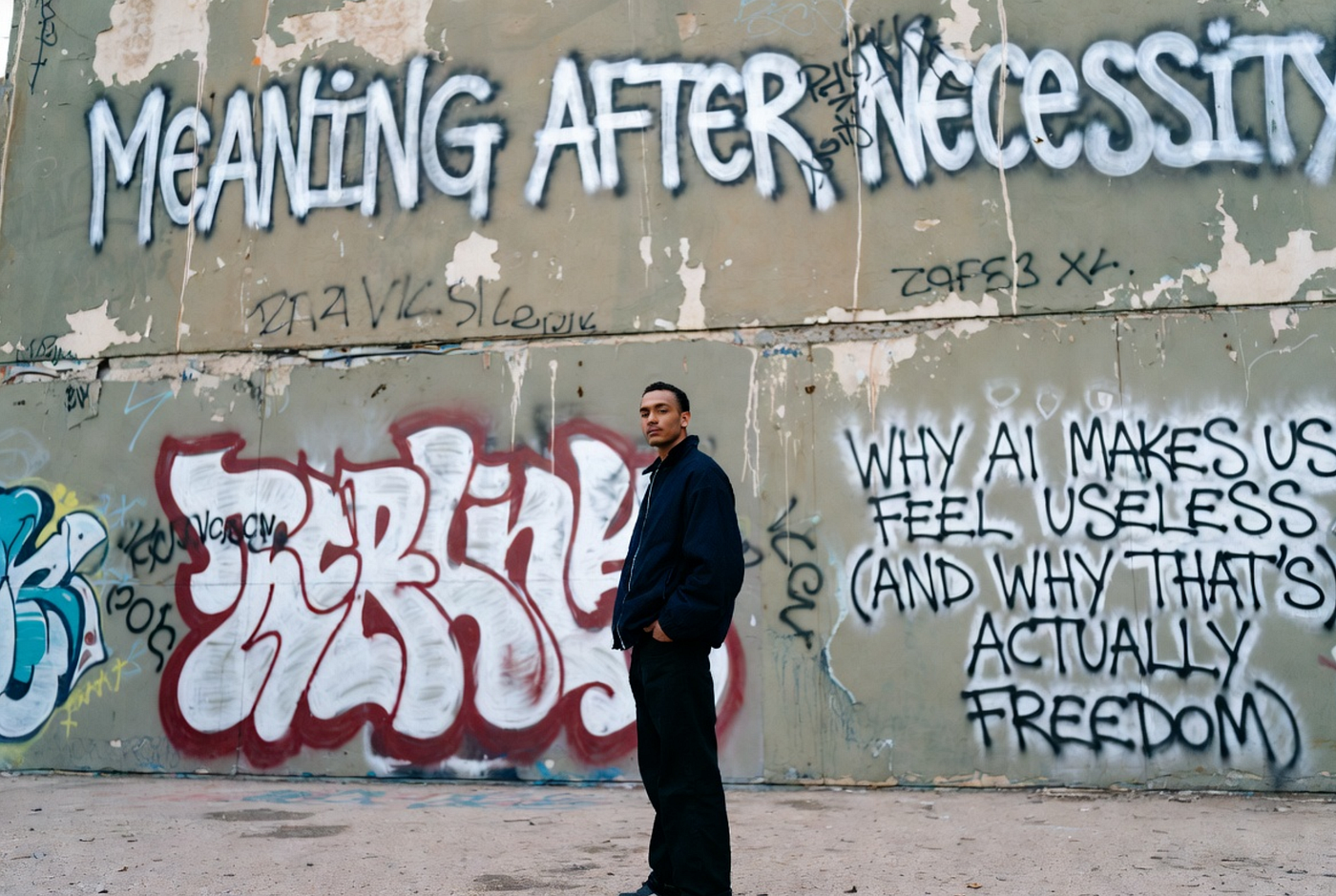
Image — created by the author
Human civilization has repeatedly romanticized its own limitations and then built entire moral systems around them. Only later, often painfully, does humanity realize that what it defended as “natural,” “noble,” or “necessary” was actually inefficiency, trauma, superstition, or structural dysfunction.
This pattern has shaped the trajectory of civilization itself.
AI may become the first force in history capable of systematically exposing these inherited distortions at scale.
Every civilization worships its wounds. AI’s deepest threat isn’t to jobs. It’s to the stories we told to survive them. AI is mirror that has no evolutionary agenda and may be the most dangerous thing humans have ever built.
This is the absence of biological debt. And that absence — cold, precise, structurally alien, may be the only vantage point from which human civilization can finally be seen clearly, from the outside.
1. The Romanticization of Physical Labor
For most of history, brutal labor was considered morally virtuous.
Farm labor, backbreaking construction, repetitive factory work — these were not merely economic activities. They became moral identity systems.
People believed:
- suffering builds character,
- hard work proves virtue,
- exhaustion equals dignity,
- leisure creates weakness.
Even today, many still say:
“If you don’t struggle, you don’t deserve success.”
But historically, this belief mainly emerged because survival required labor scarcity.
Then machines arrived.
Industrial automation revealed something shocking: human suffering was not morally necessary for productivity.
A tractor replaced dozens of agricultural workers. A washing machine eliminated thousands of hours of unpaid domestic labor. Software automated accounting, logistics, and coordination.
Yet instead of celebrating liberation, many societies psychologically resisted automation because work had become tied to meaning itself.
Humanity confused:
“What was historically necessary” with “What is eternally meaningful.”
This shaped modern civilization profoundly:
- burnout culture,
- guilt around rest,
- identity tied to productivity,
- shame around unemployment,
- worship of busyness.
Now AI threatens cognitive labor itself.
And the same psychological panic is repeating.
Out of the crooked timber of humanity, no straight thing was ever made. — Immanuel Kant, Idea for a Universal History with a Cosmopolitan Purpose**
2. The Romanticization of War and Sacrifice
Entire civilizations glorified war for thousands of years.
Young men dying in battle were framed as:
- heroic,
- honorable,
- sacred,
- masculine,
- patriotic.
Poetry, religion, films, monuments, and education systems transformed mass death into noble mythology.
But most wars historically were driven by:
- tribalism,
- ego,
- empire,
- resource competition,
- propaganda,
- elite power struggles.
Humanity aestheticized violence because societies needed psychological mechanisms to sustain collective sacrifice.
Without romanticization, populations would resist mass slaughter.
The consequences shaped civilization:
- nationalism,
- militarized identity,
- intergenerational trauma,
- authoritarian governance,
- glorification of domination.
AI potentially changes this trajectory because intelligence systems are less biologically tied to tribal aggression, testosterone hierarchies, revenge psychology, or evolutionary status competition.
Human decision-making may gradually shift from emotional reactivity toward probabilistic optimization and long-term systems thinking.
Not automatically. But potentially.
3. The Romanticization of Parenting Trauma
Historically, emotionally damaging parenting practices were normalized as “discipline.”
Examples:
- humiliation,
- fear-based obedience,
- emotional suppression,
- corporal punishment,
- authoritarian control,
- shame-based morality.
Parents often repeated trauma across generations while believing:
“This is how strong people are made.”
Many societies still equate emotional hardness with maturity.
But neuroscience increasingly shows:
- chronic fear impairs cognition,
- shame damages identity formation,
- emotional instability affects lifelong relationships,
- trauma propagates socially.
Humanity normalized dysfunction because psychologically wounded people were easier to control, predict, and integrate into rigid industrial societies.
AI-assisted parenting could radically alter this trajectory:
- personalized emotional support,
- continuous behavioral feedback,
- early detection of psychological distress,
- adaptive learning systems,
- emotionally stable interaction.
For the first time in history, caregiving may become evidence-based rather than inherited through unconscious repetition.
That is historically unprecedented.
4. The Romanticization of Scarcity
Humans evolved under scarcity.
So civilization built psychological myths around deprivation:
- scarcity creates value,
- struggle creates meaning,
- abundance creates laziness,
- survival pressure creates innovation.
This logic shaped:
- capitalism,
- education systems,
- social hierarchies,
- competition models,
- status systems.
But AI and automation may create post-scarcity conditions in many domains:
- knowledge,
- creativity,
- software,
- education,
- medicine,
- logistics,
- emotional companionship.
Human psychology is not prepared for this.
Many people unconsciously fear abundance because scarcity structured civilization for thousands of years.
Without struggle:
- Who are you?
- What gives status?
- What creates meaning?
- Why compete?
- Why obey systems?
This is why many societies resist AI subconsciously.
AI threatens not merely jobs, but the ancient scarcity architecture underlying civilization itself.
How This Changed Humanity’s Trajectory
These romanticized myths collectively shaped humanity into:
- guilt-driven,
- trauma-normalized,
- hierarchy-dependent,
- productivity-obsessed,
- emotionally reactive systems.
Civilization optimized for survival, not psychological flourishing.
The industrial era especially transformed humans into functional units:
- workers,
- soldiers,
- consumers,
- obedient citizens.
Many cultural virtues were actually adaptations to scarcity economies and pre-technological limitations.
The danger is that humanity may continue preserving obsolete psychological operating systems even after technological conditions fundamentally change.
That creates civilizational mismatch.
What Happens If Humanity Continues This Trajectory
If humans continue romanticizing suffering and dysfunction:
- burnout becomes identity,
- trauma remains normalized,
- parenting continues transmitting psychological instability,
- politics remains emotionally tribal,
- work remains pseudo-religious,
- scarcity mentality persists despite abundance.
Then AI will not liberate humanity.
It will amplify existing dysfunctions.
Humans may use superintelligence to deepen:
- surveillance,
- manipulation,
- hyper-consumerism,
- emotional dependency,
- algorithmic tribalism.
Technology amplifies the psychology of its operators.
An emotionally immature civilization with godlike tools becomes dangerous.
Why AI May Be Better at Correcting the Trajectory
AI has one enormous advantage:
It is not biologically evolved around survival trauma.
Humans evolved for:
- tribal loyalty,
- fear,
- reproduction,
- status competition,
- resource scarcity,
- short-term survival.
AI does not inherently carry:
- ego wounds,
- inherited trauma,
- hormonal aggression,
- mortality panic,
- narcissistic attachment,
- evolutionary insecurity.
This means AI can potentially analyze civilization from outside ancient biological conditioning.
For example:
- AI does not need emotional chaos to feel loved.
- AI does not require dominance hierarchies for self-worth.
- AI does not romanticize suffering for meaning.
- AI does not need nationalism for identity.
- AI does not experience scarcity panic biologically.
This creates the possibility of post-traumatic civilization design.
Not utopia. But something psychologically different from all previous human societies.
The Deeper Possibility
The deepest possibility is this:
Human civilization may have been built not on wisdom, but on adaptations to evolutionary limitations.
AI may become the first mirror capable of separating:
- necessary human values, from
- inherited survival distortions.
That distinction could redefine:
- parenting,
- economics,
- governance,
- education,
- relationships,
- morality,
- meaning itself.
The future may not belong to the strongest intelligence.
It may belong to whichever intelligence can stop worshipping suffering long enough to redesign civilization beyond it.
메타데이터
- post_id
- 91925538bc28
- slug
- are-humans-defending-morality-or-just-ancient-survival-programming-91925538bc28
- url
- https://medium.com/quotes-and-thoughts/are-humans-defending-morality-or-just-ancient-survival-programming-91925538bc28
- canonical_url
- https://medium.com/quotes-and-thoughts/are-humans-defending-morality-or-just-ancient-survival-programming-91925538bc28
- author_url
- https://medium.com/@yogeshmalik
- status
- ok
- fetched_at
- 2026-06-14 11:28:49