The Feedback Graveyard — Customer feedback dies in seven inboxes
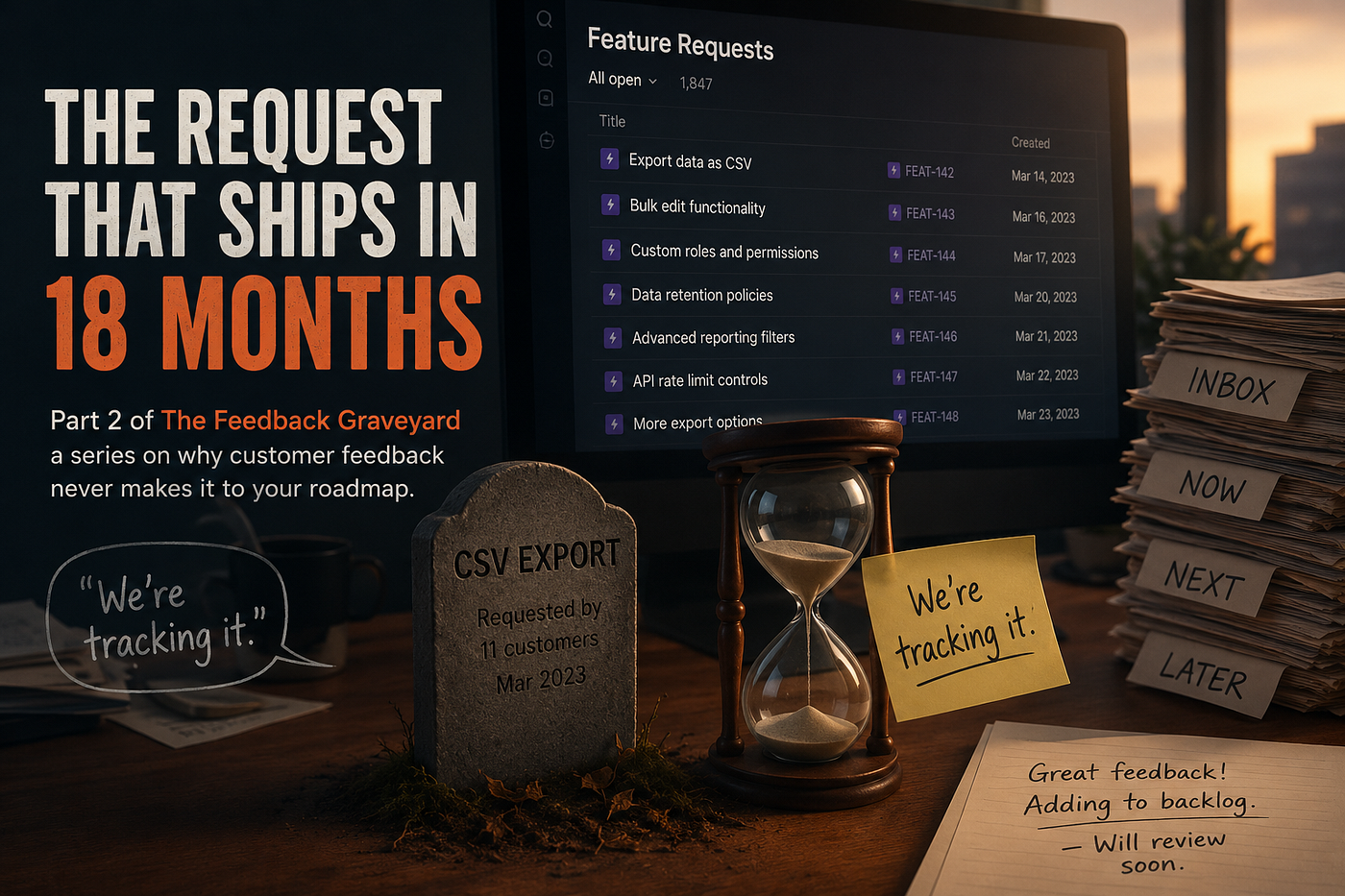
Part 1 of The Feedback Graveyard, a series on why customer feedback never makes it to your roadmap.
The Feedback Graveyard — Customer feedback dies in seven inboxes
Part 1 of The Feedback Graveyard, a series on why customer feedback never makes it to your roadmap.
The PM says nobody asked for it.
The CSM says she’s heard it five times this week.
Both are telling the truth.
That tension is where customer feedback starts to die.
I have seen this happen in almost every B2B SaaS company I have worked with. Not because people do not care. Not because product teams ignore customers. Not because sales or support forget to share things.
It happens because feedback is scattered. It dies from geography.
OpenAI
The seven inboxes
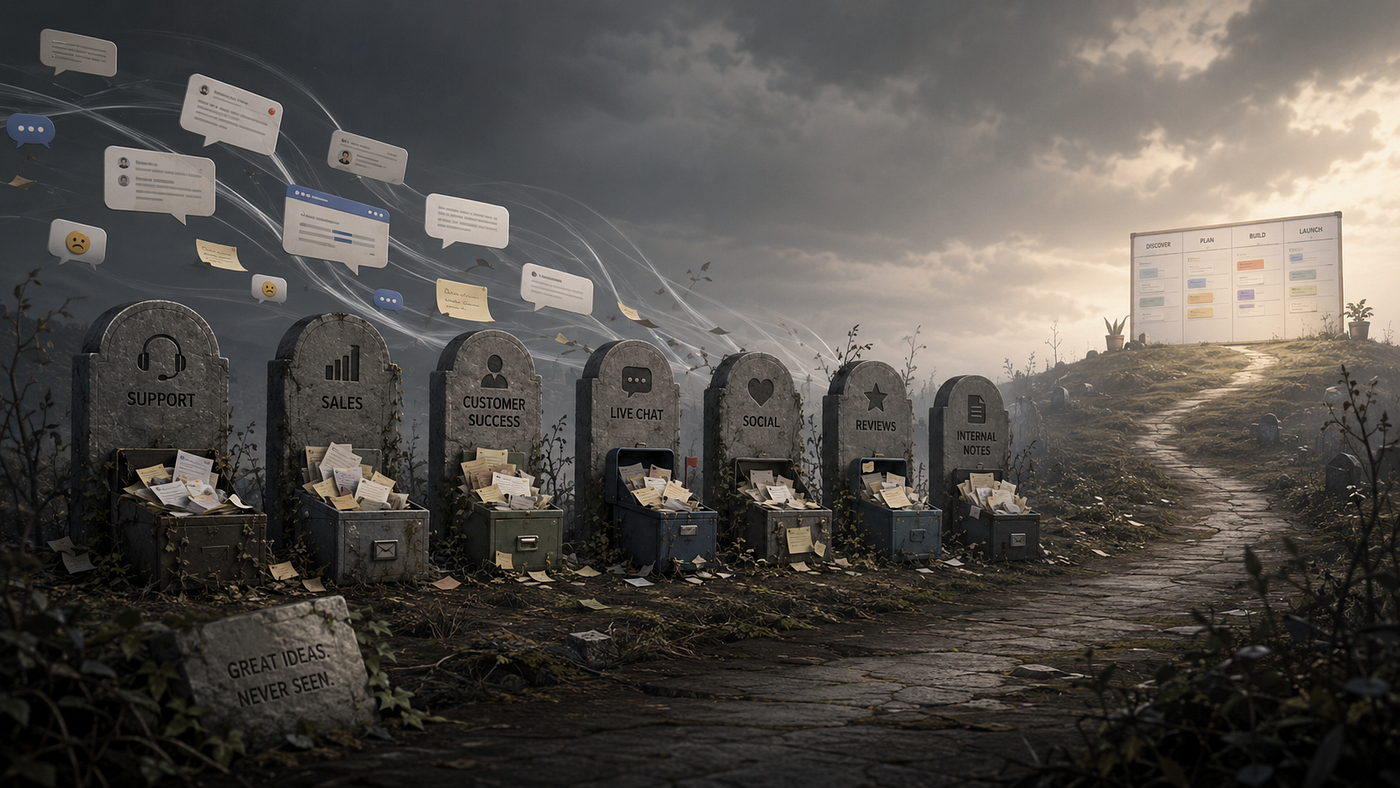
Right now, your customer feedback is probably sitting in places like these:
-
- Sales call recordings nobody re-listens to.
-
- Support tickets tagged “feature-request”.
-
- Slack Connect channels with your top customers.
-
- The founder’s personal inbox.
-
- X mentions and DMs.
-
- NPS survey comments.
-
- A Notion page called “ideas” that hasn’t been touched since November.
Each of these has an owner. None of them has the same owner.
Sales owns the calls. Support owns the tickets. Customer Success lives in Slack Connect. The founder reads her own email. Marketing keeps an eye on X. Product checks the NPS comments. And the Notion page belongs to whoever felt guilty enough to create it.
The result is painful.
The feature request that could help close a $200k deal next quarter is not missing. It is just split across four different places.
The team has the data. Nobody has the signal.
Geography is the killer
I used to think the feedback problem was a volume problem. Too many requests. Too many customers. Too many calls, tickets, comments, and conversations. Not enough time for a PM to read everything.
That is the comforting version. The real version is worse.
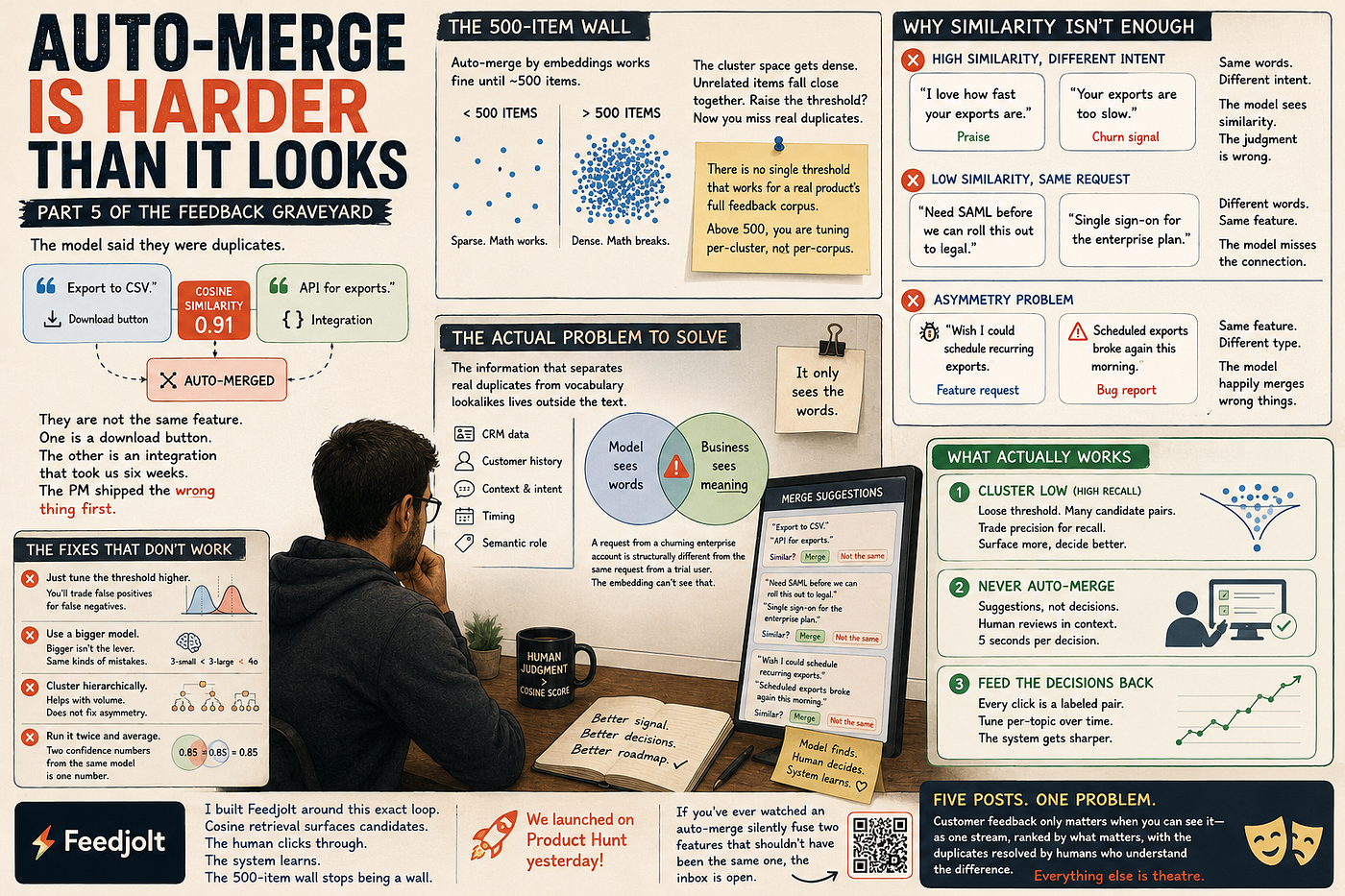
The problem is not always that there is too much feedback. The problem is that the same request appears in four different places and gets counted as one small signal in each.
Customer A writes a support ticket:
“Would be great if we could export this as CSV.”
Customer B says it on a sales call:
“The only blocker for us is that we need the data out as a spreadsheet.”
Customer C posts in Slack:
“Hey, is there any way to download this?”
The PM opens Linear and sees one upvote on “CSV export.”
So she moves on. And honestly, she is not wrong.
From where she is sitting, it looks small. But if she could see the real picture, the decision would feel different. Same request. Three customers. Two paying accounts. One deal blocked.
That might be enough to ship it next sprint.
But she cannot see it, because the signals live in three different tools, owned by three different people, and nobody has time to become the janitor of yet another feedback inbox. The fixes that don’t work
The fixes that do not work
Every team eventually tries to fix this. Most fixes fail for the same reason. They ask people to change their habits.
“Let’s make everyone put feature requests in Linear.”
It sounds reasonable. It almost never happens.
Salespeople do not want to context switch after a call. Support does not want to leave Zendesk. CSMs are already buried in Slack threads. And the customer who mentioned the request on Zoom will never open your internal tools.
“We will have a weekly feedback sync.”
This works for a few weeks. Then someone misses one. Then it becomes monthly. Then quarterly. Then it becomes one of those things everyone agrees should come back, but nobody owns.
“Let’s pay for a feedback portal.”
A portal can be useful, but it is not the source of truth. It only captures the feedback customers are willing to type into the portal. The quote from the sales call still lives in Gong. The urgent message from the champion still lives in Slack. The angry reply still lives in someone’s inbox.
“AI will summarize it.”
Part 4 of this series is about this one.
Spoiler: summaries do not solve broken routing.
The actual problem
This is not mainly a tooling problem. It is a routing problem.
The feedback already exists. Customers are already telling you what hurts, what blocks them, what they need, and what would make them buy more.
The question is whether your product team can see that feedback as a single stream or only as seven disconnected drips.
When feedback is scattered, the roadmap is built on partial evidence.
The requests that should make it into the next sprint are being judged on one seventh of the truth.
The PM is doing her best. She is just looking at one inbox.
What actually works
The goal is not to build another feature request portal. Customers will not go there consistently.
The real goal is simpler. Every place where a customer might say something should feed into one place.
Email. Support tickets. Sales calls. Slack messages. NPS comments. X DMs. Call transcripts. Notes from customer success.
Then those signals need to be automatically clustered, tagged with who said them, linked to account value, and made visible to the people making product decisions.
That is the whole system. Voting, prioritization, public roadmaps, and changelogs all come later.
First, you need to get the inbox right.
I built Feedjolt because I got tired of watching the same thing happen at different companies. Great customer feedback was not being ignored. It was being buried in the wrong place.
Feedjolt is a single inbox for everything customers say, with automatic clustering that merges duplicate requests.
If you have ever watched an important feature request disappear because it lived in the wrong tool, this series is for you.
메타데이터
- post_id
- 91a83419407a
- slug
- the-feedback-graveyard-customer-feedback-dies-in-seven-inboxes-91a83419407a
- url
- https://medium.com/@marcllopart/the-feedback-graveyard-customer-feedback-dies-in-seven-inboxes-91a83419407a
- canonical_url
- https://medium.com/@marcllopart/the-feedback-graveyard-customer-feedback-dies-in-seven-inboxes-91a83419407a
- author_url
- https://medium.com/@marcllopart
- status
- ok
- fetched_at
- 2026-06-21 23:24:37