The New Bottleneck in Enterprise AI Isn’t Intelligence. It’s Token Yield.
Tokenmaxxing is making enterprises less productive than they think
The New Bottleneck in Enterprise AI Isn’t Intelligence. It’s Token Yield.
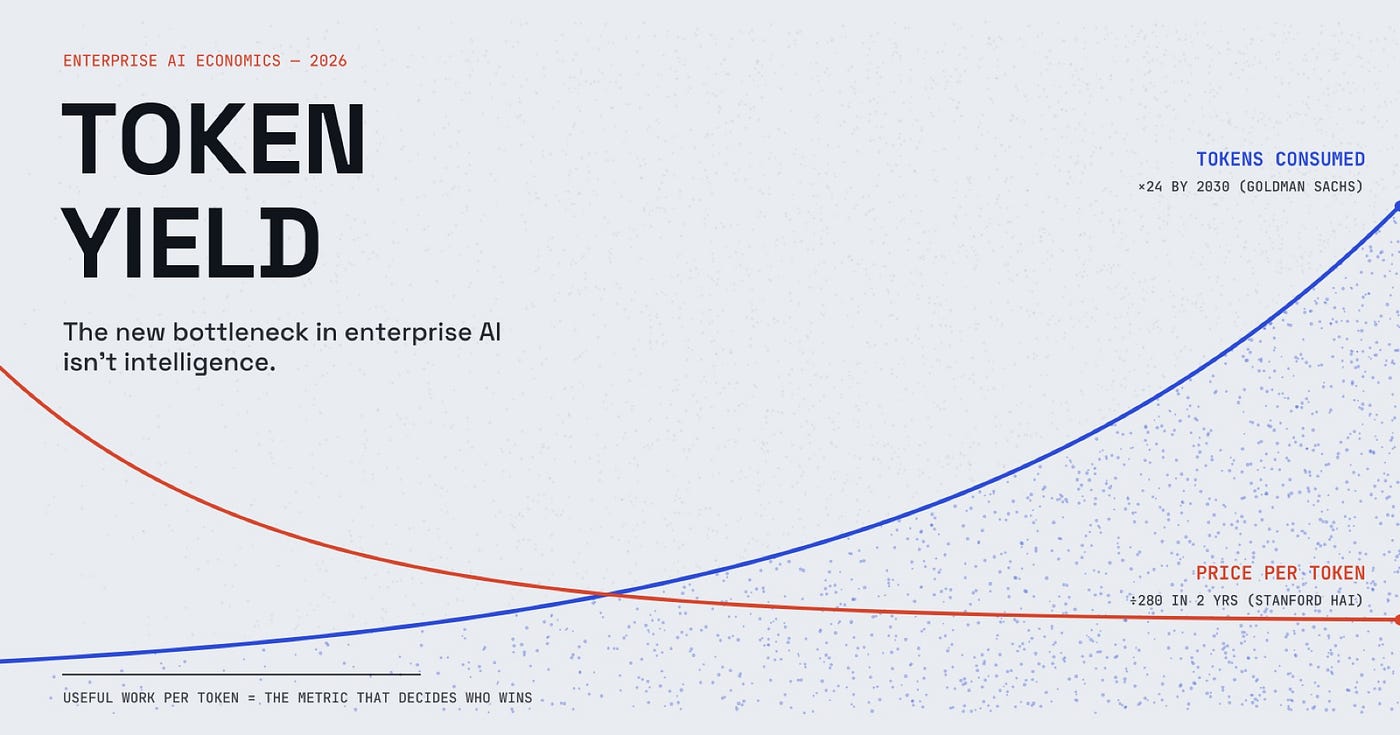
Frontier models are getting smarter and cheaper per unit, yet enterprise AI bills keep exploding. The companies that win won’t be the ones with the best model. They’ll be the ones with the best architecture.
For the past three years, the enterprise AI conversation has been dominated by one question: which model is smartest? That question is losing relevance fast. Frontier intelligence is becoming abundant and, per unit, astonishingly cheap. Stanford HAI’s AI Index found that the inference cost of GPT-3.5-level performance fell roughly 280× in just two years. Semiconductor and datacenter efficiency gains are driving per-token inference costs down 60 – 70% per year, according to Goldman Sachs Research.
And yet enterprise AI bills are rising sharply. Menlo Ventures estimates enterprise generative AI spend jumped from $11.5 billion in 2024 to $37 billion in 2025, and Gartner forecasts worldwide AI spending of roughly $2.59 trillion in 2026, up 47% year over year. Uber’s CTO publicly admitted the company blew through its entire annual AI budget by April 2026 after Claude Code adoption jumped from 32% to 84% of its 5,000-engineer organization in four months, with per-engineer API costs running $500 – $2,000 a month.
Cheaper tokens. Bigger bills. This is the Jevons paradox playing out in real time, and it points to the real bottleneck in enterprise AI today.
It’s no longer model intelligence. It’s token yield: how much useful work a system produces per token consumed.
The economics of the frontier
The latest frontier release makes the shift concrete. Claude Fable 5 – Anthropic’s most capable generally available model – pushed the state of the art forward on nearly every benchmark, hitting 80.3% on SWE-Bench Pro versus 58.6% for GPT-5.5. Stripe reportedly used it to complete a codebase-wide migration across a 50-million-line Ruby codebase in a single day – work estimated at two months for a human team.
But that capability carries a price. Fable 5 is listed at $10 per million input tokens and $50 per million output tokens – exactly double the $5/$25 rate of Claude Opus 4.8, and roughly triple the price of Sonnet 4.6. Frontier flagships barely deflate: each new top-tier model tends to launch near (or above) the price of the last one, so the most ambitious workloads see almost none of the benefit of falling unit costs.
The uncomfortable math: on a per-token basis, the newest frontier model can cost 2× the previous flagship and 20 – 50× the efficient tier – while independent workload testing shows the per-finished-task multiplier can swing anywhere from 1× to 17× depending on the job. On a hard, long-horizon task, the frontier model is often the cheapest option because it actually finishes. On a routine code review or classification task, you’re paying a 7 – 17× premium for marginal gains.
That variance is the whole story. The per-token price tells you almost nothing. Token yield tells you everything.
Where the cost actually lives
Here’s what most AI budget models still miss: the cost of enterprise AI is no longer in the prompt. It’s in the system around the model.
A modern agentic workflow doesn’t make one model call. It plans, retrieves context, calls tools, verifies outputs, retries on errors, and synthesizes results. Industry analyses consistently find that a single user request can trigger 10 – 20 model calls, and Gartner puts agentic workloads at 5 – 30× the compute of a standard chatbot query. Retrieval-augmented queries alone typically consume 3 – 5× more tokens than the same question asked directly, because thousands of pages of context ride along with every call.
EY quantified the shift starkly: a simple customer service AI workflow in 2023 (input → retrieval → response) cost about $0.04 per interaction. The equivalent orchestrated agentic system in 2026 – tools, reasoning, iterative loops – costs about $1.20 per interaction. Thirty times higher, for the “same” business function.
And because transformer models are stateless, every accumulated piece of context – the plan, the prior steps, the tool results, the file contents – gets re-sent as input on every turn of an agentic loop. An eleven-word request can expand into tens of thousands of billed tokens before the system produces a single line of useful output. Add always-on background inference – monitoring agents, document watchers, compliance surveillance – and you have a cost base that grows with every event in your business, not just every user query.
The result: inference now represents roughly 85% of total enterprise AI budgets, and Morgan Stanley projects inference will account for 70 – 80% of all AI compute spending by 2027. Goldman Sachs projects total token consumption will grow ~24× by 2030, to 120 quadrillion tokens per month. The volume curve is outrunning the price curve, and it isn’t close.
Token efficiency is an architecture problem
If the cost lives in the system, the savings live in the architecture. The data here is remarkably consistent.
An analysis of 2.4 billion enterprise API calls in Q1 2026 found that organizations running a tiered model architecture – routing each task to the cheapest model capable of doing it well – achieved a median blended cost of $2.31 per million tokens. Organizations routing everything to frontier models paid $18.40. Same class of work, an 8× difference in unit economics, determined entirely by architecture.
The individual levers compound:
Routing. LLM routers that send simple tasks (classification, extraction, summarization) to efficient models and escalate only when needed cut costs 30 – 85% at near-equal quality, per RouteLLM and AWS benchmarks. One documented team cut its monthly API bill from $40,000 to $24,000 with routing discipline alone – no product changes.
Caching. Prompt caching reduces input costs by ~90% on repeated context (system prompts, tool definitions, codebase scaffolding), and semantic caching combined with routing reduces total API call volume 30 – 50% in typical enterprise deployments. It’s also fragile: one team put a daily timestamp at the top of its system prompt and turned a 90% cache discount into 1%.
Context discipline. Overfetching is the silent killer. The rule is simple: don’t send the model everything it can read; send it what it needs to decide. Loops, retries, and context reloads multiply token consumption 3 – 7× before any optimization.
Effort matching. The biggest single default most teams get wrong is model selection inertia – the first engineer picked the model they were already using, and nobody revisited the decision at production scale. With a 20 – 50× price spread between tiers, that one unexamined default is usually the largest controllable variable in the entire cost structure.
None of these are model problems. They are routing, governance, and system design problems. Which is why the FinOps Foundation now ranks AI cost management as the top forward-looking priority for finance-technology teams in 2026 – the share of FinOps practitioners responsible for AI spend went from 31% to 98% in a single year.
The strategic implication
The pattern rhymes with the history of cloud computing. Raw compute became abundant and cheap; the durable advantage went to companies that built disciplined architectures around it – autoscaling, rightsizing, cost attribution, governance. The ones that didn’t got the famous surprise AWS bill.
Enterprise AI is at the same inflection, but steeper. Deloitte has documented enterprise teams discovering tens of millions of dollars in monthly inference bills from multi-agent deployments. Boards are already shifting the reporting conversation from token spend to efficiency ratios: cost per resolved ticket, revenue per AI workflow, human-equivalent hourly rate.
The winners of this era won’t be the companies that deploy the most powerful models most aggressively. They’ll be the ones whose AI architecture can pair the right model and the right depth of reasoning to each task, with strong routing, spend controls, observability, and governance built in from day one.
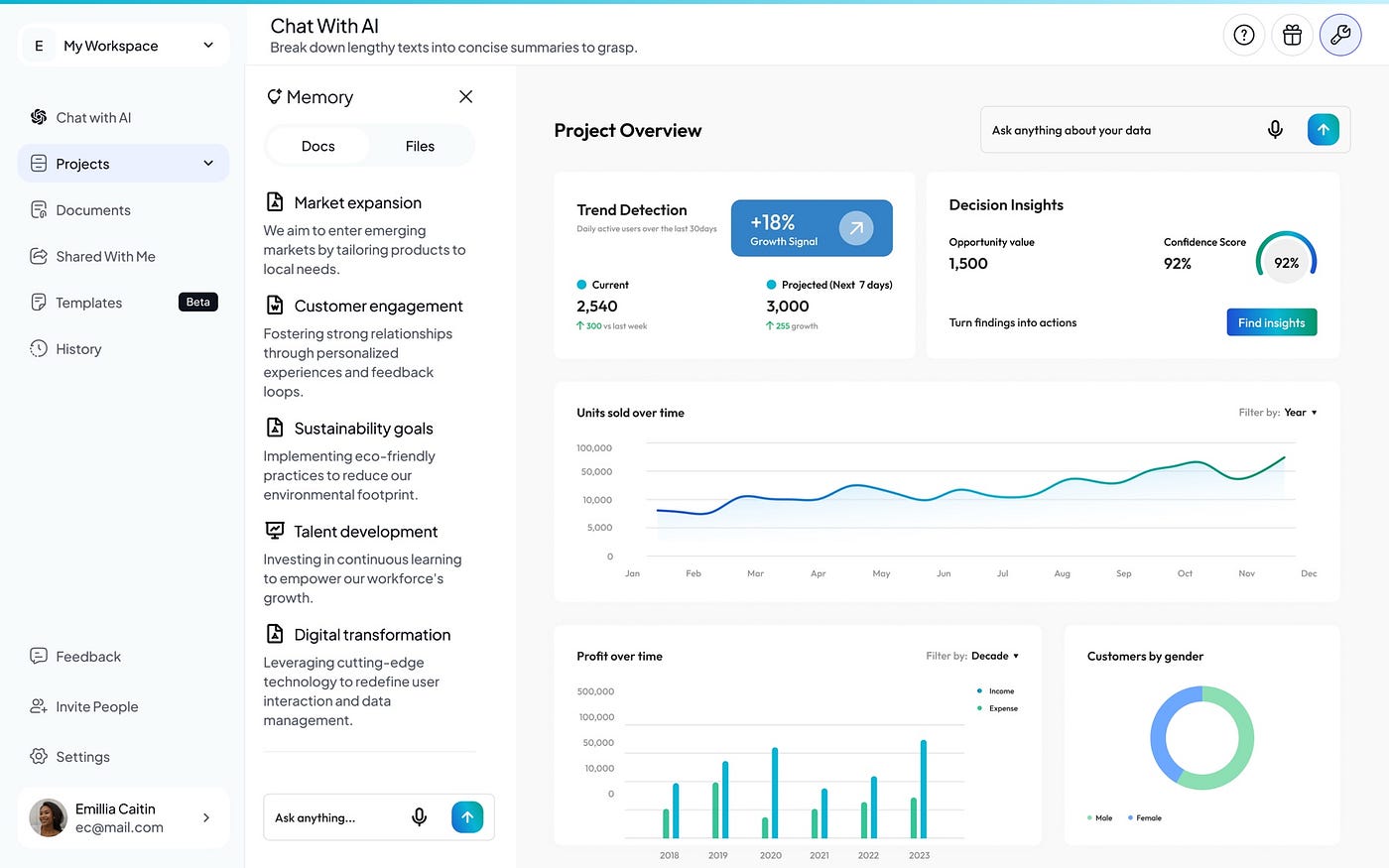
That is precisely what platforms like NMBLR are solving, an AI platform designed around token yield, not token consumption – matching intelligence to task so that every token spent produces work, not waste.
Frontier intelligence is becoming abundant. Efficient execution is not.
Model progress still matters. But in enterprise AI, architecture is increasingly what turns intelligence into competitive advantage.
References
ADVISORI. (2026, June). AI costs 2026: Why they’re exploding & how to cut them. https://www.advisori.de/en/blog/ai-costs-2026-why-exploding-how-to-cut-them
Anthropic. (2026). Pricing. Claude Platform Documentation. https://platform.claude.com/docs/en/about-claude/pricing
Cockroach Labs. (2026, June 10). The bill arrives: How to manage agentic AI costs at scale. https://www.cockroachlabs.com/blog/agentic-ai-costs-at-scale/
EY. (2026, June 1). Agentic AI enterprise token cost. https://www.ey.com/en_us/insights/ai/agentic-ai-token-costs
Finout. (2026, June). Claude Fable 5 and Mythos 5: Pricing, API costs, and benchmark comparison vs Opus 4.8 and GPT-5.5. https://www.finout.io/blog/claude-fable-5-mythos-5-pricing-benchmarks
Goldman Sachs. (2026, May 20). AI agents forecast to boost tech cash flow as usage soars. https://www.goldmansachs.com/insights/articles/ai-agents-forecast-to-boost-tech-cash-flow-as-usage-soars
Oplexa. (2026, March 31). AI inference cost crisis 2026: Why your AI bill is exploding. https://oplexa.com/ai-inference-cost-crisis-2026/
Optimum Partners. (2026, May 25). AI token costs: Why enterprise AI bills keep rising in 2026. https://optimumpartners.com/insight/ai-token-costs-and-how-they-might-wreck-your-budget/
Suplari. (2026a, June). What does enterprise AI actually cost? A finance leader’s breakdown. https://suplari.com/blog/what-does-enterprise-ai-actually-cost
Suplari. (2026b, June). How to control cost of AI tokens in enterprise businesses. https://suplari.com/blog/how-to-control-cost-of-ai-tokens
TechAhead. (2026, June 8). The inference cost trap: Why your AI agent economics break at scale. https://www.techaheadcorp.com/blog/inference-cost-explosion/
Tech Times. (2026, July 6). Fable 5 subscription ends tomorrow: Per-token costs and who gets hit hardest. https://www.techtimes.com/articles/319767/20260706/fable-5-subscription-ends-tomorrow-per-token-costs-who-gets-hit-hardest.htm
Note: Figures attributed to Stanford HAI, Gartner, Menlo Ventures, Morgan Stanley, Goldman Sachs Research, Deloitte, the FinOps Foundation, and RouteLLM/AWS are cited as reported in the sources listed above (secondary citations).
메타데이터
- post_id
- 91b85549244c
- slug
- the-new-bottleneck-in-enterprise-ai-isnt-intelligence-it-s-token-yield-91b85549244c
- url
- https://medium.com/@waynerbee/the-new-bottleneck-in-enterprise-ai-isnt-intelligence-it-s-token-yield-91b85549244c
- canonical_url
- https://medium.com/@waynerbee/the-new-bottleneck-in-enterprise-ai-isnt-intelligence-it-s-token-yield-91b85549244c
- author_url
- https://medium.com/@waynerbee
- status
- ok
- fetched_at
- 2026-07-13 06:23:13



