How to Pick the Perfect Polyethylene Grade for Your Product
You know the material is right, but which grade is the grade? Polyethylene (PE) is the workhorse of the plastics world — versatile…
How to Pick the Perfect Polyethylene Grade for Your Product
You know the material is right, but which grade is the grade? Polyethylene (PE) is the workhorse of the plastics world — versatile, durable, and cost-effective. But with over 7,500 grades on the market, from flexible films to rigid piping, the difference between a product that performs and one that fails often comes down to selecting the right type.
As an OEM or brand maker, you’re not just looking for plastic; you need a material solution that balances processability, mechanical demands, and end-use environment. The choice isn’t just between HDPE, LDPE, and LLDPE. It’s about understanding the nuances of molecular structure and how that translates to real-world performance.
The Three Pillars: HDPE, LDPE, and LLDPE

Let’s cut through the noise. Your selection journey starts with understanding the three main families:
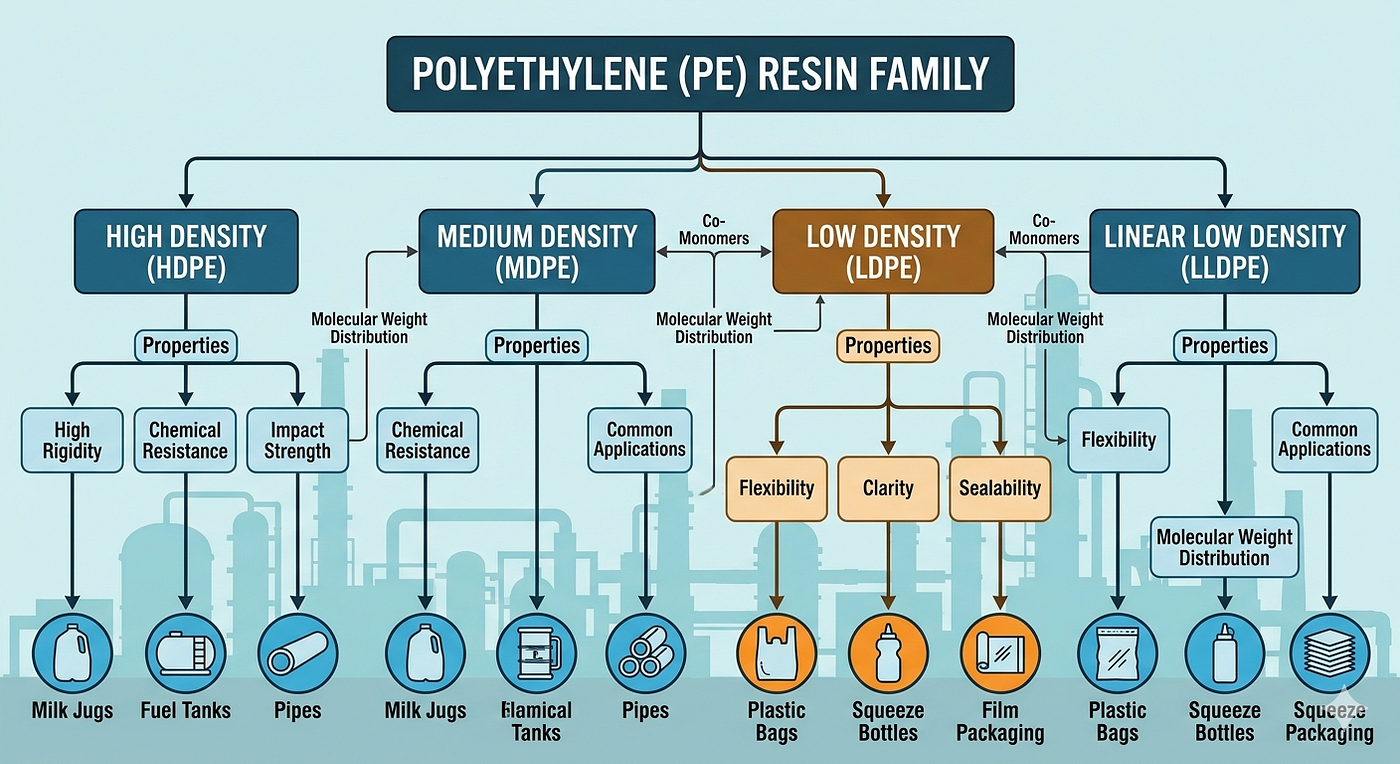
· HDPE (High-Density Polyethylene): The rigid workhorse. With its linear structure and high crystallinity (over 90%), HDPE delivers high tensile strength, excellent chemical resistance, and good low-temperature toughness. It’s the go-to for applications demanding stiffness and durability, like fuel tanks, industrial piping, and crates. However, it can be susceptible to stress cracking and has lower UV resistance, though specialty grades address these limitations.
· LDPE (Low-Density Polyethylene): The flexible generalist. Its highly branched structure gives it a low crystallinity (50–60%), resulting in a semi-rigid, transparent film. LDPE excels in applications needing flexibility and impact strength, such as squeeze bottles, trash bags, and food packaging films. Its trade-off is lower strength and a lower maximum service temperature compared to HDPE.
· LLDPE (Linear Low-Density Polyethylene): The performance hybrid. It combines a linear backbone with short, uniform branches. This unique structure gives it higher tensile and puncture strength than LDPE, with better environmental stress crack resistance. LLDPE is the material of choice for high-performance films like stretch wrap and industrial liners where durability is non-negotiable.
When Standard Grades Aren’t Enough
Beyond these three, the selection criteria get more specific. For high-wear industrial applications like liners and silos, UHMWPE (Ultrahigh-Molecular-Weight Polyethylene) offers exceptional abrasion resistance and impact strength due to its extremely long molecular chains. For critical applications requiring thermal and mechanical toughness — think high-voltage cable insulation or chemical pipework — cross-linked polyethylene (PEX or XLPE) provides superior heat resistance, creep resistance, and durability that standard PE can’t match.
Making the Call
The right grade balances performance with processability. For instance, HDPE is ideal for injection molding with a melt temperature of 200–300°C, while LDPE is more commonly extruded into films. Your choice will also be influenced by sustainability goals: many HDPE and LLDPE grades are recyclable, and bio-based PE options derived from sugarcane offer a renewable alternative.
Ultimately, the “right” PE grade hinges on the specific demands of your application — from chemical exposure and temperature requirements to mechanical stress and processing methods.
This is just a glimpse into the technical depth required to navigate the world of polyethylene. The full guide breaks down everything from detailed property comparisons (like the LLDPE vs. LDPE vs. HDPE matrix) to formulation issues and advanced selection filters.
Ready to stop guessing and start specifying with confidence? Check out the complete Polyethylene Selection Guide here to find your perfect grade match.
메타데이터
- post_id
- 91c643f44085
- slug
- how-to-pick-the-perfect-polyethylene-grade-for-your-product-91c643f44085
- url
- https://medium.com/@author-paul-martin/how-to-pick-the-perfect-polyethylene-grade-for-your-product-91c643f44085
- canonical_url
- https://medium.com/@author-paul-martin/how-to-pick-the-perfect-polyethylene-grade-for-your-product-91c643f44085
- author_url
- https://medium.com/@author-paul-martin
- status
- ok
- fetched_at
- 2026-06-17 08:20:12