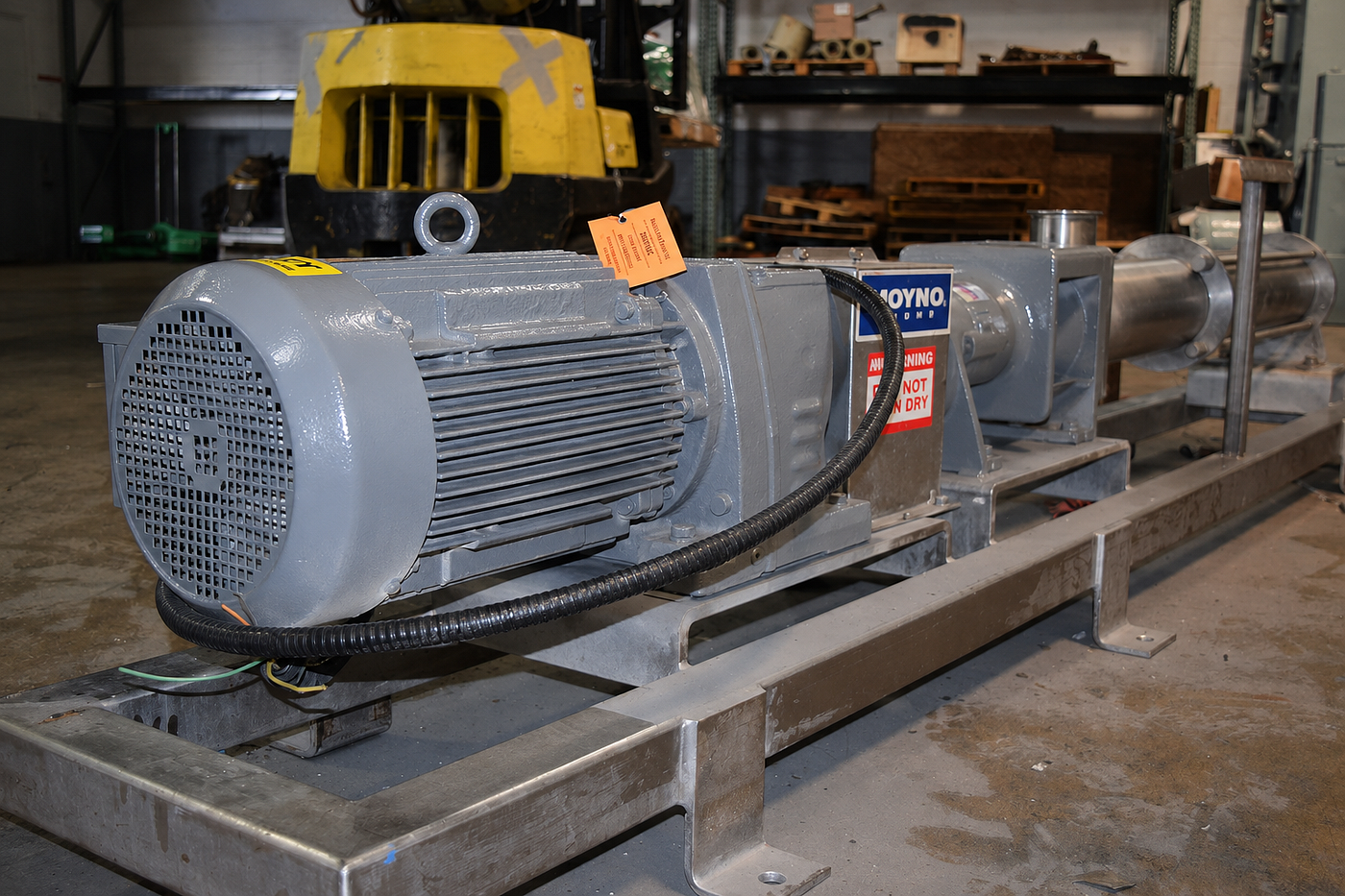
Why Industrial Pump Repair Deserves More Attention Than You’re Giving It
That humming machine in the corner is holding your entire operation together — until it isn’t.
Why Industrial Pump Repair Deserves More Attention Than You’re Giving It
That humming machine in the corner is holding your entire operation together — until it isn’t.

There’s a piece of equipment in almost every industrial facility that nobody talks about until the day everything stops. It’s not the conveyor. It’s not the compressor. It’s the pump — and when it fails, the cost isn’t just the repair bill. It’s the hours, sometimes days, of unplanned downtime that ripple across an entire production floor.
Industrial pumps are the circulatory system of modern manufacturing. They move water, chemicals, food products, pharmaceuticals, slurry, and everything in between. Power plants rely on them. Water treatment facilities can’t function without them. Petrochemical plants, food and beverage processors, and pharmaceutical manufacturers all share a single uncomfortable truth: when a pump goes down, so does productivity.
So why do so many facilities treat pump maintenance as an afterthought?
The Real Cost of Ignoring Your Pumps
A pump failure rarely happens in isolation. It cascades.
When a centrifugal pump seizes at a water treatment plant, the downstream effects can affect entire municipalities. When a vacuum pump fails in a pharmaceutical cleanroom, a full production batch may have to be scrapped. When a diaphragm pump breaks down mid-shift at a food processing facility, regulatory compliance questions arise on top of the production loss.
The cost of downtime in industrial settings is notoriously difficult to calculate in the moment — but studies across manufacturing sectors consistently show it runs into thousands of dollars per hour, and sometimes far more. Most of that cost is invisible in the moment: spoiled materials, idle labor, delayed shipments, and the compounding pressure on a team suddenly scrambling to source replacement parts.
The irony is that most pump failures are preventable, or at the very least, predictable.
What Modern Industrial Pump Repair Actually Looks Like
The best pump repair shops today don’t just swap out worn components — they treat each unit as a system worth understanding.
A proper pump repair engagement starts with a full inspection. Not a visual once-over, but a structured diagnostic that identifies every issue, not just the obvious one that caused the call. Worn bearings, eroded impellers, compromised seals, and shaft misalignment can all coexist in a single unit. Missing any one of them means the pump comes back — sooner than it should.
After the inspection, a good shop establishes a clear plan before touching a wrench. That means written documentation of findings, a defined scope of work, OEM-specification parts, and a timeline that respects the urgency of your operation.
National Gear Repair, based in Upland, California, is one of the few shops that handles this breadth of pump types under one roof. Their roster covers horizontal pumps, submersible pumps, vertical pumps, split case pumps, positive displacement pumps, vacuum pumps, liquid ring pumps, and more — across industries from power generation to pharmaceutical manufacturing. That kind of range matters when you’re managing a mixed fleet and don’t want to manage a different vendor relationship for every pump type.
The Pump Types You Should Know
Not all industrial pumps fail the same way, and not all repair shops are equipped to handle every type. Here’s a quick orientation:
Centrifugal Pumps are the workhorses of water treatment and HVAC systems. They’re relatively simple but sensitive to impeller wear and bearing degradation. Brands like Goulds are common in this category.
Positive Displacement Pumps — including gear pumps, lobe pumps, and piston pumps — are common in food and beverage and chemical applications where precise flow control matters. Waukesha, Viking, and Tuthill are well-known names here.
Vacuum Pumps are critical in pharmaceutical manufacturing, where controlled environments depend on them. Kinney, Stokes, Leybold, and Nash vacuum pumps require specialized knowledge that not every repair shop carries.
Diaphragm Pumps handle corrosive or shear-sensitive fluids and are common across chemical and food processing applications.
Liquid Ring Pumps and Rotary Vane Pumps round out the picture in applications requiring steady, gentle vacuum or pressure.
Each of these has its own failure modes, its own wear patterns, and its own set of best practices for rebuild. Knowing the difference is the gap between a repair that lasts and one that fails again in six months.
Why the 24/7 Part Actually Matters
Industrial operations don’t run on business hours. A pump that fails at 2 a.m. on a Saturday doesn’t care that the repair shop opens Monday morning.
Emergency industrial pump repair — real emergency service, not a voicemail system and a callback the next day — is a genuine differentiator. National Gear Repair maintains 24/7 availability specifically because the facilities they serve can’t afford to wait. Their emergency service comes with free pickup and delivery, which removes one more logistical obstacle between a broken pump and a running line.
The 24-month guarantee they back their repairs with is worth noting too. It’s a signal about confidence in workmanship — shops that do the job right don’t shy away from standing behind it.
A Practical Checklist: Signs Your Pump Needs Attention Now
If you’re managing an industrial facility, these are the early warning signs worth acting on before they become emergencies:
- Unusual vibration or noise — Often the first sign of bearing wear or impeller damage
- Reduced flow rate — Can indicate wear ring degradation or internal recirculation
- Increased energy consumption — A pump working harder than it should to move the same volume
- Seal leaks — Don’t wait on these; they escalate quickly and create secondary damage
- Frequent cavitation — The telltale rattling sound that indicates your pump is running in damaging conditions
- Temperature rise — Excessive heat in the casing or bearing housing signals friction problems
Any one of these is a reason to schedule an inspection. More than one is a reason to call today.
The Bottom Line
Industrial pump repair isn’t glamorous. It doesn’t get written up in trade magazines the way new automation technology does. But in terms of impact on operational continuity, few maintenance decisions matter more.
The facilities that manage pump health proactively — with regular inspections, qualified repair partners, and a willingness to act on early warning signs — are the ones that don’t lose days of production to a failure that could have been caught weeks earlier.
If you’re in manufacturing, water treatment, pharmaceuticals, chemicals, food and beverage, or power generation, your pumps deserve a better plan than “wait and react.”
National Gear Repair provides 24/7 emergency industrial pump repair and rebuild services from their facility in Upland, California. They service a wide range of pump types and brands across multiple industries, with free pickup and delivery and a 24-month guarantee on all repairs. For inquiries, visit nationalgearrepair.com.
메타데이터
- post_id
- 91c6c7b9fb93
- slug
- why-industrial-pump-repair-deserves-more-attention-than-youre-giving-it-91c6c7b9fb93
- url
- https://medium.com/@NationalGearRepairInc./why-industrial-pump-repair-deserves-more-attention-than-youre-giving-it-91c6c7b9fb93
- canonical_url
- https://medium.com/@NationalGearRepairInc./why-industrial-pump-repair-deserves-more-attention-than-youre-giving-it-91c6c7b9fb93
- author_url
- https://medium.com/@NationalGearRepairInc.
- status
- ok
- fetched_at
- 2026-06-26 03:39:16