Coherent Corp.
The explosive growth of artificial intelligence, hyperscale cloud services, and high-performance computing is driving an unprecedented…
Coherent Corp. Launches the CHR1074 224Gbps Quad-Channel TIA for Next-Generation 800G and 1.6T Optical Transceivers
The explosive growth of artificial intelligence, hyperscale cloud services, and high-performance computing is driving an unprecedented demand for faster and more efficient data center connectivity. As network speeds accelerate beyond 400G, the optical components powering these systems must evolve to support significantly higher bandwidth while maintaining efficiency and reliability. Addressing this challenge, Coherent Corp. has introduced the CHR1074, a 224Gbps quad-channel transimpedance amplifier (TIA) designed to enable the next generation of 800G and 1.6T optical transceivers used in AI and cloud infrastructure.
Meeting the Bandwidth Demands of AI-Driven Data Centers
AI workloads require massive data exchange between processors, storage systems, and accelerators. As clusters scale into thousands of GPUs and specialized processors, interconnect bandwidth becomes a critical bottleneck. To keep pace with these demands, hyperscale data centers are rapidly transitioning from 400G optical interconnects to 800G and eventually 1.6T solutions.
In this ecosystem, optical transceivers serve as the backbone of high-speed data transfer. A key component within these modules is the transimpedance amplifier, which converts the small electrical current generated by a photodiode into a usable voltage signal for downstream processing. At speeds exceeding 200Gbps per lane, achieving high signal fidelity, low noise, and energy efficiency becomes increasingly complex.
The CHR1074 addresses these challenges by delivering 224Gbps performance across four channels, enabling designers to build next-generation optical modules capable of supporting extreme data throughput in AI and cloud networks.
Fast-Settling Architecture for Dynamic Traffic Patterns
Modern hyperscale networks are highly dynamic. Traffic patterns frequently shift due to virtualization, AI model training bursts, and workload balancing. To optimize power consumption, data center equipment often places links into low-power states during idle periods. However, traditional TIAs may introduce delays when transitioning from idle to active operation.
The CHR1074 tackles this problem with a fast-settling architecture capable of restoring full performance within approximately 50 nanoseconds when links transition from standby to active mode.
This rapid response dramatically improves network responsiveness and helps maintain the low latency required for distributed AI training and real-time data processing. For hyperscale operators managing millions of simultaneous connections, such performance gains can significantly improve overall system efficiency.
High Signal Integrity and Power Efficiency
Operating at 224Gbps requires extremely precise analog performance. Signal distortion, noise, and power consumption can quickly degrade link reliability if not carefully managed.
The CHR1074 integrates several key features designed to support high-speed optical links:
- High signal integrity to preserve data accuracy at extreme speeds
- Low noise amplification for improved receiver sensitivity
- Optimized power consumption to support dense optical deployments
- Compact design suitable for modern pluggable transceiver modules
These attributes enable system designers to scale bandwidth while keeping power budgets under control — an essential requirement as data centers continue to expand.
Power efficiency is particularly critical because next-generation 800G and 1.6T modules may contain multiple high-speed optical lanes. Even small improvements in component efficiency can translate into substantial reductions in heat generation and cooling requirements across large data center environments.
Enabling the Transition to 224Gbps Optical Lanes
The optical networking industry is currently transitioning toward 224Gbps PAM4 electrical and optical lanes, which form the foundation for future 1.6T transceiver architectures. Each transceiver aggregates multiple high-speed lanes to reach the total module bandwidth.
With the CHR1074, Coherent provides a key building block for these emerging architectures. By combining the amplifier with advanced photodiodes and driver ICs, system designers can build highly integrated optical engines that deliver the bandwidth required for next-generation networking platforms.
The product also complements Coherent’s broader portfolio of photonic and semiconductor solutions, including silicon photonics drivers and high-speed photodiodes used in optical communication systems.
Strengthening Coherent’s Position in Optical ASICs
The launch of the CHR1074 reflects Coherent’s strategy to expand its role in the high-speed optical ASIC market. The company has decades of experience in photonics and optical communications technology, and its semiconductor devices are widely used across data center and telecom infrastructure.
According to company leadership, the rise of AI-driven infrastructure is reshaping the requirements of optical interconnect systems. Delivering both performance and efficiency at 224Gbps speeds is therefore essential for supporting future network architectures.
By combining ultra-fast link recovery, high signal fidelity, and efficient power management, the CHR1074 positions Coherent as a strategic partner for customers building the next generation of high-bandwidth optical modules.
Coherent Corp. Launches the CHR1074 224Gbps Quad-Channel TIA to Enable 800G and 1.6T Optical Transceivers
The rapid expansion of artificial intelligence, hyperscale cloud infrastructure, and high-performance computing is transforming the requirements for data center networking. As AI clusters grow to thousands of GPUs and accelerators, the need for faster and more efficient optical interconnects has become critical. To address this demand, Coherent Corp. has introduced the CHR1074, a 224Gbps quad-channel transimpedance amplifier (TIA) engineered to power next-generation 800G and 1.6T optical transceivers.
This latest innovation reflects a broader industry transition toward 224Gbps lane speeds and advanced optical technologies that can support the immense data movement required by modern AI workloads. By combining high-speed analog performance with power efficiency and rapid link recovery, the CHR1074 provides a key building block for next-generation optical modules used in hyperscale data centers.
The Growing Need for Ultra-Fast Optical Interconnects
Data centers have historically progressed through several bandwidth generations — from 10G and 40G to 100G and 400G optical networks. However, the explosive growth of AI model training and real-time data analytics has accelerated the demand for even higher throughput.
Today’s hyperscale facilities are rapidly transitioning to 800G optical transceivers, with 1.6T modules already under development. These systems rely on multiple high-speed electrical and optical lanes to aggregate the total bandwidth required for high-performance computing environments.
At the core of these optical receivers lies the transimpedance amplifier, a crucial component responsible for converting the weak current signals produced by photodiodes into usable electrical voltage signals. As link speeds climb beyond 200Gbps per lane, the performance requirements for TIAs become increasingly demanding. Designers must address challenges related to signal integrity, noise, power consumption, and thermal management while maintaining reliable operation at extreme data rates.
The CHR1074 was developed specifically to meet these challenges, enabling system designers to build optical modules capable of supporting the next generation of AI-driven data center networks.
Understanding Transimpedance Amplifiers (TIAs)
A transimpedance amplifier is an analog device used in optical communication receivers. Its primary role is to convert the tiny current generated by a photodiode into a voltage signal that can be processed by downstream electronics such as limiting amplifiers or digital signal processors.
When optical signals travel through fiber and reach a receiver module, they are detected by a photodiode that produces a small electrical current proportional to the incoming light intensity. However, this current is extremely weak — often in the microamp range — and cannot be processed directly by digital circuitry.
This is where the TIA plays a critical role. It amplifies the current signal and converts it into a stable voltage output while preserving the signal’s integrity. In high-speed systems, the TIA must also provide:
- Wide bandwidth to support extremely fast data rates
- Low noise amplification to maintain signal clarity
- High sensitivity for reliable optical detection
- Stable gain and linearity across multiple channels
At speeds approaching 224Gbps per lane, even minor distortions can significantly degrade signal quality. Advanced TIA designs must therefore incorporate sophisticated architectures to maintain performance at these extreme frequencies.
The Role of PAM4 Modulation in High-Speed Optical Links
Another key technology enabling next-generation optical networks is Pulse‑Amplitude Modulation 4‑level (PAM4), a modulation technique that dramatically increases data transmission efficiency.
Traditional optical links used NRZ (Non-Return-to-Zero) signaling, where each symbol represents a single bit using two voltage levels — high and low. While simple and robust, NRZ becomes inefficient at extremely high speeds because increasing bandwidth requires proportionally faster signal transitions.
PAM4 addresses this limitation by using four discrete signal levels instead of two, allowing each symbol to represent two bits of data. This effectively doubles the data rate without requiring a proportional increase in channel bandwidth.
For example:
- NRZ signaling transmits 1 bit per symbol
- PAM4 signaling transmits 2 bits per symbol
This approach has become essential for enabling 400G, 800G, and 1.6T optical networks. However, PAM4 signals are also more sensitive to noise and distortion because the voltage difference between levels is smaller. As a result, receiver components — including TIAs — must deliver exceptionally high signal integrity and low noise performance.
Key Features of the CHR1074 224Gbps Quad-Channel TIA
The CHR1074 is designed to support four channels operating at 224Gbps, making it ideal for advanced optical transceiver architectures used in hyperscale data centers.
Key capabilities include:
1. Ultra-High Data Rate Support
The amplifier supports 224Gbps PAM4 electrical lanes, which are emerging as the industry standard for next-generation optical modules. These high-speed lanes form the foundation for 800G and 1.6T transceiver platforms.
2. Fast-Settling Architecture
Modern data center networks frequently transition links between active and low-power standby states to reduce energy consumption. However, conventional receiver circuits may require significant time to stabilize after waking from standby mode.
The CHR1074 features a fast-settling design capable of restoring full performance in approximately 50 nanoseconds. This rapid recovery helps maintain low network latency and ensures that data flows resume instantly when required.
3. High Signal Integrity
Maintaining signal fidelity at 224Gbps requires extremely precise analog circuitry. The CHR1074 is engineered to minimize noise, distortion, and jitter, ensuring reliable PAM4 signal detection even under demanding operating conditions.
4. Power-Efficient Design
Power efficiency is a critical factor for hyperscale data centers, where thousands of optical modules operate simultaneously. The CHR1074 is optimized to reduce power consumption while maintaining high performance, helping operators manage cooling and energy costs.
5. Compact Integration for Pluggable Modules
Next-generation optical transceivers must deliver higher bandwidth within the same compact form factors used in modern data center hardware. The CHR1074’s integrated quad-channel architecture allows designers to build high-density optical engines that fit within advanced pluggable module designs.
Enabling the Next Generation of Optical Transceivers
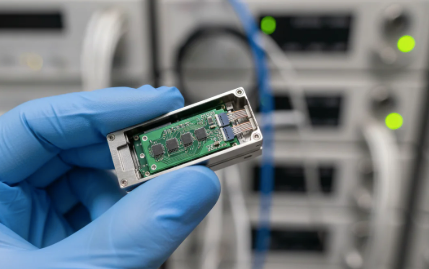
Optical transceivers combine multiple components — including lasers, modulators, photodiodes, drivers, and TIAs — into compact modules that connect switches, servers, and accelerators across high-speed fiber networks.
As the industry transitions toward 1.6T optical modules, designers must integrate multiple 224Gbps lanes into increasingly compact packages. High-performance TIAs like the CHR1074 play a crucial role in enabling these architectures by providing the analog performance necessary for reliable high-speed signal detection.
By pairing the CHR1074 with advanced photodiodes and optical drivers, system designers can build highly integrated optical engines capable of supporting the massive bandwidth requirements of AI infrastructure.
Strategic Importance for AI and Cloud Infrastructure
The introduction of the CHR1074 also highlights the growing importance of optical semiconductor devices within the broader data center ecosystem. As AI workloads continue to scale, data movement between processors, memory systems, and storage networks becomes a dominant performance factor.
High-bandwidth optical interconnects are therefore essential for enabling:
- Large-scale AI model training
- Distributed computing clusters
- Real-time data analytics platforms
- High-performance cloud services
By delivering both high speed and energy efficiency, the CHR1074 helps address the core networking challenges associated with next-generation AI infrastructure.
Looking Ahead: The Future of Optical Networking
The launch of the CHR1074 underscores a broader transformation taking place within optical communications. As bandwidth requirements continue to increase, the industry is moving rapidly toward 224Gbps electrical lanes and multi-terabit optical modules.
Future optical systems will rely on increasingly sophisticated analog and photonic technologies to maintain signal integrity at these extreme speeds. Innovations in TIAs, modulators, photonic integration, and digital signal processing will collectively define the next generation of networking hardware.
With the introduction of the CHR1074, Coherent is contributing a critical component to this evolving ecosystem. By enabling faster link recovery, improved power efficiency, and reliable operation at 224Gbps speeds, the device provides a foundation for the optical transceivers that will power tomorrow’s AI-driven data centers.
As cloud infrastructure continues to expand and AI workloads grow in complexity, solutions like the CHR1074 will play an essential role in ensuring that data center networks can keep pace with the demands of the digital age.
메타데이터
- post_id
- 91ccfd5fa149
- slug
- coherent-corp-91ccfd5fa149
- url
- https://medium.com/@sunoltech/coherent-corp-91ccfd5fa149
- canonical_url
- https://medium.com/@sunoltech/coherent-corp-91ccfd5fa149
- author_url
- https://medium.com/@sunoltech
- status
- ok
- fetched_at
- 2026-06-24 11:06:28