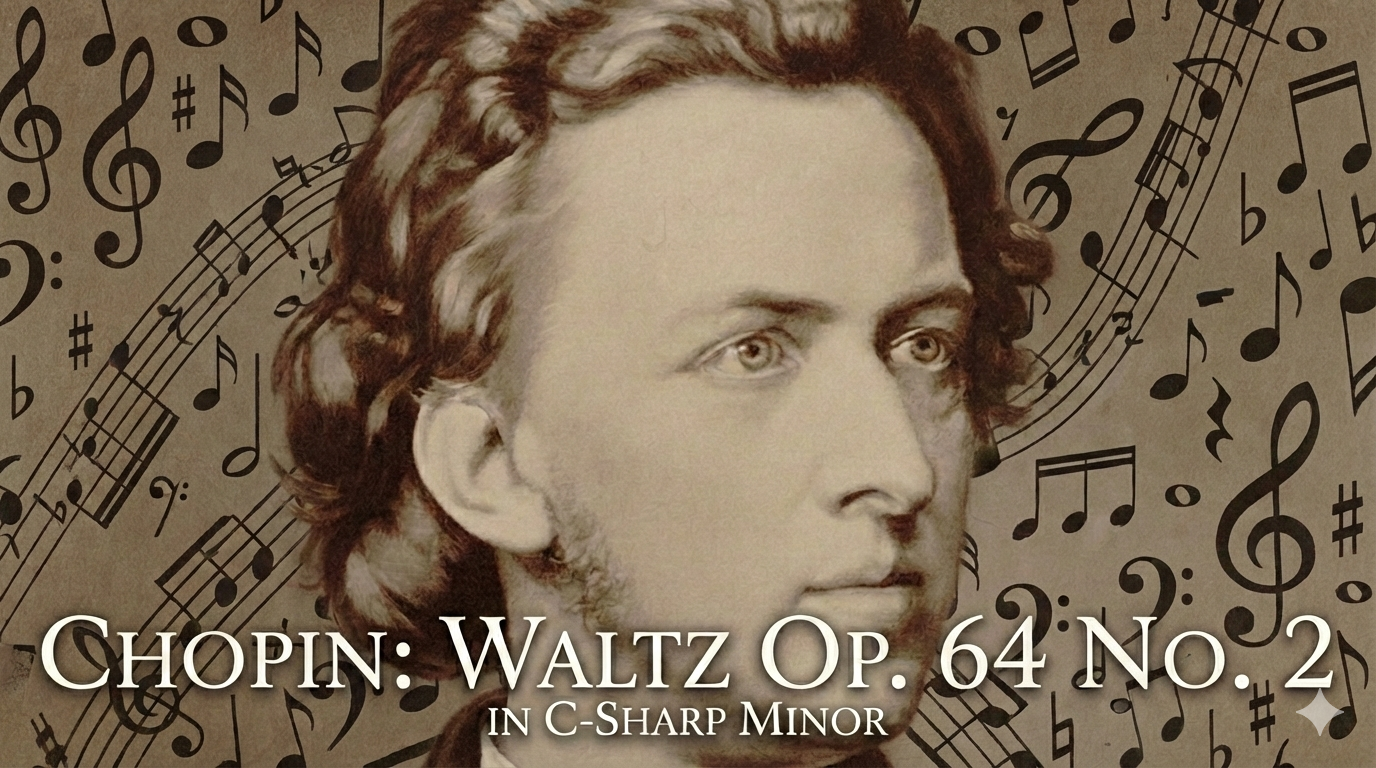
My Journey upon Chopin’s Path in Paris: A Musical Expedition
Chopin’s music has always resided in a special place in my heart; his compositions, no matter how small or large the scale, left me without…
My Journey upon Chopin’s Path in Paris: A Musical Expedition

Chopin’s music has always resided in a special place in my heart; his compositions, no matter how small or large the scale, left me without exception awe-inspired and aching for more. I had phases of complete obsession with his Scherzo №2 in B-flat Minor, Concerto №1 in E Minor, and his “Wrong Note” Etude Op. 25 №5. Although Chopin is a Polish-born composer, his father was from France, and after the failed November Uprising against the Russian rule, he was forced to leave his beloved country and never return. Chopin later settled in Paris, where he continued his musical work until his death in 1849. That means he spent 19 years, nearly half of his life, in Paris, cementing its importance to Chopin’s life and career. Hence, when it finally came time for the week-long trip to Paris in December of 2025, it was one of my top priorities to visit every place I could that was related to him and his work.
It was not hard to find hints of 19th to 20th century classical music culture in the bustling city of Paris; when I went to the hill of Montmartre, we quite literally stumbled upon the former house of the world-famous composer Erik Satie (whom I hope I will write about in the near future) whilst trying to escape the bitter cold winds of December. There was a little sign commemorating the musician’s residency that would have been hard to miss had we not been staring up at the towering Parisian rooftops as we were walking its streets. Such instances further emulate the typical belief that Paris is the heart of cultural evolution in Europe and arguably the rest of the world.
Chopin’s Apartment in the Place Vendôme
Moving our attention to Chopin, my first destination was his final residency, an apartment in the Place Vendôme, a plaza that is world-famous for housing countless luxury stores, as well as the Vendôme Column, a colossal bronze statue of Napoleon Bonaparte standing proudly in the center.

Chopin’s apartment in the Place Vendôme
I scanned the area for possible indications of Chopin’s residency, but to my dismay, I couldn’t find any. This led me on quite the search, pacing around the square for about 30 minutes, looping three times around the entire perimeter. Along the way, I was able to see the Ritz Hotel, Cartier, and Chanel, and part of the reason I took so long to walk around the square was because my mom kept wandering off into a designer shop after just a few minutes.

Chopin’s memorial plaque, half-hidden behind Christmas decorations
Finally, my eyes caught a little grey corner sticking out of some Christmas decorations (it was really hard to spot it in the commotion!), and it turned out to be one of the plaques posted on the famous historical sites. The sign reads “Frédéric-François Chopin, né à Żelazowa Wola (Pologne) le 22 février 1810, est mort dans cette maison le 17 octobre 1849,” which translates to “Frédéric-François Chopin, born in Żelazowa Wola (Poland) on February 22, 1810, died in this house on October 17, 1849.” The fact that such a significant site, the very place where one of history’s greatest pianists and composers lived and died, was covered by Christmas decorations was quite irritating to me; such treatment, in my opinion, bordered on disrespect. I would think that someone of Chopin’s importance should be revered more than this by the city. The apartment itself is today a Chaumet shop, which is a luxury boutique, so other than the honorary plaque, there was really nothing else to see.
La Madeleine: Witness to Chopin’s Final Farewell

La Madeleine, where Chopin’s funeral was held
Thus, it was time we moved on to the next site. We walked around the Palais Garnier Opera House (which I have a future episode relating to: The Phantom of the Opera. Stay tuned!), took a break at the Lafayette Shopping Center, and arrived at La Madeleine, the church where Chopin’s funeral was held. The place’s grandeur was simply breathtaking; while the Neoclassical architectural design is inspired heavily by the Athenian Parthenon, its sheer scale nearly dwarfs the ancient Greek temple. La Madeleine is nearly double the length of the Parthenon while also being about 50% wider. Standing in front of the looming columns gave me an intense feeling of glory that was unmatched by any other work of architecture, not even the Roman Pantheon. Perhaps it was the knowledge that the funerals of several historical figures were held there other than Chopin, such as Coco Chanel, Johnny Hallyday, and Marlene Dietrich. The building’s history does not disappoint, either. La Madeleine went through several halts in construction, modifications in purpose, and even at one point was completely demolished. It was commissioned by King Louis XV in his goals for it to become a new center of urban prestige in Paris. However, from the very beginning, repeated complications slowed progress. Pierre Contant d’Ivry, the first architect hired for the job, died in 1777. When the new architect, Guillaume-Martin Couture, stepped in, he decided to start from scratch and razed the original building. But La Madeleine’s misfortune was not at its end. After only 12 years of construction, the French Revolution erupted, and the building was halted in its tracks. During the reign of the Jacobins, propositions such as repurposing it to be a stock exchange, library, or even a ballroom were considered. However, when Napoleon Bonaparte took over France, he set his ambitions on turning France into a “neo-Roman Empire.” Hence, the idea of turning La Madeleine into a temple for his army was formed. It was to be called ‘Temple de la Gloire de la Grande Armée:’ Temple to the Glory of the Great Army. But once again, La Madeleine’s promising prospect was thrown in the dirt, as the new Arc de Triomphe gained more attention and funding from Napoleon. After this and several other setbacks in construction, La Madeleine was at last completed and set to be a parish church. Although not a building commemorating the glory of an empire, La Madeleine’s historical and cultural roots are astoundingly complex. The sculptor Charles Marochetti sculpted a colossal statue of angels lifting Mary Magdalene into heaven, an intricate fresco called “The History of Christianity” by Jules-Claude Ziegler encompasses the vast area above the altar, depicting countless significant figures of the Christian religion, and legendary French musicians and composers such as Camille Saint-Saëns and Gabriel Fauré worked as organists in La Madeleine. To this very day, many classical music concerts are held almost every day, further proving the irrefutable essence of classical music that is embedded into the legacy of this church.

Leading up to Chopin’s eventual death, Chopin made a daunting final request: that Mozart’s Requiem be performed during the ceremony, as Mozart was a composer Chopin deeply admired. In fact, on his deathbed, Chopin uttered the famous words, “You will play Mozart in memory of me, and I will hear you.” Now, to us in the modern day, this may seem quite perplexing to us. After all, why would performing a work of music at a funeral be a challenge? However, in 19th Century Catholicism, it was banned that a woman would sing in a religious setting. Unfortunately, a soprano was an essential element in Mozart’s Requiem, making it impossible to abide by the law of the Church. Therefore, extensive measures were taken to make the performance possible. After long debates and negotiations with Paris’s current archbishop, Chopin’s peers and friends were able to come to the agreement that as long as there was a black curtain between the female singers and the congregation, the performance would be allowed. So it was: Mozart’s Requiem was played with a black curtain veiling the performers’ identities from the attendees of the funeral. Other than this, Mvt. III of Chopin’s 2nd Piano Sonata, better known as the Funeral March, was also performed, along with his Preludes №4 and 6 on the famous organ that lies in the church. Stepping into the echoing halls of La Madeleine Church and imagining the organ bellowing the mournful tunes of the two preludes and the ominously serene melodies of the Requiem sent shivers through my body. It was truly an honor standing in a church that had experienced so many different historical moments, and it was almost as if I were absorbing every single one of them by simply being present.

The grand pipe organ housed within the Église de la Madeleine
The Final Resting Place: Père Lachaise Cemetery

Chopin’s grave at the Père Lachaise Cemetery
At last, our final destination in our trail of Chopin had arrived. After about 10 subway stations, we arrived at the Père Lachaise Cemetery where Chopin eternally rests. I expected there to be some kind of grand monument (and I did find quite a few obelisks around the cemetery that were well over three meters tall), but to my surprise, there was a modest statue in Chopin’s grave. Its title is “La Musique en pleurs,” translating to “The Music in Tears” by Auguste Clésinger, son-in-law of George Sand, former lover of Chopin (I know, a very interesting coincidence!). Don’t get me wrong; it is still a great work of art, but critics don’t find much merit in his Neoclassical style of sculpting, as the aesthetic was considered too cliché. Hence, speaking under purely technical standards, “La Musique en pleurs” is just an average sculpture. However, when I found out about the deep symbolism and meaning that it holds, the gravity of the work hit differently. “The Music” in this sculpture refers to Euterpe, the Greek muse of lyric poetry and music. Here, she is seen mourning upon a broken lyre (basically a Greek harp). The broken lyre is a metaphor to Chopin’s life being cut short at a rather young age of 39. Clésinger gave the sculpture the title “The Music in Tears,” attempting to express that it was not only people who mourned Chopin’s death, but the very concept of music itself. The sculpture also portrays the underlying melancholy that Chopin brought to every piece he wrote with its sad mood that was further amplified by the gloomy weather on the day that I went to the cemetery. Standing in front of Chopin’s final resting place, commemorating his profound yet tragic life was very moving, and it was an experience not to be forgotten.

Coincidental discovery of Rossini’s grave
Although Chopin’s grave was the one I came for, on the way there and back, I saw resting places of many other historical figures such as Vivant Denon, Gioachino Rossini, and countless more. We had originally thought that going to Chopin’s grave was a bit of a stretch in terms of our schedule for the day, but I believe that going to the cemetery was certainly well worth the time, as the historical significance and inspiration that the visit brought me negated any hurdles we faced during the commute there.
With that, my personal deep dive into Chopin’s life in Paris comes to an end. Yet there is another historical site that commemorates Chopin’s legacy, a place I was unfortunately unable to go to: The Polish Library in Paris located in Saint-Louis Island near the Notre-Dame Cathedral. In the library, there is a small room dedicated to Chopin, and it houses personal memorabilia such as his personal composition manuscripts, letters, and even a plastered death mask (very interesting!). It is safe to say that I will most definitely be going there if I get the opportunity to go to Paris once more.
Even though Chopin’s life was cut short, his legacy will live on for many centuries to come, and being able to experience firsthand the environment he lived and worked in for almost half of his life impacted me profoundly, and it was an adventure that will shape my understanding and perception of not only Chopin’s works, but Romantic music as a whole for the rest of my life.
메타데이터
- post_id
- 91d58c2aa043
- slug
- my-journey-upon-chopins-path-in-paris-a-musical-expedition-91d58c2aa043
- url
- https://medium.com/@aidenshim/my-journey-upon-chopins-path-in-paris-a-musical-expedition-91d58c2aa043
- canonical_url
- https://medium.com/@aidenshim/my-journey-upon-chopins-path-in-paris-a-musical-expedition-91d58c2aa043
- author_url
- https://medium.com/@aidenshim
- status
- ok
- fetched_at
- 2026-07-13 06:23:13