Pride is Like the Fourth of July: Part Celebration, Part Commemoration
And, in the end, Pride is a demand for Dignity
PRIDE 2026, TIME TO RAISE OUR VOICES IN A LOVING ROAR!
Pride is Like the Fourth of July: Part Celebration, Part Commemoration
And, in the end, Pride is a demand for Dignity

Pride balloons at Vancouver, WA Pride 2022, photo by the author
Pride is a celebration of queer and trans identity, yes. But Pride should also be a commemoration of LGBTQ+ people’s historic and ongoing struggle for equal rights.
Pride has a lot in common with the Fourth of July:
When we think about July 4th — Independence Day here in the U.S. — we envision fun stuff like hotdogs, potato salad, sack races, firecrackers, roman candles, and sparklers.
We also gather on “The Fourth” to bond as family: blood family, chosen family, our community families, and as a national family.
We drape ourselves in versions of red, white, and blue, feeling a special devotion to the Stars and Stripes. We end the evening with stuffed bellies (and maybe a bit of a buzz on) by oo’ing, ah’ing, and applauding an extravagant fireworks display, replicating “the rockets’ red glare, the bombs bursting in air” of the Revolutionary War.
Then, we go home, proof having once again been provided that, when the smoke cleared, our flag was still there.

July 4th 2016 Fireworks over Newport Bay, OR, photo by the author
But, while Independence Day is, on its surface, a joyful celebration, the date remains a solemn reminder that this fragile experiment in self-governance has, from its conception, demanded and will always demand vigilance and self-sacrifice. After 250 years, we are still working on becoming “a more perfect union.”
When we think about PRIDE, what images come to mind?
In my mind’s eye, Pride conjures up camp drag queens and kings. It’s buff studs in spangled jock straps, hairy chested leather boys, dykes on bikes, and topless lesbians with bedazzled nipples strutting and preening to a relentless four-on-the-floor house beat.
Rainbows and glitter abound, as boisterous cheers of love and support ring out from queer peers and allies alike. Grandmothers are giving out free hugs, men are kissing men, women are kissing women, while the gender non-conformers among us embrace and kiss each other and everyone else.

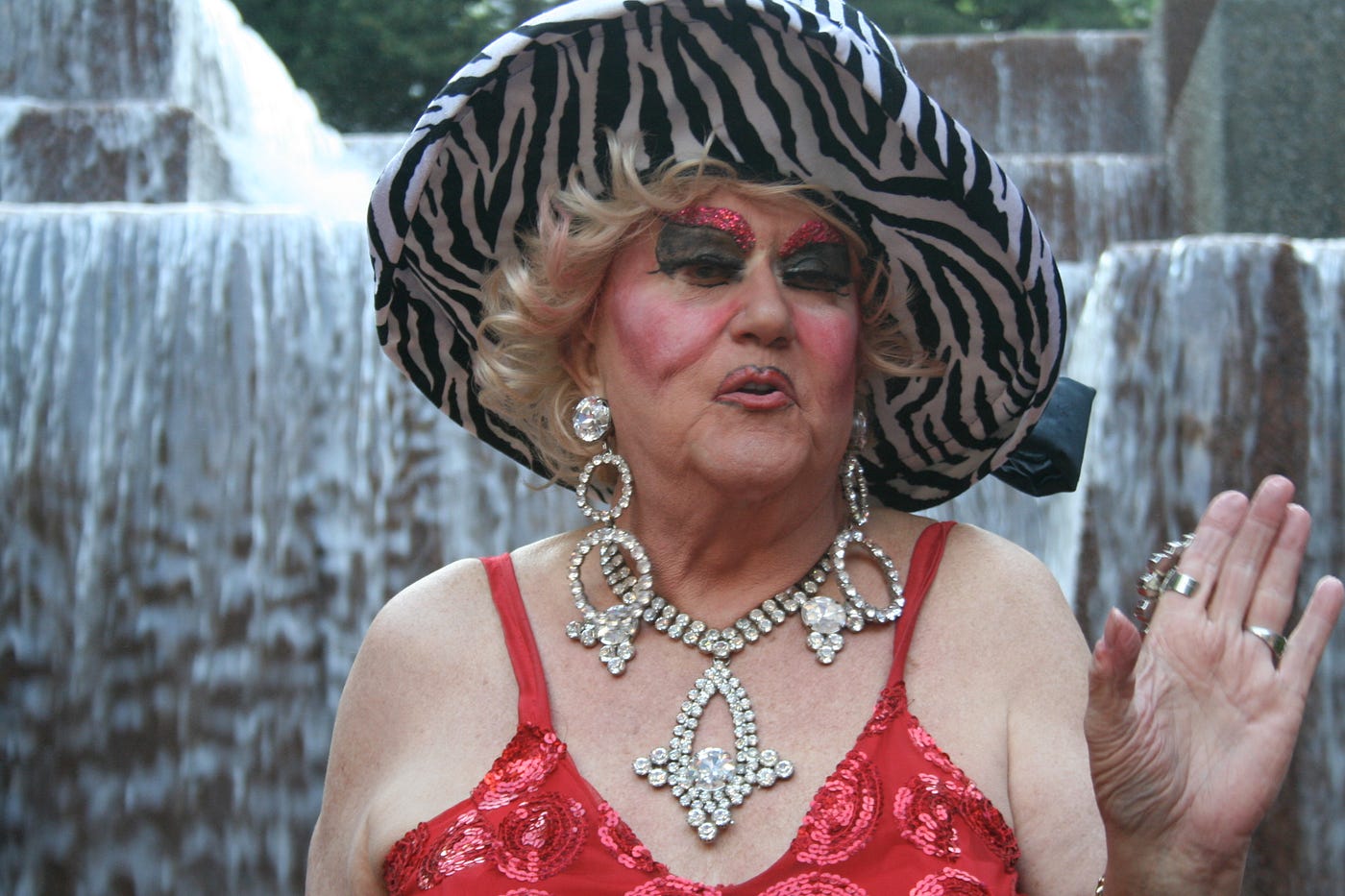
Drag Queen at Pride festivities 2022, Esther Short Park, Vancouver, WA, photo by the author
Like the Fourth, Pride is also about family… a beautiful, extended, multi-colored family united in self-love and unconditional acceptance of one another. But, unlike the Fourth, we don’t need fake bombs bursting in air. Each and every one of us is a perpetual sparkler. What further proof do we need that our flags — dozens upon dozens of them — are still there?
The LGBTQ+ community has come a long way since that first “Liberation Day” march down Manhattan’s Christopher Street on June 28, 1970, a momentous date that forever imprinted June as “Pride Month.” And our progress should be celebrated. Certainly, we deserve a day or two every year to congratulate and indulge ourselves. And, good on us for recognizing that… and for rewarding ourselves with such unabashed revelry.
But, as we party in the streets, we mustn’t forget that our struggle is far from over. In fact, in pockets of this country, we’ve been losing ground at an alarming rate. And, by executive decree, Pride flags no longer wave over U.S. embassies and federal buildings.
So, taking any of our hard-won rights for granted would be a serious mistake.
In some states and cities, what makes Pride “Pride” has been banned altogether. In others, local events have been cancelled due to a shortfall in sponsorship funds. Businesses fear that continuing to associate themselves with Pride will lead to retaliation, in the form of boycotts, vandalism, or vigilante violence.
Meanwhile, vociferous shouts of condemnation are being leveled at the LGBTQ+ community — especially at our trans and nonbinary siblings and friends. This chorus of dehumanizing derision threatens our family bond, as bigots attempt to pit one letter of our ever-lengthening acronym against another.
And, as America’s greatest queer president once warned, “a house divided cannot stand.”
Homo- and transphobia is being spewed from behind pulpits, within congressional buildings and city halls, in school board meetings, and across the social-media landscape. Impressionable youth are once again being indoctrinated that being gay is unnatural, immoral, something to be ashamed of, and so deserving of bullying.
Many gender-dysphoric children have nowhere to turn… especially those without understanding and supportive parents. More and more states are denying these kids recommended, life-saving medical treatment. Meanwhile, schools forbid them from choosing their own names or preferred pronouns.
And, an increasing number of these draconian measures are being applied to adults as well. It’s gotten so bad in Idaho, that merely entering the public restroom matching a person’s true gender identity can land them behind penitentiary bars.
If we know anything, it’s that those who would erase us have no sense of humor. That automatically makes the joy we exhibit during Pride a revolutionary statement. But, it’s still important for us to keep a sense of solemnity at the root of our festivities.
Two opposite perspectives
A few years ago, I invited a straight friend to meet me at Portland’s Riverfront Pride fair. She had been to Pride once or twice before, having attended the parade with her lesbian daughter. I knew her well enough to be assured that she was a stalwart ally.
The fenced-in festival area was teeming with a veritable smorgasbord of queerness. Of course, there were countless same-sex couples. But they weren’t all just holding hands. Some had their partners on leashes, or attached via chains attached to nose or nipple rings.
Lots of skin was being unashamedly exposed, regardless of the size or shape of the body. There were radical piercings and tattoos galore. Gender ambiguity and androgyny abounded, particularly among the younger crowd.
Everyone there seemed to be taking full advantage of this time and space to put their truest, queerest selves on public display.
We’d spent about 30 minutes strolling from booth to booth, collecting brochures for local LGBTQ+ charities and medical services, examining volunteer opportunities, and chatting with venders, when my friend suddenly announced that she had to go.
She was clearly uncomfortable. In fact, she was on the verge of an anxiety attack.
In retrospect, I think our individual perspectives that day reflect the two opposite faces of Pride: the celebratory versus the deadly serious.
What I saw there filled me with delight: a crowd of folks of all ages, from children to the elderly, reveling in the freedom to be themselves without fear of judgment or harassment. For some, over the course of any given year, I suspected the annual Pride festival was their only opportunity to really let their freak flags fly.
While my friend saw the exact same scene, she had a completely different response to it.
Being an empath, she found herself intermingling with a crowd of folks — especially teens — who, tomorrow, would have to go back to circumstances in which they felt neither safe nor permission to be their truest selves.
Sensing this was too gut-wrenching. My delight was her anxiety. She had to escape this unpleasant reality.
In conclusion
Without a doubt, LGBTQ+ folks make up a marginalized minority. For simply declaring the truth about who we are, we subject ourselves to discrimination, dehumanization, even violence. So, ultimately, that makes every Pride event, large or small, not just a festive, joyful occasion, but a civil rights demonstration as well.
Distilled down to its purest form, Pride is part celebration, part commemoration and, all in all, a demand for dignity.

This story is a response to the Prism & Pen writing prompt, **Pride 2026, Time To Raise Our Voices in a Loving Roar!**
[embed]It’s Pride 2026, Time To Raise Our Voices in a Loving Roar! A Prism & Pen writers promptmedium.com
Rand Bishop’s latest novel, *Long Way Out*, is available in e-book and print editions wherever books are sold online. The audiobook, narrated by the author, is available through Audible and most audiobook distributors. Verified customer reviews are essential to the success of any self-published book. Thank you.
메타데이터
- post_id
- 91e1abbad2be
- slug
- pride-is-like-the-fourth-of-july-part-celebration-part-commemoration-91e1abbad2be
- url
- https://medium.com/prismnpen/pride-is-like-the-fourth-of-july-part-celebration-part-commemoration-91e1abbad2be
- canonical_url
- https://medium.com/prismnpen/pride-is-like-the-fourth-of-july-part-celebration-part-commemoration-91e1abbad2be
- author_url
- https://medium.com/@randbishop
- status
- ok
- fetched_at
- 2026-06-09 15:37:30