19.5MB Black Box: Why IronXL is 3.4x Larger than NPOI
As the author and maintainer of NPOI for over 17 years, I’ve seen the .NET ecosystem evolve through countless iterations. One trend that…
19.5MB Black Box: Why IronXL is 3.4x Larger than NPOI
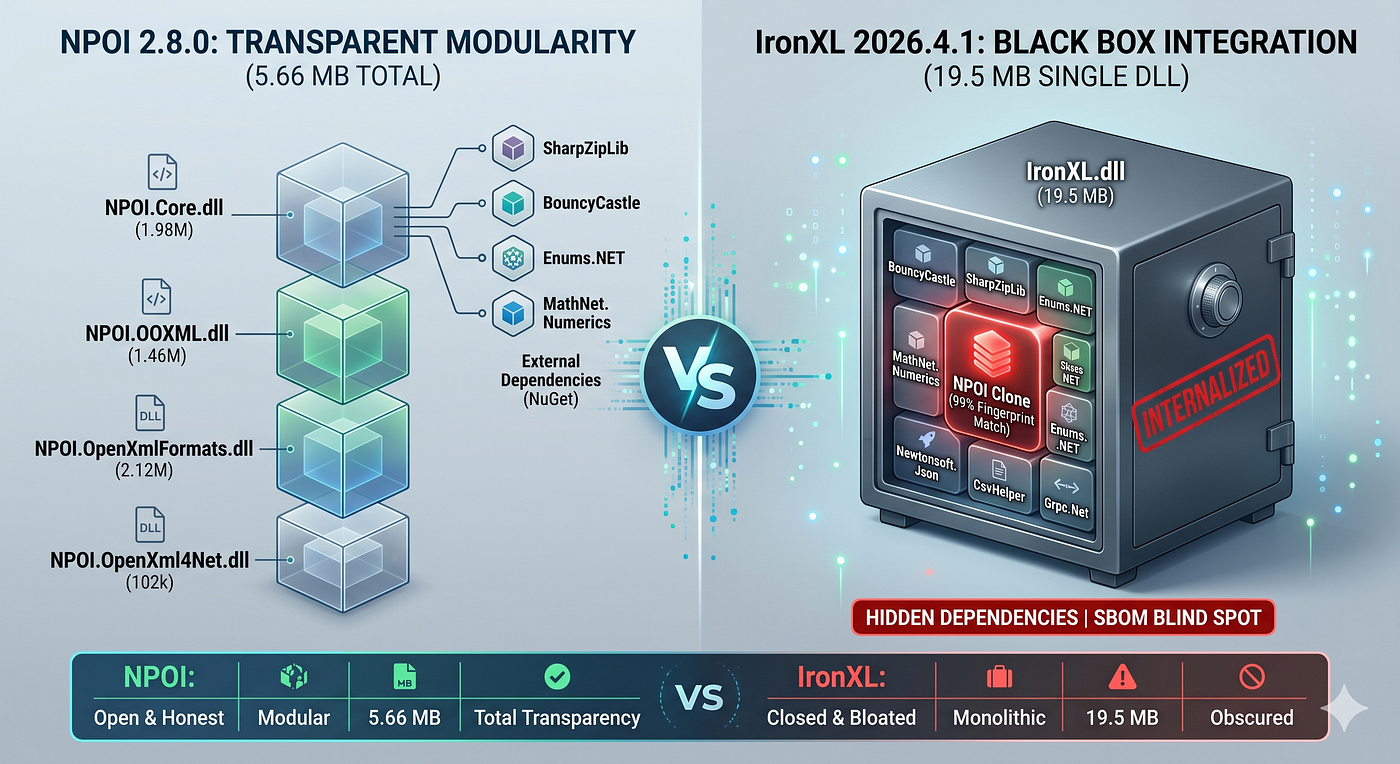
AI generated picture
As the author and maintainer of NPOI for over 17 years, I’ve seen the .NET ecosystem evolve through countless iterations. One trend that consistently surfaces is the rise of “premium” commercial wrappers that promise a “seamless” experience.
But in software engineering, “seamless” often comes with a hidden cost — not just in licensing fees, but in architectural bloat.
Today, we are looking at the latest IronXL (2026.4.1) and comparing it to the recently released NPOI 2.8.0. The numbers tell a story that every CTO and Lead Developer should hear.
The Raw Data: A Tale of Two Footprints
When we talk about library size, we aren’t just talking about disk space. We are talking about memory footprint, cold-start latency in Serverless environments (AWS Lambda/Azure Functions), and overall supply chain transparency.
NPOI 2.8.0: The Power of Modularity
NPOI is designed as a transparent, modular system. To support the full range of modern Excel formats (.xlsx, .xls), you only need four core assemblies:
- NPOI.Core.dll: 1.98 MB
- NPOI.OOXML.dll: 1.46 MB
- NPOI.OpenXmlFormats.dll: 2.12 MB
- NPOI.OpenXml4Net.dll: 102 KB
- Total footprint: ~5.66 MB
IronXL 2026.4.1: The Monolithic Giant
IronXL chooses a different path: the “Fat DLL.”
- IronXL.dll: 19.5 MB
- The gap is staggering: IronXL is 3.4 times larger than the total NPOI suite.
99% Fingerprint Match: The “Internalization” Secret
Why is IronXL 14MB heavier? Through deep-dive binary analysis, we discovered that IronXL is not a ground-up reconstruction of Excel logic. Instead, it utilizes “Internalization” — the process of bundling external open-source libraries and hiding them inside its own namespace.
Our fingerprint analysis shows a 99% match with the NPOI codebase.
Inside the 19.5MB “black box” of IronXL, you are actually running a hidden, renamed, and obscured copy of the NPOI engine. But it doesn’t stop there. IronXL has swallowed NPOI’s entire dependency tree:
- MathNet.Numerics: Used for complex formula evaluation.
- BouncyCastle: For file encryption.
- SharpZipLib: For ZIP compression.
- Enums.NET: For high-performance enum operations.
- Newtonsoft.Json & CsvHelper: For data parsing.
The “Double Loading” Problem
If your project already uses MathNet.Numerics for data science or Newtonsoft.Json for your APIs, you now have two copies of these libraries in your memory: your transparent NuGet version and the hidden, renamed version inside IronXL. This is a massive waste of resources and a potential source of “Diamond Dependency” conflicts.
The Security and Compliance Risk
In 2026, Software Bill of Materials (SBOM) and supply chain security are non-negotiable. IronXL’s strategy of hiding its dependencies creates a massive “Security Blind Spot”:
- Invisible Vulnerabilities: If a CVE is discovered in BouncyCastle or NPOI, your security scanners (Snyk, Dependabot) will likely return a “Green” status. They cannot “see” the 99% NPOI clone hidden inside
IronXL.dll. You are forced to wait for the vendor to release a patch, with zero visibility into your actual risk. - The Versioning Void: Because the internalized NPOI copy is “version unknown,” you have no way of knowing if you are running the latest optimizations from NPOI 2.8.0 or code from years ago. You are paying a 2026 premium for what might be 2023’s engine.

Compare NPOI 2.8.0 and Iron 2026.4.1
Final Thoughts: Transparency is a Feature
As the maintainer of NPOI, my philosophy has always been transparency. NPOI 2.8.0 gives you exactly what you need in a 5.6MB package. It respects your project’s architecture and your right to manage your own dependencies.
IronXL’s 19.5MB footprint is a heavy price to pay for a “commercial” label. It obscures its open-source roots, ignores the benefits of modularity, and introduces unnecessary bloat to your production environment.
Before you pay for a 19.5MB black box, ask yourself: Why settle for a hidden clone when you can use the transparent original?
메타데이터
- post_id
- 920b5b79caa8
- slug
- 19-5mb-black-box-why-ironxl-is-3-4x-larger-than-npoi-920b5b79caa8
- url
- https://medium.com/@tonyqus/19-5mb-black-box-why-ironxl-is-3-4x-larger-than-npoi-920b5b79caa8
- canonical_url
- https://medium.com/@tonyqus/19-5mb-black-box-why-ironxl-is-3-4x-larger-than-npoi-920b5b79caa8
- author_url
- https://medium.com/@tonyqus
- status
- ok
- fetched_at
- 2026-06-16 19:09:56