4 Things Enterprise Teams Learn After Deploying AI Voice Agents
Low latency, deterministic behavior, and evaluation strategy matter more than most teams expect in enterprise AI assistants.
4 Things Enterprise Teams Learn After Deploying AI Voice Agents
Low latency, deterministic behavior, and evaluation strategy matter more than most teams expect in enterprise AI assistants.
Most discussions around AI assistants still focus on model capabilities.
The webinar below focuses on something more practical: what starts breaking once these systems are connected to actual enterprise workflows, APIs, users, and operational constraints.
During the session, Mateusz Wosinski, Senior ML Tech Lead, walks through two production deployments:
- a voice agent automating outbound calls,
- and a conversational assistant integrated into a digital twin platform.
This article summarizes several implementation lessons from those projects.
The full webinar including architecture details and live examples is available: HERE.
1. Voice latency changes how the whole system is designed
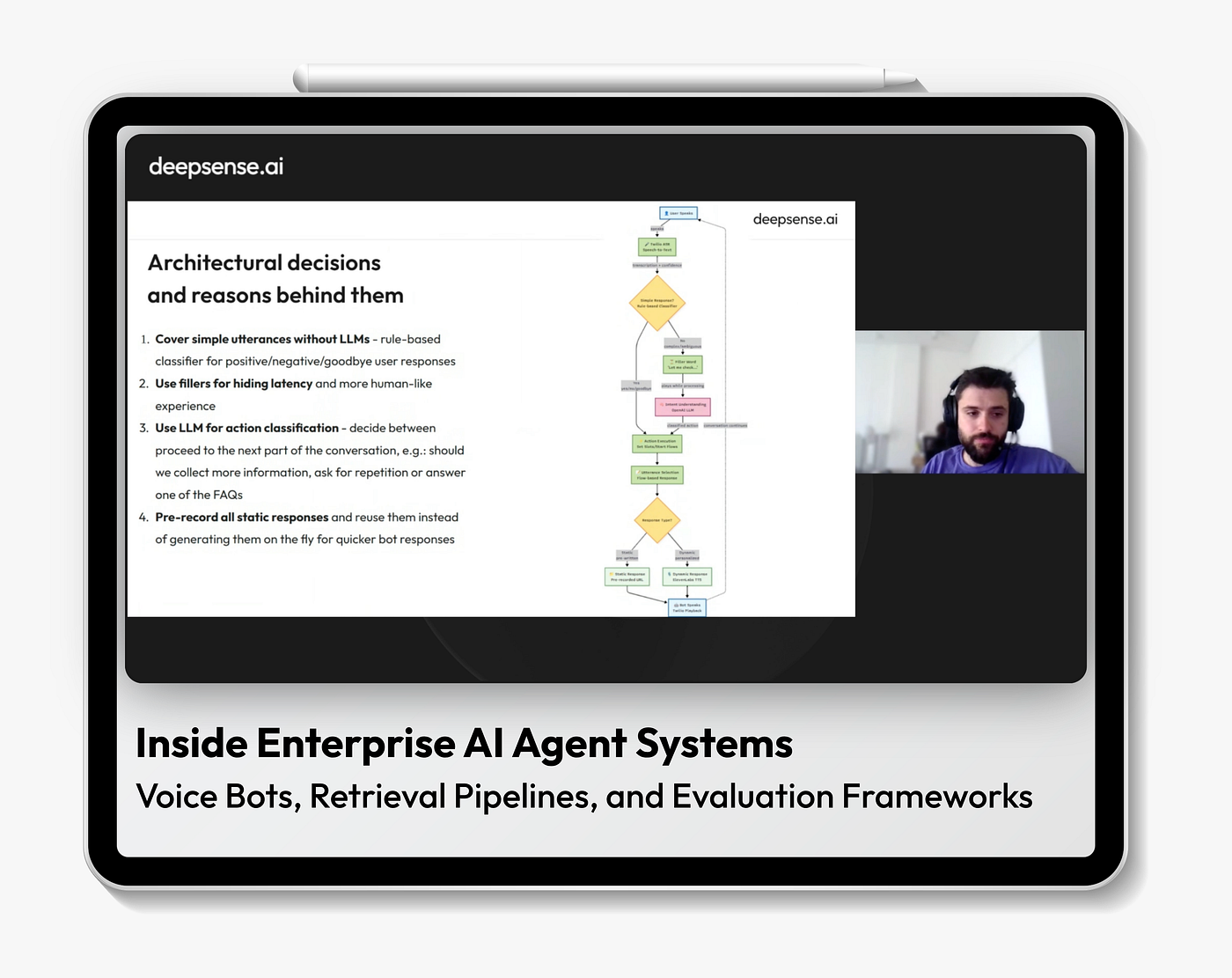
One of the projects discussed during the webinar involved a telephony voice agent handling outbound calls and appointment scheduling.
The system needed to:
- verify identity,
- answer FAQs,
- handle objections,
- schedule appointments,
- escalate calls to human agents when necessary.
Conversational pacing turned out to matter just as much as response quality.
Even short silent gaps felt unnatural during calls, which forced several architectural decisions:
- pre-generated utterances,
- filler phrases masking backend operations,
- parallel execution of selected actions,
- rule-based handling for short responses instead of LLM calls.
In voice systems, latency quickly becomes part of the UX itself.
That changes how teams think about orchestration, inference strategy, and even dialogue design.
2. Fully generative systems are often harder to control than teams expect
Another practical observation from the webinar was how carefully LLM usage had to be constrained in customer-facing workflows.
In several places, the system relied on deterministic logic instead of free-form generation:
- static responses were pre-recorded,
- rule-based classifiers handled simple intents,
- LLMs were primarily used for intent understanding and action selection.
This improved:
- wording consistency,
- latency predictability,
- operational control,
- escalation reliability.
The more sensitive the workflow, the more valuable deterministic behavior becomes.
That trade-off appears frequently in enterprise deployments, especially when systems interact directly with customers.
3. Conversational layers can simplify complex enterprise platforms surprisingly fast
The second use case focused on a digital twin platform with a large and fragmented interface.
Instead of redesigning the UI from scratch, the solution introduced a conversational assistant integrated directly into the platform.
Users could retrieve information and trigger actions through natural language, while the underlying orchestration layer handled:
- tool execution,
- retrieval,
- access control,
- service integrations,
- guardrails.
One interesting lesson from the project was organizational rather than purely technical.
A conversational layer often creates usability improvements much faster than a full UI redesign — especially in systems where users are already accustomed to existing workflows.
The webinar also goes deeper into:
- Elasticsearch-based retrieval,
- orchestration services,
- hybrid search architecture,
- and chunking strategies for large document collections.
Full session: HERE
4. Evaluation becomes much more than model evaluation
One of the more interesting parts of the webinar was the evaluation framework built around the assistant platform.
Mateusz introduced four separate evaluation layers:
- unit and integration tests,
- scheduled synthetic tests,
- scenario-based evaluation,
- security and prompt injection testing.
The scenario layer became especially important because many user requests required:
- multi-step reasoning,
- multiple tool invocations,
- retrieval across several systems,
- access-policy enforcement.
In systems like this, evaluation quickly spreads across retrieval, orchestration, permissions, and workflow reliability.
It also becomes:
- a retrieval problem,
- an orchestration problem,
- a permissions problem,
- and a workflow reliability problem.
You can access it HERE.
메타데이터
- post_id
- 92243a480ba3
- slug
- 4-things-enterprise-teams-learn-after-deploying-ai-voice-agents-92243a480ba3
- url
- https://medium.com/deepsense-ai/4-things-enterprise-teams-learn-after-deploying-ai-voice-agents-92243a480ba3
- canonical_url
- https://medium.com/deepsense-ai/4-things-enterprise-teams-learn-after-deploying-ai-voice-agents-92243a480ba3
- author_url
- https://medium.com/@deepsense-ai-team
- status
- ok
- fetched_at
- 2026-06-11 15:16:29