Compiler vs Interpreter — Why LangGraph Is Becoming Your Hot Path Cost Center
Agentic workflow distillation compiles a multi-step agent process into smaller model weights — when it beats runtime and what breaks the…
Compiler vs Interpreter — Why LangGraph Is Becoming Your Hot Path Cost Center
Agentic workflow distillation compiles a multi-step agent process into smaller model weights — when it beats runtime and what breaks the trick.
For three years, we’ve been saying that the runtime framework — LangGraph, CrewAI, Pydantic AI — is AI agent architecture. The first half of 2026 says something different: every LLM call inside the orchestrator loop is an interpreter you’re paying for the tenth time on the same procedure.
Notion lost roughly five percentage points of gross margin to AI inference (ainvest.com, 2025) — the broader SaaS industry is losing 5–10pp according to SaasMag AI COGS 2026. A single developer generated $5,000 in Claude Code revenue under a $200 flat plan (The Decoder, 2026). And AWS quietly raised GPU prices by 15% on a Saturday afternoon (theregister.com, January 4, 2026) — because it knows you don’t have a cheaper alternative in the same product line.
Underneath those receipts sits an architectural observation. The compile-time approach already has several hard academic anchors: Sarukkai et al. (Stanford and Reve, April 2026) demonstrated a 2.5× cost reduction per episode on ALFWorld at iso-accuracy without fine-tuning. Liu et al. (AAMAS 2026) described a full pipeline with [REASON]/[ACT] span-segmented loss. Vendors like distil labs are marketing 10–100× cheaper SLMs matching frontier models — a claim not peer-reviewed, but directionally consistent with the academic 2.5× lower bound.
Quick Win — Core Insight
Agentic workflow distillation is the process by which a multi-step agent workflow (planning, tool calls, scratchpad reasoning, routing decisions) generates synthetic trajectories that a smaller model learns from — either without weight updates (in-context distillation) or through full fine-tuning. The result: the same workflow runs without an orchestrator at runtime.
Sarukkai et al. (arXiv:2512.02543) verified this without training: the cost per episode on ALFWorld dropped from $0.059 to $0.024, yielding over $34,900 in savings per billion episodes while preserving accuracy. On AppWorld, the same numbers give a 3.5× cost reduction (retaining 79% of teacher accuracy). The vendor distil labs claims an order of magnitude more — 10–100× — but that’s a marketing claim, not a peer-reviewed result, so treat it as the upper bound of the expected effect, not a promise.
For an architect, this is a new lever. Don’t ask “whether to use LangGraph.” Ask which workflows are stable enough to build a compiler for — instead of interpreting them at runtime with every LLM call.
To make that decision sensibly, you first need to understand what the compiler does under the hood — what an agent trace looks like, which loss function distills it, and why a small model, after fine-tuning, knows which tool to use without a prompt.
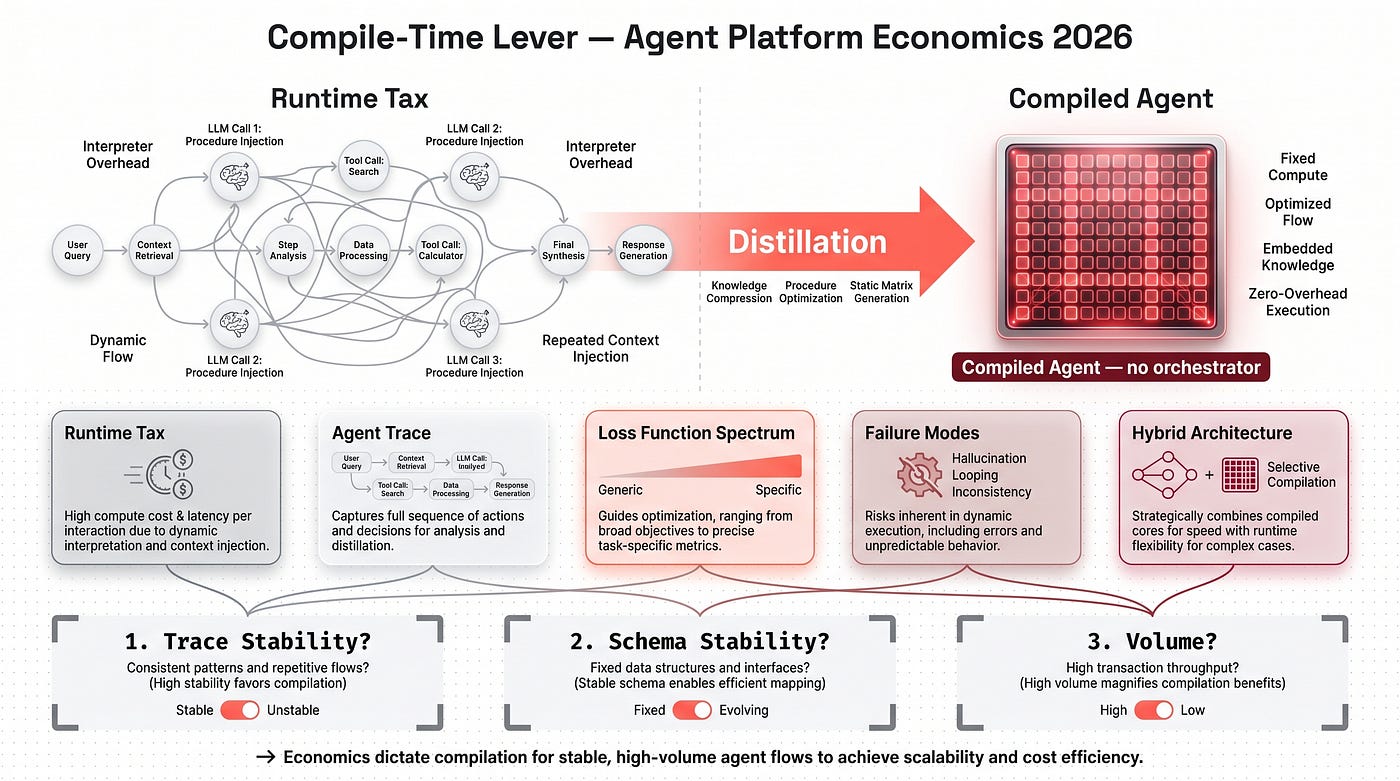
The Runtime Tax — Why Your Agent Platform Pays 10× for the Same Procedure
A runtime framework is an agent interpreter. On every LLM call, it injects the full workflow instruction into the prompt — node descriptions, available tools, the JSON schema, the scratchpad from previous turns. You’re architecturally paying 10–100× more than a single LLM call in pure few-shot mode, because every call drags the full procedure along with it.
In one test domain, researchers measured over 60,000 tokens per conversation in the in-context paradigm vs. ~40,000 in LangGraph on the same insurance workflow — an approximate order of magnitude from available benchmarks comparing these architectures. 1.5–1.6× more tokens means a 1.5–1.6× higher bill before you even touch a distilled model. The scale isn’t dramatic on a single conversation — it becomes dramatic at 100,000 conversations per month.
Runtime Maturity as a Compile-Time Readiness Signal
The consolidation of the runtime layer paradoxically strengthens the case for compilation. LangGraph reports 13M weekly PyPI downloads, Pydantic AI ~9.6M, and CrewAI ~1.7M (data: May 2026). The layer has been chosen — and every mature runtime layer in software history (Java JIT, 2000–2004 → AOT GraalVM; JavaScript JIT → WebAssembly MVP 2017; Python → Cython) eventually got a compiler. Agentic frameworks have just reached that moment.
Here’s the economic paradox. On one side, LLMflation — the cost per token drops 10× per year (Appenzeller, a16z, November 2024). On the other, AWS GPU prices rising 15% on a Saturday and Alphabet growing capex from a guided $75B in 2025 to an actual ~$91B, with the 2026 forecast reaching $180–190B. Cheaper per token, but more expensive capacity — and the workflow keeps injecting the full instruction into every call. The compile-time approach is the lever that decouples the hot path from runtime token-spot exposure.
The key insight: if your platform runs 500 or more conversations per day on a single workflow, the runtime cost is mathematically higher than the cost of a one-time compile — even if the compilation cost itself doesn’t have a single citable number yet.
The mechanism for compiling a workflow into weights — and what happens between the trace and deployment — is worth breaking down into first principles.
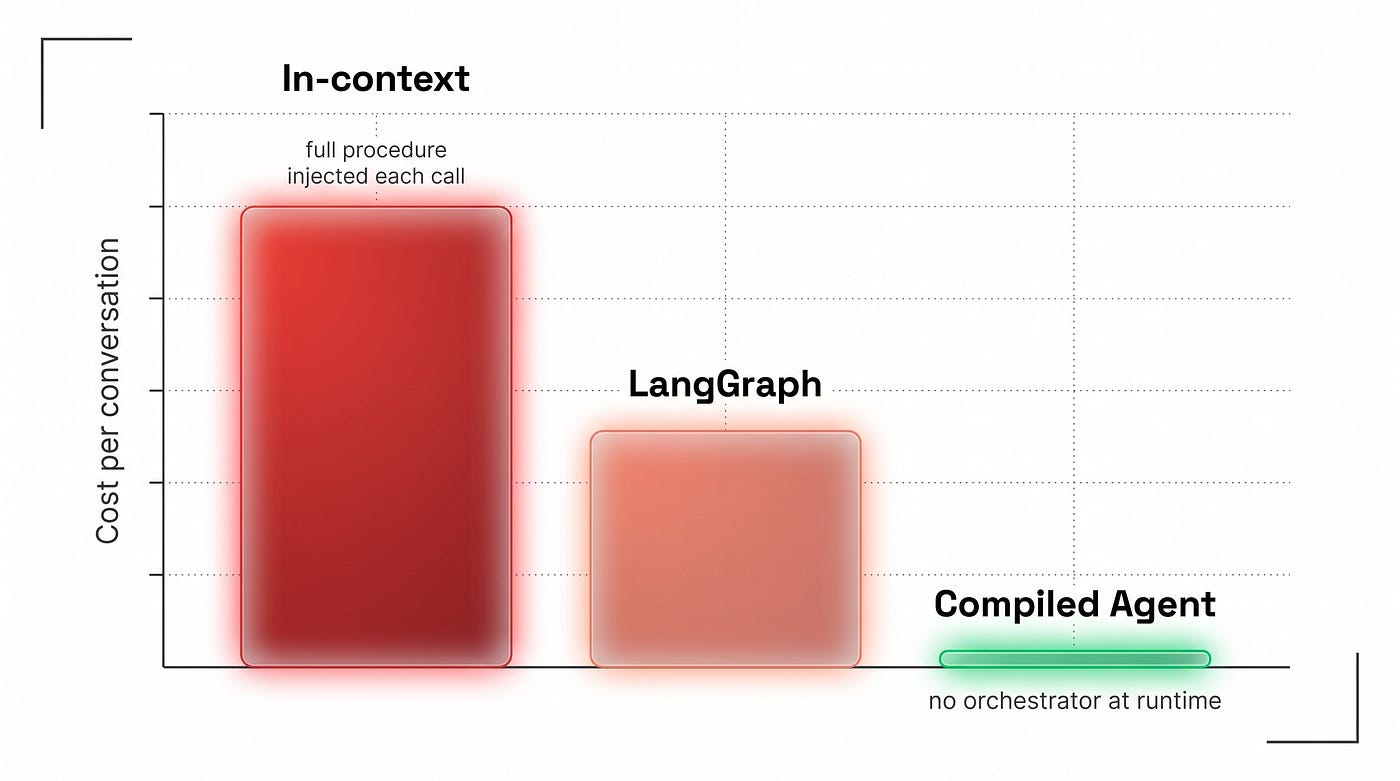
Cost per conversation across three architectures on the same workflow. The in-context baseline injects the full procedure; LangGraph compresses it in a graph; the compiled agent emits routing on its own.
The Trick — Trace, Loss Function, Fine-Tune
The compile step has four conceptual elements: defining the procedure as a graph, generating synthetic conversations via the teacher (frontier model), fine-tuning a small model with a deliberate choice of loss function, and deploying without an orchestrator. The mathematical foundation is 11 years of distillation research, on which 2026 layers agent-specific recipes.
Hinton put it concisely:
“We show later that matching the logits of the cumbersome model is actually a special case of distillation.” — Geoffrey Hinton et al., Distilling the Knowledge in a Neural Network, arXiv:1503.02531 (2015)
From that moment, DistilBERT showed this scales to pretraining (60% faster inference, over 95% GLUE quality). FireAct (Chen et al., ICLR 2024) proved that Llama2–7B + 500 ReAct trajectories from GPT-4 yield a 77% improvement on HotpotQA EM — a sample-efficiency threshold emerges below which the model simply doesn’t learn the format.
Lumos and AgentTuning scaled up the trajectories. And Liu et al. (Structured Agent Distillation, AAMAS 2026) added what was missing: span-segmented loss, where [REASON] and [ACT] tokens carry different weights, plus a curriculum scheduler and online teacher querying (offline trajectories lower the success rate by 2–3% through drift).
The small student knows routing not because it has greater capacity, but because it knows its own decision boundary statistically — from ten thousand observed trajectories. Hinton’s soft logits plus the presence of a scratchpad in the training data give it the intuition about which tool to use on the next move. The orchestrator becomes unnecessary because the procedure lives in the weights, not in the prompt.
Under the Hood: Four Ways to Count the Penalty for Getting It Wrong
Choosing the loss function isn’t cosmetic. In my experience reviewing agent platforms in 2026, this is the place where teams simply guess — and quality drops by 5–15 points without a clear reason. Four families, briefly:
- Flat token cross-entropy (FireAct, simplest) — the student treats all tokens equally, like standard SFT. Works when the trajectory is short and homogeneous.
- Span-segmented
[REASON]/[ACT](Liu et al., AAMAS 2026) — different weights for the scratchpad and actions. Better for mixed planning + execution workflows. - Reverse-KL with importance weighting (Skill-SD) — mode-seeking. The student picks one confident path instead of averaging several correct ones — eliminating mode-averaging hallucinations in tool-calling.
- Process-Aware Distillation with PRM + GRPO (AgentArk and related 2026) — rewards the quality of intermediate reasoning, not just the final answer.
The third family is the most commonly mis-selected. Token CE prefers the mean — mode-covering — and gives the student “a mix of two APIs” in its decision boundary when the teacher saw three correct paths. Reverse-KL forces the choice of one. This is one of three or four places where agent distillation differs qualitatively from classifier distillation.
Treat the recompile cycle like a CI/CD build, not a major retrain. The exact time and cost depend on the teacher scale, the number of trajectories, and the student size — I’m deliberately skipping the hard numbers from marketing copy because they too easily create a false sense of precision. The key practice: data gen + fine-tune + eval gate in a single pipeline, triggered by every change to the procedure or schema.
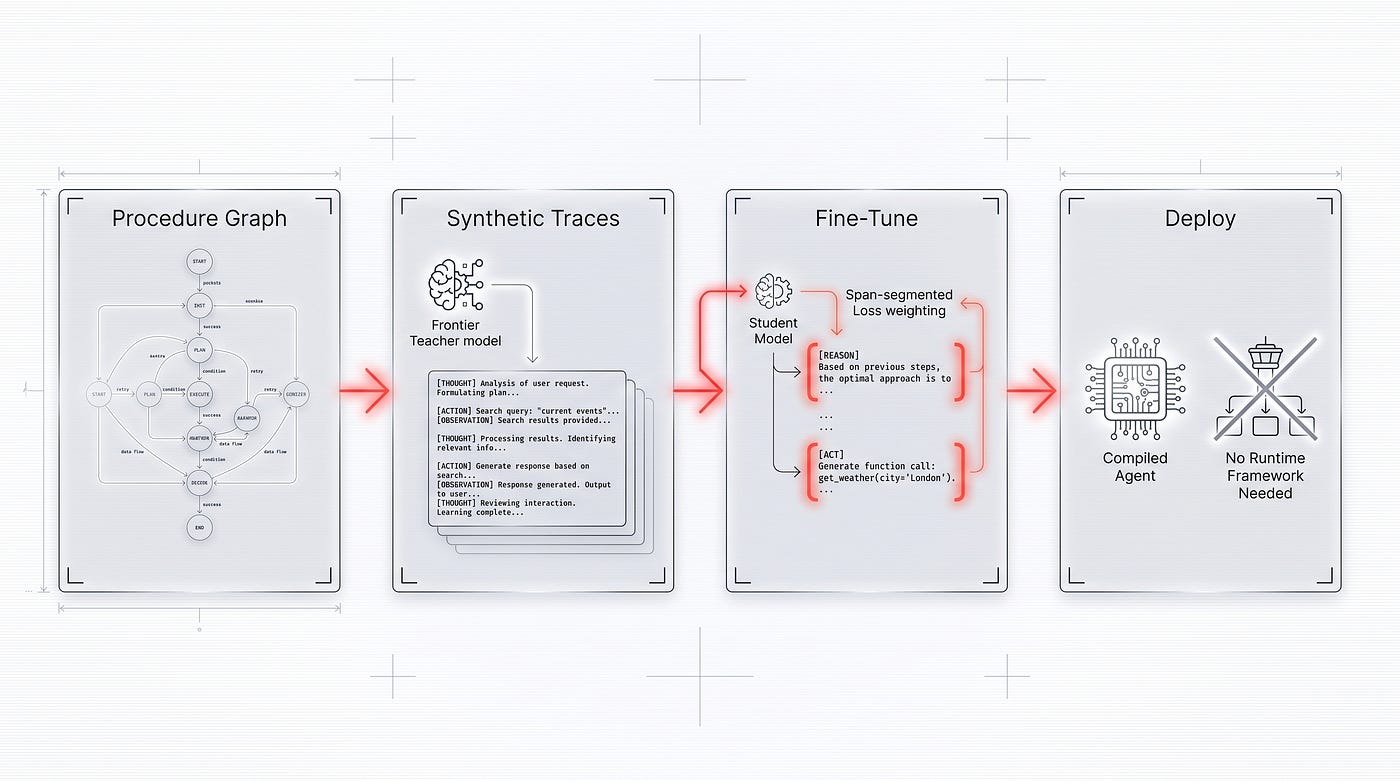
Full distillation pipeline: procedure graph, trajectory synthesis by the teacher, fine-tuning with a deliberately chosen loss function, deploy without a runtime orchestrator.
What Compiles Cleanly and What Breaks the Trick
Three failure modes define the compiler’s sweet spot. They’re not bugs — they’re constraints that protect you from investing in a workflow that mathematically shouldn’t be compiled.
Schema churn is the gentlest killer. A compiled agent has the JSON schema baked into its weights. If Stripe changes a field name on a Saturday afternoon — analogous to AWS GPU +15% with no announcement — your compiled agent will fail silently on Sunday morning. It responds correctly, but sends requests to the API with an outdated format. Mitigation: a recompilation cycle as CI/CD triggered by an API change, plus a semantic gateway in front of the agent to absorb minor schema changes.
Tool-use diversity hits sample efficiency. FireAct showed that Llama2–7B needed a minimum of 500 GPT-4 ReAct trajectories for the format to emerge; at 100–200 samples — nothing. AgentDistill (arXiv:2506.14728) critiques the same phenomenon in a different form: “students passively replicate fixed trajectories without learning to adapt.”
In practice: if your agent uses the same three tools in 95% of cases, it compiles cleanly. If it uses fifty tools in a long-tail distribution, sample efficiency isn’t enough to cover the decision space. That’s not a verdict on the compiler’s quality — it’s a statement of its boundaries.
Long-horizon autonomy means compounding errors. The Survey on On-Policy Distillation (arXiv:2604.00626) is direct: “multi-step agentic tasks typically require sequence-level objectives with trajectory-aware credit assignment.” Flat token-level KD systematically under-fits long workflows because drift from the teacher distribution grows exponentially with each turn.
Robustness paradoxically saves part of this group. A compiled agent on noisy tools (search returns None) experiences a 14% drop in quality — prompted ReAct loses 34% (FireAct). Distillation absorbs the teacher’s error-recovery behavior, so a compiled agent can be more resilient than an interpreter — but only if the sample size and the loss function were chosen deliberately.
Three decision questions for an architect considering a compile cycle:
- Trace stability: measurable on 1,000 historical conversations — would this workflow have the same shape in 95% of examples? If the trajectory is unstable, compilation produces a model that’s confident in the wrong decisions.
- Schema stability: are the APIs of the tools used stable longer than your recompile cycle (3–6 months)? More frequent schema changes mean recompiling more often than a CI/CD pipeline for regular code.
- Volume: the FireAct sample-efficiency threshold + Sarukkai 2.5× iso-accuracy suggest a break-even at moderate volumes, but the exact number is workload-dependent. Start by measuring the cost per conversation in your current runtime.
There’s a hidden third position in this decision. Sarukkai et al. (arXiv:2512.02543) proposed training-free distillation — dynamic ICL with teacher demos plus self-consistency cascades — that bypasses fine-tuning entirely. Use it when schema churn is high (recompiling doesn’t pay off), but the teacher is available and the volume justifies per-call cost optimization. A third point in the architect’s decision matrix.
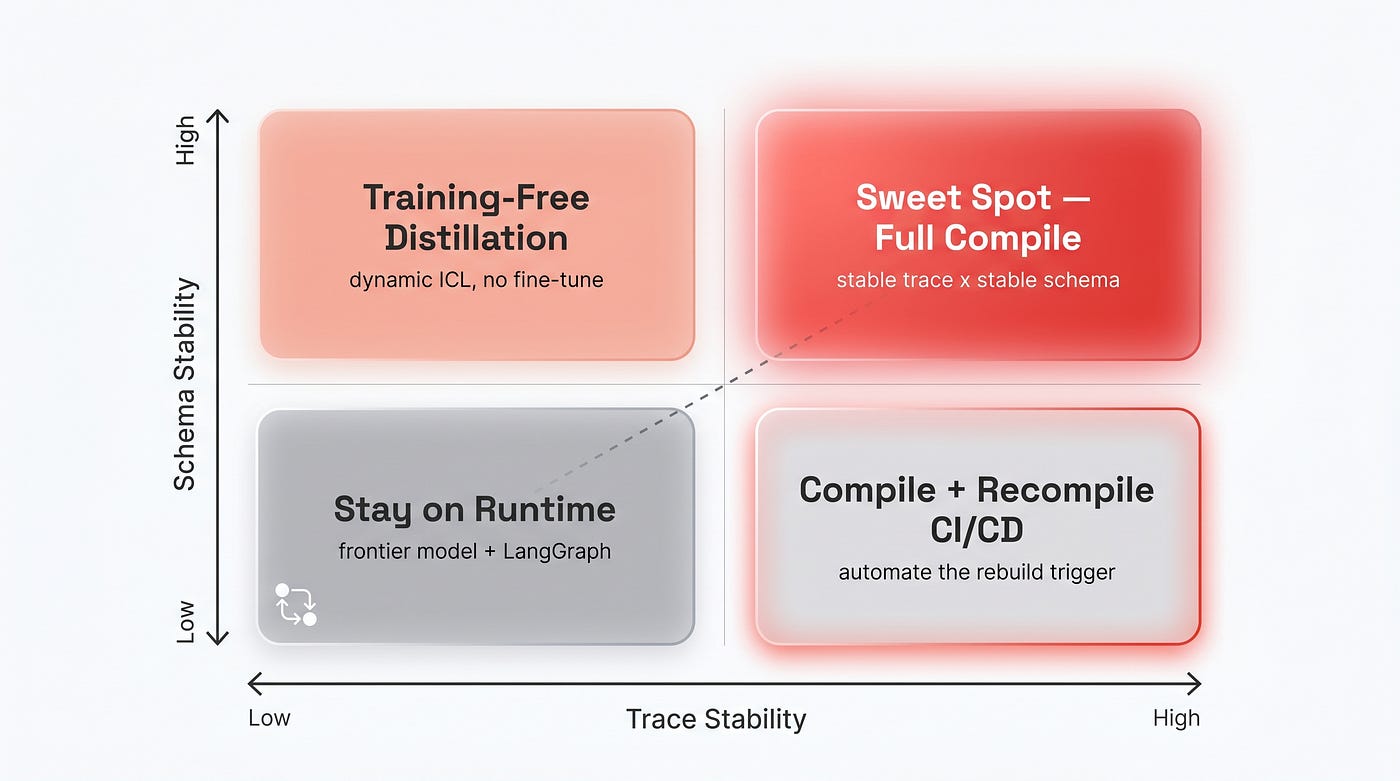
Architect’s decision matrix 2026: where to place a workflow before investing in a compile cycle. The sweet spot is stable trace plus stable schema; training-free distillation catches high-volume + low schema stability.
No, This Doesn’t Kill LangGraph — It Pushes It to the Long Tail
The temptation is to cite the contrarian position without qualifiers: “LangGraph is dead.” That’s wrong. The default pattern in 2026 is a hybrid: a compiled hot path handling 95% of traffic, a runtime with LangGraph for the 5% of unique/edge cases, a capability router deciding per request. Salesforce Agentforce is already implementing this commercially under the name “hybrid reasoning.”
The hybrid isn’t a compromise. It’s the natural consequence of how software layers have always evolved. CPU branch prediction + microcode trap is the same pattern for x86. JIT compiled hot path + interpreted slow path is the same pattern for the JVM. The question isn’t “whether to go hybrid” — it’s “how quickly you adopt the pattern and what your rollout looks like.”
Knuth said this about the entire category of compilation:
“Premature optimization is the root of all evil.” — Donald Knuth, Structured Programming with go to Statements, ACM Computing Surveys 1974
Don’t compile a workflow that doesn’t have the volume × stability × schema stability to justify the CapEx. Measure first. The second lesson from that quote: the harness doesn’t die — it shifts to where optimization is mathematically beneficial.
The Harness Layer Is Still Growing — But Where
LangChain demonstrated this directly in February 2026. Deepagents-cli on Terminal Bench 2.0 jumped from 52.8% to 66.5% — +13.7 points — without changing the model (LangChain blog, February 17, 2026), purely through harness changes (injecting environmental context, loop detection middleware, explicit prompting on evaluation style). Paradoxically, this strengthens the thesis: the harness eats some capability, but compilation eats the harness’s hot path. Both layers grow — in different parts of the stack.
The capability router is the most critical element that most teams overlook. Three patterns:
- Rule-based: regex or category lookup. The cheapest. Works for narrow domains where the request type is obvious from the payload.
- Cheap classifier: BERT-class, ~10ms latency. For 5–20 workflow types with mixed intent.
- Confidence-based: the compiled agent emits a confidence score, and falls back to runtime if it is below the threshold. Requires model-level support and is the strongest in heterogeneous traffic.
Infrastructure enters here too. K8s 1.36 user namespaces GA closes one security gap for sandboxed compiled agents — no root inside the container. That’s an enabler, not a topic in itself, but an architect should know this when designing deployments.
The economic punchline: the annual bill for a workflow with hundreds of thousands of conversations in a purely runtime form approaches numbers where a one-time compile cycle plus a capability router deliver an orders-of-magnitude reduction in year one. I don’t need a full table — the observation stands that the CapEx-over-OpEx framing changes the architectural decision once you cross the break-even point.
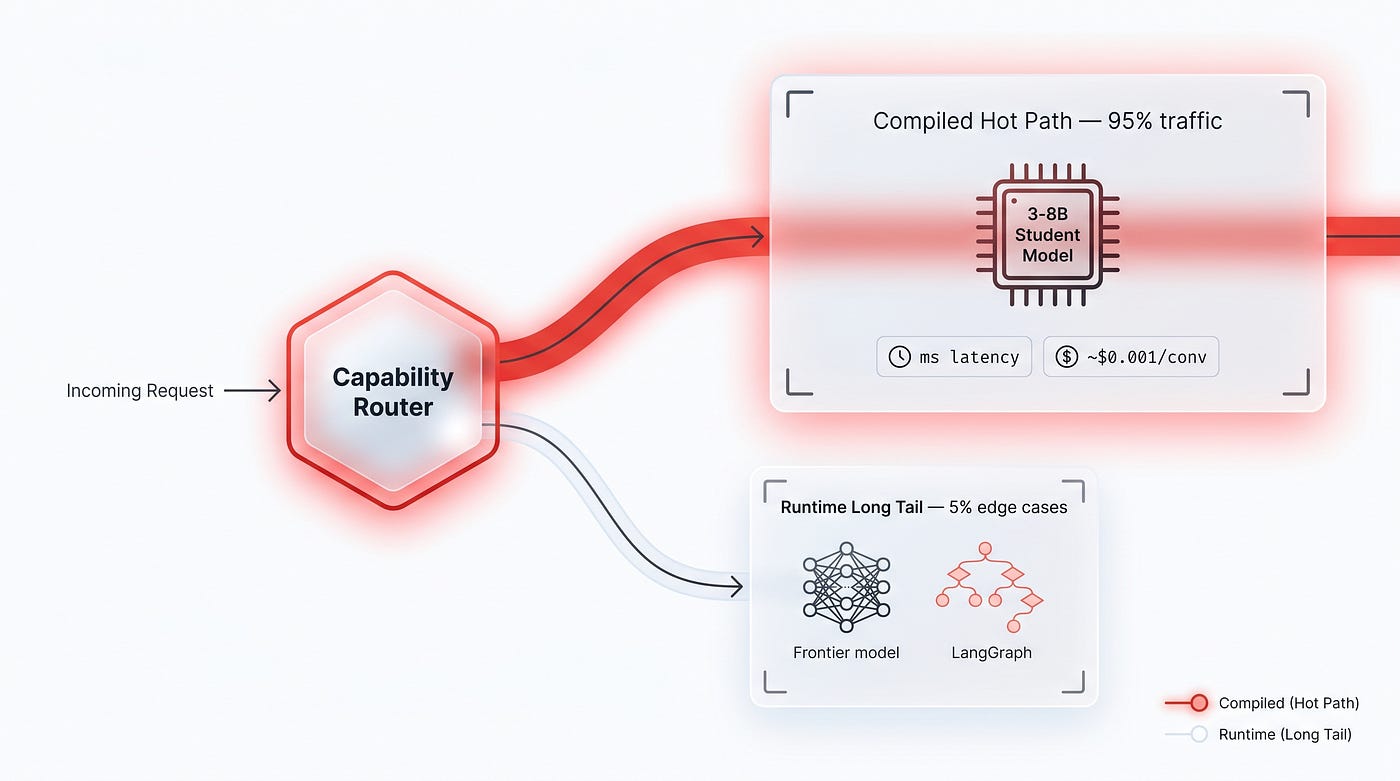
Hybrid pattern 2026: the capability router decides per-request between the compiled hot path (95% traffic, ms latency) and the runtime long tail (5% edge cases, frontier model plus LangGraph).
Architect’s Bet — The Compile-Time Lever in Your Platform Review
The 2026 architect gets a third axis for agent platform architecture. The first was the capability axis — which model for which task. The second is the FinOps axis — how to count and allocate costs. The third is the deterministic axis: which workflow goes into weights, which stays in the runtime, where to place the capability router.
LangGraph’s consolidation at 13M weekly downloads isn’t evidence that the runtime has won. It’s evidence that the runtime is mature enough to be a compile target — exactly like Java was for JIT in 2000–2004, or JavaScript was for WebAssembly in 2017. An architect who in 2026 doesn’t add the compile-time approach to the decision criteria of their agent platform review is operating with a 2024 mindset at 2026 costs.
Practical implications:
- Add a “compile candidates” section to your review template: which workflows have the volume × stability × schema stability to justify CapEx — a list of three to five is realistic for a mid-sized platform.
- Build the recompile pipeline as part of CI/CD: data gen automation, fine-tune trigger, eval gate. This isn’t a research project — it’s an engineering practice in 2026.
- Negotiate with frontier API providers from a new position: “we’ve already compiled this workflow locally; your value is reserved for edge cases.”
- Consider training-free for low trace stability but high-volume workflows — Sarukkai et al. provided a proven recipe without fine-tuning.
Thanks for reading this far — agent distillation is a topic that easily drifts toward marketing claims of orders of magnitude, so staying with the receipts requires attention.
If you’re currently running an agent platform review — pick one workflow with the highest volume and the most stable schema. Measure the current cost per conversation in the full pipeline. That’s the first step toward pricing the lever. Share in the comments which workflow you started with and what failure mode you encountered — failure modes are the most interesting part of this decision, and I’m genuinely curious what works and what breaks in production across different teams.
If you want to go deeper into the capability routing decision — between models and between architectures — I’ve written about that separately.
메타데이터
- post_id
- 9239aa4f3902
- slug
- compiler-vs-interpreter-why-langgraph-is-becoming-your-hot-path-cost-center-9239aa4f3902
- url
- https://medium.com/@wasowski.jarek/compiler-vs-interpreter-why-langgraph-is-becoming-your-hot-path-cost-center-9239aa4f3902
- canonical_url
- https://medium.com/@wasowski.jarek/compiler-vs-interpreter-why-langgraph-is-becoming-your-hot-path-cost-center-9239aa4f3902
- author_url
- https://medium.com/@wasowski.jarek
- status
- ok
- fetched_at
- 2026-06-09 15:37:30