Real-Time Replication Done Right: A Closer Look at Journal Mode
How much data can your company afford to lose if a critical VM fails right now?
Real-Time Replication Done Right: A Closer Look at Journal Mode
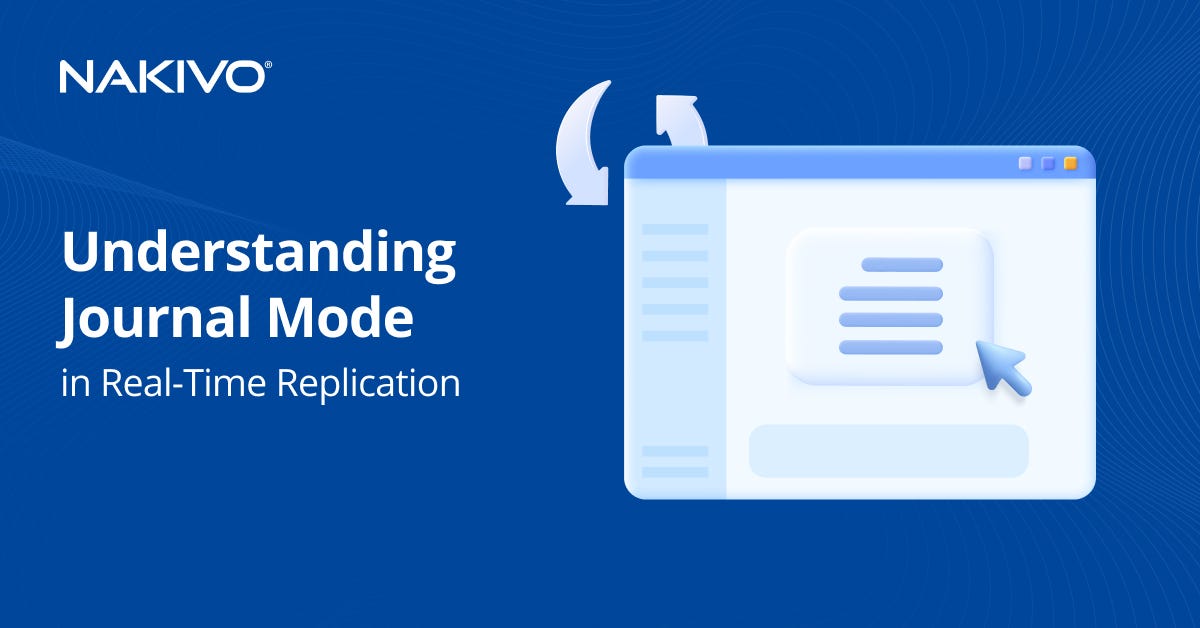
How much data can your company afford to lose if a critical VM fails right now?
For most IT teams, the honest answer is “as little as possible” — and for truly mission-critical workloads, the answer is often “none.” Yet many backup and replication strategies still rely on scheduled snapshots, leaving a window of exposure between snapshots. If a failure happens in that window, whatever changed is gone. This is the core limitation of traditional snapshot-based replication.
Snapshot-based replication protects data at fixed points in time — every 15 minutes, every hour, or on whatever schedule your policy defines. Between those intervals, changes to your VM aren’t captured anywhere. For most workloads, that’s an acceptable tradeoff. But for databases, transactional systems, or any environment where every write matters, that gap represents real risk.
The tighter you try to make that window, the more overhead you introduce — more frequent snapshots mean more resource consumption and more strain on your infrastructure. At some point, traditional snapshotting simply can’t get your Recovery Point Objective (RPO) close enough to zero without becoming impractical.
How Journal Mode Works
Journal Mode takes a different approach to the problem. Instead of relying on periodic snapshots, it captures every write operation continuously, in real time, using Changed Block Tracking (CBT). Rather than restoring to the most recent snapshot, this continuous tracking allows recovery to virtually any point in time — not just the fixed checkpoints a snapshot schedule would normally allow.
It’s important to distinguish this from native VMware snapshotting, which Journal Mode does not rely on.
Journal Mode is a built-in capability of NAKIVO Backup & Replication, purpose-built to close the RPO gap that traditional, interval-based replication leaves open.
What Journal Mode Delivers
For teams managing mission-critical VMware workloads, Journal Mode offers several benefits:
- Near-zero RPO for workloads where minutes — or even seconds — of data loss are unacceptable
- Continuous, real-time change tracking, replacing the gaps inherent to scheduled snapshots
- Granular point-in-time recovery, giving you the flexibility to roll back to the exact moment before an issue occurred, rather than the nearest snapshot
- Flexible retention, configurable from as little as 1 hour up to 30 days, so you can align protection with your compliance and operational requirements
Together, these capabilities change the question IT teams need to ask. Instead of “how often should we snapshot this VM?” the question becomes “how close to zero can we actually get our recovery point?”
Where Does it Fit
Journal Mode isn’t necessarily the right fit for every workload — for many systems, scheduled snapshot-based replication is still a reasonable, resource-efficient choice. But for the VMs where downtime or data loss carries real financial, operational, or compliance consequences, continuous journaling offers a different level of protection than interval-based snapshots can provide.
Read about the Journal Mode and how to configure it on the NAKIVO blog.
메타데이터
- post_id
- 923b78be2ada
- slug
- real-time-replication-done-right-a-closer-look-at-journal-mode-923b78be2ada
- url
- https://medium.com/@nakivo/real-time-replication-done-right-a-closer-look-at-journal-mode-923b78be2ada
- canonical_url
- https://medium.com/@nakivo/real-time-replication-done-right-a-closer-look-at-journal-mode-923b78be2ada
- author_url
- https://medium.com/@nakivo
- status
- ok
- fetched_at
- 2026-08-12 07:14:32