Review: Quadrophenia by The Who
All bands have a fractured personality.
TRILOGIES: THE WHO
Review: Quadrophenia by The Who
All bands have a fractured personality.
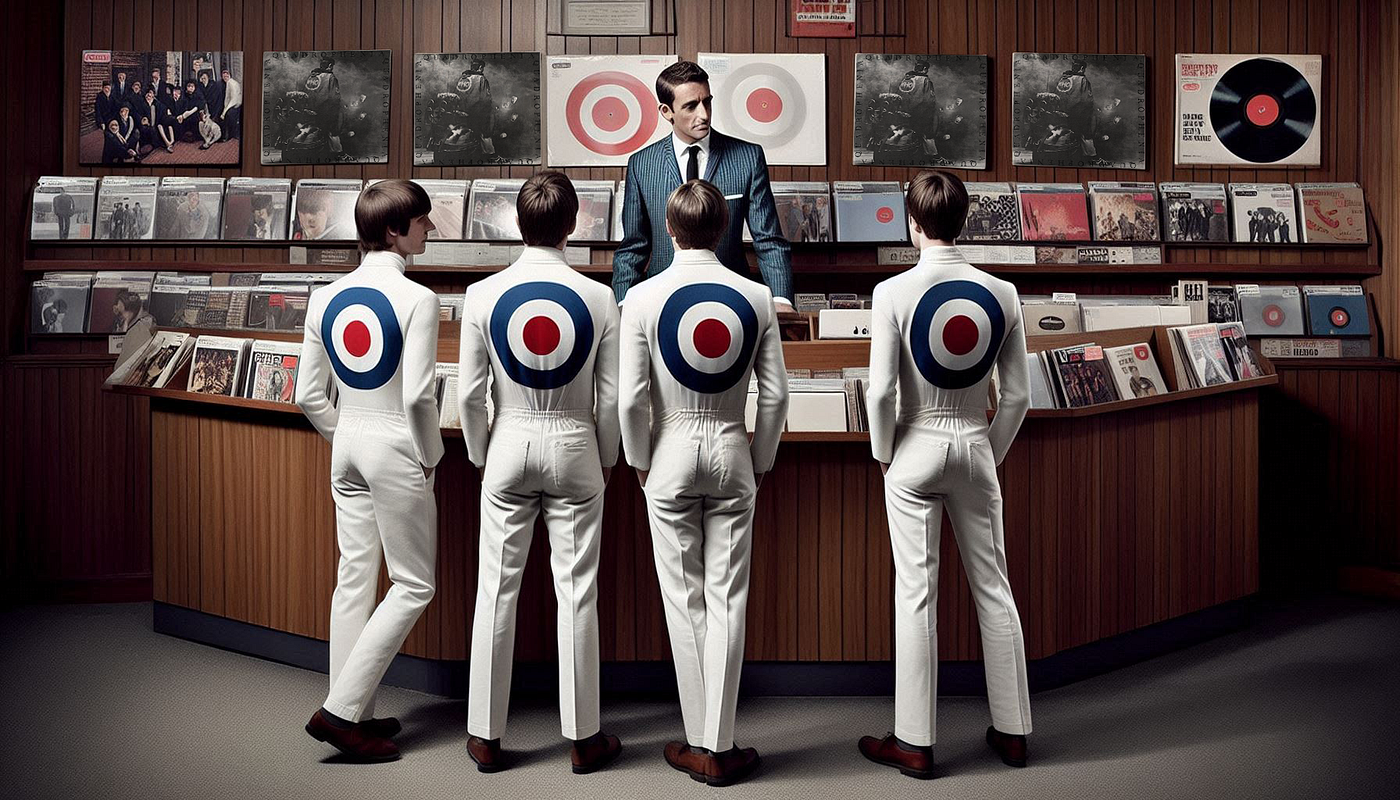
There’s a different version for each one of you. Digital collage with AI elements. By the author.
The fractured mirror reflects a different part us, breaking the coherent whole while revealing something else.
And there on the album cover is a mod, perhaps Jimmy himself, sitting on his mod-maxxed Vespa scooter, seeing the fractured reflections of the band members in each of his four mirrors.
With Tommy, The Who had brought a fantastical character to life. Intriguing, but not an easy place to reflect upon ourselves. Who’s Next returned to more prosaic territory and it is from here that it derives much of its power.
Quadrophenia lands somewhere in between. Like Tommy, Quadrophenia revolves around a central character of Jimmy the Mod. It’s the second album in this Trilogy that has been turned into a movie. For a bunch of kids growing up in the suburbs of Melbourne, we could see ourselves in Jimmy’s life splashed upon the big screen. For many of the mods in the cinema, they were Jimmy.
I can recall friends on the train ride home, yelling out the lyrics to 5:15.
Out of my brain on the 5:15
Jimmy’s story was our story. Until it wasn’t.
The album opens with I am the Sea, an overture ofsimilar construction to Tommy’s Overture, stating the key musical themes of the album. Yet immediately, there is a sense that something is different. Synth textures wash through the mix and there is a sense of refined composition and studio craft.
While I’ve ruminated on the connection between the fictional Tommy and the very-much-alive Roger Daltrey, the connection of the music to the band members is more explicit on Quadrophenia, with each member assigned a theme song.
As if to reinforce the point, the identity crisis comes howling out of the speakers with The Real Me. Furious and kinetic, it was released as the third single off the album and highlights the ongoing tension between single and album. There were three singles released from Quadrophenia, and as focused vignettes of troubled youth, they barely need the overarching story for them to deliver their power. For most artists, the Greatest Hits compilation feels like a satirical artefact; a few actual hits surrounded by the songs that feel closest, but didn’t actually make it. Yet The Who were a great singles band that wouldn’t struggle to fill a double album greatest hits package with 24 songs fully deserving to be there. As a starting point, the first disc could simply be Meaty, Beaty, Big and Bouncy.
Would such a disc be a more compelling listen than Quadrophenia?
Concept albums are meant to be listened to as such, from start to finish. The first Walkman was released in 1979. By the time I was 18 in the early 80s, my friends were starting to acquire them. The only thing I can recall any of them listening to was my friend, Jenny the mod, recounting walking up and down Beaumaris beach on a cold and wet winter’s day, listening to Quadrophenia. It spoke deeply to her. I wonder if she would feel the same today?
It is here that another contrast with Tommy emerges. With Tommy, the end of the album is the end of Tommy, but Jimmy? I sense that Jimmy goes on to experience that one thing that visits upon most adults: Growing Up.
In many ways, Quadrophenia is a perfect reflection of the callowness of youth. In youth, it can be easy to see one’s self within it which can be both discomforting and illuminating. As we grow up, we recognise that callowness within ourselves and rather than being illuminated by it, our begrudging acceptance of this soon takes on a hollowness.
With Cut My Hair, the painful line is drawn between peer group pressure, being a fashion victim and navigating teenage rebellion from the family. Within these conflicting agendas sit desires that seem less meaningful as aging progresses. It’s relatable, but something is missing. What rings out is that hollowness that fails to match the essential intimacy of Who’s Next.
It’s a sentiment that reoccurs as I cycle through the album. One thing is certain in my mind, though. In almost every regard, it sounds better than Tommy. Townshend’s capabilities as a composer have developed substantially with Quadrophenia achieving a sophistication that rewards a closer listen.
Side One of the first album closes with The Punk and the Godfather, which reflects this impression. It sounds incredible, except that the lyrics sound more like journalism than passionate writing. They expand the story without elevating it, serving the mind while not entirely serving the body as rock should. The clunky lyrics don’t seem to help Daltrey’s vocals either.
On Who’s Next, the additional instrumentation feels like a natural extension of The Who’s sound as a rock band. On Quadrophenia, it often feels at odds with their natural strengths. Side Two of the first disc feels strangely unmemorable. Helpless Dancer, for example, feels painfully contrived. There is nothing wrong with the individual elements, the lyrics or the instrumentation, and the songs effectively maintain the concept, yet in achieving this, many of the tracks fail to make it as standalone songs. It’s Daltrey that struggles the most. He’s singing the words but not embodying them. Some of the phrasing on I’ve Had Enough, for example, is uncomfortably awkward.
Side three opens with 5:15, another single from the album. Hard hitting in the typical Who sense, Daltrey sounds more at ease. Yet, there is Townshend at the head of the track wondering why he should care. Somehow, I now feel like I care more for that image of Jenny walking on the beach than I do for the music. I’ve met enough Jimmy’s in my life to know how all this ends, and often, it’s neither edifying nor pretty. The “reality” of Jimmy as a character delivers a lot of the album’s power, and for those young kids kicking around Melbourne, a moment of discovery, possibility and camaraderie. Yet as that moment of discovery fades, so does the sense of revelation. The Kinks song, Walter, comes to mind, no just because it offers its own reflection on a childhood past, but because I had a mod friend called Walter who I ran into ten years after the fact. We were utterly delighted to see each other, yet the spectre of life having moved on hung above, haunting us with a time and a moment we desperately wished to reach out to and touch, but couldn’t.
Songs, rock and pop ones in particular, exist on a slender premise that can be hard to balance. On the one hand, it needs to be specific enough to form an image within the listener’s mind. It also needs to but universal enough for the listener to project themselves into that image. From 5:15 onwards, Quadrophenia performs admirably to the first criteria, yet flounders with the second criteria. The brilliance of Quadrophenia feels encapsulated with the Jenny story, the circumstances of the listening matter more than they should.
Just as Jimmy peters out in a swirl of drug psychosis, the album feels like it’s doing the same. Like the metaphors filling the second half of the album, it too feels like it's drowning. Maybe that’s the point? See and Sand, Drowned, and The Rock all move the concept forward, without transcending it. Perhaps Townshend knew he had something up his sleeve and had a certain impatience to get to it?
The latter might not be true, but the former certainly is. What he had up his sleeve was extraordinary.
The album closes with Love, Reign o’er Me, not just one of the most powerful songs on the album or in The Who’s catalogue, one of the most powerful songs in rock history. If I ever find myself walking on a rain-soaked beach, watching the ocean churn in the depths of a freezing winter, the whole album wouldn’t be necessary. Just this song on repeat, filling the headphones, would be enough. Because unlike most everything else on the album, this is the one song that the listener can truly be inside. And Roger Daltrey knows it. His vocal gets so inside the song that it is almost frightening. Something he’d been unable to do with some of the other songs.
Just like Love Ain’t For Keeping, there are those lovers laying in the field and maybe for the first time Jimmy is no longer just a boy, he’s becoming a man. Like Jimmy at the end of the movie, and Walter and myself standing in the street, only a fool wouldn't believe that the only thing left to do is to walk away. No one wants that, because it hurts so much, but if the callow youth is going to find true love, then he must.
There’s something, not actually missing, but somehow subdued within the track. It’s Pete Townshend’s guitar, and somehow that feels like a walking away, too. Like some Vulcan mind trick, Love, Reign o’er Me shines a light on the rest album, elevating the journey in an unexpected way, and thus the album as a whole. For the listener, I don’t think there are any half measures with this album. It’s either all in, a complete listen from start to finish, or it’s a singular moment, a modern day Moses returning from the journey with the only revelation any of us need. It Love, Reign o’er Me, the only song on the album to carry that moment.
It’s been said that Quadrophenia is the greatest concept album of all, and perhaps it is. Just like Tommy, it struggles under the weight of the concept and while there isn’t a bad song on the album, too few of them manage to scale to the higher plateau of greatness. In this sense, Quadrophenia is truly greater than the sum of its parts. Both Tommy and Quadrophenia are literally cinematic and I wonder whether I’d now prefer to sit down and watch the movie or listen to the album. Chekov’s Aphorism has me leaning towards the movie. The movie at least presents the possibility of Jimmy resolving into a single character. The Who, fragmented as any band, couldn’t be so lucky. Quadrophenia, as an imagined personality split in four directions is more a state of existential reality than a diagnosable mental condition. States that meld into as singular identity as we grow up. As Otis Redding said:
I can’t do what ten people tell me to do, so I guess I’ll remain the same.
Being the greatest concept album or rock opera, depending on how you would like to describe it, is not the same a being the greatest album in rock. In that respect, Who’s Next is a contender, while Quadrophenia is not.
This is the final essay in my Trilogy covering the albums Tommy, Who’s Next and Quadrophenia. You can read the previous essay here:
메타데이터
- post_id
- 924a7969ee74
- slug
- review-quadrophenia-by-the-who-924a7969ee74
- url
- https://medium.com/the-album-cafe/review-quadrophenia-by-the-who-924a7969ee74
- canonical_url
- https://medium.com/the-album-cafe/review-quadrophenia-by-the-who-924a7969ee74
- author_url
- https://medium.com/@robertgowty
- status
- ok
- fetched_at
- 2026-07-13 20:46:58