Where to Inject GHK-Cu: Subcutaneous Site Guide
GHK-Cu is usually discussed in the language of skin quality, collagen support, firmness, glow, and visible rejuvenation. That makes sense…
Where to Inject GHK-Cu: Subcutaneous Site Guide
GHK-Cu is usually discussed in the language of skin quality, collagen support, firmness, glow, and visible rejuvenation. That makes sense. It is a copper peptide with a long history of interest in skin and connective-tissue biology.
But once a provider prescribes injectable GHK-Cu, the first practical question is much simpler:
Where does it go?
That question matters. Not because the patient should be guessing or designing their own protocol, but because understanding the logic behind subcutaneous injection sites makes it easier to follow the plan correctly.
This guide is a beginner-friendly orientation to subcutaneous site selection for GHK-Cu: what subcutaneous means, which general regions are commonly used, why rotation matters, what to avoid, and why your provider’s instructions should always be the final authority.
GHK-Cu is a subcutaneous peptide
At PeRx, GHK-Cu is administered by subcutaneous injection. That means the medication goes into the layer of fat under the skin and above the muscle.
This is different from an intramuscular injection, which goes deeper into muscle. It is also different from an intravenous injection, which goes directly into a vein.
Subcutaneous injections are commonly used for peptide protocols because they allow gradual absorption through the small blood vessels in the fatty tissue. For a signaling molecule like GHK-Cu, that steady absorption pattern is part of why the route is used.
If you are researching the product itself, you can view PeRx’s GHK-Cu page here: https://perxpeptides.com/peptides/ghk-cu
What subcutaneous site means
A subcutaneous site is an area of the body where there is enough fatty tissue under the skin to place the medication safely and comfortably.
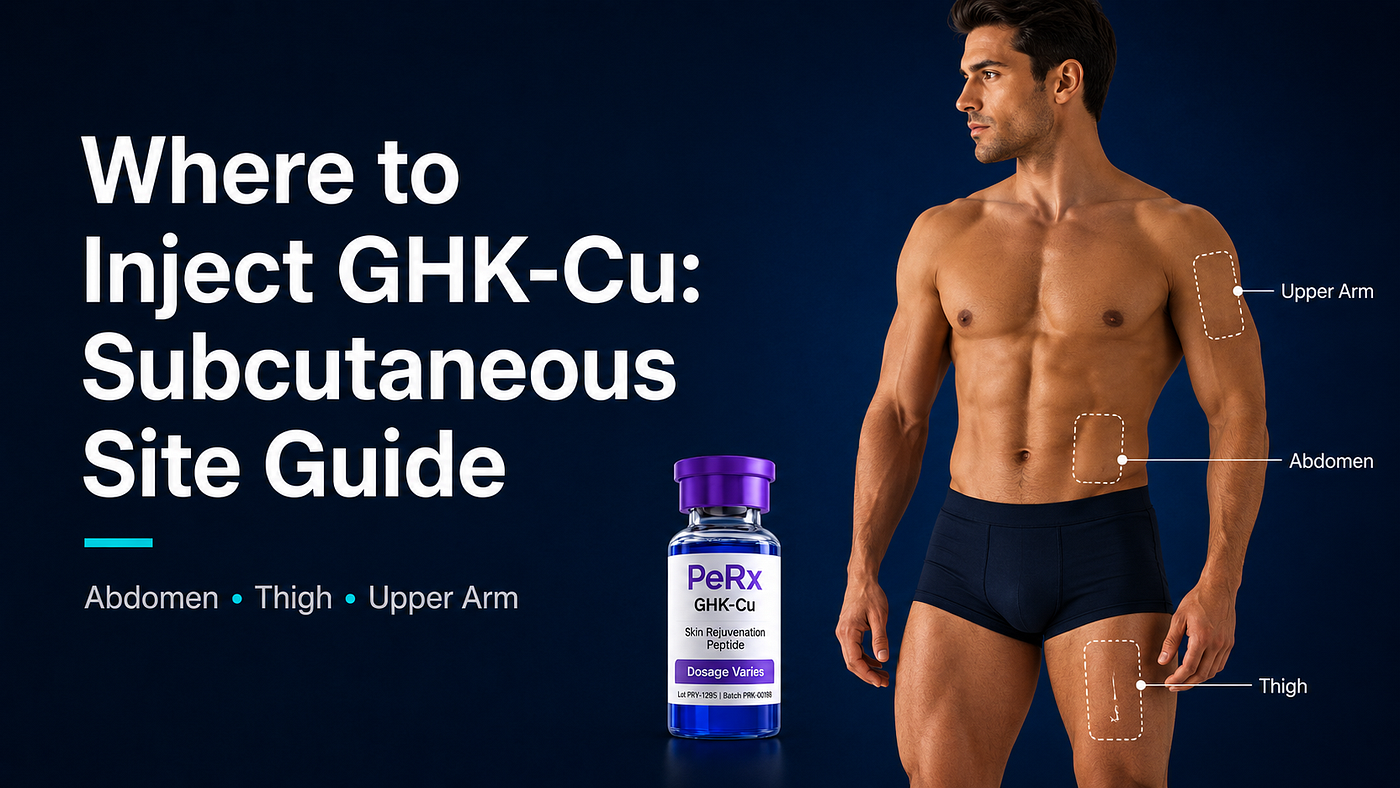
In general clinical terms, common subcutaneous regions include the abdomen, the front or outer thigh, and the back of the upper arm.
That does not mean every region is right for every person or every protocol. Body composition, comfort, reach, skin condition, and provider preference all matter.
Your provider gives you the specific plan. This article explains the principles behind that plan.
Why the abdomen is commonly used
The abdomen is often one of the easiest areas for patients to use because it is visible, reachable, and usually has enough subcutaneous tissue.
For beginners, visibility matters. You can see what you are doing, control the angle, and avoid rushing. A site that is awkward to reach can lead to poor technique, even when the patient understands the instructions.
The abdomen also makes rotation easier because there is enough surface area to vary the exact spot from one administration to the next.
The key idea is not to use the same tiny area repeatedly. Your provider’s plan should tell you how to rotate.
Why the thigh may be used
The thigh can also be a practical subcutaneous region, especially for patients who prefer not to use the abdomen or need more rotation options.
The front or outer thigh is usually easier to reach than the back of the upper arm. Like the abdomen, it allows the patient to see the site and control the injection more comfortably.
Some patients find the thigh slightly more sensitive than the abdomen. Others prefer it. Comfort varies person to person, which is one reason provider guidance and personal feedback both matter.
Why the upper arm is less beginner-friendly
The back of the upper arm is another common subcutaneous region in general, but it can be harder to use on yourself.
The issue is not that the region is wrong. The issue is access. If you cannot comfortably see and control the site, technique becomes harder. Some patients use this region with help, while others stick to areas they can reach more easily.
For a beginner, simple and consistent is usually better than complicated.
Why site rotation matters
Rotation is one of the most important habits in any subcutaneous peptide protocol.
Using the same exact spot over and over can irritate the tissue. Over time, repeated use of one small area may make that region more uncomfortable or less predictable for absorption.
Rotation helps prevent that.
The principle is simple: do not keep returning to the same exact spot before the area has had time to settle. Spread administrations across the approved regions in the pattern your provider gives you.
A good rotation plan is not random. It is structured enough that you know where to go next, but simple enough that you can actually follow it.
What to avoid
Do not inject into a site that looks irritated, bruised, swollen, unusually red, warm, or painful.
Do not inject through damaged skin.
Do not use a site that feels lumpy or unusually firm.
Do not keep using the same spot because it feels familiar.
Do not change the route or site plan without checking with your provider.
If something about a site looks or feels off, choose another approved area from your plan and contact your provider if the issue does not settle or seems unusual.
What good technique usually depends on
Most beginner problems come from rushing.
A calm setup makes the process easier. Make sure you have the supplies your provider instructed you to use. Wash your hands. Clean the site as directed. Let the skin dry. Use a new needle. Follow the angle and steps in your instructions.
The injection itself is usually quick. The preparation is what keeps it controlled.
PeRx has a dedicated subcutaneous injection guide here: https://perxpeptides.com/injection-guide
GHK-Cu arrives ready to use
One of the most important points for beginners: PeRx GHK-Cu arrives ready to use.
That means the pharmacy preparation is handled before the vial reaches you. No mixing is required on the patient end. You are not expected to prepare the medication yourself or make calculations from online forums.
Your role is to store it correctly, use it as directed, rotate sites according to the plan, and track what your provider asked you to track.
That structure matters. It keeps the patient focused on safe, consistent administration rather than trying to figure out pharmacy work at home.
Storage matters too
GHK-Cu is a delicate molecule. The vial should be stored according to the instructions that come with your prescription.
Do not leave it sitting out casually. Do not store it in a hot car, gym bag, or bathroom drawer. Do not freeze it unless the pharmacy or provider specifically tells you to.
Storage is part of the protocol. If the molecule is mishandled, the label may still look the same, but the product may not perform the way your provider expects.
When the vial arrives, read the storage instructions first.
What to track during a GHK-Cu course
Because GHK-Cu is often used in skin-focused protocols, patients may be tempted to check the mirror every day.
That usually creates more confusion than clarity.
Skin-quality changes are easier to evaluate over time. Before starting, decide what you and your provider are actually watching. That might include skin texture, firmness, radiance, visible fine lines, post-procedure appearance, or another provider-directed marker.
Photos can be useful if they are consistent: same lighting, same angle, same time of day, same expression. Random mirror checks are less reliable.
The goal is not to obsess. The goal is to create a fair way to judge whether the protocol is doing what it was intended to do.
Beginner mistakes to avoid
The biggest mistakes are usually simple.
Using the same site repeatedly. Changing sites without a plan. Forgetting storage instructions. Expecting visible changes too quickly. Comparing your protocol to someone else’s. Using online advice instead of your provider’s instructions.
GHK-Cu is not a random beauty product. It is a provider-prescribed peptide. The plan matters because the route, storage, timing, and rotation all affect how consistently the course can be evaluated.
The honest summary
GHK-Cu is administered subcutaneously, which means it goes into the fatty tissue beneath the skin. Common regions include the abdomen, thigh, and upper arm, but the specific site plan should come from your provider.
The best injection site is not simply the one that feels easiest. It is the one that fits the protocol, can be used with good technique, and can be rotated properly over time.
PeRx GHK-Cu ships ready to use, so the patient does not need to prepare or mix the medication. The patient’s job is to follow the provider’s plan, rotate sites, store the vial correctly, and ask questions early when something is unclear.
A good GHK-Cu course is not built on guesswork. It is built on the right product, the right route, and a site plan you can follow consistently.
Ready to learn more? View GHK-Cu on PeRx: https://perxpeptides.com/peptides/ghk-cu
This article is for education and isn’t medical advice. Peptide therapy requires a prescription from a licensed provider.
메타데이터
- post_id
- 924ff608db3a
- slug
- where-to-inject-ghk-cu-subcutaneous-site-guide-924ff608db3a
- url
- https://medium.com/@lunairelabs/where-to-inject-ghk-cu-subcutaneous-site-guide-924ff608db3a
- canonical_url
- https://medium.com/@lunairelabs/where-to-inject-ghk-cu-subcutaneous-site-guide-924ff608db3a
- author_url
- https://medium.com/@lunairelabs
- status
- ok
- fetched_at
- 2026-06-09 15:37:30



