Understanding MITRE’s Cybersecurity Tools: ATT&CK, ENGAGE, D3FEND, CybOXand CTID, How to Use Them…
When it comes to Cyber Threat Intelligence (CTI), one name that stands out in the cybersecurity world is MITRE. But if you’re new to the…
Understanding MITRE’s Cybersecurity Tools: ATT&CK, ENGAGE, D3FEND, CybOXand CTID, How to Use Them for CTI
When it comes to Cyber Threat Intelligence (CTI), one name that stands out in the cybersecurity world is MITRE. But if you’re new to the field, seeing different platforms like attack.mitre.org, engage.mitre.org, and defend.mitre.org can be confusing.
So, what do these platforms mean? What’s their purpose? And more importantly, how can we use them together for better CTI?
1. MITRE ATT&CK The Foundation of Threat Intelligence
Site: https://attack.mitre.org
The MITRE ATT&CK® framework is a global knowledge base of attacker behavior, based on real-world observations. It shows how attackers operate their goals (Tactics), methods (Techniques), and detailed steps (Procedures).
Use in CTI:
- Track attacker groups (like APT29, FIN6)
- Identify commonly used techniques (e.g., phishing, credential dumping)
- Map attacks to defensive capabilities
- Plan red/blue team exercises
2. MITRE D3FEND Defensive Techniques Against Attacks
Site: https://d3fend.mitre.org
D3FEND is the defensive side of ATT&CK. It focuses on how to detect, deny, and disrupt attacker techniques. It includes detailed explanations of defense methods, such as using decoy files, process monitoring, or log analysis.
Use in CTI:
- Align defense strategies directly with ATT&CK techniques
- Implement security controls against specific attacker behaviors
- Make threat intel actionable by mapping it to real-world defensive actions
3. MITRE ENGAGE Deceiving and Learning from the Attacker
Site: https://engage.mitre.org
ENGAGE is all about adversary engagement in simple terms, it helps you interact with attackers in a controlled way using deception and denial techniques.
Use in CTI:
- Design honeypots and deception campaigns
- Learn attacker behavior in real time
- Collect intelligence by watching how attackers react to fake assets
- Slow down, mislead, or confuse the attacker
4. CTID Center for Threat-Informed Defense
Site: https://ctid.mitre-engenuity.org
CTID (by MITRE Engenuity) is a research group that works with industry leaders like Microsoft, Splunk, and Red Canary. Their goal is to build free, open-source tools and emulation plans to help everyone benefit from threat-informed defense.
Use in CTI:
- Use Adversary Emulation Plans (like for APT3, APT29)
- Run red-team simulations to test how you’d defend against real threat groups
- Apply research-backed methodologies from real companies
5. CYBOX
Cybox stands for Cyber Observable eXpression. It was a standardized language (by MITRE) used to describe cyber observables meaning anything you can detect or observe in a cyber environment that may indicate malicious activity.
Think of it like this:
If you’re monitoring a system for a cyberattack, you’ll see things like:
- File modifications
- Registry changes
- Network traffic spikes
- Suspicious emails
- Malware hash values
- IP addresses making connections
Cybox provided a standard way to represent all of these observations, so that different tools and teams could share and understand cyber threat data more easily.
Used with STIX & TAXII
Cybox was commonly used along with:
- STIX (Structured Threat Information eXpression) → Describes threats (actors, TTPs, etc.)
- TAXII (Trusted Automated eXchange of Intelligence Information) → Used to exchange threat intelligence.
Current Status (Important):
As of now, Cybox has been deprecated. Its functionality has been merged into:
STIX 2.0 and beyond MITRE merged Cybox into STIX so everything is now described in one unified format (STIX 2.x).
So:
Old setup: Cybox = Observables STIX = Threats TAXII = Exchange
Now: STIX 2.x = Threats + Observables (Cybox merged in)
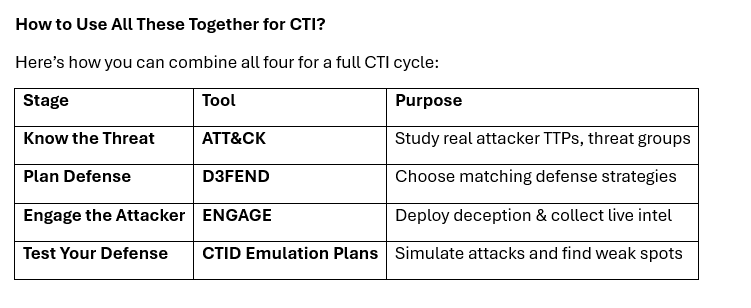
This creates a full feedback loop:
- You learn from real attacks (ATT&CK)
- Apply protection (D3FEND)
- Watch & learn in real-time (ENGAGE)
- Test your security posture (CTID)
메타데이터
- post_id
- 92b07c8b01fc
- slug
- understanding-mitres-cybersecurity-tools-att-ck-engage-d3fend-and-ctid-how-to-use-them-for-92b07c8b01fc
- url
- https://medium.com/@genrunic/understanding-mitres-cybersecurity-tools-att-ck-engage-d3fend-and-ctid-how-to-use-them-for-92b07c8b01fc
- canonical_url
- https://medium.com/@genrunic/understanding-mitres-cybersecurity-tools-att-ck-engage-d3fend-and-ctid-how-to-use-them-for-92b07c8b01fc
- author_url
- https://medium.com/@genrunic
- status
- ok
- fetched_at
- 2026-07-18 17:08:22



