Trevi Fountain - The Baroque Wonder of Rome
The Trevi Fountain is one of the most famous landmarks in Rome and one of the best-known fountains in the world. Located in Piazza di…
Trevi Fountain - The Baroque Wonder of Rome
The **Trevi Fountain is one of the most famous landmarks in Rome and one of the best-known fountains in the world. Located in Piazza di Trevi, near the Quirinal Palace**, it attracts huge numbers of visitors every day and remains one of the most photographed monuments in the Italian capital.
Its fame comes not only from its monumental size and Baroque beauty, but also from its strong connection with Roman history, cinema, travel traditions, and urban mythology. For many visitors, the Trevi Fountain is not simply a fountain, but a symbolic encounter with Rome itself.
The fountain has appeared in several famous films, including La Dolce Vita, Roman Holiday, and Three Coins in the Fountain. These cinematic appearances helped transform it into an international image of Rome, associated with romance, elegance, nostalgia, and the unforgettable atmosphere of the Eternal City.
One of the most famous traditions connected with the Trevi Fountain is the coin toss. Visitors usually throw a coin into the water with the right hand over the left shoulder, hoping, according to tradition, to return to Rome. This simple gesture has become one of the most repeated rituals in the city.
The amount of money thrown into the fountain is remarkable. It has been estimated that around 3,000 euros are thrown into the water each day, adding up to more than one million euros each year. This detail shows both the enormous popularity of the monument and the strength of the tradition surrounding it.
The history of the Trevi Fountain is closely connected with the ancient Roman aqueduct known as Aqua Virgo. This aqueduct dates back to the time of Emperor Augustus and was one of the important water systems of ancient Rome. Even after being damaged during the siege of the Goths in 537, it continued to function during the Middle Ages.
The terminal point of the aqueduct was located on the eastern side of the Quirinal Hill, near a crossroads known as Treio. This area gave the fountain its name. In the 15th century, a fountain was built there, marking the point where water arrived in the city through the ancient aqueduct system.
The modern history of the monument began in the 17th century. In 1640, after several projects had been proposed but never completed, Pope Urban VIII asked the architect and sculptor Gian Lorenzo Bernini to transform the square and the fountain. Bernini started by enlarging the square and demolishing some small structures.
However, the ambitious project soon stopped because the necessary funds ran out. As a result, Bernini’s transformation remained incomplete, and the area waited almost another century before the great fountain known today began to take shape. This long delay reflects the complex history of Rome’s monumental projects.
In 1730, Pope Clement XII organized a competition for the construction of a new fountain. The official winner was Alessandro Galilei, an architect from Florence. However, the choice caused dissatisfaction in Rome, partly because the winning architect was not Roman.
Eventually, the commission was awarded to Nicola Salvi, who had placed second in the competition. Salvi became the main designer of the Trevi Fountain. His project created one of the most spectacular Baroque compositions in Rome, combining architecture, sculpture, water, theatricality, and urban space.
Construction began in 1732, but the fountain was not finished during Salvi’s lifetime. He died in 1751, before seeing the completion of his masterpiece. The work continued after his death, with other artists and architects contributing to the final result.
The central statue of Oceanus, created by Pietro Bracci, was placed in the main niche of the fountain. Later, Giuseppe Pannini completed the monument in 1762. The Trevi Fountain was officially inaugurated on May 22, 1762, by Pope Clement XIII.
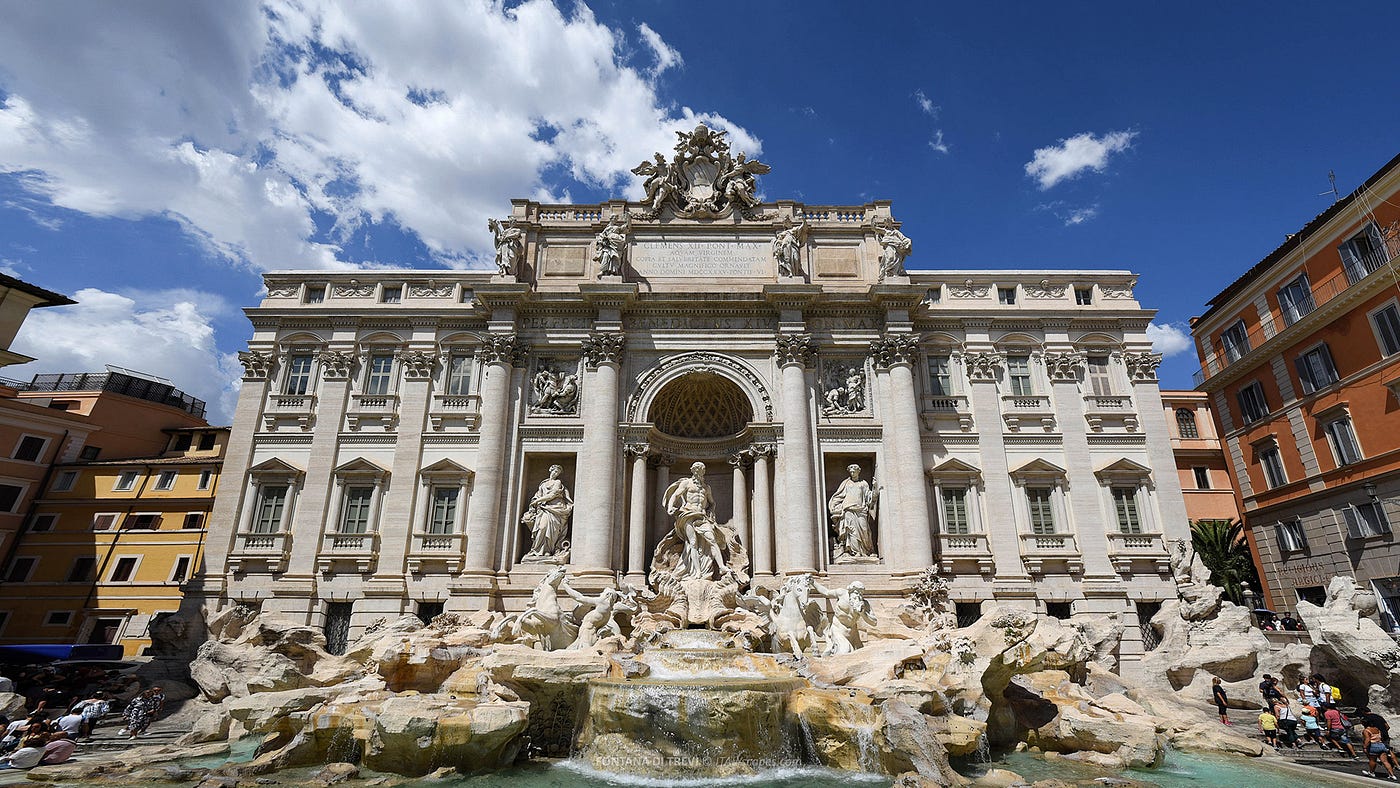
Architecturally, the Trevi Fountain is the largest Baroque fountain in Rome. It measures 26.3 meters in height and 49.15 meters in width, giving it a powerful presence within the relatively small Piazza di Trevi. Its size creates a dramatic contrast between the narrow streets leading to it and the sudden opening of the square.
The fountain is made of travertine stone, a material quarried near Rome, especially in the area of Tivoli. Travertine was widely used in Roman architecture and gives the monument a strong visual connection with the city’s classical and Baroque heritage.
The main focus of the composition is Oceanus, the god of water, standing in the central niche. His figure dominates the fountain and gives the whole monument a sense of movement and authority. Around him, the sculptural group includes horses and figures that animate the scene.
The fountain is designed like a theatrical stage. The façade behind the statues forms a monumental architectural backdrop, while the sculptures appear to emerge from the stone and water. The movement of the horses, the flowing drapery, and the cascading water all contribute to the dynamic Baroque effect.
Water plays an essential role in the visual impact of the monument. It falls over the sculpted rocks and flows into the large basin in the foreground. This movement makes the fountain feel alive, turning stone into a dramatic scene filled with rhythm, sound, and motion.
The Trevi Fountain also functions as a meeting point and urban landmark. Its location in Piazza di Trevi makes it easy to include in a walk through central Rome. Although it is often crowded, especially during the day, its visual impact remains powerful even when the square is full of visitors.
Access to the fountain is free, making it one of the most important free attractions in Rome. Visitors do not need a ticket to see it, and this accessibility contributes to its constant popularity. It can be admired during the day, in the evening, or at night, when lighting changes its atmosphere.
The closest Metro station is Barberini, on Line A, located about 600 meters from the fountain. The closest bus stop is Corso, around 250 meters away, served by several bus lines, including 62, 63, 83, 85, 119, 160, and 492.
The Trevi Fountain remains one of the clearest examples of Rome’s ability to unite ancient infrastructure, papal ambition, Baroque art, popular tradition, and modern tourism. Built on the legacy of an ancient aqueduct, it became a masterpiece of 18th-century design and a global symbol of the city.
More than a monument, the Trevi Fountain is a ritual space, a cinematic icon, and one of the essential images of Rome. Its history, architecture, water, sculptures, and legends continue to make it one of the most unforgettable places in the Eternal City.
메타데이터
- post_id
- 92d88cfc66da
- slug
- trevi-fountain-the-baroque-wonder-of-rome-92d88cfc66da
- url
- https://medium.com/@ovidiu.tutunaru/trevi-fountain-the-baroque-wonder-of-rome-92d88cfc66da
- canonical_url
- https://medium.com/@ovidiu.tutunaru/trevi-fountain-the-baroque-wonder-of-rome-92d88cfc66da
- author_url
- https://medium.com/@ovidiu.tutunaru
- status
- ok
- fetched_at
- 2026-06-21 07:44:09