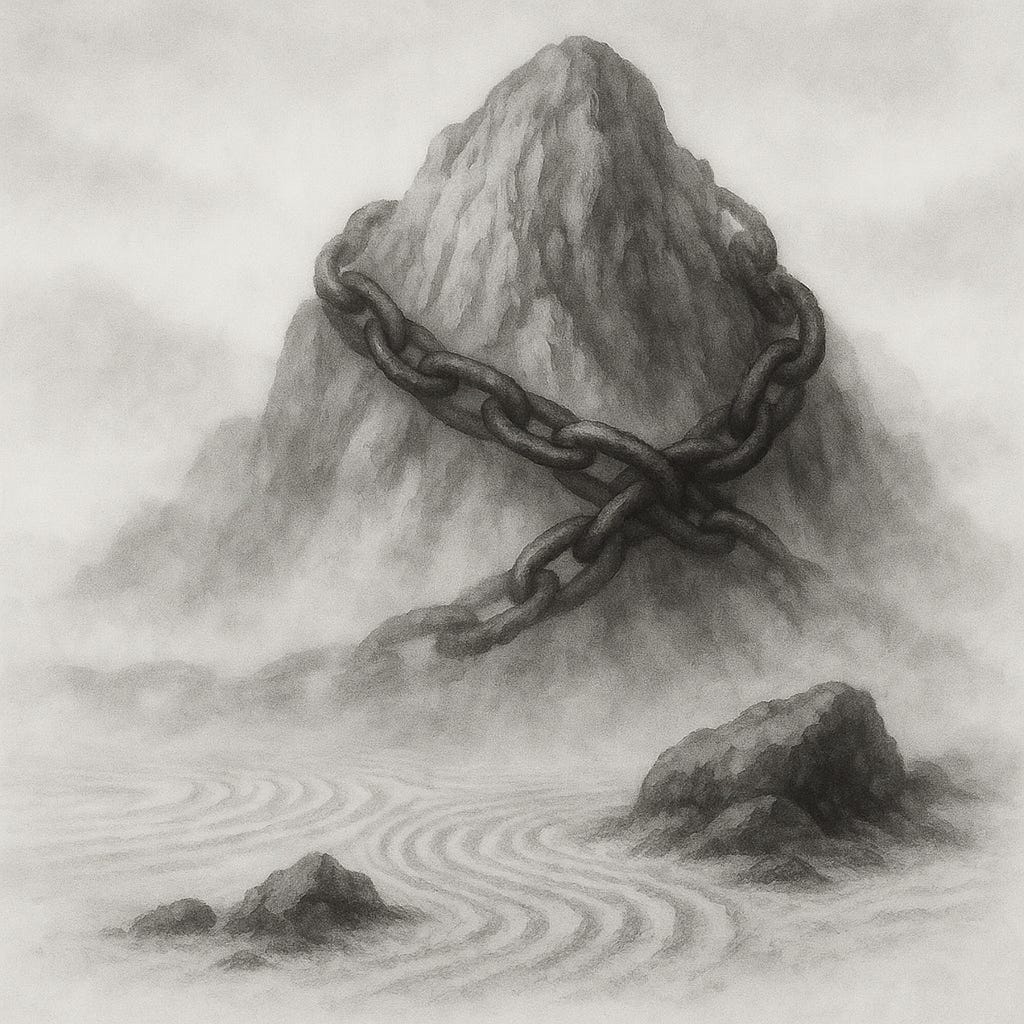
Laozi and Zhuangzi: A Philosophy of Mutual Co-Arising
Why Zhuangzi Is a Continuation of Laozi Rather Than a Radical Break
Laozi and Zhuangzi: A Philosophy of Mutual Co-Arising
Why Zhuangzi Is a Continuation of Laozi Rather Than a Radical Break

Preface
One of the most influential interpretations of early Daoist philosophy in recent years is the claim that Laozi and Zhuangzi represent fundamentally different philosophical projects. Among the scholars advancing this view is Geling Shang, who argues that while the Daodejing still presents a constructive account of Dao, the Zhuangzi moves beyond it, developing a far more radical critique of conceptualization, language, and reification. On this reading, Zhuangzi should not be understood simply as Laozi’s successor, but as a philosopher who significantly departs from him.
This interpretation has enriched contemporary Daoist scholarship by drawing attention to the originality and sophistication of Zhuangzi. Nevertheless, I believe it overstates the discontinuity between these two foundational texts.
The purpose of this essay is not to deny that Laozi and Zhuangzi differ in style, emphasis, and literary method. They clearly do. Rather, I argue that the philosophical foundations of Zhuangzi’s thought are already present in the Daodejing. In particular, Laozi’s concept of 相生 (xiangsheng), or mutual co-arising, provides the key to understanding the continuity between them.
Once this principle is recognized, Zhuangzi appears not as a revolutionary overturning Laozi’s philosophy, but as an elaborator who unfolds its implications for language, knowledge, identity, and human life. The relationship, I shall argue, is analogous to that between the Buddha and Nāgārjuna. Just as Nāgārjuna develops the implications of dependent origination without rejecting the Buddha, Zhuangzi develops the implications of Laozi’s relational worldview without abandoning it.
The Forgotten Importance of Mutual Co-Arising(相生)
The philosophical heart of Laozi’s thought appears remarkably early in the Daodejing. Chapter 2 states:
有無相生 (Being and nothingness co-arise) 難易相成 (Difficult and easy establish each other) 長短相形(Long and short arise by comparison) 高下相傾 (High and low lean against each other)
音聲相和 (Music and voice harmonize each other) 前後相隨 (Front and back follow each other)
These verses are often read merely as observations about pairs of opposites. Their significance is much deeper. They explain how reality itself comes to be understood.
Notice the verbs.
Being and non-being co-arise.
Difficult and easy complete one another.
Long and short define one another.
High and low depend upon one another.
Sound and tone harmonize with one another.
Before and after follow one another.
These are not independently existing substances interacting after the fact. Rather, each member of the pair acquires its identity only through its relationship with the other.
Reality is therefore fundamentally relational.
This is already a profound rejection of conventional substantialism — the belief that things possess fixed, self-existing essences independent of everything else.
Laozi’s world is one of dynamic relationships rather than isolated substances.
This, I believe, is the philosophical seed from which the Zhuangzi naturally grows.
Reinterpreting Chapter 42
This insight also transforms our understanding of one of the most famous passages in the Daodejing:
道生一,一生二,二生三,三生萬物
Many readers immediately interpret “生” (“gives birth”) as describing a metaphysical act of creation.
But Chapter 2 has already explained Laozi’s understanding of 生.
It is 相生.
Things arise through mutual dependence.
Consequently, the “birth” described in Chapter 42 need not imply a transcendent creator or an ontological ground existing beyond nature. Instead, it may describe the progressive differentiation of relational structures.
Unity differentiates into polarity.
Polarity generates increasing complexity.
Complexity gives rise to the ten thousand things.
This is a process of spontaneous emergence rather than supernatural creation as in the book of Genesis.
Such a reading is reinforced by Chapter 25:
人法地,地法天,天法道,道法自然
Dao itself follows ziran (自然) — that which is self-so, spontaneous, and naturally unfolding.
Rather than standing outside nature like the Christian God, Dao is characterized by the spontaneous order through which reality continuously organizes itself.
Laozi and the Buddha: Two Philosophies of Co-Arising
The concept of 相生 also reveals a remarkable philosophical parallel with the Buddha’s teaching of conditionality.
The Buddha repeatedly explains reality through what later tradition summarizes as:
“When this exists, that comes to be.
With the arising of this, that arises.
When this ceases, that ceases.”
This is not a theory of creation. Nor is it a theory of independently existing substances. It is an account of conditional co-arising.
Phenomena exist because of relationships and conditions.
They possess no independent existence.
Laozi’s 相生 expresses a remarkably similar intuition.
Being exists because non-being exists. Long exists because short exists. High exists because low exists.
Identity itself emerges through relationship.
This does not imply that Laozi borrowed from Buddhism or that Buddhism borrowed from Laozi. Rather, two great philosophical traditions independently arrived at a common insight: reality is fundamentally relational rather than substantial.
Zhuangzi Draws Out Laozi’s Insight
Seen from this perspective, Zhuangzi is not introducing a new philosophy. He is exploring the implications of Laozi’s relational worldview.
If distinctions arise relationally, then fixed conceptual categories become suspect. If identity is relational, then rigid notions of self become problematic. If reality consists of dynamic relationships, then perspective itself becomes fluid.
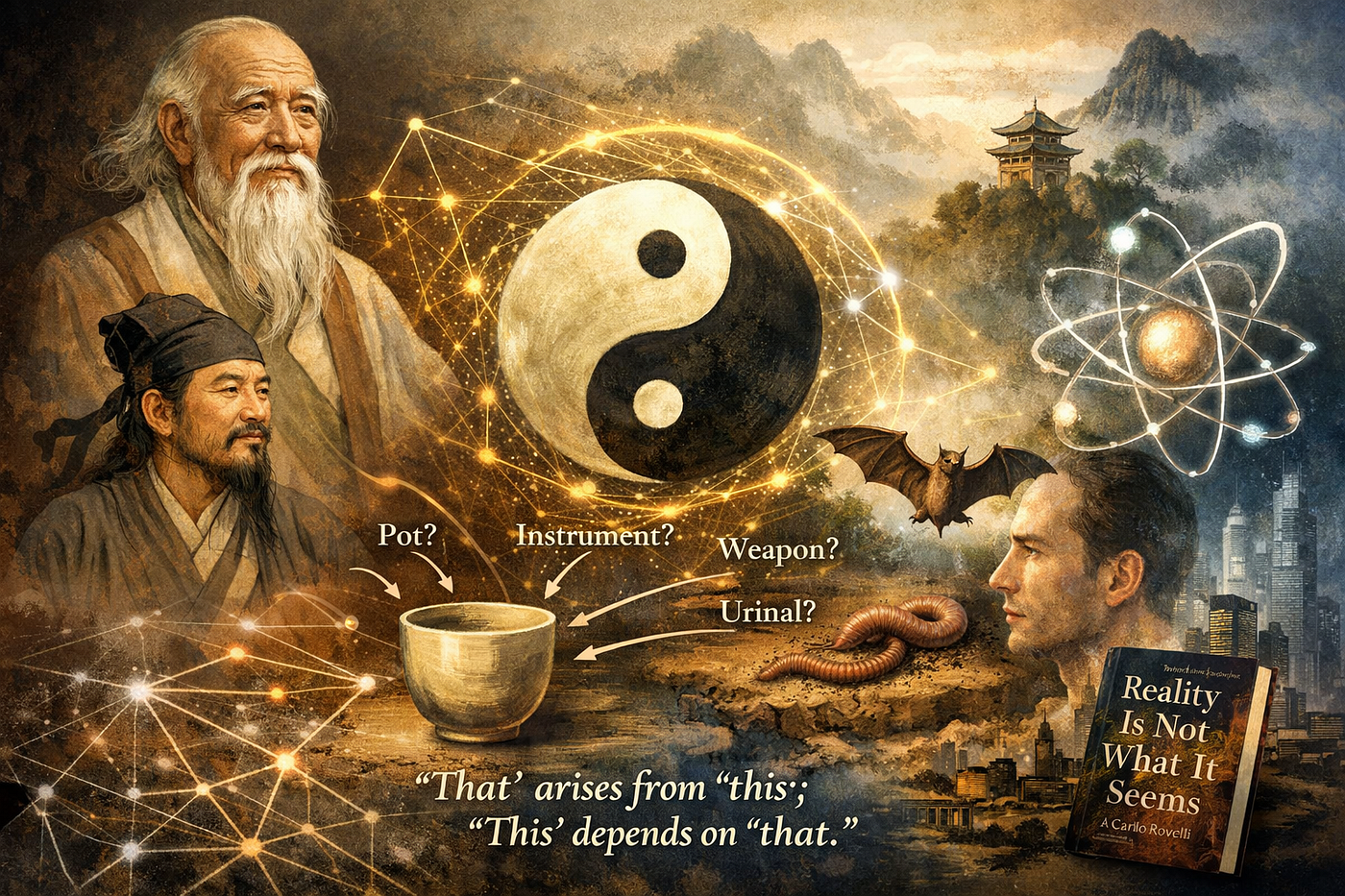
The Butterfly Dream explores the instability of identity. The discussion of “this” and “that” (彼是) questions rigid distinctions.
The “Equalizing of Things” (齊物論) extends Laozi’s critique of absolutism.
Cook Ding demonstrates that genuine mastery arises through participation in natural processes rather than mechanical technique.
These are not new philosophical foundations. They are applications of Laozi’s original insight.
Zhuangzi asks a question implicit throughout the Daodejing:
If reality truly consists of mutually dependent relationships, what follows for language, knowledge, identity, ethics, and human life?
The Zhuangzi is an extended meditation on that question.
A Parallel with Nāgārjuna
The relationship between Laozi and Zhuangzi resembles that between the Buddha and Nāgārjuna.
The Buddha introduced dependent origination. Nāgārjuna demonstrated that if everything arises dependently, then nothing possesses intrinsic existence (svabhāva).
Likewise, Laozi introduces 相生. Zhuangzi unfolds its consequences for language, knowledge, and perspective.
Neither later thinker abandons the earlier one. Each reveals implications already latent within the original teaching.
The continuity is philosophical even where the literary style changes.
Reading Ancient Texts with Modern Knowledge
Critics sometimes object that interpreting Laozi through relational philosophy, systems theory, or Buddhism reads modern ideas back into ancient texts.
This objection misunderstands the nature of philosophical interpretation. Every generation interprets ancient texts using the best knowledge available.
Historians employ archaeology. Classicists use modern linguistics. Biblical scholars draw upon literary criticism. Buddhist scholars use phenomenology and philosophy of mind.
The question is not whether an interpretive framework is modern.
The question is whether it illuminates the text without contradicting it.
Modern philosophy provides conceptual tools that help articulate patterns Laozi described intuitively. It does not replace the Daodejing; it enables us to understand it more deeply.
Conclusion
The continuity between Laozi and Zhuangzi is deeper than differences in literary style might suggest.
Laozi had already begun dismantling the conventional substantialist worldview. Through 相生, complementarity, and relationality, he presented reality not as a collection of independently existing things but as a dynamic web of mutually dependent processes.
Zhuangzi did not overturn this vision. He expanded it. His stories, paradoxes, and perspectivism explore the implications of Laozi’s relational philosophy for language, identity, knowledge, and human existence.
The relationship between Laozi and Zhuangzi is therefore better understood as one of development rather than rupture — much like the relationship between the Buddha and Nāgārjuna.
The more significant historical shift occurs later, when Dao or wu (無) is reified into an ontological ground. That is where the philosophical trajectory changes most dramatically.
Read together, however, Laozi and Zhuangzi present one of the world’s earliest and most profound relational philosophies.
Postscript: A Modern Reflection
One reason I find this interpretation compelling is that it resonates with several developments in contemporary philosophy and science.
This does not mean that Laozi anticipated modern physics. Nor does modern science prove Laozi correct. Rather, modern thought provides a richer conceptual vocabulary for appreciating insights that Laozi expressed more than two thousand years ago.
The quantum physicist Carlo Rovelli argues that reality is fundamentally relational. In his relational interpretation of quantum mechanics, physical properties are not absolute features of isolated objects but arise through interactions between systems.
Although Laozi and Rovelli belong to entirely different intellectual traditions, both challenge the picture of reality as a collection of independently existing substances.
The same relational insight appears in Laozi’s 相生, the Buddha’s conditional co-arising, Nāgārjuna’s critique of intrinsic existence, and Zhuangzi’s exploration of perspective and transformation.
These traditions are not identical, nor should they be conflated. Yet they converge upon a profound philosophical intuition: reality is best understood not as a world of isolated things, but as a web of relationships, interactions, and continuous transformation.
Perhaps this is why Laozi and Zhuangzi continue to speak so powerfully to the modern world. Their enduring significance lies not in anticipating contemporary science but in articulating a relational vision of reality that modern philosophy and science increasingly help us appreciate more clearly.
메타데이터
- post_id
- 92e713db7b45
- slug
- laozi-and-zhuangzi-a-philosophy-of-mutual-co-arising-92e713db7b45
- url
- https://medium.com/@kleong54/laozi-and-zhuangzi-a-philosophy-of-mutual-co-arising-92e713db7b45
- canonical_url
- https://medium.com/@kleong54/laozi-and-zhuangzi-a-philosophy-of-mutual-co-arising-92e713db7b45
- author_url
- https://medium.com/@kleong54
- status
- ok
- fetched_at
- 2026-07-15 20:09:32