How Electronic Signatures Improve Contract Lifecycle Management: A Complete Guide for Modern…
Introduction
How Electronic Signatures Improve Contract Lifecycle Management: A Complete Guide for Modern Businesses
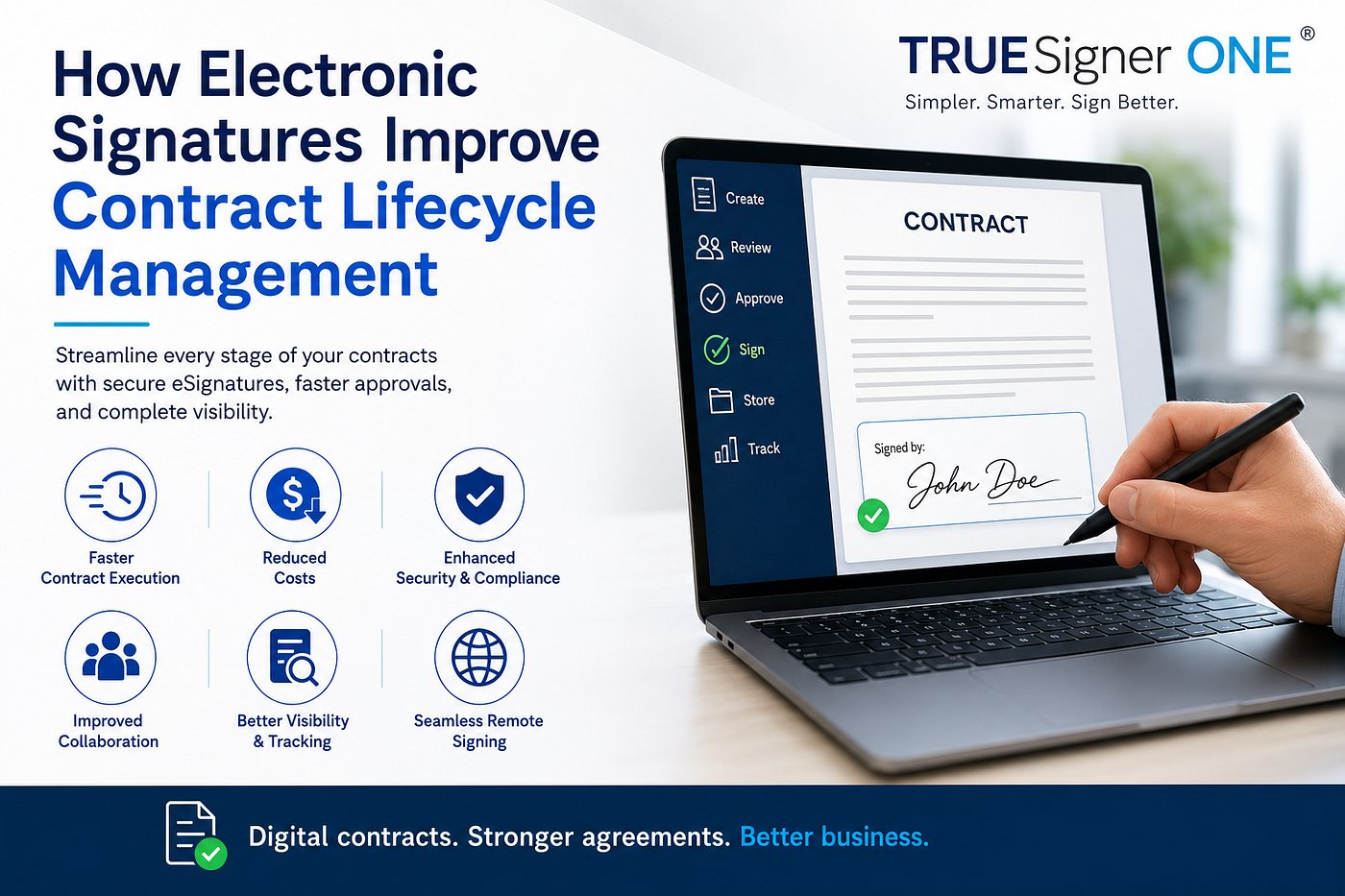
Introduction
Contracts are the backbone of every business relationship. Whether it’s onboarding employees, closing sales deals, signing vendor agreements, or managing legal documents, contracts play a crucial role in daily operations.
However, traditional contract processes often involve printing, scanning, courier services, manual approvals, and extensive paperwork. These outdated methods create delays, increase costs, and reduce operational efficiency.
This is where electronic signatures (eSignatures) become a game changer.
By digitizing contract approvals and signatures, organizations can significantly improve their Contract Lifecycle Management (CLM) processes. Electronic signatures help businesses accelerate contract execution, improve compliance, enhance visibility, and create a better experience for all stakeholders.
Let’s explore how electronic signatures are revolutionizing contract lifecycle management and why solutions like TRUESigner ONE are becoming essential for modern organizations.
What Is Contract Lifecycle Management (CLM)?
**Contract Lifecycle Management** (CLM) refers to the process of managing contracts from creation to renewal or termination.
The typical contract lifecycle includes:
Contract Creation
Drafting legal agreements and defining terms.
Contract Review and Negotiation
Internal and external stakeholders review, edit, and negotiate terms.
Approval Process
Managers, legal teams, finance departments, and executives provide approvals.
Contract Signing
Authorized parties execute the agreement.
Contract Storage
Signed contracts are securely stored and organized.
Monitoring and Compliance
Tracking obligations, deadlines, renewals, and compliance requirements.
Renewal or Termination
Contracts are renewed, amended, or terminated as needed.
Efficient CLM ensures that contracts move quickly through every stage while minimizing risks and maintaining compliance.
Challenges of Traditional Contract Management
Organizations relying on paper-based processes often face several challenges:
- Lengthy approval cycles
- Lost or misplaced documents
- Manual tracking errors
- Increased operational costs
- Security vulnerabilities
- Lack of visibility into contract status
- Delayed revenue recognition
- Poor customer and vendor experience
These inefficiencies can impact productivity and slow business growth.
As businesses become increasingly digital, traditional contract management methods can no longer keep pace with organizational needs.
What Are Electronic Signatures?
An electronic signature is a digital method of signing documents electronically instead of using handwritten signatures on paper.
Electronic signatures allow individuals to:
- Sign contracts online
- Approve documents remotely
- Authenticate agreements securely
- Track signing activities
- Maintain legally enforceable records
Unlike traditional signatures, electronic signatures eliminate geographical barriers and significantly speed up contract execution.
How Electronic Signatures Transform Contract Lifecycle Management
1. Faster Contract Execution
One of the biggest advantages of electronic signatures is speed.
Traditional contract signing may take days or even weeks due to:
- Printing documents
- Physical delivery
- Manual signatures
- Scanning and emailing
Electronic signatures allow contracts to be signed within minutes from any location.
For example:
A sales agreement that previously required 7–10 days to complete can often be finalized in less than 24 hours using eSignatures.
This acceleration helps organizations close deals faster and improve revenue generation.
2. Reduced Administrative Costs
Paper-based contract management involves numerous expenses:
- Printing costs
- Courier charges
- Storage expenses
- Administrative labor
Electronic signatures eliminate most of these costs.
Organizations can save substantial amounts annually by moving to digital contract workflows.
Additionally, employees spend less time handling paperwork and more time focusing on strategic activities.
3. Enhanced Security and Compliance
Security is a major concern when managing contracts.
Modern electronic signature solutions provide:
- Encryption
- Audit trails
- Authentication mechanisms
- Tamper-evident documents
- Timestamping
These security measures help organizations maintain compliance with legal and regulatory requirements.
Every action performed on a contract is recorded, creating a transparent and verifiable audit trail.
This level of accountability is difficult to achieve with paper-based processes.
4. Improved Collaboration Across Teams
Contracts often require input from multiple stakeholders.
Electronic signature platforms enable seamless collaboration among:
- Legal teams
- HR departments
- Procurement teams
- Finance teams
- Sales departments
- External partners
Stakeholders can review, comment, approve, and sign documents from anywhere.
This centralized collaboration reduces communication delays and improves workflow efficiency.
5. Better Document Tracking and Visibility
A common problem with traditional contracts is the lack of visibility.
Questions frequently arise such as:
- Who has the document?
- Has it been signed?
- Is approval pending?
- What stage is the contract currently in?
Electronic signature platforms provide real-time status tracking.
Users can instantly see:
- Sent documents
- Viewed documents
- Pending signatures
- Completed agreements
This visibility improves accountability and reduces follow-up efforts.
6. Seamless Remote Contract Signing
Today’s workforce is increasingly distributed.
Remote employees, clients, vendors, and partners require flexible signing options.
Electronic signatures allow contracts to be signed from:
- Laptops
- Smartphones
- Tablets
- Web browsers
This convenience enhances the overall user experience while ensuring business continuity.
Remote signing capabilities have become especially important for organizations operating across multiple locations and countries.
Key Benefits of Electronic Signatures in CLM
Organizations implementing electronic signatures within their CLM strategy experience several measurable benefits:
Faster Deal Closures
Reduce contract turnaround time dramatically.
Increased Productivity
Automate repetitive administrative tasks.
Lower Operational Costs
Minimize paper, printing, shipping, and storage expenses.
Improved Compliance
Maintain complete audit trails and secure records.
Better Customer Experience
Provide a smooth and convenient signing process.
Enhanced Accuracy
Reduce manual errors associated with paper-based workflows.
Greater Transparency
Track contract status in real time.
Industries Benefiting from Electronic Signature-Based CLM
Electronic signatures are transforming contract management across industries.
Human Resources
HR teams use eSignatures for:
- Offer letters
- Employment contracts
- Employee onboarding
- Policy acknowledgments
Sales
Sales organizations leverage electronic signatures to:
- Close deals faster
- Execute proposals
- Finalize agreements
Procurement
Procurement teams streamline:
- Vendor contracts
- Supplier agreements
- Purchase approvals
Legal
Legal departments improve document control and compliance management.
Financial Services
Banks, NBFCs, and financial institutions use eSignatures for customer onboarding and contract execution.
Healthcare
Healthcare providers utilize electronic signatures for consent forms and administrative documentation.
Why Businesses Need an Integrated eSignature Solution
A standalone signing tool may address only part of the contract process.
Organizations increasingly need solutions that integrate seamlessly with existing business systems.
An integrated eSignature platform helps:
- Automate workflows
- Connect with CRM systems
- Integrate with HR software
- Support document management systems
- Enable compliance monitoring
This integration creates a more efficient and scalable contract management ecosystem.
How TRUESigner ONE Enhances Contract Lifecycle Management
TRUESigner ONE is a powerful electronic signature solution designed to help businesses modernize contract workflows.
Key capabilities include:
Secure Electronic Signatures
Enable legally compliant digital signing experiences.
Workflow Automation
Automate approval and signing processes.
Audit Trails
Maintain detailed records of every signing activity.
Multi-Party Signing
Facilitate contracts requiring multiple stakeholders.
Enterprise-Grade Security
Protect sensitive documents and business information.
Remote Signing Support
Allow users to sign documents from any location.
API Integration
Integrate seamlessly with existing business applications and workflows.
Faster Turnaround Times
Accelerate contract execution and improve operational efficiency.
By leveraging TRUESigner ONE, organizations can optimize every stage of the contract lifecycle while enhancing compliance and reducing costs.
Best Practices for Implementing Electronic Signatures in CLM
To maximize the value of electronic signatures, organizations should:
Standardize Contract Workflows
Create consistent approval and signing processes.
Define User Roles and Permissions
Ensure proper access control and accountability.
Automate Notifications and Reminders
Reduce delays and missed approvals.
Maintain Centralized Contract Repositories
Store contracts securely for easy retrieval.
Monitor Performance Metrics
Track turnaround times and workflow efficiency.
Train Employees
Ensure users understand platform features and compliance requirements.
Following these best practices helps organizations achieve a smooth digital transformation.
The Future of Contract Management
The future of contract lifecycle management is digital, automated, and intelligent.
Emerging technologies such as:
- Artificial Intelligence (AI)
- Workflow Automation
- Predictive Analytics
- Cloud-Based Document Management
- Electronic Signatures
are reshaping how organizations manage agreements.
Businesses that embrace digital contract processes today will be better positioned to improve agility, reduce risk, and enhance customer experiences tomorrow.
Conclusion
Contract Lifecycle Management is critical for business success, but traditional contract processes often create delays, increase costs, and introduce unnecessary risks.
Electronic signatures solve these challenges by enabling faster contract execution, stronger compliance, improved visibility, and seamless collaboration.
As organizations continue their digital transformation journeys, integrating electronic signatures into CLM has become a strategic necessity rather than a convenience.
Solutions like TRUESigner ONE empower businesses to streamline contract workflows, accelerate approvals, enhance security, and create a more efficient contract management process from creation to completion.
The result is faster business operations, improved stakeholder experiences, and a stronger foundation for long-term growth.
Frequently Asked Questions (FAQs)
1. What is Contract Lifecycle Management (CLM)?
Contract Lifecycle Management is the process of managing contracts from creation and negotiation through execution, monitoring, renewal, and termination.
2. How do electronic signatures improve contract management?
Electronic signatures accelerate approvals, reduce paperwork, enhance security, improve visibility, and streamline contract workflows.
3. Are electronic signatures legally valid?
Yes. Electronic signatures are legally recognized in many countries when they comply with applicable regulations and standards.
4. How do electronic signatures reduce contract turnaround time?
Documents can be sent, reviewed, and signed electronically within minutes, eliminating delays caused by printing, shipping, and manual handling.
5. Can electronic signatures help with compliance?
Yes. Electronic signature platforms provide audit trails, timestamps, authentication, and document integrity features that support compliance efforts.
6. Which industries benefit most from electronic signatures?
HR, legal, finance, procurement, healthcare, insurance, education, and sales organizations benefit significantly from electronic signature adoption.
7. What security features should an electronic signature solution offer?
Look for encryption, audit trails, authentication methods, secure storage, and tamper-evident document protection.
8. What makes TRUESigner ONE suitable for CLM?
TRUESigner ONE offers secure signing, workflow automation, audit trails, multi-party signing, API integrations, and enterprise-grade security to streamline contract lifecycle management.
9. Can electronic signatures support remote work environments?
Yes. Users can securely sign documents from any location using desktops, laptops, tablets, or smartphones.
10. How can businesses get started with electronic signatures?
Organizations should evaluate their contract workflows, choose a secure eSignature platform like TRUESigner ONE, integrate it with existing systems, and train users on best practices.
메타데이터
- post_id
- 92ee8ee2d0f4
- slug
- how-electronic-signatures-improve-contract-lifecycle-management-a-complete-guide-for-modern-92ee8ee2d0f4
- url
- https://medium.com/@TRUESignerONE/how-electronic-signatures-improve-contract-lifecycle-management-a-complete-guide-for-modern-92ee8ee2d0f4
- canonical_url
- https://medium.com/@TRUESignerONE/how-electronic-signatures-improve-contract-lifecycle-management-a-complete-guide-for-modern-92ee8ee2d0f4
- author_url
- https://medium.com/@TRUESignerONE
- status
- ok
- fetched_at
- 2026-06-10 15:53:41