Intention as Medicine: What Chronic Illness and Traditional Chinese Medicine Taught Me
Sorry this is something I have to add at the beginning of every article I post here so you can be sure you’re safe and we all know MS is…
Intention as Medicine: What Chronic Illness and Traditional Chinese Medicine Taught Me

*Sorry this is something I have to add at the beginning of every article I post here so you can be sure you’re safe and we all know MS is highly independent. this article reflects my personal experience only. Herbal medicine involves precise Please consult a qualified practitioner listed in the National Certification Commission for Acupuncture and Oriental Medicine (NCCAOM®) directory before using similar formulas. You can take the first step by searching *the (NCCAOM®) directory, available here:
🔗 **https://www.nccaom.org/find-a-practitioner/**
One Word
There is one word that quietly shapes almost every aspect of my life: intention. Not motivation. Not productivity. Not blind positivity. Intention. As a student of Traditional Chinese Medicine and someone living with Multiple Sclerosis, I have spent years thinking about what healing actually means. Chronic illness changes your relationship with the body in ways that are difficult to explain to people who have never experienced it. Simple actions become negotiations. Standing up, getting dressed, walking across a room, maintaining posture, holding your arms upright, even opening a tightly tied knot can become exhausting.
Presence
Over time, I realized something important: healing is not always the same thing as curing. Sometimes healing begins with intention long before symptoms change. Intention Exists Before Treatment Begins In Traditional Chinese Medicine, people often focus on the visible parts of treatment: acupuncture needles, herbal formulas, cupping, qigong, nutrition, movement. But there is also an invisible layer that I believe matters deeply: the energy and intention surrounding the treatment itself. Patients can feel when a practitioner is distracted, rushed, emotionally absent, or disconnected.
They can also feel when someone is fully present with them. The room changes. The breathing changes. The nervous system responds differently. Even before a needle is inserted, intention has already entered the treatment space. I have come to believe that intention influences how we: listen, touch, move, speak, study, and care for ourselves. Not because intention is magic, but because human beings are deeply affected by emotional and environmental states.
Chronic Illness Changed My Understanding of Strength
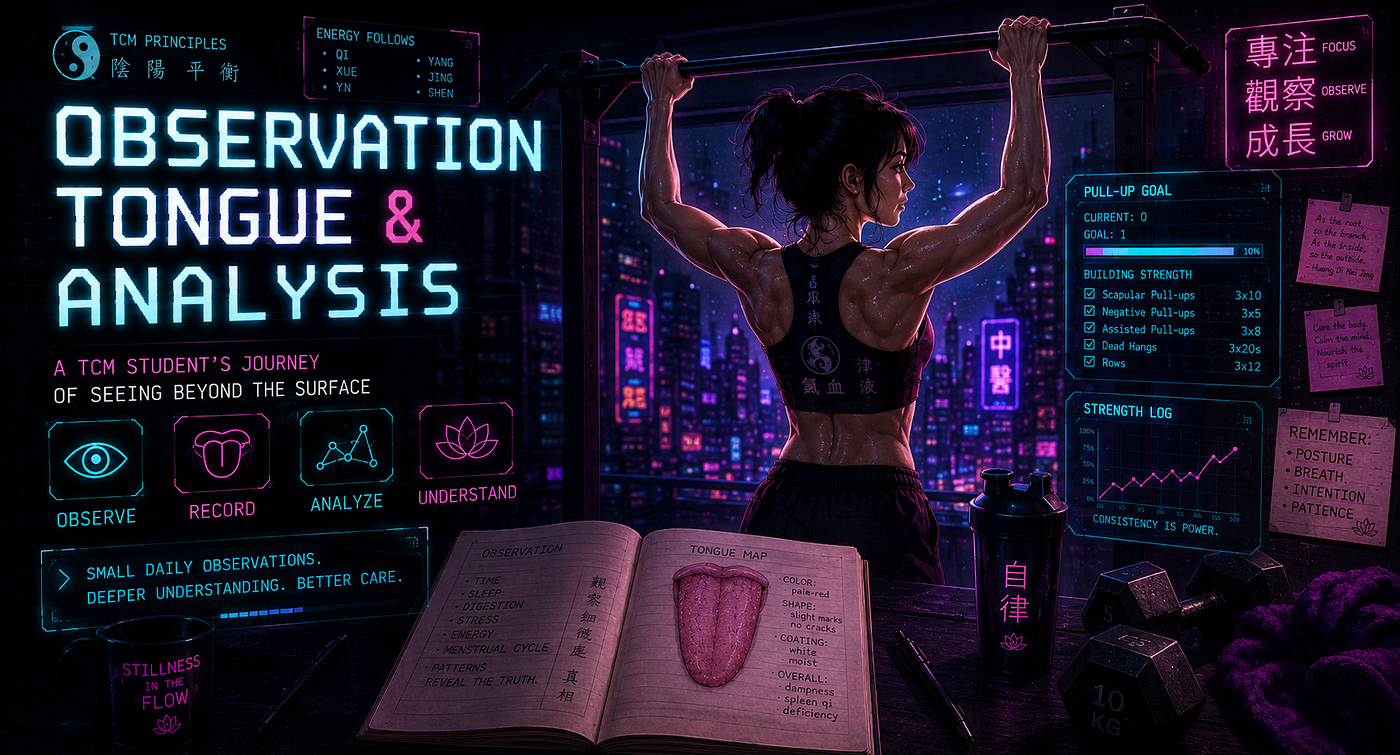
Living with MS forced me to confront a painful truth: I cannot control everything my body does. There are days when my tremors are severe. Days when weakness makes posture difficult. Days when I struggle through yoga classes unable to hold poses that seem simple for everyone else in the room. Recently, I joined a gym because I decided I wanted to actively work toward rebuilding strength instead of surrendering to decline emotionally. My goals may sound small to some people: improving stability, strengthening my legs, practicing resistance exercises, increasing endurance, maybe one day achieving an assisted pull-up. But when you live with neurological illness, these goals become deeply meaningful.
Every workout is an act of intention. I am not exercising because I believe effort alone guarantees remission. Chronic illness is more complicated than that. But I am exercising because intention changes the relationship I have with my body. Instead of viewing my body only as something failing me, I am trying to approach it as something I can still communicate with, support, and strengthen. That shift matters psychologically, emotionally, and spiritually.
Qi Follows Attention
One of the ideas that resonates with me most in TCM is the concept that awareness directs energy. Where attention goes, energy often follows. You can see this in: qigong, breathing practices, meditation, posture, movement, acupuncture, and even the preparation of herbal medicine. I noticed this in my own life long before I could fully explain it academically.
When my mind becomes chaotic, fearful, or fragmented, my body often follows. When I slow down enough to become intentional — with movement, breath, routine, and treatment — my nervous system responds differently. Not perfectly. Not instantly. But noticeably. This is why intention matters to me so much. Intention creates direction even when certainty is impossible.
Intention Is Not Magical Thinking
I want to be careful here because I think wellness culture sometimes becomes dangerous when it implies that illness exists simply because someone “wasn’t positive enough” or “didn’t manifest correctly.” I do not believe intention replaces medicine. I do not believe intention guarantees cure. And I certainly do not believe people deserve illness because of negative thinking. What I do believe is that intention shapes: consistency, mindset, emotional resilience, treatment relationships, and our willingness to continue caring for ourselves even when progress is slow. Sometimes intention is simply deciding: “I will continue trying.
Even when your body feels unreliable. Even when healing is incomplete. Even when you are exhausted.
Healing as Relationship
TCM has slowly taught me that healing is not always a battle against the body. Sometimes it becomes a relationship with the body. A negotiation. A practice of listening. A practice of adapting. A practice of respect. That perspective changed the way I view treatment, movement, food, study, and even daily routines. Intention transformed these things from mechanical tasks into meaningful acts of care.
Some days my intention is ambitious, strengthening my body, improving my mobility, working toward remission, becoming a better future practitioner. Other days the intention is much smaller, breathing calmly, making it through a difficult yoga class, nourishing myself properly, or simply continuing forward without giving up. I no longer think intention is about controlling outcomes perfectly. I think intention is about how we choose to meet the life and body we have today.
Edit: Dang, I freaking duplicated some parts of this article before I published it and then really published it. This is what fatigue does, but whatever because it was still worth it to share this message and I can still notice things ✌️
Full freedom: disability does not equal full dependence
I apply lessons from mu trainer and continue ti practice and build uo from there,
[embed]
[embed]
메타데이터
- post_id
- 92f2a66a3b9d
- slug
- intention-as-medicine-what-chronic-illness-and-traditional-chinese-medicine-taught-me-92f2a66a3b9d
- url
- https://medium.com/stillness-in-the-flow/intention-as-medicine-what-chronic-illness-and-traditional-chinese-medicine-taught-me-92f2a66a3b9d
- canonical_url
- https://medium.com/stillness-in-the-flow/intention-as-medicine-what-chronic-illness-and-traditional-chinese-medicine-taught-me-92f2a66a3b9d
- author_url
- https://medium.com/@grrracelee
- status
- ok
- fetched_at
- 2026-06-15 20:49:13