The Hidden Cost of Weekend Dining for Students in Australia
Australia’s weekend coffee shop culture is familiar to many students. Ordering coffee after class or having brunch with friends has become…
The Hidden Cost of Weekend Dining for Students in Australia
Australia’s weekend coffee shop culture is familiar to many students. Ordering coffee after class or having brunch with friends has become part of daily life. But for many international students there’s one thing that still seems a little baffling: Why is the meal more expensive during the weekend or on public holidays?
A sign is posted at a dessert shop : “15% public holiday surcharge applies.” Other businesses may charge as much as 20 percent on public holidays. When you tap a card, a $5 cup of coffee can simply change to $5.50.
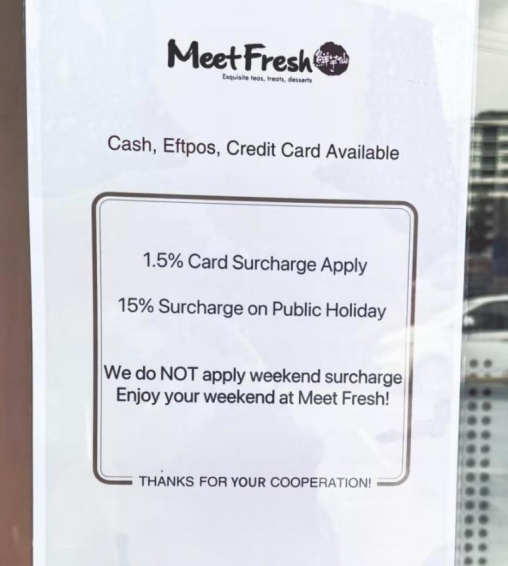
A surcharge notice displayed at a dessert shop in Sydney. Photograph by Wenxin Bao.
For some consumers, these fees may seem unfair or unexpected. However, for businesses, weekend surcharges may be related to rising labour costs and Australia’s penalty rate system. With an increasing number of cashless forms of payment and the cost of dining consistently on the rise, the issue of weekend surcharges is becoming a regular issue for students.
These extra expenses may seem like a surprise and a pain for international students lacking understanding of the Australian payment culture.
Student Experiences
For many international students, weekend surcharges are something they notice almost immediately after arriving in Australia. Although the extra charge is usually small, repeated spending on food and drinks can make a noticeable difference to a student budget.
Callie Chen, a postgraduate student at the University of Sydney, said she was surprised the first time she saw an additional fee added to her bill on a Sunday.
“I thought the restaurant charged me incorrectly at first,” she said. “In my home country, the price on the menu is usually the final price, so I didn’t understand why weekends were different.”
She explained that surcharge fees have gradually changed the way she spends money on weekends. “Sometimes my friends and I choose weekday lunches instead because it feels cheaper overall,” she said. Instead of eating out regularly, she now tries to cook at home or avoid going to restaurants on public holidays.
For many students already managing rent, groceries and tuition costs, even small increases in everyday spending can influence their choices about where and when to eat out.
Why Do Weekend Surcharges Exist?
Although many students see weekend surcharges as frustrating, the system is closely connected to Australia’s labour laws. During weekends and public holidays, many workers are paid higher wages through what is known as penalty rates. According to the Fair Work Ombudsman (2024), penalty rates are designed to compensate employees for working outside normal business hours.
For restaurants and coffee shops, labour costs are usually one of the biggest operating costs. Compared with weekdays, when employees’ wages rise on weekends or holidays, businesses may face higher costs.
Some businesses do not raise menu prices every day, but choose to charge temporary surcharges only during periods when operating costs are high. Some businesses charge a surcharge of 10% on Sundays and up to 15% or 20% on public holidays. In this way, they can keep prices relatively stable on weekdays and cope with the additional costs incurred during peak hours.

Public holiday surcharge price comparisons based on observations and receipts collected from Sydney food and beverage businesses. Table created by Wenxin Bao.

A receipt showing a 15% public holiday surcharge at a Sydney dessert shop called MeetFResh. Photograph by Xinyue Chen.
However, many consumers believe that the system is not transparent enough, especially when the surcharge notice is small or difficult to notice before payment. For international students who are not familiar with the Australian payment system, these additional costs may surprise and confuse them.
The Business Perspective
For many small businesses, weekend surcharges are not just to increase profits, but to control rising operating costs. Coffee shop and restaurant owners said that high wages during weekends and holidays may put great pressure on small businesses, especially during rising rent and food prices.
The cashier of the coffee shop sometimes writes the surcharge notice in very small font, which is easy to be ignored before payment. “Jason”*, a coffee shop worker in Sydney, said that penalty rates can significantly increase labour costs on public holidays.
“Many customers think businesses are trying to charge extra for no reason,” he said. “But on public holidays, we pay much more for staff wages. If we remove surcharges completely, it becomes difficult for small businesses to maintain normal operations.”
He also pointed out that some businesses choose to maintain normal prices during working days to benefit their regular customers, rather than maintaining prices by charging surcharges.
Despite this explanation, the surcharge policy still makes some consumers dissatisfied. As the cost of living in Australia continues to rise, the debate about whether weekend surcharges is fair is becoming more common among businesses and consumers.
Young People and Digital Spending

A student using Apple Pay at a digital payment terminal in Sydney. Photograph by Wenxin Bao.
For many young Australians and international students, cashless payment has become part of everyday life. Mobile payment methods such as Apple Pay and bank cards are now commonly used in restaurants, coffee shops and supermarkets. The Reserve Bank of Australia (2023) reported that cashless payments continue to increase across the country, especially among younger consumers. According to the Australian Competition and Consumer Commission (2024), businesses must clearly disclose card payment surcharges to consumers before payment is made.

Cash and card payments in Australia from 2007 to 2022. Source: Reserve Bank of Australia (2023).
Meanwhile, there are an increasing number of social media posts, including TikTok and RedNote, about surcharges. Many students will share their experiences online, especially when store prices are high during holidays or when they are surprised by unexpected charges.
On RedNote, some international students describe Australian surcharges as one of the most confusing parts of living in Australia.
In a digital media environment where young audiences prefer quick and convenient access to information, issues related to daily consumption can easily become a topic of widespread discussion on the Internet.
Conclusion
While weekend surcharges may be a small element in everyday expenses, for many students, they are a big issue in terms of the cost of living, fairness and transparency in Australia. Businesses state the additional costs are needed to make up for increased labour costs, however many consumers still feel frustrated by having to pay more for the same product on different days.
As Australia continues becoming a more cashless and digitally connected society, discussions about surcharges are likely to remain part of everyday life. These additional expenses can influence where, how often and when students decide to go out, especially for students already balancing rent, groceries and tuition costs.
*Names of the interviewee and business have been changed to protect employment privacy.
메타데이터
- post_id
- 92f4d78a5e3d
- slug
- the-hidden-cost-of-weekend-dining-for-students-in-australia-92f4d78a5e3d
- url
- https://medium.com/@wenxin-bao/the-hidden-cost-of-weekend-dining-for-students-in-australia-92f4d78a5e3d
- canonical_url
- https://medium.com/@wenxin-bao/the-hidden-cost-of-weekend-dining-for-students-in-australia-92f4d78a5e3d
- author_url
- https://medium.com/@wenxin-bao
- status
- ok
- fetched_at
- 2026-06-09 14:34:10




