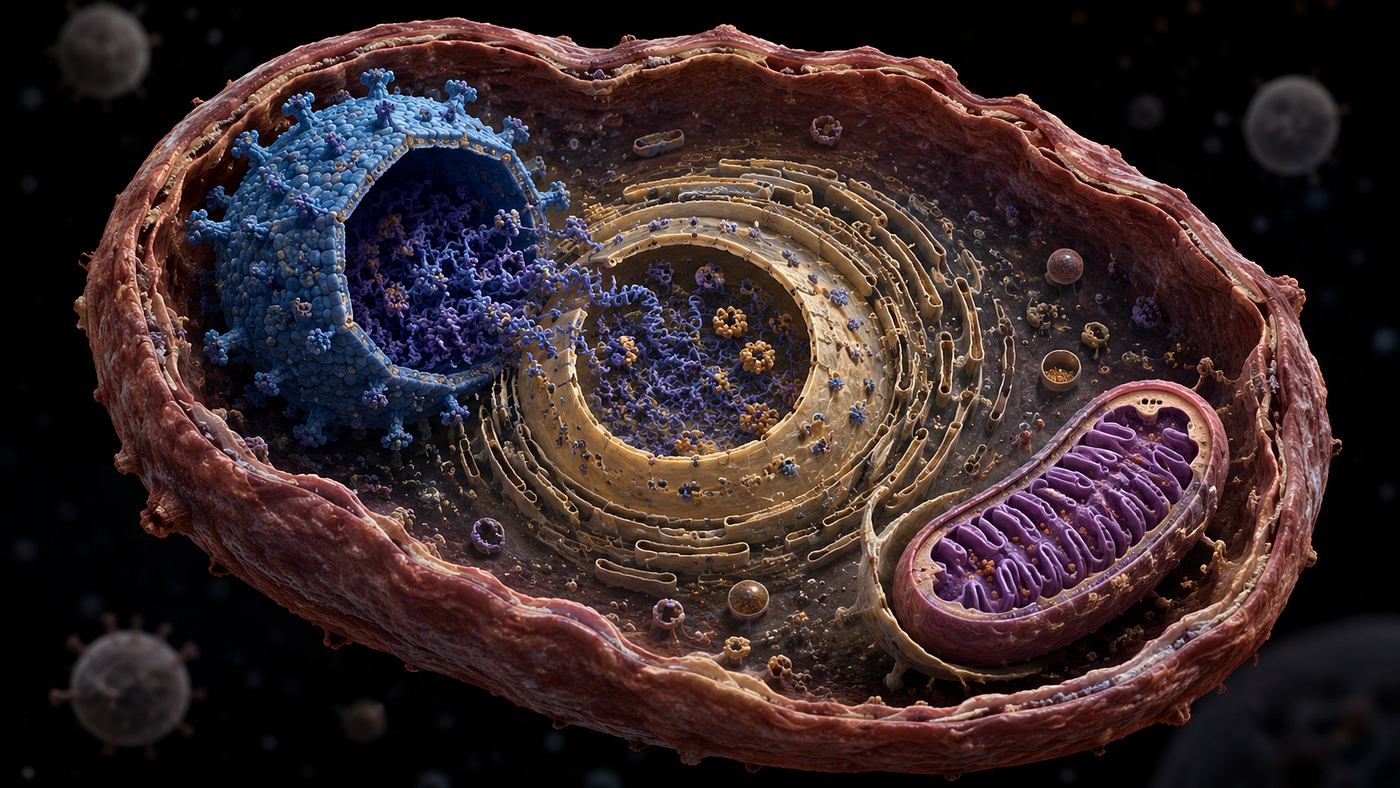
TAU: Not Just Another Boring Protein
TAU — here are the basics so you don't think it's an exotic drink
TAU: Not Just Another Boring Protein
TAU — here are the basics so you don't think it's an exotic drink
Before we talk about tau, we need to start with the smallest pieces.
A cell is the basic living unit of the body. The brain is made of billions of cells called neurons, and neurons are responsible for sending and processing information using electrical and chemical signals.
Inside every cell are proteins. A protein is a small biological machine made from amino acids. Each protein has a specific job.
Tau is one of these proteins.
So if someone asks, “what is tau?”, the simplest accurate answer is:
Tau is a protein found in brain cells (neurons) that helps maintain the internal structure of the cell.
Inside neurons, there are internal transport systems called microtubules. These are like microscopic railways that help move materials inside the cell. Tau stabilizes these structures so they do not collapse.
That raises the next question: what happens when tau changes?
Proteins are not fixed objects. Cells can chemically modify them. One of the most important modifications is called phosphorylation.
Phosphorylation is the addition of a small chemical group called a phosphate. This acts like a switch that changes how a protein behaves.
Tau can exist in different phosphorylation states depending on the activity of enzymes in the cell.
Enzymes are proteins that control chemical reactions. The ones that add phosphate groups are called kinases. The ones that remove them are called phosphatases.
When these two systems are balanced, tau functions normally. When the balance shifts, tau can become over-phosphorylated, which can cause it to detach from microtubules and lose its stabilizing role.
At this point a natural question appears: what causes that imbalance?
The answer is not one thing. It is a combination of internal conditions inside the neuron.
When scientists use the word “stress” in this context, they are not referring to emotional stress. They are referring to cellular stress.
Cellular stress means physical and chemical disruption inside the cell, such as:
reduced energy production, oxidative damage (damage from reactive oxygen molecules), inflammation signals, disruption of normal protein folding and recycling.
These conditions shift the internal chemistry of the neuron and can influence kinase and phosphatase activity, which then affects tau.
Now we can introduce another system that often appears in modern discussions: cGAS–STING.
cGAS–STING is a cellular alarm system.
cGAS stands for cyclic GMP–AMP synthase. STING stands for Stimulator of Interferon Genes.
Inside a healthy cell, DNA is kept inside a protected compartment called the nucleus. If DNA appears in the wrong place in the cell, it can indicate infection or damage.
cGAS is a sensor protein that detects misplaced DNA. When it detects it, it produces a signaling molecule that activates STING.
STING then triggers a broader immune response, including inflammatory signals and antiviral defense mechanisms.
In simple terms, cGAS–STING is a built-in danger detection and alarm system inside cells.
This brings us back to tau.
Tau is not part of the immune system. However, it exists inside neurons that are also subject to immune signaling and stress responses.
When pathways like cGAS–STING are activated, they change the internal environment of the cell. This can indirectly influence enzymes that regulate tau, especially those involved in phosphorylation.
At this point a key question arises: does this mean tau is an antiviral protein?
Based on current evidence, the cautious answer is no.
Some laboratory studies using isolated cells have shown that changes in tau phosphorylation can influence viral replication, including herpes simplex virus type 1 (HSV-1). In those simplified systems, altered tau states are associated with changes in viral protein expression.
However, these are in vitro studies (experiments done in cells outside a living organism). They do not automatically demonstrate what happens in the brain of a living person.
In vivo systems (living organisms) are far more complex, involving many interacting cell types, immune responses, and regulatory feedback loops.
Because of this, the safest interpretation is:
Tau is a protein that responds to cellular stress and is influenced by immune-linked signaling pathways, but it is not established as a dedicated antiviral protein.
메타데이터
- post_id
- 92f64685a3cc
- slug
- tau-all-the-basics-92f64685a3cc
- url
- https://medium.com/health-science/tau-all-the-basics-92f64685a3cc
- canonical_url
- https://medium.com/health-science/tau-all-the-basics-92f64685a3cc
- author_url
- https://medium.com/@marvin.vonrenchler
- status
- ok
- fetched_at
- 2026-06-09 15:37:30