In 1938 President Franklin Roosevelt was growing increasingly frustrated with his inability to push…
In his fireside chat, Roosevelt identified two schools of thought that would be competing in the upcoming primaries, liberal and…
In 1938 President Franklin Roosevelt was growing increasingly frustrated with his inability to push all of his proposed “New Deal” reforms through Congress. He was especially annoyed by the opposition within his own party, particularly after his attempt to pack the Supreme Court had failed. The problem, as FDR saw it, was that there were too many conservative Democrats in Congress. He wanted them replaced with liberals and in a radio-broadcast “fireside chat” of June 24, 1938 he announced his intention to throw his support behind liberal challengers seeking to unseat conservative incumbents in Democratic primaries. It would come to be called the “Purge of 1938,” and it was a dismal failure.
In his fireside chat, Roosevelt identified two schools of thought that would be competing in the upcoming primaries, liberal and conservative. “Roughly speaking,” he said, “the liberal school of thought recognizes that the new conditions throughout the world call for new remedies…. The opposing or conservative school of thought, as a general proposition, does not recognize the need for government itself to step in and take action to meet these new problems… Assuming the mental capacity of all the candidates, the important question which it seems to me the primary voter must ask is this: ‘To which of these general schools of thought does the candidate belong?’”
By tradition, sitting American presidents did not become involved in party primaries. Democratic Party chairman James Farley urged Roosevelt to stay out of the races. (“Boss, I think you’re foolish,” he told him) but FDR ignored the advice. As he put it in the fireside chat, “As the head of the Democratic Party, charged with the responsibility of carrying out the definitely liberal declaration of principles set forth in the 1936 Democratic platform, I feel that I have every right to speak in those few instances where there may be a clear issue between candidates for a Democratic nomination involving these principles.”
Roosevelt initially targeted 10 conservative Democratic Senators, but after seven of them had easily won their primaries, Roosevelt became more aggressive in his attempt to unseat the remaining three: “Cotton Ed” Smith of South Carolina, Walter George of Georgia, and Millard Tydings of Maryland.
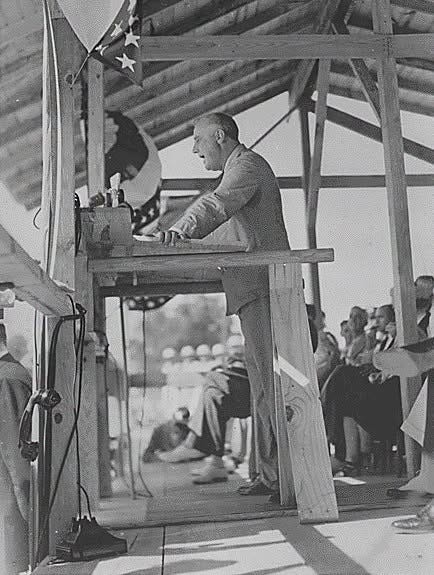
In August, FDR traveled to Georgia and while sharing the stage with Senator George at a dedication ceremony, publicly endorsed one of his opponents. That same day he continued on to South Carolina, where he signaled his support for Smith’s challenger, Governor Olin D. Johnson who had been handpicked by Roosevelt. Over Labor Day weekend Roosevelt gave six speeches in Maryland, supporting Tydings’s challenger, Congressman David Lewis. But in all three cases the incumbents won easily. Although Roosevelt’s candidate did unseat 8-term Democratic incumbent congressman John O’Connor of New York, the “purge” was otherwise a dismal failure.
In the aftermath, Roosevelt was lambasted in the press for being power hungry and for attempting to fill Congress with his “yes men,” and he was left appearing petty, weak, and ineffectual. Not only did the targeted conservative Democratic senators win reelection in the 1938 elections, overall the Democrats lost eight Senate seats and 72 House seats to the Republican Party.
The photo shows FDR speaking at the ceremony in Barnesville, Georgia in which he signaled his opposition to the nomination of Walter George.
메타데이터
- post_id
- 92fdf37de192
- slug
- in-1938-president-franklin-roosevelt-was-growing-increasingly-frustrated-with-his-inability-to-push-92fdf37de192
- url
- https://medium.com/@sayedshakarabbas/in-1938-president-franklin-roosevelt-was-growing-increasingly-frustrated-with-his-inability-to-push-92fdf37de192
- canonical_url
- https://medium.com/@sayedshakarabbas/in-1938-president-franklin-roosevelt-was-growing-increasingly-frustrated-with-his-inability-to-push-92fdf37de192
- author_url
- https://medium.com/@sayedshakarabbas
- status
- ok
- fetched_at
- 2026-07-21 05:35:08