Learn The Books
My father handed me his working life when I was eleven. I’m still carrying it
Learn The Books
My father handed me his working life when I was eleven. I’m still carrying it
Photo by Alex Mnatsakanov on Unsplash
I was eleven years old when my father sat me down and asked me to write the most important letter of his life.
It was 1995. James McCarthy—carpenter, machine plant operator, father of three had snapped. A co-worker had been pushing him for months. One day he pushed too far, and my father delivered an uppercut to the man’s jaw: the kind of punch that ends arguments and starts disciplinary procedures. His employer needed an explanation. A formal letter. His version of events, in writing.
He could have asked anyone. He asked me.
I don’t know exactly what he saw in me that day. I was a child. But James McCarthy had left school after primary, had spent his life working with his hands, and he understood something about language that formal education had never taught him. That words, in the right hands, have weight. He had watched me. He had seen something. And he sat me down at the kitchen table and trusted me with his livelihood.
I wrote the letter. He kept his job.
He never called it a gift. He called it learn the books. That was his catchphrase, his instruction, his entire philosophy of what I should do with my life.
Learn the books.
He said it the way other men say work hard or be good. It was specific. It was pointed. It was his way of saying you have something I didn’t have, and I need you to use it.
Seamus Heaney wrote about this. In Digging, he watches his father work the garden, the spade going down clean into the ground, and he realises he has no spade. He has a pen. I’ll dig with it. That’s the whole poem. The son picks up the tool that fits his hand and carries on the work in a different medium.
I didn’t know the poem when I was eleven. But I knew the feeling.
James McCarthy was born into an Ireland that was still finding its feet.
One of thirteen children. Rural Tipperary. A small house that held more people than most apartments hold furniture. The 1950s and 60s in rural Ireland were not soft years. Food was scarce. The state itself was barely thirty years old, still a young country trying to establish itself on the world stage. You did not choose your work. You rolled up your sleeves and you took what was there.
He went into carpentry first. Then plant machinery. Then Tipperary Co-op, where he would spend over twenty-five years operating heavy equipment before retiring at sixty-five not because he wanted to, but because the clock said so. Retirement didn’t suit him. It still doesn’t. Today, at sixty-nine, he is up before 5 a.m., most mornings and out painting houses and doing handyman jobs around his community, a man who cannot sit still because stillness, to him, is waste.
This is not restlessness. This is identity.
James McCarthy works because work is what he is made of.
He gave me hurling.
Not just the game — the feeling of it. He brought me to matches from the time I could barely walk. Stood on the sidelines in sleet and rain, roared himself hoarse at club games where I was out on the field.
When I was treated unfairly and there were times I was, he stood up. Quietly, but completely. The kind of standing up that doesn’t make a scene but makes absolutely clear that this child has someone in his corner.
In 2019, Tipperary beat Kilkenny in the All-Ireland hurling final. We were there together, in the stands, scarves on, thumbs up for the camera. I have a photo from that day. His face in it is everything I need to know about what hurling means to James McCarthy, and what James McCarthy means to me.
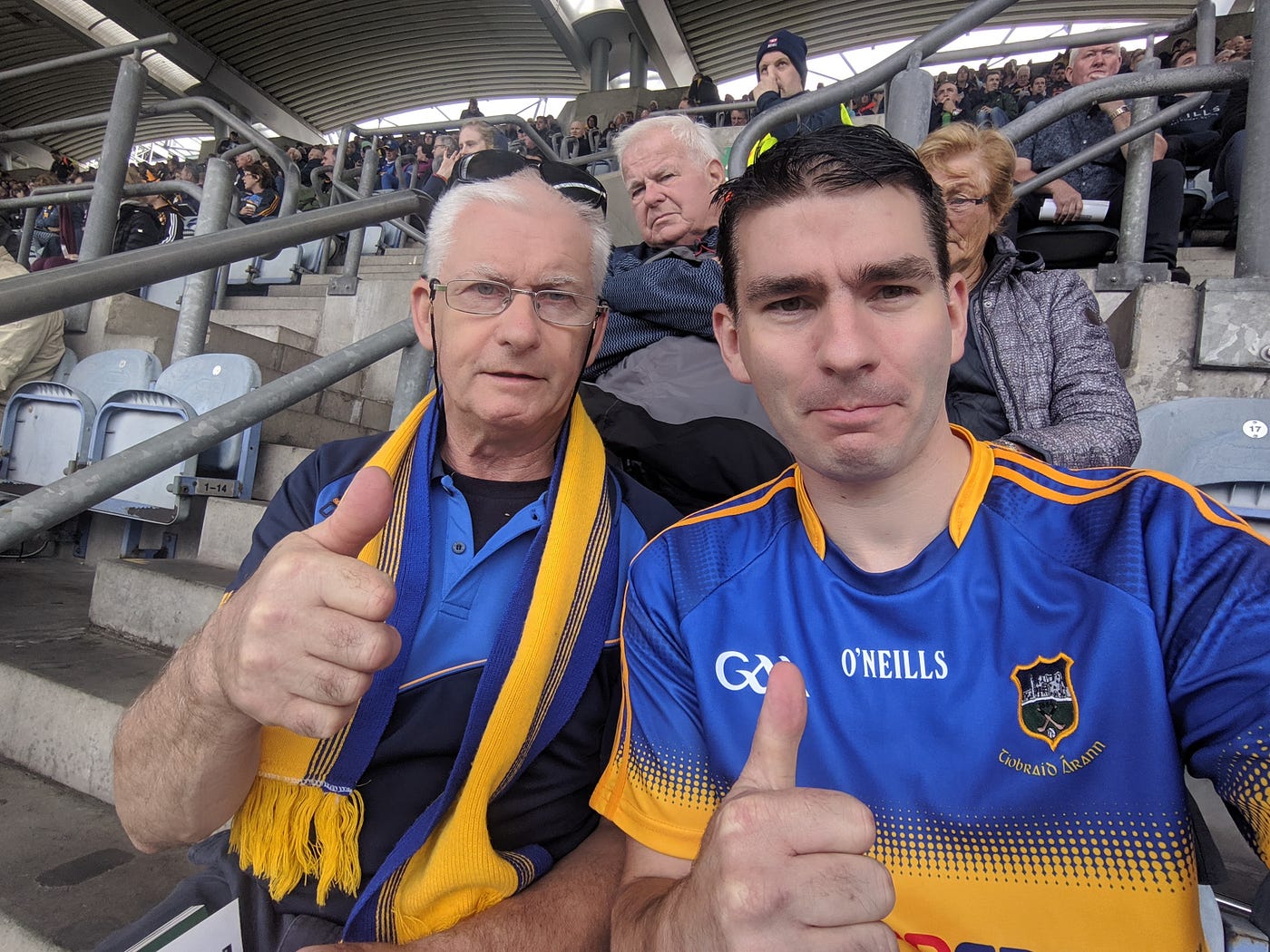
All Ireland Hurling Final Tipperary vs. Kilkenny, August 18th, 2019: Photo credit: author
The aul pint was his release valve.
A Guinness, usually. Sometimes more than one. A man who carried the weight of a large family, a physical job, and a world that didn’t offer many places for working-class men to put down their burdens.
He found it in the pub, in the company of friends, in the slow exhale of a pint of stout at the end of a long week.
There were times he over-indulged. I won’t pretend otherwise. But I understood it even then, in the way children understand things they can’t yet name. A man who spent his days operating heavy machinery, raising three children, holding together a life with his hands — he needed somewhere to set it down. The pub was that place.
He wasn’t escaping. He was releasing.
There’s a difference. He is more careful now. Older and wiser, as the saying goes. But I still see that version of him in the photographs, laughing, jovial, arm around a friend, Guinness in hand, completely at ease in the company of people who loved him. That laugh. Nobody in a room when James McCarthy laughs is in any doubt that something funny has happened.
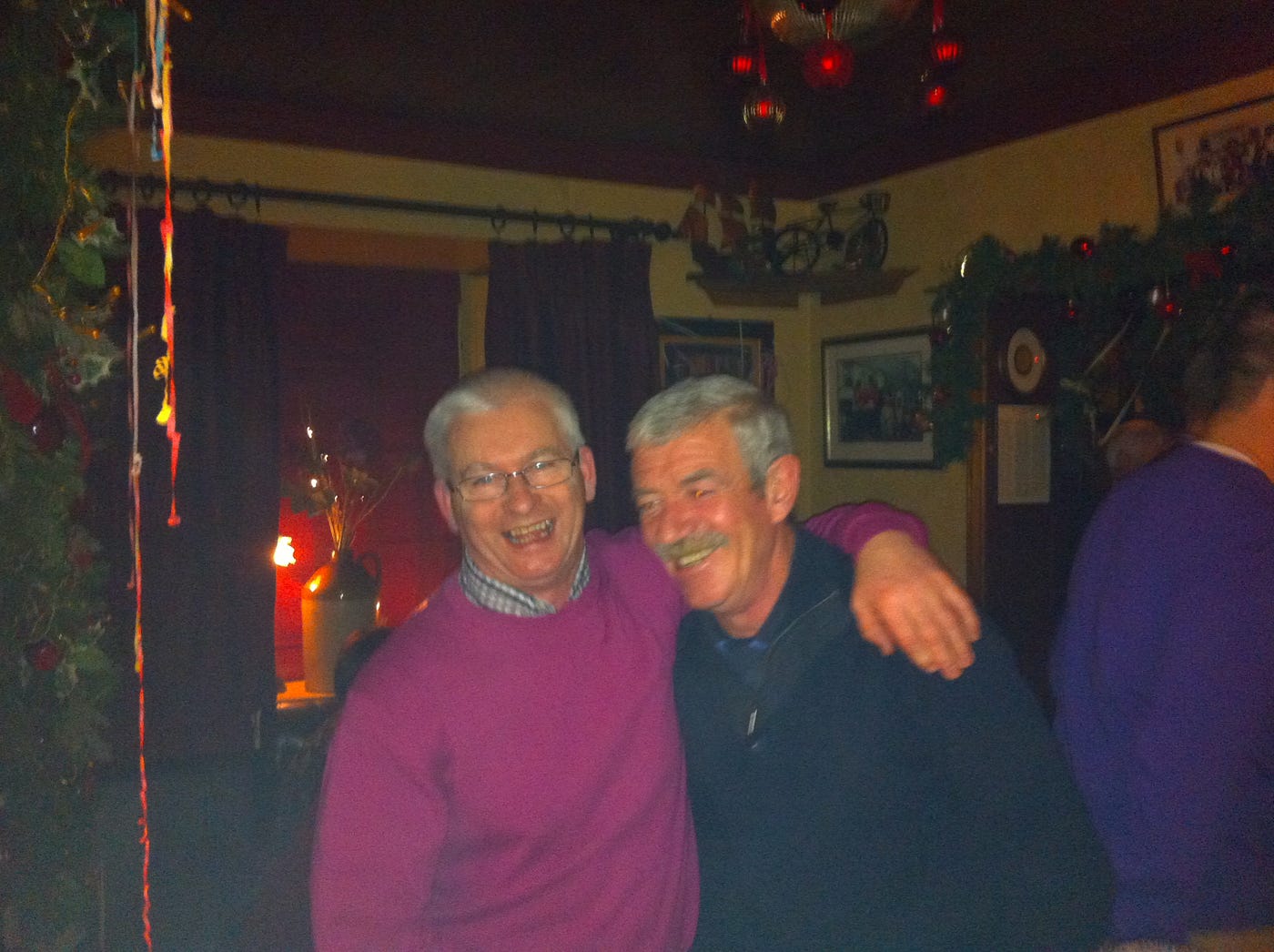
My father and a friend. Photo credit: Author.
He was there at my worst.
On the 7th of November 2004, I was admitted to a psychiatric ward in Clonmel. They let me home for Christmas. On Christmas Day it snowed, and my father suggested a walk up the Red Hill in Cappawhite.
I don’t remember much conversation on the way up. The snow muffled everything. Our boots crunched against the frozen ground as we climbed.
At one point, a robin appeared on a bare branch, a flash of red against all that white, before disappearing again. We kept walking.
When we reached the top, we stopped and looked out across the valley. The view stretched for miles. Fields, roads, farmhouses and hedgerows lay beneath a blanket of snow. Cappawhite looked as though someone had pulled a white sheet across it during the night. It was beautiful in a way that only rural Ireland can be when winter arrives and decides to show off.
My father stood there beside me with his hands in his pockets, taking it all in. After a while, he nodded towards the landscape and said something like,
“Ah shur, tippin’ away.”
It was exactly the sort of thing James McCarthy would say. Nothing profound. No attempt to explain what had happened to me in the weeks before or reassure me that everything would be alright. Looking back, I think that is why I remember it. My own mind had become a place I no longer recognised. The hill was still there. The fields were still there. My father was still there. Life, in its stubborn ordinary way, was carrying on. I don’t remember what else was said that day. I remember the snow. I remember the view from the top of the hill. And I remember walking back down beside a man who hadn’t flinched and hadn’t left.
He’s not a man of elaborate emotional vocabulary. He didn’t have the right words. He had something better.
He came. That was enough.
I have thought about that walk a hundred times since. What it meant that he didn’t try to fix me. That he just walked beside me and let the world be ordinary again for an hour.
He and my mother Mary have been the ground under my feet my whole life. The year I was born, they were living in a mobile home. Not as a lifestyle choice. Because that was what they had. Tough times don’t last, tough people do. He never said that phrase to me, but he lived it so completely that I absorbed it anyway.
When I was a teenager in the mid-nineties and had developed an obsession with computers, James and Mary went to the local Credit Union and took out a loan to buy me my first PC for Christmas. They didn’t have the money. They got it anyway. Because they saw something in me, and seeing something in your child and acting on it, even when it costs you, is what parents do without ceremony or complaint.
He turns seventy in November.
I catch myself doing something I’m not proud of, composing, in the back of my mind, what I might one day say at his funeral. It’s an awful thing to admit. He’s reasonably healthy. He’s out there painting houses and watching Tipp and drinking the occasional Guinness and getting up before sunrise. And I’m lying awake running through sentences.
I think it’s because I love him so much that grief has already started arriving early, in small instalments, before it’s owed. The mind trying to prepare for something it knows it cannot prepare for.
He has developed a belly in recent years. I nag him about the bread and the biscuits. He ignores me with the cheerful authority of a man who has been doing things his own way for seven decades. I worry about his heart, his weight, the years that accumulate without asking permission. I want him to eat more protein and fewer Kimberley biscuits. He wants a cup of tea and peace.
We are, in this way, exactly like every father and son who ever lived.
Learn the books.
I learned them, Dad. I’m still learning them. Every sentence I write, every word I put down, carries the weight of a kitchen table in 1995 and a man who trusted an eleven-year-old with something that mattered.
You dug with your hands. I dig with words. But we are digging the same ground.
Happy Father’s Day, James McCarthy.
메타데이터
- post_id
- 930a99412b90
- slug
- learn-the-books-930a99412b90
- url
- https://medium.com/black-bear-recovery/learn-the-books-930a99412b90
- canonical_url
- https://medium.com/black-bear-recovery/learn-the-books-930a99412b90
- author_url
- https://medium.com/@aidangmccarthy
- status
- ok
- fetched_at
- 2026-06-21 09:28:28